
Blog
How to Store Fertilizer in the UAE: Open Bags, Humidity and Pack Sizes

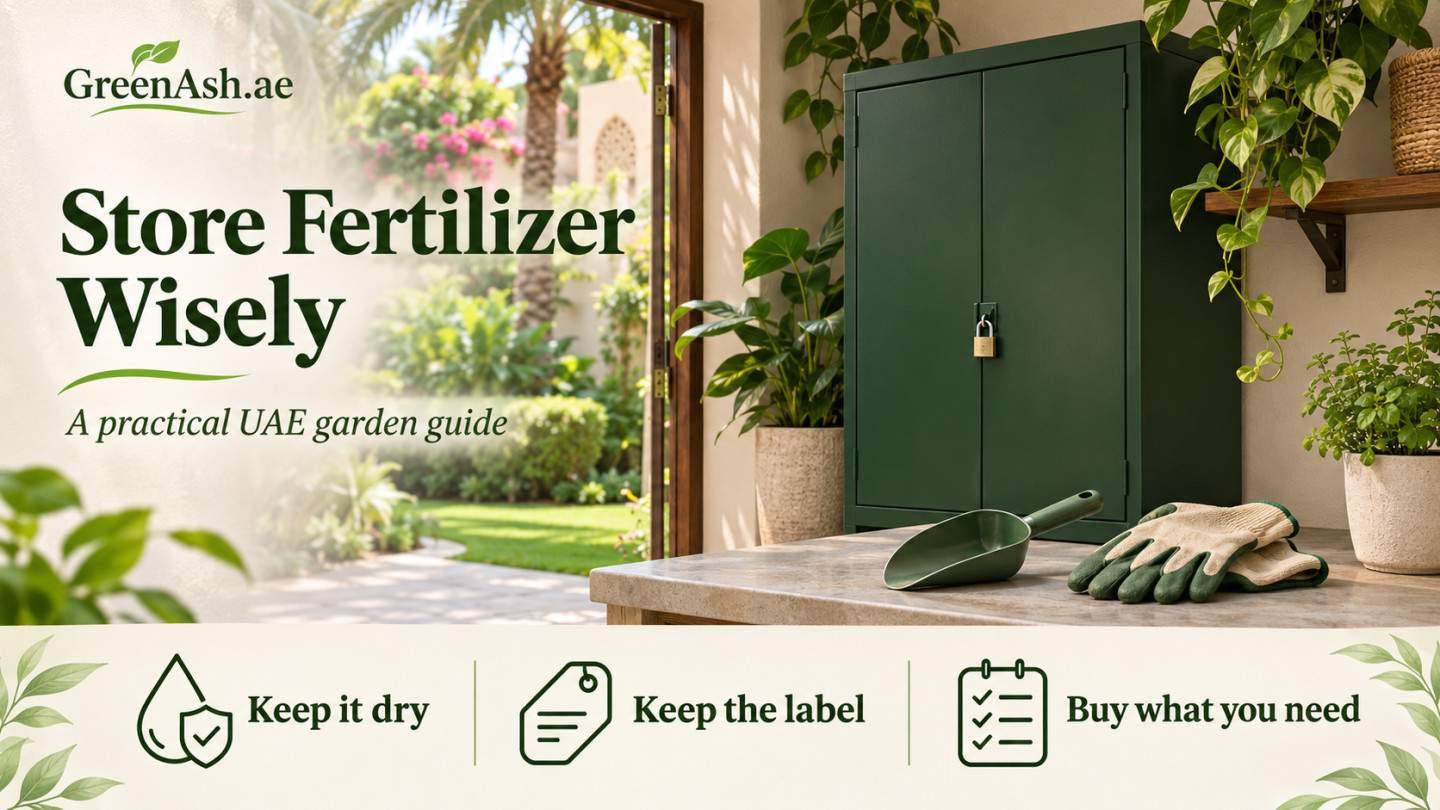
An opened fertilizer bag should be as easy to identify and measure next month as it was on purchase day. For UAE gardeners, that means thinking about the storage space before choosing a large pack: a balcony cabinet may be shaded but still hot, and an irrigation splash can reach a bag that appeared safely tucked away.
This guide covers small packs of garden fertilizer. Follow the storage instructions and safety data sheet for the exact product. Bulk farm stocks, oxidizing fertilizers and specialist materials require product-specific facilities and professional advice.
Start with the label and the storage location
Read the storage section before opening the pack. Check temperature limits, moisture protection and any directions to keep the material away from incompatible products. Yara’s general guidance calls for weather protection, a clean storage area and protection from moisture; it also notes that some fertilizers are sensitive to high temperatures.
For a UAE home, inspect the proposed space during the warm part of the day. Do not assume that an outdoor cupboard meets a label’s cool-storage requirement simply because sunlight does not reach the bag. If you cannot provide the specified conditions, choose a smaller quantity or arrange suitable storage before ordering.
Keep fertilizer separate from pesticides, food and animal feed. UMass Extension recommends secure, labelled storage and keeping containers upright with labels visible. A small bottle of liquid concentrate also benefits from suitable secondary containment to catch a leak. Do not place it where a spill can run into a drain.
How to close and protect an opened dry bag
Iowa State University recommends retaining the original bag and placing opened fertilizer bags inside a larger container with a tight-fitting lid. This protects the contents while preserving the product identity and nutrient analysis.
- Read the packet’s closing instructions and reseal its inner packaging after measuring.
- Place the original bag inside a clean, dry, suitable outer container if extra moisture protection is needed.
- Make the product name visible on the outside so the container does not become anonymous.
- Return it to the designated storage space immediately after use.
The outer container is extra protection, not a substitute for the original label. Do not pour fertilizer into a drinking-water bottle, food jar or unmarked tub. UMass specifically advises against food and beverage containers for fertilizer storage.
Why fertilizer cakes or becomes difficult to spread
Fertilizers differ in how readily they attract moisture from the air. Yara explains that moisture absorption can reduce their physical quality, while Iowa State describes granular fertilizer becoming hard and caked. A bag can therefore develop lumps without having been directly rained on.
Preventing moisture entry is easier than deciding what to do with a solid block later. Keep measuring equipment dry, close the pack promptly and investigate repeated caking rather than treating each bag as an isolated problem. Check for a damaged liner, a poor seal or water reaching the shelf.
Caking alone does not establish the product’s nutrient content, usability or expiry status. If the material is wet, contaminated, unusually changed or cannot be measured and applied as directed, set it aside and ask the supplier or manufacturer. Send photographs of the pack, batch details and the material. Do not compensate by applying a larger amount or improvising a stronger solution.
Choose a pack size you can finish and store
A lower price per kilogram is useful only when the product suits your plants and the remaining quantity can be stored correctly. GreenAsh lists Miracle-Gro Water Soluble All Purpose Plant Food in a 226 g pack. The listing specifies tightly closed, cool, dry storage away from children and pets. Check the supplied packaging for the directions that apply to your pack.
Compare suitable products after deciding what nutrients are needed; our fertilizer NPK guide explains that first decision. A small pack and a large bag with different analyses are not interchangeable simply because both are called fertilizer.
| Before buying | What to write down |
|---|---|
| Expected use | Plants or area to feed, and the amount calculated from that product’s directions |
| Stock already owned | Product name, approximate amount and condition of the packaging |
| Available storage | A location that meets the label conditions and has room for the full pack |
| Order quantity | Enough for the planned work without accumulating unnecessary leftovers |
For a lawn, calculate the amount per application before comparing bags; our lawn fertilizer coverage guide walks through that process. Keep any purchase calculation separate from a feeding schedule: buying more does not justify feeding more often.
Keep a simple inventory and inspect it
Write the purchase date on a record and retain the batch information. Use older suitable stock before opening a replacement, while respecting expiry dates and manufacturer instructions. Yara recommends this stock-rotation approach.
At your next gardening session, check closures, readable labels, leaks and packaging damage. A photograph of each label is a useful backup, but keep the physical label too. If more than one person feeds the garden, record which product was used and when; otherwise an unopened replacement can conceal the fact that the same plants were just fed.
For damaged packaging, obtain advice on suitable replacement packaging or secondary containment rather than transferring contents into whatever container is available. Keep spills out of drains. For unwanted fertilizer and contaminated packaging, ask your local waste service about appropriate disposal; the RHS warns that incorrect fertilizer disposal can harm the environment.
Frequently asked questions
Can I store fertilizer on a UAE balcony?
Only if the location meets the product’s storage requirements. Check heat, moisture exposure and access by children or pets. Shade alone does not prove that the space is suitable.
Does fertilizer expire?
There is no shelf-life figure that applies to every formulation. Check the pack and ask the manufacturer about an older batch whose storage history is uncertain. Do not infer an expiry date from colour or lump formation.
Can I combine two half-empty fertilizer bags?
Keep products in their own labelled packs. Combining leftovers makes identification, batch tracking and correct dosing harder, and compatibility cannot be assumed.
Should I mix a large batch of liquid feed for later?
Plan the amount needed for the current job. Do not assume a diluted mixture has the same storage instructions as its concentrate. Consult the product directions; our liquid fertilizer guide covers measuring and mixing for use.