
Blog
Growing Parsley in the UAE: From Slow Seeds to Repeat Harvests

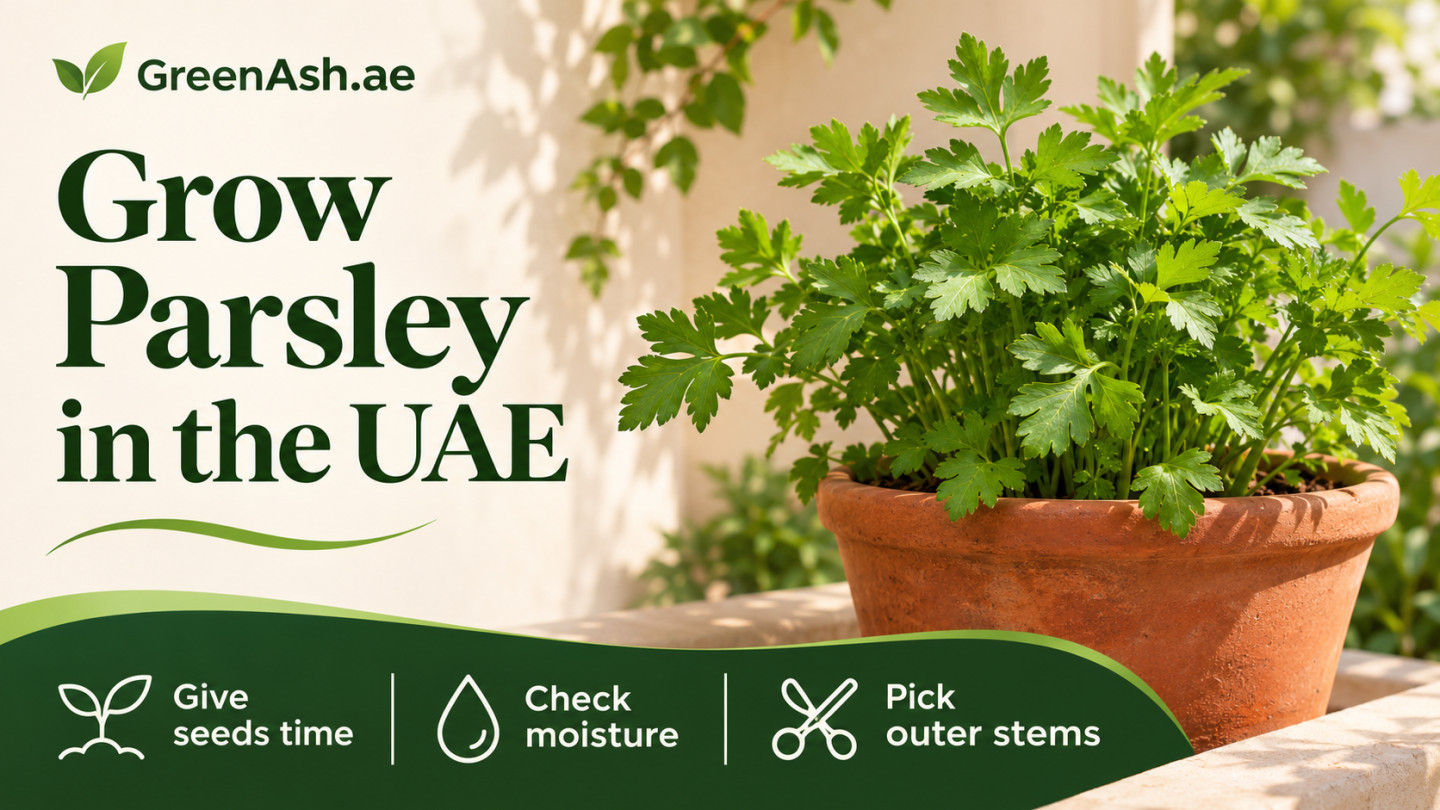
Growing parsley in the UAE starts with patience. A pot that looks empty after a fortnight is not necessarily a failed sowing, and a young plant needs time to build a leafy crown before it can supply your kitchen. Give parsley a suitable container, steady moisture and a sensible harvest routine, and a small planting can provide useful fresh sprigs.
This guide covers leaf parsley for cooking. The UAE recommendations below adapt general horticultural guidance to hot balconies and gardens; they are not a locally trialled sowing calendar or a guarantee of summer production.
Choose leaf parsley and plan for cooler weather
Flat-leaf and curly parsley are both culinary herbs. Flat-leaf types are convenient for chopping into tabbouleh and sauces; curly types have tightly divided foliage. Root or Hamburg parsley is grown for a different purpose, so check the packet before buying. GreenAsh lists parsley seeds; consult the current listing and packet for availability, variety and sowing instructions.
University of Florida guidance treats parsley as a cool-season crop and recommends protection from intense afternoon sunlight. For UAE home gardens, a practical starting point is to establish plants during the cooler part of the year and choose a position with morning light and shelter from harsh afternoon exposure. Judge your actual balcony: reflected heat from a wall can make a sheltered corner much hotter than expected.
Parsley and coriander are different crops. Label their pots at sowing; if you want both herbs, use our separate UAE coriander guide for the second planting.
Set up the pot before opening the seeds
The RHS recommends a parsley container at least 25 cm wide and deep. Choose one with drainage holes and use a suitable potting mix. A decorative outer container must not trap drainage water around the inner pot.
- Check the usable depth: a tall decorative pot may have a shallow insert.
- Plan access: you should be able to inspect moisture and reach the outer stems without crushing the centre.
- Work out the fill volume: our potting-soil quantity guide helps estimate litres before buying a bag.
Sow once, then give germination time
Direct sowing in the final pot avoids disturbing parsley roots. Follow the packet depth; general RHS guidance uses about 1 cm. Sow thinly into pre-moistened mix, cover gently and label with the date. Keep the seed zone moist without saturating it. Once seedlings are established, thin to the variety’s spacing; RHS guidance gives 15–30 cm between plants.
Germination reports vary considerably: Florida guidance gives a shorter timescale, while the RHS warns that emergence can take a month or more, sometimes up to six weeks. Do not dig up the pot to investigate every few days or repeatedly add seeds to the same spot. Record the original sowing date and conditions first.
Illinois Extension suggests soaking seeds in water overnight before sowing. This is an optional preparation step, not a promise of quick emergence; follow any different packet instructions. If you buy young plants instead, handle the rootball gently and avoid damaging the taproot.
Build a moisture-checking routine
Parsley prefers moist, well-drained soil. In a UAE pot, use a daily inspection as a reminder to check, rather than an instruction to water automatically. Feel the mix, look at the plant and check whether drainage water is trapped underneath. A windy exposed pot and a shaded pot may need different treatment on the same day.
Keep a brief note when something changes: moving the pot, a hotter afternoon, a missed watering or a recent feed. This makes troubleshooting more useful than adding several products at once. Do not assume every yellow leaf means fertilizer is needed.
For established container herbs that need feeding, GreenAsh lists Baby Bio Herb Food, 175 ml. Use the instructions on the bottle for dilution and frequency, and account for fertilizer already included in the potting mix. Concentrate should not be poured straight onto roots.
Harvest stems, not just the leaf tips
Wait until the plant is large enough to spare some foliage. Cut a few outer leafy stems near their bases, leaving the central growth intact. Rotate picking between plants instead of stripping one crown. Wash harvested parsley before kitchen use.
Parsley is biennial, but gardeners commonly raise fresh plants each season for leaves. Once an older plant directs its growth into a flower stalk, leaf quality declines. Keep a replacement sowing in mind rather than expecting one pot to remain productive indefinitely. Illinois Extension notes that parsley can be refrigerated after washing and draining, or frozen for later use.
Common questions
Can I grow parsley indoors?
Yes, if the position supplies enough light. Illinois Extension recommends high light and a cool growing location. A dim kitchen shelf is a poor substitute for a bright window; evaluate the position before committing all your seedlings to it.
Should I resow if nothing appears after two weeks?
Not automatically. Check the seed packet, sowing date and moisture history. Parsley can emerge slowly. If trying another batch, use a separately labelled pot so you can distinguish the two sowings.
Can parsley supply a large salad every day?
Plan the planting around your use. A few stems for garnish and a bowl of finely chopped parsley require very different amounts. Start with several separately spaced plants, record your harvests and expand if the plants cannot recover between pickings.
How can I avoid repeating a failed sowing?
Keep the packet and note where and when you sowed, whether the mix dried out, and when seedlings appeared. Before buying replacement seed, review our seed storage and germination guide.
Sources and growing notes
General plant guidance: RHS: growing parsley; University of Florida IFAS: parsley; Illinois Extension: parsley. Overseas seasonal dates are not copied into the UAE recommendations.