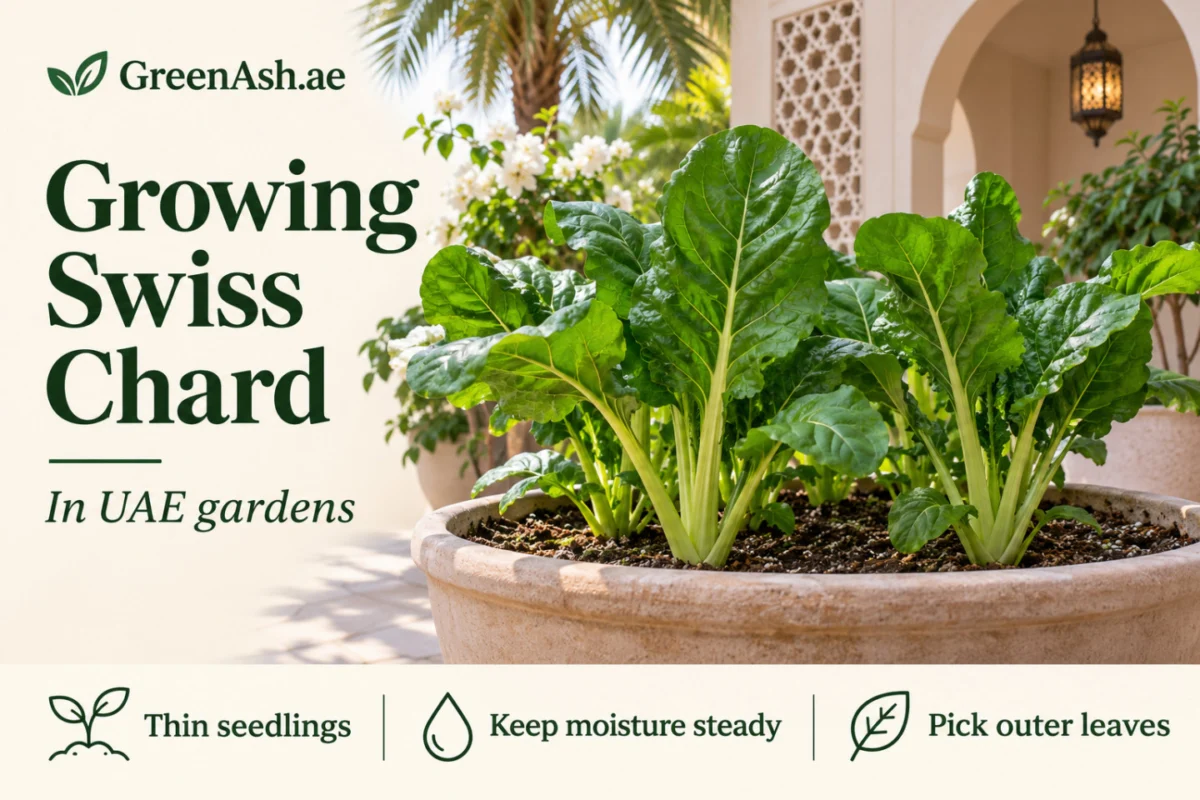
Swiss chard is worth considering when you want repeated harvests of leafy greens from a UAE garden bed or a large container. The useful trick is to grow a few well-spaced plants, then take outer leaves while keeping the centre growing. Sowing more seed into the same space does not necessarily give a better crop.
This guide covers chard, also called silverbeet or leaf beet. It is related to beetroot but grown for leaves and stalks rather than a swollen root. It is not true spinach: see our separate spinach-growing guide if that is the crop on your packet.
Choose the seed for the harvest you want
Some chard varieties are selected for colourful, substantial stalks; others are grown mainly for tender cutting leaves. GreenAsh lists Hortus Swiss Chard, Green Smooth-Leaf Cutting Variety, named Bietola da Coste Liscia Verde da Taglio. Do not assume a green cutting variety will produce the rainbow-coloured stems shown in general chard photographs.
Check the live product page for availability and read the current packet before sowing. Decide whether you want small salad additions or larger leaves for cooking. That decision helps you judge when to harvest, how much space to reserve and whether one container is enough for your household.
Use cooler UAE conditions as your starting point
Utah State University describes chard as a cool-season crop. Its guidance gives best seed germination at approximately 13–24°C and reduced germination above about 27°C. These are general crop observations, not a guarantee for a specific packet.
For UAE home growing, this points to starting in the cooler part of the year and checking the actual sowing position. A planter against a sun-heated wall can be warmer than the weather forecast suggests. Begin with a small labelled sowing if conditions are still hot. Overseas spring sowing dates should not be copied directly into a UAE calendar.
Write the variety, sowing date and location on a marker. Keep a note of emergence so that next season you can compare your own planting positions instead of relying only on a month printed in a foreign growing guide.
Prepare room for mature leaves
Choose a sunny, well-drained bed or a substantial container with drainage holes. Chard can tolerate some shade, but a dark corner is not equivalent to a productive growing position. Make sure you can reach the outer leaves without pushing through neighbouring plants.
For pots, use a suitable vegetable potting mix and check whether it already contains fertilizer. For beds, use soil testing to guide nutrient additions. Our potting-soil quantity guide helps estimate the litres needed before buying bags.
The Hortus listing gives a sowing depth of 1 cm and spacing of 20–30 cm. Confirm the packet directions for the seed you receive. Plan the layout before opening the packet: draw the intended plant positions on paper, including room at the edges, rather than filling every visible gap with seed.
Why one “seed” can produce several seedlings
University of Maryland Extension explains that ordinary chard seed is a seed ball containing several embryos. Unless it is specifically sold as monogerm seed, more than one seedling may emerge from a single sowing point. That is normal, not evidence that you accidentally sowed twice.
- Sow and label: cover to the packet depth and water gently.
- Inspect each sowing point: look for groups of seedlings, not just gaps between groups.
- Thin crowded growth: retain a strong plant at each intended position. Snipping unwanted seedlings near soil level avoids tugging at neighbouring roots.
- Check the whole row: compare the final spacing with the packet, including plants at the ends.
Keep unused seed for a later sowing rather than using it all to compensate for uncertain germination. Our seed storage guide explains how to handle opened packets.
Keep growth steady between pickings
Moisture fluctuations can slow leaf development and make chard leaves tougher. Check the root zone regularly and adjust watering to the container, soil and weather. A daily inspection does not mean a daily watering is always needed.
If growth slows, check moisture and crowding before adding fertilizer. Record any feeding already supplied through the mix or earlier applications, and use directions intended for the crop and growing method. There is no useful universal “capful” for every liquid feed.
Use each watering visit as a short inspection: look under leaves, check the youngest growth and examine any holes or blotches. Photograph damage before choosing a treatment. For chewing damage and damp hiding places, our snail and slug guide explains what to inspect. A damaged leaf by itself does not identify the cause.
Harvest outer leaves and protect the centre
The RHS recommends taking a few outer leaves, cutting each stalk cleanly near its base and leaving several central leaves to develop. Light, regular picking is a straightforward approach for a small household planting. Avoid stripping a young plant simply because the first leaves are ready.
Work around the plant so you can see where the chosen stalk joins it. Keep scissors clear of the central growing point. Spread your picking across several plants instead of repeatedly taking everything from one.
Young leaves suit salads, while larger leaves and stalks can be cooked. Thick stalks take longer to cook than leaf blades, so separate them when preparing a mixed harvest. Refrigerate picked leaves promptly and wash before use. Pick for the meal you plan rather than leaving a large harvested bundle in the garden while finishing other jobs.
Frequently asked questions
Is Swiss chard the same as spinach?
No. Chard is a leaf beet. Similar kitchen uses do not make its sowing and growth requirements identical to true spinach.
Why are several seedlings growing together?
A normal chard seed ball can contain several embryos. Thin the group as well as checking spacing between sowing points.
Can the same plants keep producing indefinitely?
No. Repeated picking can extend harvest, but plants eventually decline or flower. The RHS notes that chard can bolt in hot weather. Plan a replacement sowing when conditions suit rather than expecting one planting to supply leaves forever.
How soon can I harvest?
Use the packet estimate for planning, then judge the leaf size and strength of the plant. Baby-leaf picking and a harvest of large cooking leaves are different targets; neither has one guaranteed date in every UAE garden.
Sources and UAE application
Crop guidance comes from Utah State University Extension, the Royal Horticultural Society and University of Maryland Extension. The local planning steps apply these crop requirements to UAE home gardens; their overseas seasonal calendars are not presented as UAE planting dates.

Leave a Reply