
Blog
Termite Control in UAE: Anti Termite Treatment, House Termites & the Best Products

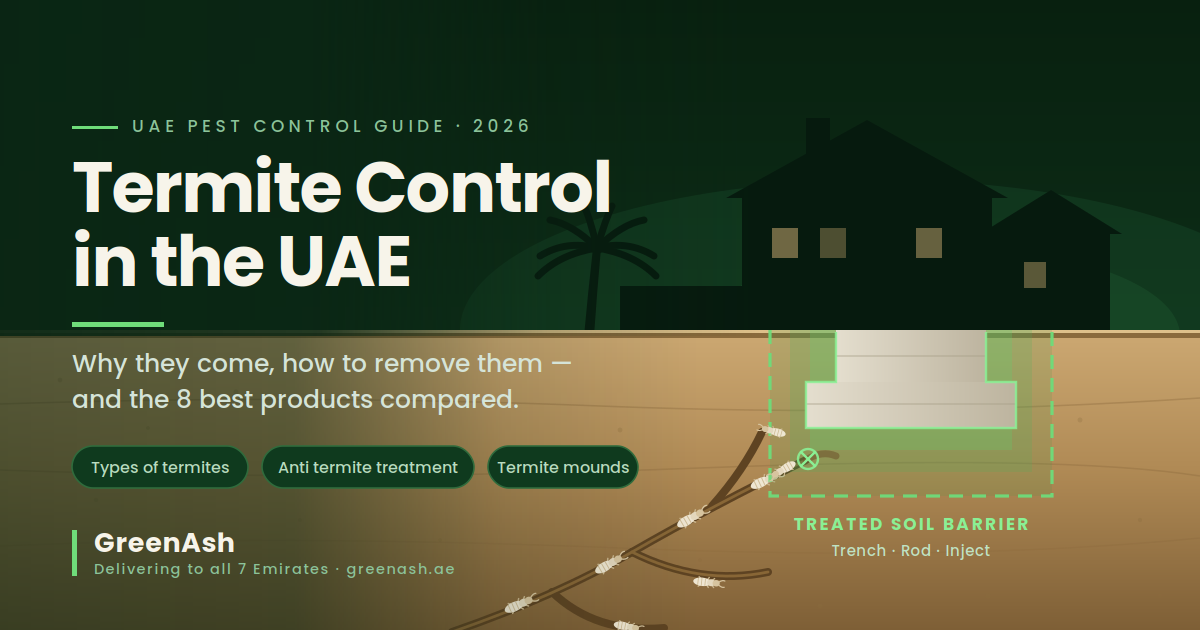
Termite Control in UAE: Anti Termite Treatment, House Termites & the Best Products in 2026
Last updated: November 2026 · Written by the GreenAsh team, Dubai · For homes, villas and farms in all seven emirates
Quick answer
Mud tubes on a wall, hollow skirting or a pile of tiny pellets under a wardrobe mean termites, and the right treatment depends on which kind you have. Soil termites (subterranean and sand termites) are stopped with a continuous treated zone in the soil around and under the building, and university research shows non-repellent actives such as imidacloprid are more reliable for this than repellent sprays. Drywood termites live inside furniture and timber, so a soil treatment does nothing for them. A whole house job needs a licensed pest control company; you can inspect, fix moisture, and treat garden timber, posts and small outbuildings yourself.
By the end of this guide you will be able to: tell termites from ants and wood beetles, work out whether they come from the soil or the wood, decide what you can treat yourself and what needs a professional, mix the products we stock at the rates on their pages, and stop termites coming back.
In this guide
- How termites live and feed
- Termites found in the UAE
- Is it termites? A diagnosis table
- Why termites come to your house
- How to inspect your home
- Repellent or non-repellent
- What you can treat yourself
- Step by step soil treatment for garden structures
- Mixing table for 1 L, 5 L and 16 L
- Drywood termites in furniture
- Product comparison
- Hiring a licensed company
- UAE timeline by season
- Common mistakes
- If it did not work
- Safety
- Frequently asked questions
How termites live and feed, and why that decides the treatment
Termites are social insects, called “white ants” (النمل الأبيض) locally, although they are closer relatives of cockroaches than of ants. A colony has three castes. Workers are soft, pale and wingless, and they do all the feeding and tunnelling. Soldiers have enlarged heads and jaws and guard the galleries. Reproductives are the king and queen, plus the winged swarmers (alates) that leave to start new colonies. According to UC IPM’s Pest Notes on subterranean termites, a colony can range from a single founding pair to hundreds of thousands of individuals, kings and queens can live a decade or more, and workers live one to several years.
They eat cellulose: timber, plywood, MDF, cardboard, paper, cotton and the paper face of gypsum board. They cannot digest it alone. Protists in their gut break the cellulose down, and termites pass gut contents to each other mouth to mouth, a habit called trophallaxis. That sharing is the reason some treatments work. A slow acting insecticide or bait picked up by one worker is passed through the colony, including to the queen, who never comes out to be sprayed.
Soil dwelling termites dry out quickly in open air. That is why they build mud tubes from soil, saliva and chewed wood to travel between the ground and their food, and why they follow moisture. In a desert country, the moisture usually comes from us: irrigation, air conditioning drains, leaking pipes and planters built against walls. Fix the water and you remove the thing that lets a colony survive next to your house.
Which termites are found in the UAE?
The most detailed local survey we found is a 2005 study by W. Kaakeh in the Journal of Agricultural and Marine Sciences, which identified six subterranean termite species from five genera in the UAE: the harvester termites Anacanthotermes ochraceus and Anacanthotermes ubachi, the sand termite Psammotermes hypostoma, and Microcerotermes diversus, Heterotermes aethiopicus and Microtermes najdensis. All six were found in Abu Dhabi and Dubai. A. ochraceus was the most common, followed by P. hypostoma and M. diversus. All are subterranean and travel through earthen galleries, and they fed on dead, living or decaying plant material and some non-cellulose materials.
The table below describes each group in general terms; the survey itself lists species, places and hosts. That survey covered soil termites. Drywood termites are a separate group that nest in dry, sound wood and need no soil contact at all. In the UAE the realistic route for them is inside wooden furniture, doors, crates and joinery brought into the home.
| Group | Where it nests | What you see | Typical UAE place | What works |
|---|---|---|---|---|
| Subterranean termites (for example Microcerotermes, Heterotermes) | In the soil | Mud tubes on walls and foundations, hollow timber lined with dried soil | Ground floor skirting, door frames, boundary walls, store rooms | A continuous treated soil zone, ideally non-repellent, plus moisture control |
| Sand termites (Psammotermes) | Deep sandy soil | Sand crusts and tubes on trunks, posts and fences | Irrigated gardens, palms, pergolas, decking, farms | Remove buried wood, treat soil around posts and structures, cut overwatering |
| Harvester termites (Anacanthotermes) | Underground nests | Workers collecting dry plant material at the surface | Undeveloped plots, desert edges, farms | Usually a garden and farm issue; keep dead plant debris and wood away from buildings |
| Drywood termites | Inside the timber itself | Hard six-sided pellets under small round holes | Wardrobes, doors, antique or imported furniture, any floor of a tower | Wood injection or whole item treatment; a soil barrier does nothing |
| Dampwood termites | Wet, decaying wood | Soft, damp timber | Under sink cabinets, leaking planters, roof leaks | Fix the leak and replace the rotten wood first |
Is it termites? A symptom, cause and action table
Many people call every small pale insect a termite, and many termite problems are first blamed on damp. Use this table before you buy anything.
| What you see | Most likely cause | What to do next |
|---|---|---|
| Pencil-width mud tubes running up a wall, column or foundation | Subterranean termites | Break a short piece open. Live pale workers mean an active colony. Leave the rest for an inspector and plan a soil treatment. |
| Skirting or a door frame that sounds papery and dents under a screwdriver, galleries lined with soil | Subterranean termites feeding inside the wood | Map every soft spot. This is a whole building job, so get a licensed company. |
| Small piles of hard, gritty pellets with six flat sides, below tiny holes under 2 mm | Drywood termites | Sweep the pellets away and check again in a few days. New pellets mean an active colony in that piece of wood. |
| Very fine, flour-like powder from round holes | More likely wood boring beetles than termites | Have it identified before treating; termite products and methods may not fit. |
| Winged insects indoors near windows, then piles of shed wings | A termite swarm if the wings are equal in length and the antennae are straight; flying ants if the front wings are longer and the antennae bent | Collect a few in a jar. Termite swarmers indoors are a strong sign of an infestation inside the building. |
| Swarmers or tubes only on a stump, woodpile or old fence in the garden | Termites feeding outdoors | Not proof the house is infested. Remove the wood, then inspect the house walls closely. |
| Bubbling paint and a damp patch with no tubes or galleries | A water leak | Fix the leak first. Leaks attract termites later, so recheck the area in a few weeks. |
| A young palm or shrub dying, with sand crusts on the lower trunk | Sand termites, often after overwatering | Check the irrigation and the root zone, remove dead wood, and treat the soil around the base only with a product whose page allows soil use. |
The ant or termite check comes from UC IPM and the University of Kentucky: termites have straight antennae, a broad waist and two pairs of wings of equal length, while ants have elbowed antennae, a pinched waist and front wings longer than the back ones. Kentucky also notes that swarmers live only about a day and cannot damage wood themselves. They are a sign, not the damage.
Why termites come to your house: the eight real causes
Termites are not drawn by dirt. They need moisture, cellulose, a way in and cover. These are the conditions that let a colony thrive next to a building.
- Irrigation against the wall. Drip lines, sprinkler spray and daily watering keep the soil beside the foundation damp all year. Soil termites follow that water. Our drip irrigation guide shows how to test where your emitters actually wet the soil.
- Air conditioning drains onto soil. A split unit drain that empties beside a wall makes a permanently wet patch, even in July.
- Wood touching soil. Pergola legs, fence posts, decking joists, sleepers and wooden planters give termites a bridge from the ground into a structure. UC IPM advises keeping structural wood at least 30 cm (12 inches) above soil.
- Thick mulch and soil banked up the wall. Bark and wood mulch are food and keep humidity high, and soil piled above the damp proof line hides tubes.
- Imported or second-hand furniture. This is how drywood termites reach apartments with no soil contact.
- Buried wood and old palm stumps. Construction offcuts and root balls left in the backfill feed a colony right next to a new villa.
- Leaks. A slow leak under a kitchen sink or a failed bathroom membrane wets screed and timber, which suits both soil and dampwood termites.
- Cracks and service gaps. Slab cracks, expansion joints and the gaps around pipes and cables are the usual entry points. The US EPA lists sealing them as a basic prevention step.
How to inspect your home this weekend
You need a torch, a flat screwdriver, a phone camera and a notebook. The question you are answering is simple: are the termites coming from the soil, or living in the wood?
- Walk the outside wall. Look at the base of every wall, column and boundary wall, behind stacked pots and under garden taps. Kentucky describes mud tubes as about pencil width.
- Check the inside line of the ground floor. Skirting, door frames, the back and base of fitted wardrobes, under the stairs, kitchen plinths and the store room. Press the screwdriver gently into the wood. Sound timber resists; termite damaged timber gives way and may show galleries following the grain.
- Look for the four types of tube. UC IPM describes working tubes (soil to wood), exploratory tubes, drop tubes hanging from wood back to soil, and swarm tubes. A tube with live workers inside is active; a dry, crumbling tube may be old.
- Test pellets for activity. UC IPM’s drywood advice: clear away any pellets under a hole, then look again a few days later. Fresh pellets mean feeding is continuing.
- Check the garden. Stumps, old sleepers, pergola feet, palm bases and fence posts. Termites there do not prove the house is infested, but they tell you a colony is close.
- Photograph and mark. Number each find on a rough plan of the house. You will need it for a professional quote, and to check later whether the treatment worked.
A cheap way to monitor the garden: lay a piece of damp, untreated cardboard or softwood on the soil in a suspect spot, cover it with a tile, and lift it every week or two. Workers feeding underneath show you where activity is. Texas A&M notes that do-it-yourself bait stations were not shown to give control in their tests, so treat this as a monitor, never as a treatment.
Repellent or non-repellent: the science that matters most
Every liquid termiticide falls into one of two groups, and the difference explains most failed DIY treatments.
- Repellent actives are the pyrethroids, such as cypermethrin and lambda-cyhalothrin. Termites can sense the treated soil and turn away before they pick up a lethal dose. That kills the termites you hit, but the colony survives and keeps probing for an untreated gap. UC IPM notes that repellent pyrethroids have been phased out for soil termite work in California for this reason.
- Non-repellent actives include imidacloprid, fipronil and chlorantraniliprole. Termites cannot detect them, so they tunnel through treated soil, pick up the active and pass it to nestmates. The University of Kentucky’s termite guide for homeowners says non-repellent products are usually more reliable on the first attempt, and the Texas A&M termite FAQ reports that non-repellents performed better in its tests, especially in alkaline clay soils.
Imidacloprid was designed to mimic nicotine and binds strongly to insect nerve receptors, which is why it is much more toxic to insects than to mammals and birds. The NPIC imidacloprid fact sheet adds three points that change how you apply it: it can last months or years in soil and binds more tightly over time, it may leach to groundwater under some conditions, and it is very toxic to honeybees. So it belongs in the soil against the building, never sprayed on flowering plants, and never near wells, ponds or open drains.
What this means in practice: use a non-repellent for the soil, where you want the colony to carry the active home. Use a pyrethroid only for spot work on a tube, a crack or a piece of garden timber, and accept that it protects the spot rather than ending the colony.
What you can treat yourself, and what needs a licensed company
We sell termite products, and we still want to be clear about this. Both Kentucky and UC IPM say that do-it-yourself products seldom eradicate an existing infestation in a home. Kentucky notes that a typical professional treatment may use hundreds of gallons of diluted termiticide, injected along the foundation, under slabs and into the walls with masonry drills, large tanks and soil rods. Texas A&M suggests limiting DIY work to smaller, less valuable structures such as sheds, fence posts, decks and woodpiles.
| Your situation | Who should treat | Why |
|---|---|---|
| Tubes or damage inside the house, in skirting, frames, walls or under the slab | Licensed pest control company | The soil under and around the whole building has to be treated without gaps, which needs drilling, rodding and large volumes |
| Damage in roof timbers, beams or load bearing wood | Licensed company, plus a contractor for repairs | Safety of the structure comes first |
| A new villa or extension before the slab is poured | Your contractor’s licensed applicator | Pre-construction soil treatment is part of the build; ask for the product name and label |
| Termites in a garden pergola, fence, shed, decking or wooden planter not attached to the house | You can, with care | Small, separate structures are the case extension services accept for DIY |
| Tubes on a boundary wall or garden column, with no sign inside the house | You can treat the spot; book an inspection of the house | A colony that close may already be under the house |
| One loose piece of furniture with drywood pellets | A licensed specialist is most reliable, or replace the item | UC IPM says local treatment works best when the infested area is accessible, and colonies are easily missed |
| Commercial, rented or multi-tenant property | Licensed company | Shared walls and occupants make DIY unsafe and the landlord or management may need a record |
Some termiticides in our range are labelled restricted use for certified applicators only, so we do not recommend them for home use in this guide. If a company uses one at your home, ask for the label and follow its re-entry instructions.
Step by step: soil treatment around garden structures and posts
This is the job a careful homeowner can do: a timber pergola, a fence line, a shed, decking or wooden raised beds away from the house. The method follows the trench and soil drench approach the extension sources describe for professionals, scaled down.
- Remove the food. Pull out rotten sleepers, buried offcuts and dead stumps. Replace any post that has lost most of its strength. Treating soil around wood that is already hollow only protects the next post.
- Stop the water. Move drip emitters and sprinklers so they do not wet the posts or the base of the structure. Let the top of the soil dry for a few days before treating, so the mix soaks in rather than running off.
- Dig a narrow trench. Around each post or along the base of the structure, open a trench about one spade wide and one spade deep. Keep the soil on a plastic sheet beside it.
- Mix only what you will use today. Measure the concentrate with a syringe or measuring cup kept for pesticides, never a kitchen spoon. Use the rate on the product page or label (see the table below).
- Treat the trench and the backfill. Pour the mix slowly into the trench with a watering can or low pressure sprayer, then return the soil in layers, wetting each layer, so the whole column of soil is treated and not only the bottom.
- Treat exposed wood surfaces if the label allows. Some product pages list wood treatment. If yours does not, treat only the soil.
- Keep people and pets off until dry.
- Check every few weeks. Look for fresh tubes and lift your cardboard monitors. New tubes suggest a gap in the treated soil or a new moisture source.
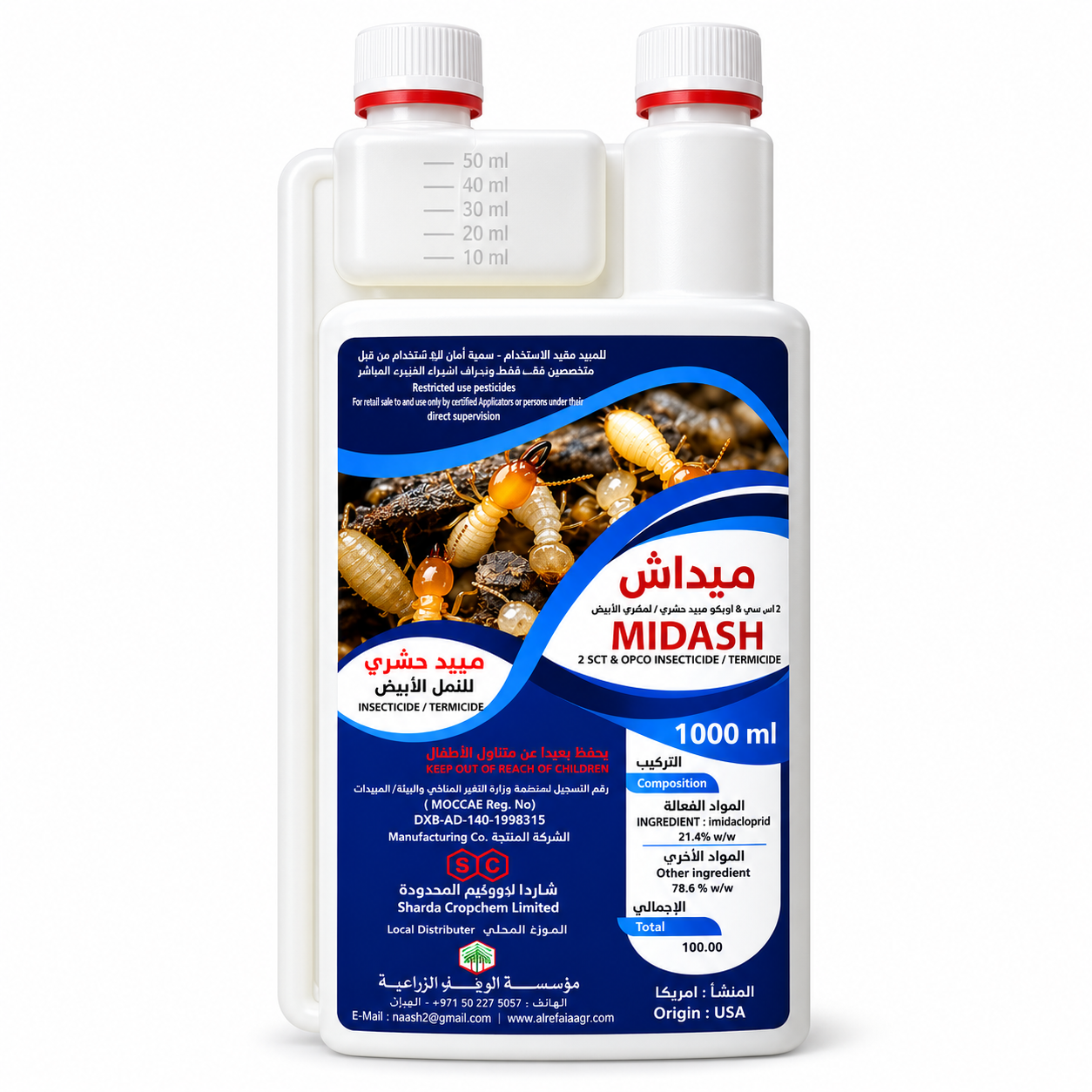
Mixing table: 1 L, 5 L and 16 L, from the product pages
These figures are calculated only from the rates printed on our product pages. Always check the label on the bottle you receive before mixing, as it is the legal instruction. None of these pages gives a volume of mix per metre of trench, so do not guess one from another product; if the label on your bottle gives a volume, follow it.
| Product and page rate | 1 L hand sprayer | 5 L pressure sprayer | 16 L knapsack |
|---|---|---|---|
| MIDASH Imidacloprid 21.4%: 2.5 to 5 ml per litre (soil, by trench, rod or injection) | 2.5 to 5 ml | 12.5 to 25 ml | 40 to 80 ml |
| Cymperator 25 EC, drywood: 50 ml per 10 L (5 ml per litre) | 5 ml | 25 ml | 80 ml |
| Cymperator 25 EC, subterranean: 100 ml per 10 L (10 ml per litre) | 10 ml | 50 ml | 160 ml |
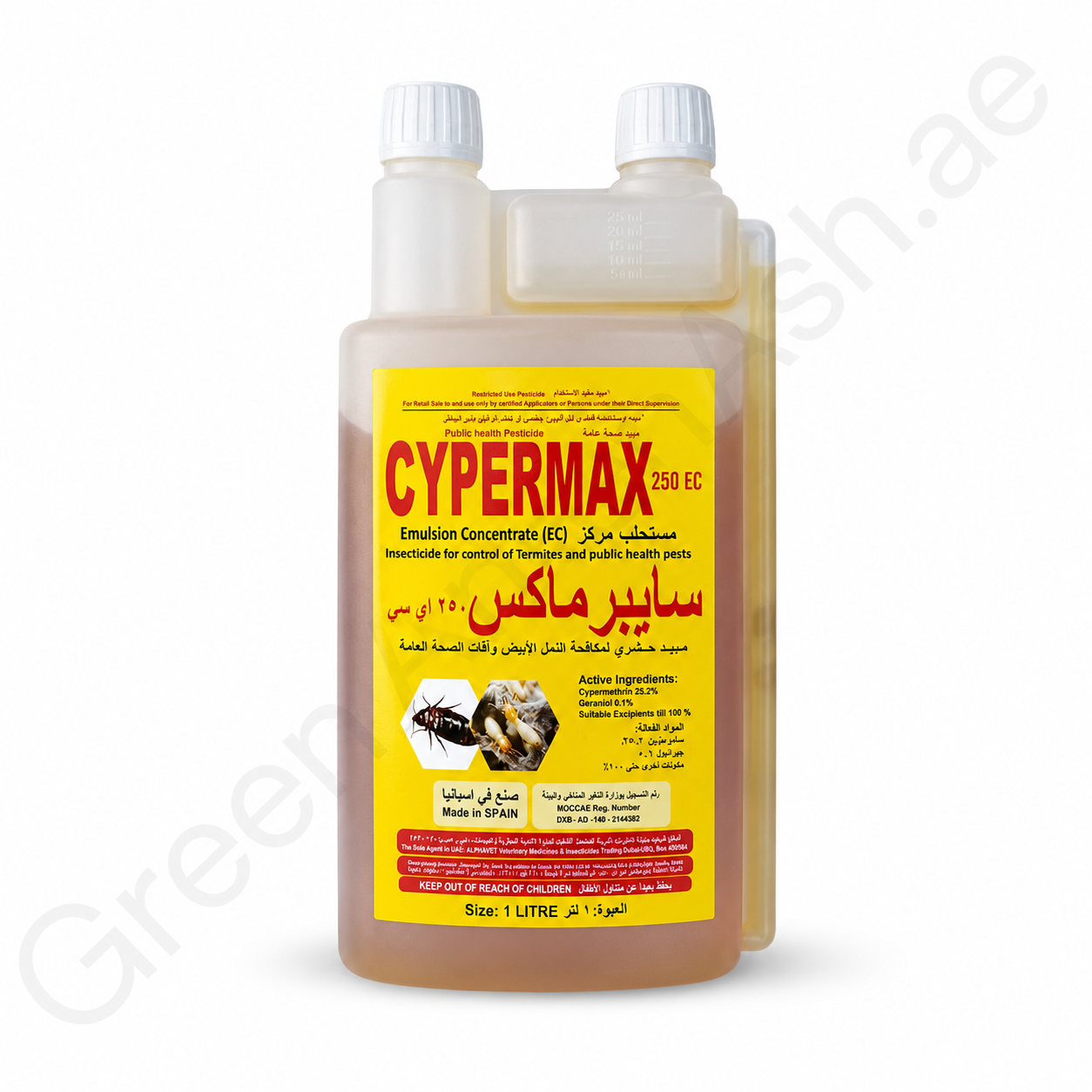
| Cypermax 250 EC: 1.5 to 3 ml per litre, covers 10 to 20 m² per litre of mix | 1.5 to 3 ml | 7.5 to 15 ml | 24 to 48 ml |
| Sharda Lambda-Cyhalothrin 10% CS: 2 to 3 ml per litre (surface, spot, crack and crevice) | 2 to 3 ml | 10 to 15 ml | 32 to 48 ml |
Worked example for a spray area: the Cypermax page says one litre of mix covers 10 to 20 m². Say you have tubes along a 20 m garden boundary wall. Spraying a strip 0.5 m up the wall and 0.5 m of ground at its base is 20 × 0.5 + 20 × 0.5 = 20 m². (This is only for a free-standing garden wall; the page advises a licensed professional for structural termite work.) At 10 to 20 m² per litre that needs 1 to 2 L of mix, so put 2 L of water and 3 to 6 ml of Cypermax in a 5 L sprayer. For 100 m² you would need 5 to 10 L of mix, which is 7.5 to 30 ml of concentrate depending on the rate you choose.
A 5 L pressure sprayer is the most practical size for this work; our garden sprayer guide compares handheld, pressure and knapsack models and shows how to check your output before you start.

Drywood termites in furniture, doors and wardrobes
Drywood colonies are small, usually fewer than 1,000 termites according to UC IPM, and they can be spread through several pieces of wood. You will not see mud tubes. You will see pellets: hard, with six flat sides and clear ridges along their length, pushed out of kick-out holes under 2 mm across. Dampwood pellets are rounder, without the ridges.
The options, from UC IPM’s drywood termite Pest Notes:
- Whole structure fumigation reaches hidden colonies and kills within several days, but the building has to be empty of people, pets and plants. It is a licensed specialist job.
- Heat treatment works when the wood itself reaches at least 49°C (120°F) and holds it for at least 33 minutes. Thick beams take many hours to heat through, and heat sinks such as wood laid on tile or concrete reduce the effect.
- Local treatment with liquids, dusts or foams injected into the galleries works best when the infested area is accessible. UC IPM points out its limits: inspectors cannot be sure of the colony’s full extent, results vary by applicator, and infestations can rebound.
- Replacing the wood is often the surest fix for a single door frame, shelf or skirting length.
Neither fumigation nor heat leaves any protection behind, so inspect any wooden furniture that arrives in the house, especially the unfinished back and underside, before it goes into a bedroom.
UC IPM advises that local treatment be done by a licensed applicator and says home-use products are not effective for drywood termites. For a single loose item, replacing it or having a specialist treat it is the reliable option. The Cymperator page does give a drywood rate of 50 ml in 10 L of diluent, applied to the wood or injected, which is the rate a professional using that product would follow. Varnished and painted surfaces absorb almost nothing, so spraying the outside of a finished cabinet does little.
Spot treatment of mud tubes and garden timber with a pyrethroid
A pyrethroid spray is the right tool when you need to treat a small, defined spot: the tube on a garden column you have just broken open, the base of a timber gate, a pile of logs that cannot be moved yet, or cracks around a store room door. Break the tube, spray the opening and the soil at its base, and treat the crack or gap it came through. Do not expect it to stop a colony under the house; that is what the soil treatment is for.
Termite product comparison: what each page says
All of these are public health products. None is for use on food crops, so none of the pages gives a pre-harvest interval; do not spray them on vegetable beds, fruit trees or herbs.
| Product | Active and strength | Pack | Use on the page | Rate on the page | Harvest interval on page | Who it suits |
|---|---|---|---|---|---|---|
| MIDASH | Imidacloprid 21.4% w/w, non-repellent | 1000 ml | Soil around foundations, walls and termite-prone zones; pre and post construction | Commonly 2.5 to 5 ml per litre, as per label | None (not a crop product) | Soil around garden structures; professionals for whole buildings |
| Cymperator 25 EC | Cypermethrin 26% EC, repellent | 1 L | Drywood and subterranean termites, plus flies, cockroaches, ants, mosquito fogging | Drywood 50 ml per 10 L; subterranean 100 ml per 10 L | None (public health) | Local wood injection and spot work |
| Cypermax 250 EC | Cypermethrin 25% EC, repellent | 1 L | Termites, cockroaches, ants, bed bugs; cracks, crevices, nests and infested zones | 1.5 to 3 ml per litre; 10 to 20 m² per litre of mix | None (public health) | Spot treatment of tubes, cracks and garden timber |
| Sharda Lambda-Cyhalothrin 10% CS | Lambda-cyhalothrin 10%, capsule suspension, repellent | 500 ml | Surface, spot and crack and crevice work; termites listed among 14 pests | 2 to 3 ml per litre (no termite-specific rate) | None (public health) | Indoor crack and crevice work alongside a professional soil treatment |
| Demon Max | Cypermethrin 25.3% w/w EC, repellent | 500 ml | Termites, ants, cockroaches; soil, foundations and pre-construction | 5 to 10 ml per litre; 20 to 25 ml per litre for heavy termites | None (public health) | Follow the label on the bottle: the page rate is much higher than Cypermax at a similar strength |
Two notes on products this guide used to mention. Triple Power Insecticide’s page does not list termites, so we no longer suggest it for termite work. The pages for STUN 18.3 SC and Alpha-Cypermethrin 10% EC say restricted use for certified applicators, so they are for licensed companies only.
Hiring a licensed company: what to ask
Kentucky makes a useful point here: termites damage wood slowly, so taking a week or two to choose the right company rarely adds much damage. Use that time well.
- Check the licence. Ask for the company’s pest control licence from your emirate’s municipality and the name of the technician who will do the work. Kentucky notes that the technician matters more than the salesperson.
- Get two or three inspections and quotes, and compare what each one proposes to treat, not only the total.
- Ask for the product name and a copy of the label. The US EPA advises not to accept a product whose label has no directions for termite control and structural protection.
- Ask whether the soil product is repellent or non-repellent. Texas A&M says perimeter-only treatment is acceptable only with a non-repellent product, and only if the label allows it, and that the highest permitted label rate generally lasts longest.
- Ask about drilling. Where will they drill through tiles, paving and slabs, how will holes be sealed, and how will they avoid pipes, cables and water tanks?
- Ask about re-entry. When can children, pregnant family members and pets come back, and how long should rooms be aired? Texas A&M suggests airing the home for 1 to 2 hours after application.
- Read the warranty. Kentucky notes that warranties usually include free retreatment if termites return, as long as the annual renewal is kept. Texas A&M advises that annual renewal fees should not exceed 20% of the original treatment cost.
Texas A&M’s long term tests found soil termiticides lasting about four to ten years, and Kentucky says correctly applied liquid termiticides should control termites for at least five years according to their labels. UC IPM suggests a professional inspection every 3 to 5 years, or more often if the house has a termite history.
UAE timeline: what to do and when
Termite activity in irrigated UAE gardens does not stop for winter, but the work you do changes with the season.
| Period | What to do |
|---|---|
| October and November | The best time for outdoor work. Do your full inspection, remove buried wood and stumps, move drip lines away from walls before the planting season, and book any professional treatment while digging and drilling in the open is bearable. |
| December to February | Cooler and sometimes rainy. Check for swarmers and shed wings at windows and lights after rain or humid nights, and look under cardboard monitors every two weeks. Treat garden structures on dry days, never just before rain, so the mix stays in the soil. |
| March and April | Second inspection of the year. Check the results of any autumn treatment. Seal cracks and service gaps before summer. |
| May to September | Irrigation and air conditioning run hardest, so this is when moisture problems grow. Check AC drain outlets and irrigation monthly. Do any spraying in the early morning or evening only; the Cypermax page says not to spray in the midday heat. Wear protective clothing only for short spells and drink water; heat stress in full PPE is a real risk. |
How it differs by home
- Villas: the soil is the main route. Concentrate on irrigation, AC drains, planters against walls and any timber in the garden.
- Apartments: above the ground floor, drywood termites in furniture are the likely cause. Pellets, not tubes, are the sign. Tell your building management, as neighbouring units may share the problem.
- Farms and palm plots: sand and harvester termites are common in this setting. Clear dead fronds, old trunks and wooden debris, and avoid overwatering young palms. Keep termiticides away from wells and irrigation ponds, and never treat soil where food crops grow unless the product is labelled for that crop.
- Salty or very sandy soil: sand drains fast, so follow the label volume and never flood a trench near a water tank, well or drain.
- New builds: pre-construction soil treatment is the best chance to protect the house, because it is the only time the soil under the slab can be reached fully. Ask your contractor for the product used and keep the record.
Common mistakes, and what to do instead
- Breaking open tubes and spraying the termites you see. It kills a few workers and teaches the colony to move. Map the activity first, then treat the soil or call a company.
- Using a soil treatment for drywood termites. Drywood termites never touch the soil. Treat or replace the wood.
- Treating only one side of the house. Kentucky calls spot treatments a gamble, because colonies forage in many directions. A gap in the treated soil is where they come in.
- Relying on a repellent spray in the soil. It protects a spot for a while but leaves the colony alive. Use a non-repellent for soil work.
- Treating and leaving the leak. The moisture that attracted the colony is still there, and treated soil degrades. Fix drains, irrigation and leaks the same week.
- Using a kitchen spoon to measure. At 1.5 to 5 ml per litre, a spoon is not accurate enough. Use a syringe or measuring cup kept only for pesticides.
- Spraying near ponds, wells or flowering plants. Pyrethroids are toxic to fish and bees, and imidacloprid is very toxic to bees and can leach. Keep them in the soil against the structure.
- Waiting for termites to appear in the room. By then damage is usually well advanced. Inspect twice a year.
If it did not work: troubleshooting
- Live termites in the first week after a non-repellent treatment: expected. The active spreads through the colony over weeks. Do not spray them with a pyrethroid, as that can push them away from the treated soil.
- New tubes weeks after treatment: look for an untreated gap, a new tube route over paving or a door step, or a fresh moisture source. Treat the gap only if it is in a garden structure you were treating yourself; anything on the house goes to the company.
- Fresh pellets after drywood treatment: the colony extends further than the galleries you reached. Replace the wood or get a specialist to treat the whole item.
- Tubes coming back after a professional treatment: call the company under the warranty, and give them your dated photos and plan. Ask what was treated and where.
- Damage in beams, roof timbers, or a door frame that has given way: stop DIY. Get a licensed company and a contractor to check the structure.
- Anyone feels unwell after a treatment: leave the area, get fresh air and take the product label with you to a doctor.
Safety: protective equipment, people, pets, bees and water
- Protective equipment: chemical-resistant gloves, long sleeves, long trousers, closed shoes, eye protection and a mask while mixing and applying. The MIDASH, Cymperator and Cypermax pages all call for gloves or protective equipment; Cypermax adds eye protection and a mask.
- Re-entry: keep children, pets and other people away until treated surfaces are dry. The Cymperator page gives re-entry after at least 30 minutes or once surfaces are dry; follow the label on your bottle for each product.
- No food crops: these are public health products with no harvest interval on their pages. Do not use them on or near vegetables, herbs or fruit trees, and keep them away from food, dishes, feed and drinking water.
- Bees: imidacloprid is very toxic to honeybees, and the Demon Max page says cypermethrin is toxic to bees. Never spray flowering plants.
- Fish and water: keep all of these away from ponds, pools, water features, wells and drains. Do not pour leftover mix or rinse water into a drain.
- Storage: keep the concentrate in its original, closed container, in a cool, shaded, locked place out of reach of children.
- Disposal: mix only what you need. Never reuse empty containers; follow your municipality’s guidance for empty pesticide containers.
- First aid: follow the first aid section on the label. If anyone swallows the product or feels unwell, get medical help at once and take the label with you.
Frequently asked questions about termite control in the UAE
How much does anti termite treatment cost in the UAE?
It depends on the size of the property, whether drilling through tiles and slabs is needed, and the product used, so ask two or three licensed companies to inspect and quote. Compare what each will treat, which product they will use and what the warranty covers, not only the total. If you treat a garden structure yourself, your cost is one bottle of concentrate, a sprayer and protective equipment.
How long does termite treatment take to work?
A pyrethroid kills the termites it contacts but leaves the colony. A non-repellent soil treatment such as imidacloprid works more slowly, because it has to spread through the colony; seeing some termites in the first week is normal. Baits, which are professional products, can take months.
Can I treat termites in my villa myself?
You can inspect, fix moisture, remove buried wood and treat separate garden structures. Termites in the house itself need a licensed company, because the whole soil zone under and around the building must be treated without gaps. Kentucky and UC IPM both say DIY products seldom eradicate an infestation in a home.
What is the difference between repellent and non-repellent termiticides?
Termites can detect repellent products such as cypermethrin and avoid them, so the colony survives. They cannot detect non-repellent products such as imidacloprid, so they carry the active back to the nest. University tests found non-repellents more reliable for soil treatment.
Can termites live in an apartment on a high floor?
Yes, but usually as drywood termites carried in with wooden furniture, doors or crates. Look for hard six-sided pellets under small holes. Soil treatment is irrelevant to them.
Are there termite mounds in the UAE?
Not the tall mounds of Africa and Australia. The species recorded in the UAE nest underground and reach wood through earthen galleries, so what you find are mud tubes, sand crusts on posts and trunks, and nests hidden in the soil.
Which insecticide is strongest against termites?
Strength on the bottle is less important than the type. For soil termites, a non-repellent such as imidacloprid applied without gaps is usually more reliable than a repellent such as cypermethrin, according to Kentucky and Texas A&M. For drywood termites, getting the product into the galleries matters more than the active.
Is termite treatment safe around children and pets?
Keep them out of treated areas until surfaces are dry and the room has been aired, follow the re-entry time on the label, never spray toys, bedding or bowls, and lock the concentrate away. Imidacloprid does not pass through skin easily but is absorbed if swallowed, according to NPIC, so storage and hand washing matter.
How often should termite treatment be repeated?
University tests put soil termiticide life at roughly four to ten years, depending on product, soil and how well it was applied. Inspect yourself twice a year and have a professional inspection every 3 to 5 years, sooner if termites have been found before.
Need help choosing?
Send us photos of what you have found, the tubes, pellets or damage, with a note of where they are, and we will tell you whether it looks like a soil or a drywood problem and which product, if any, fits. For a whole house treatment we will tell you to call a licensed company. Browse our household insecticides or contact the GreenAsh team.
Related guides
- Advion cockroach gel: how to use it properly, for the cockroaches you may find during a termite inspection
- Khatmal (bed bugs): identification and treatment
- Insecticides in the UAE: how to read a pesticide label
- Choosing a garden sprayer
- Drip irrigation: setting up and testing a line
This guide is general information. Always read and follow the product label before use. Rates, permitted uses and re-entry times vary by product and can change. Products labelled for certified applicators must be applied by a licensed professional.
