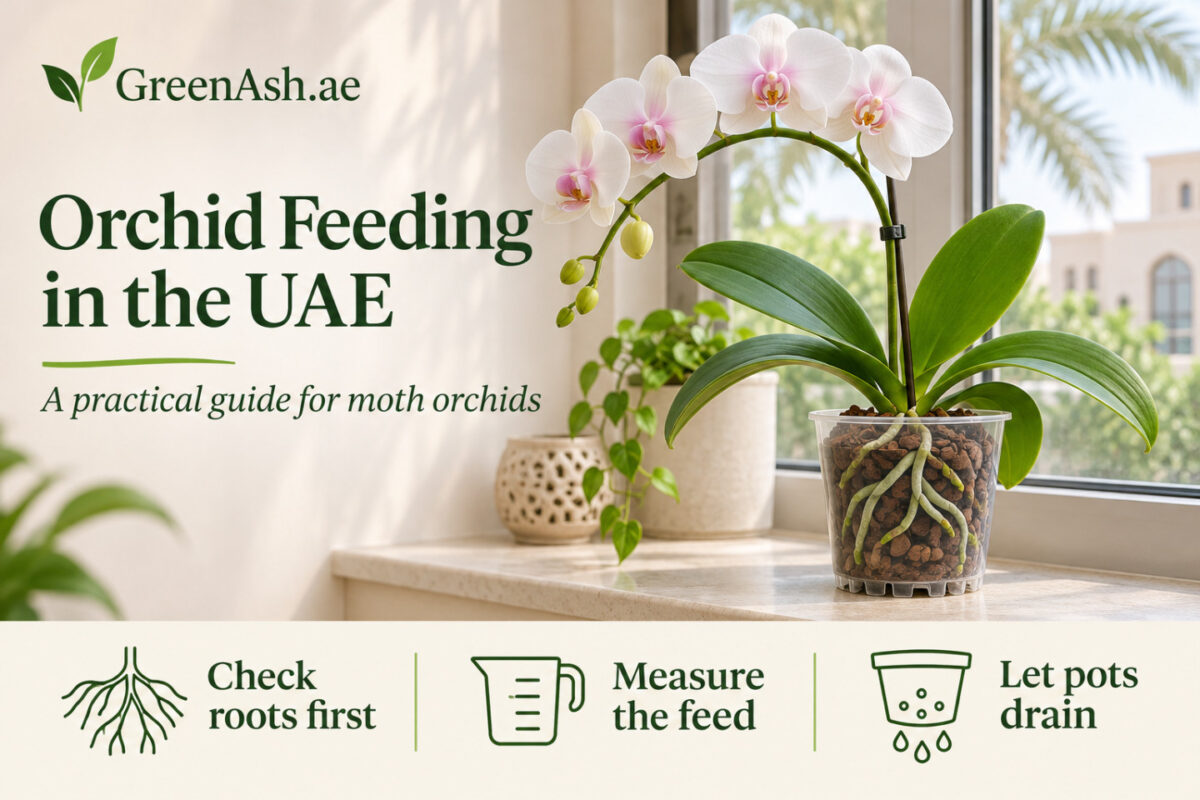
Choosing orchid fertilizer in the UAE starts with the plant and its pot, not the promise on a bottle. For a moth orchid on an apartment windowsill, a useful feeding routine combines a suitable product with correct watering, free drainage and enough light. Extra fertilizer cannot compensate for damaged roots or an unsuitable position.
This guide is for Phalaenopsis, commonly called moth orchids. Other orchids can have different growth and rest cycles. The UAE advice below adapts established orchid-care guidance to indoor conditions; it does not assume that a European seasonal feeding calendar fits an air-conditioned home.
Check the roots before buying more feed
The American Orchid Society explains that overwatering and underwatering can produce similar symptoms. A plant with failing roots cannot take up water and nutrients normally. If leaves look limp, inspect the root zone before deciding the orchid is hungry.
Lift the nursery pot out of its decorative cover. Check for trapped water, a persistently wet centre and deteriorating growing medium. A transparent pot makes inspection easier. Keep a note of the last watering and feeding dates so that a second person does not accidentally repeat the application.
| What you find | What to do before feeding |
|---|---|
| Water standing inside the outer pot | Empty it and check that the nursery pot can drain |
| Wet medium and a declining plant | Inspect roots and seek help with the cause; do not increase feed |
| A healthy plant with no new flowers | Review light and growing conditions before changing fertilizer |
| An existing feeder or recent fertilizer application | Check its instructions before adding another product |
Match the feeding routine to your UAE home
The American Orchid Society recommends bright light with little or no direct sun for moth orchids. Water thoroughly when the medium is nearly dry, without allowing the plant to dry out completely. Keep water from collecting where the leaves meet in the crown.
In a UAE home, assess the actual windowsill: a bright room does not mean every shelf receives useful light, and a sunny window can heat up well beyond the room temperature. Keep the plant clear of a direct air-conditioning blast. These are practical placement checks, not a reason to move a moth orchid onto a hot balcony for stronger light.
Bark and moss do not dry at the same speed. The Society’s beginner guidance notes that bark retains less moisture than moss and suggests learning the weight of the pot as it dries. Compare the pot after watering with its weight before the next watering. Use that observation alongside the condition of the medium, rather than watering simply because a weekly reminder appears.
Choose a product you can measure and use consistently
A concentrated liquid, soluble powder and ready-to-use feeder require different handling. Read the exact format on the pack. A concentrate needs dilution; a ready-to-use product should not inherit the directions from a similar-looking concentrate.
Two examples in GreenAsh’s live catalogue are Baby Bio Orchid Food and Desert Energy Orchid Feed. Both listings describe liquid concentrates for orchids. The Baby Bio page does not give an exact dilution quantity in its main instructions, so check the supplied bottle label before mixing. The Desert Energy page gives application guidance but does not provide a complete NPK analysis. Do not infer missing nutrient percentages from flowering claims.
Before ordering, check these four points:
- Directions: Can you read the dilution, application method and feeding interval?
- Measurement: Can your measuring tool accurately measure the amount needed for your small watering batch?
- Existing feed: Is another fertilizer or feeder already in use?
- Quantity: Does the pack suit the number of orchids you actually maintain?
For understanding nutrient numbers, see our NPK guide. For one or two plants, ease of accurate measurement is a more useful purchase criterion than buying the largest bottle.
Build a simple feeding routine
The RHS recommends light, regular feeding during active growth and following the manufacturer’s instructions. It also warns that feeding at every watering can accumulate salts. Treat the product’s feeding interval and the plant’s need for water as separate checks: a calendar date is not a reason to soak a pot that is still wet.
- Read your own pack. Confirm it is intended for orchids and identify whether it is concentrated or ready to use.
- Check the plant and medium. Resolve standing water or suspected root problems before adding fertilizer.
- Prepare only the required batch. Measure water and concentrate separately with suitable marked equipment. Do not estimate a partial cap unless the label specifies it.
- Follow the stated application method. A root feed is not automatically suitable for spraying leaves or flowers.
- Let the pot drain. Return it to its cover only after excess liquid has drained away.
- Record the application. Note product, dilution and date. Keep one feeding record even if several people care for the plant.
To scale a label rate, use: amount of concentrate = label amount × your water volume ÷ label water volume. Keep units consistent. If the answer is smaller than your measuring tool can reliably read, obtain a finer measuring tool rather than rounding the dose upwards. Our liquid fertilizer guide covers mixing habits in more detail.
Manage salt buildup without keeping roots wet
Fertilizer contributes dissolved salts, and irrigation water can add more. The American Orchid Society discusses water quality as part of feeding, so repeated deposits deserve a review of both the fertilizer routine and the water source. Do not assume that every UAE tap supplies identical water.
The RHS suggests using water without fertilizer every fourth watering to help flush accumulated salts. Let that water pass through and drain completely; leaving the pot soaking in the drainage water defeats the purpose. This is part of a watering routine, not an instruction to add an extra soaking while the medium is already wet.
If deposits return quickly or roots continue declining, pause the search for a stronger feed. Record the water source, product and mixing rate and seek orchid-specific advice. Avoid improvised acid additions to a watering can.
Frequently asked questions
Will bloom fertilizer make a moth orchid flower immediately?
No product should be treated as an instant flowering switch. Light, temperature, plant condition and the orchid’s growth cycle all matter. Review these conditions before buying a second feed because the first did not produce a flower spike.
Should I feed more because the UAE weather is hot?
No. Outdoor weather alone does not describe the conditions around an indoor orchid. Check actual growth, the pot’s drying pattern and the product instructions. Do not increase concentration to compensate for heat or wilting.
Can I combine a drip feeder with liquid orchid food?
Do not automatically add both. Check the feeder’s duration and instructions and account for it in the feeding plan. Keeping one clearly documented product routine makes it easier to identify over-application.
Does misting replace watering the pot?
No. Root-zone watering still needs attention. Also distinguish a hydration mist from a fertilizer spray by reading the label; the word “mist” alone does not tell you what the product supplies.
What should I send GreenAsh when asking which feed to buy?
Send the orchid name if known, photographs of the whole plant and visible roots, the potting material, your current fertilizer label and the last application date. Include whether the pot sits inside a cover. Those details are more useful than a flower photograph alone.