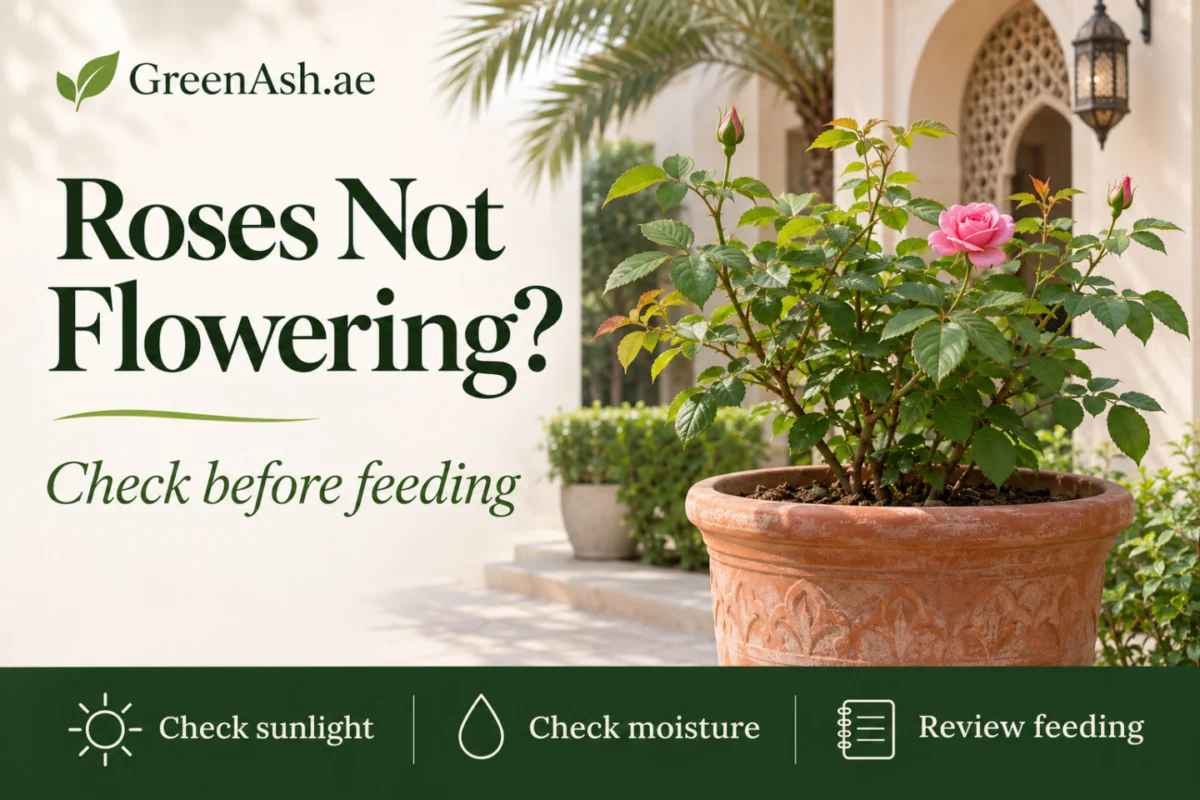
If your rose has leaves but few flowers, buying a stronger fertilizer may not solve the problem. Shade, weather stress, pruning and excess feeding can all affect flowering. For a UAE balcony or villa garden, start with what has changed around the plant, then decide whether nutrition needs attention.
Use the checks below before choosing a rose feed. They apply to established plants in pots and beds; a recently purchased rose also needs its nursery care and feeding history checked.
1. Find out what flowering pattern to expect
Some roses flower once a year, while others repeat. A pause between flushes does not automatically mean something is wrong. Find the variety name on the nursery label, invoice or order history and ask whether it is a repeat-flowering type.
Write down when you last saw flowers, when the plant was pruned and when it moved location. A photograph from purchase day can be useful: was it already carrying a complete flush of blooms, or was it a young plant still building growth? Compare your plant with its own history rather than a photograph of a different rose in full flower.
2. Check actual sunlight and heat exposure
Roses generally need a sunny site. The RHS recommends at least half a day of sun for container roses and suggests shading the container itself where possible while keeping the plant in sunlight. A bright covered balcony is not necessarily receiving direct sun.
For one day, note which parts of the rose receive sun in the morning and afternoon. Include shadows cast by balconies, walls and nearby shrubs. In UAE conditions, also note exposure to reflected heat from paving or walls. This is a site assessment, not a reason to move every rose into the strongest afternoon sun.
If flowering declined after a move, compare the old and new positions. Avoid changing the position, pruning heavily and adding several feeds together: you will have little basis for judging which change mattered.
3. Follow water into the root zone
Good drainage and even moisture support healthy roses. Check the growing medium below the surface and watch what happens during watering. A running timer only confirms that the system has switched on; inspect the individual outlet beside the rose.
| What you notice | What to check next |
|---|---|
| A pot dries much faster than neighbouring pots | Compare its size, exposure and actual water delivery. |
| The pot remains wet and the rose wilts | Check drainage holes and trapped water before adding more water or feed. |
| Only one rose in a bed declines | Compare moisture near that plant with a healthy neighbour. |
| Leaves have brown edges | Review heat, watering and recent fertilizer applications; the symptom alone does not identify a deficiency. |
Avoid adopting a UK or US weekly watering quantity as a fixed UAE prescription. Pot volume, growing medium and exposure change the amount and frequency needed. Aim water at the root zone rather than routinely wetting flowers and foliage.
4. Review pruning and inspect buds
Incorrect pruning can reduce flowering, and the right approach depends on the rose type. Before cutting a non-flowering plant back again, identify it and check suitable pruning guidance. Keep a record of the last cut instead of treating repeated hard pruning as a general remedy.
Look closely at buds and young shoots. Visible insects, sticky residue, distorted growth or damaged petals call for identification, not an automatic fertilizer increase. Our guide to aphids on roses and vegetables helps when you find clusters on tender growth. Take clear close-up photographs and one whole-plant photograph if you need advice.
5. Decide whether fertilizer is actually needed
University of Massachusetts Extension advises testing soil to establish whether a flower bed needs phosphorus. A large middle number on a fertilizer pack is not proof that it will produce more flowers in your particular bed. Do not infer that UAE soil is phosphorus-deficient simply because a rose has stopped blooming.
For a bed with recurring poor growth, request a soil test and tell the laboratory what you are growing and what you have already applied. For a container, first check the potting-mix label and nursery feeding history. RHS guidance notes that container roses need attention to feeding, but additional applications should follow the fertilizer manufacturer’s recommendations.
Make a short feed inventory: product name, amount, date and which plant received it. Include granules, liquid feeds and any fertilizer already incorporated in the mix. This is especially helpful when a gardener and homeowner both care for the same pots.
Choosing rose food at GreenAsh
GreenAsh lists Miracle-Gro Rose & Shrub Continuous Release Plant Food in a 1 kg pack for roses and shrubs. Consider it when a feeding need is established and the current pack directions suit your planting. It is not a treatment for inadequate light, waterlogged roots or a normal pause in flowering.
Before ordering, have your bed area or container dimensions ready. Ask for the complete current label if the online directions do not give enough information to interpret the container rate. Do not apply the same unexplained “per pot” amount to both a small nursery pot and a large terrace planter.
Our slow-release fertilizer guide explains application records and feeding-duration claims. Avoid combining a fresh full dose of granules with a separate full liquid-feeding programme unless the product guidance accounts for both.
A practical observation plan
- Today: record variety, last flowering, pruning and feeding; photograph the plant.
- During the next watering: check moisture, outlet flow and drainage.
- Over a normal day: record direct sunlight and exposure around the pot or bed.
- Then: correct an identified care problem or arrange testing before adding nutrients.
- Review new growth: compare fresh shoots and developing buds with dated photographs. Keep checking rather than adding another product after a few flowerless days.
This is an assessment plan, not a promise that roses will bloom within a week.
Frequently asked questions
Should I use a high-phosphorus bloom booster?
Only when the nutrient need and product directions justify it. The words “bloom booster” do not diagnose why your rose is not flowering.
Do yellow leaves mean I need more rose fertilizer?
No single leaf colour establishes the cause. Check the pattern, watering and roots. For yellow leaves with green veins, read our iron chlorosis guide before adding another general feed.
Should I copy a spring-to-August feeding calendar?
Not automatically. Those dates often refer to temperate climates and winter dormancy. Use the rose’s growth, local conditions and the current product directions to plan feeding in the UAE.
Will a larger fertilizer dose bring flowers sooner?
There is no basis for that assumption. Excess feeding is itself one possible cause of poor flowering. Establish the problem and measure any justified application carefully.
Sources
This guide draws on the RHS container-rose guide, University of Maryland Extension’s rose problem guide and UMass Extension’s advice on phosphorus in flower gardens. The observation steps adapt those principles to UAE homes; overseas seasonal calendars are not presented as local planting or feeding dates.

Leave a Reply