
Blog
Yellow Leaves with Green Veins in UAE Gardens: When Iron Chelate Helps

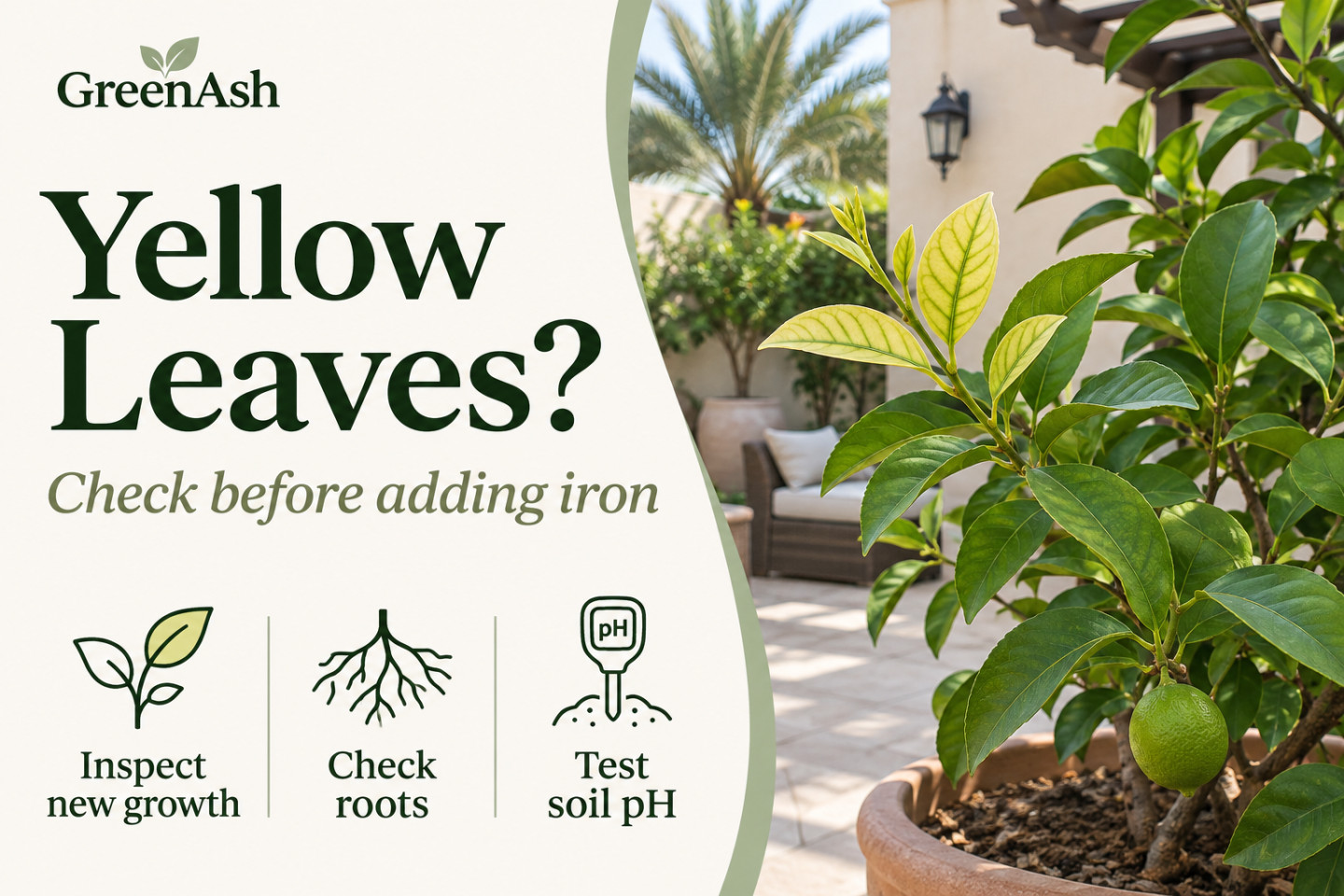
Yellow leaves with green veins can point to iron chlorosis, especially when the newest leaves are affected first. Before adding a fertilizer to your UAE garden, check which leaves changed, how the roots are watered and whether the growing medium is alkaline. These observations help you choose a useful treatment and avoid buying several products for the same unexplained symptom.
The short answer: iron chelate helps when three things line up. The yellowing starts on the youngest leaves, the roots are healthy and not sitting wet, and the soil is alkaline. In that case only one chelate type, Fe-EDDHA, keeps working in the soil; EDTA products are for leaf sprays. By the end of this article you will be able to tell iron chlorosis from its look-alikes, pick the right chelate for soil or leaves, weigh out a dose for a tree, a bed or a sprayer from the product page rates, and time it around UAE heat.
Start with the pattern on the plant
Chlorosis means yellowing associated with reduced chlorophyll. Iron deficiency commonly appears on young leaves near shoot tips. Poor drainage, root injury and other nutrient problems can also cause yellowing. A photograph is a useful starting point, but the pattern alone does not establish the cause. Illinois Extension explains the main causes and symptoms of chlorosis.
Take three photos before changing anything. Photograph the whole plant, a shoot with new and older leaves together, and a close-up of an affected leaf. Note whether the problem is on one branch, one pot or several plants sharing the same irrigation line. Keep the date with the photos so later comparisons are meaningful.
What to look for in those photos. In mild iron chlorosis the tissue between the veins turns a pale lime green while the veins stay dark, so the leaf looks netted. As it gets worse the background turns yellow, then cream, and Purdue Extension describes brown tips and margins and brown dead spots speckling the leaf, followed by dieback of the shoot. Illinois Extension adds the useful direction of travel: iron chlorosis starts on the younger, terminal leaves and moves inward, while manganese and zinc chlorosis start on inner or older leaves and move outward. So compare the tip of a shoot with leaves 20 or 30 cm further back. If the tip is the worst part, iron stays on the list.
Diagnosis table: what it is, and what it is not
| What you see | Most likely cause | What to do first |
|---|---|---|
| Newest leaves yellow with sharp green veins; older leaves still green | Iron chlorosis, usually iron locked up by alkaline or wet soil rather than missing | Check drainage and pH, then consider Fe-EDDHA in the soil or a chelate leaf spray |
| Broad green bands along the main veins, pale between them, showing late in the growing season on branch ends | Manganese deficiency (Purdue describes this pattern) | Do not treat with iron alone; a mixed micronutrient spray or a tissue test helps |
| Older, lower leaves yellow between the veins first; new leaves green | Magnesium deficiency, or zinc or manganese moving outward | See our Epsom salt and magnesium guide before buying iron |
| Older leaves evenly pale, veins included, whole plant slow | Nitrogen shortage | Review your feeding with our NPK fertilizer guide |
| Whole plant yellowing, soil wet or sour smelling, pot standing in water | Root damage from waterlogging or root rot | Fix drainage and watering; extra nutrients will not be taken up by damaged roots |
| One branch yellow, rest of the plant normal | Damage to that branch or its roots (girdling root, digging, a split) | Inspect the branch and trunk base; this is not a soil nutrient problem |
| Brown, crisp leaf edges with little yellowing between veins | Salt or heat scorch | Check irrigation volume and leaching, not iron |
| Even yellow or gold foliage on a healthy plant from the day you bought it | A golden or variegated cultivar | Nothing; Utah State notes some cultivars are yellow by design |
Palms need their own line. University of Florida research by Timothy Broschat shows iron deficiency in palms as chlorosis of the newest leaves, but says high soil pH usually does not cause it in palms. The common causes are planting too deep, poor soil aeration and root rot. If a palm planted last year has yellow new fronds, check its planting depth and how wet the root ball stays before buying any iron. The UF/IFAS iron deficiency in palms publication has photos of the pattern.
Inspect the root zone and test the pH
High-pH soil can contain iron that roots struggle to access. Poorly drained soil can worsen symptoms. This makes a soil or potting-medium assessment more useful than assuming the bed has run out of iron. The New Mexico State University iron chlorosis guide describes these effects in alkaline growing conditions.
- Check moisture beside the roots. Record whether the medium is dry, moist or saturated before the next scheduled irrigation. Look for blocked drainage holes in pots and water retained in outer decorative containers.
- Check delivery to the affected plant. Compare its drip outlet with a nearby working outlet. Our drip irrigation testing guide explains how to measure output.
- Review recent changes. Write down repotting, planting, digging nearby, fertilizer applications and irrigation adjustments.
- Ask for a suitable test. Give a soil-testing laboratory the plant name and explain that you are investigating chlorosis. Request sampling instructions and interpretation appropriate to soil or container substrate. If the cause remains unclear, a plant diagnostic service may recommend tissue testing.
Use the findings to address drainage or root problems before repeatedly adding nutrients. A single pH result helps guide product selection, but it does not by itself explain every yellow leaf.
How to read the pH number
The extension figures line up closely. Illinois Extension says iron becomes less available above about pH 6.5 to 6.7, and that most plants absorb it best between 5.0 and 6.5. Purdue says many trees and shrubs cannot take up enough iron or manganese at pH 6.5 and above. Utah State Extension and Colorado State put the point where the cheaper chelates stop working at about pH 7.2, and Colorado State notes that soils above pH 7.5 are often calcareous, meaning they contain free lime. In practice:
- Below about 7.0: iron chlorosis is less likely to be a soil pH problem. Look harder at roots, water and other nutrients.
- 7.0 to 7.5: susceptible plants start to struggle. EDTA and DTPA chelates in the soil lose effect as the reading climbs.
- Above 7.5, or any soil that fizzes with acid: treat it as calcareous. Only Fe-EDDHA (or the related EDDHMA) is worth putting in the soil.
UAE soils are mostly sand. The International Center for Biosaline Agriculture soil survey brief for Abu Dhabi says sandy soils make up nearly 75% of the UAE landscape and that salinity affects over 34% of UAE soils. Sand drains fast, which helps roots breathe, but villa beds can hold imported topsoil, builder’s fill or a layer of compacted clay under the sand, and drip lines can keep one spot wet all day. Test rather than guess, and test the bed and a pot separately, since potting mix and garden soil behave differently.
Overwatering is the most common trigger you control
Colorado State Extension names spring overwatering as a common trigger and notes that sprinkler settings left unchanged can apply up to 40% more water than plants need in spring and autumn. Wet soil loses air, roots respire poorly and iron uptake drops even in soil that has plenty of iron. Colorado State’s PlantTalk notes that for some species simply stopping the overwatering and improving aeration prevents chlorosis. Utah State adds two habits to drop: plastic sheeting used as mulch, which cuts oxygen to roots, and heavy phosphorus feeding, which can worsen chlorosis. Illinois lists high soil calcium, zinc, manganese, phosphorus and copper as things that tie up iron. In UAE terms, if your timer has not been changed since the summer, cut it back in November before you buy iron.
A simple branch test before you buy
Purdue Extension describes a diagnostic spray that separates iron from its look-alikes. Make solutions of iron, magnesium, manganese and zinc sulphate, each at about 5% weight per volume (Purdue gives 1.5 to 2 tablespoons per quart, roughly 950 ml, of distilled water), and spray each one on a different, labelled branch. The branch that greens tells you which nutrient is short. Do this only on a cool morning, on a few leaves, because a 5% solution is strong and NMSU warns that foliar sprays burn above 85 F (29 C). For most home gardeners a tissue test from a laboratory is the cleaner answer, and the Purdue Extension iron chlorosis publication rates tissue analysis as the best way to identify an elemental deficiency.
Why the iron chelate type matters
Chelates help keep iron in a form available for uptake, and their suitability varies with soil conditions. NMSU identifies Fe-EDDHA as a particularly useful choice for alkaline soils. Read the chelate name as well as the iron percentage. A general “chelated iron” description leaves out information needed for a soil-treatment decision.
The science in plain terms
Most soils contain plenty of iron. The problem in alkaline soil is that it sits as ferric oxides and hydroxides that do not dissolve, so roots cannot pick it up. A chelate is an organic molecule that wraps around an iron ion and holds it in solution. How tightly it holds depends on the molecule and on the soil pH. At high pH, weaker chelates such as EDTA let go of their iron, which then drops out as the same insoluble oxides the plant could not use in the first place. Fe-EDDHA holds on across a much wider pH range, so the iron reaches the roots. NMSU says FeEDTA is the most common chelate and can be applied to leaves, but it is not effective in alkaline soils, and that FeDTPA and FeHEDTA should also be avoided in those soils. Colorado State says EDTA and DTPA lose effect quickly as pH rises above 7.2 to 7.5, while EDDHA products such as Sequestrene 138 still work.
EDDHA has a second detail worth knowing. It exists in different arrangements, called isomers. The ortho-ortho form binds iron most strongly and is the part that does the work in calcareous soil. That is why a good label gives two numbers: total iron chelated by EDDHA, and the share held as ortho-ortho. Among the in-stock products we read, only the Basafer Plus page gives that second figure (6% Fe, of which 5% is ortho-ortho). So 20 g of Basafer Plus carries 1.2 g of iron, about 1.0 g of it in the ortho-ortho form.
On leaves the picture changes. Leaf sprays skip the soil chemistry, so EDTA is fine there, and UF/IFAS rates FeDTPA as the most effective foliar product for palms. But leaf iron barely moves. Purdue explains that a chelate spray can green leaves within hours, yet the effect is temporary and often fades within weeks, and new growth comes out yellow again because the iron does not travel into it. Illinois agrees: foliar sprays only affect existing leaves. A spray is a quick confirmation or a cosmetic fix. The soil, or the roots, decide whether the next flush stays green.
How long each method lasts
| Method | Speed | How long it lasts | Best for |
|---|---|---|---|
| Chelate leaf spray (EDTA, DTPA or EDDHA) | Hours to days (Purdue, Utah State) | Weeks; new leaves not covered | Confirming iron, small plants, vegetables, a quick cosmetic fix |
| Fe-EDDHA in the soil | Visible on the next flush | About a year (Utah State); less than a season to two years (Colorado State) | Trees, shrubs, roses and beds in alkaline soil |
| EDTA or DTPA in the soil | Little or none above about pH 7.2 | Not worth it in alkaline soil | Acidic or neutral potting mix only |
| Ferrous sulphate in the soil | Slow | Purdue says it is ineffective above pH 7.2 on its own | Not a fix for calcareous beds |
| Trunk injection or implants | Up to 30 days (Illinois) | One to five years (Colorado State) | Large trees, by a trained arborist only |
For comparison, GreenAsh lists YAM OMEGA Fe-EDDHA 6% in a 1 kg pack and Basafer Plus 6% Fe-EDDHA in a 1 kg pack. These are options to assess once iron treatment is justified. Compare the current pack directions for your crop and application method before purchasing.
The difference between the two pages matters. Basafer Plus gives its ortho-ortho share and rates by crop. YAM OMEGA names EDDHA but gives no rate and no ortho-ortho figure, so you would need the printed pack label in hand before dosing it. That is why Basafer Plus is the one we put forward for soil treatment.

Check these details before applying
- Crop and method. Confirm that the label covers the intended soil, irrigation or foliar application. Use the directions for that method.
- Measured amount. Identify whether the rate is given per plant, planted area or volume of water. Weigh the specified amount and keep a record.
- Other products. List fertilizers already in use and check compatibility before combining treatments.
- Conditions and handling. Follow label restrictions on temperature, mixing, protective equipment and storage.
Foliar treatment can provide a temporary response on treated leaves, while the root-zone cause may persist. Hot conditions can also limit treatment effectiveness or cause spray injury. Choose the method and timing from the exact product instructions.
Step by step: soil treatment with Fe-EDDHA
All the quantities below come from the Basafer Plus product page: 20 to 60 g per fruit tree depending on size and age, 5 to 25 g per plant for vines and ornamentals, and 5 to 15 kg per hectare for vegetables, applied at the start of vegetative growth or at the first signs of deficiency and repeated if necessary after 3 to 6 weeks. The page says to mix the quantity in water and apply it around the root zone or through drip. It gives no water volume, so use enough to wet the root zone you normally irrigate.
- Water the day before. Moist soil spreads the solution evenly. Do not apply to bone dry sand, where it runs straight down a few channels.
- Weigh the product. Use a kitchen scale for doses of 5 g or more. Spoon volumes vary too much for a product sold by weight.
- Dissolve it in a watering can. 5 to 10 litres suits a shrub or young tree. Stir until no grains remain.
- Pour it where the feeder roots are. That is the band under the outer canopy and around the drip emitters, not against the trunk. Purdue suggests working chelate into the top 2.5 to 5 cm (1 to 2 inches) of soil around the plant and then watering it in well.
- Follow with a normal irrigation to carry it into the root zone, then return to your usual schedule. Do not flood the bed, as excess water pushes the chelate past the roots in sand.
- Mark the date and wait. Judge the result on leaves that open after treatment, not on the old yellow ones.
Worked doses from the Basafer Plus page rates
| Plant or area | Page rate | Dose to weigh | Iron supplied |
|---|---|---|---|
| Young citrus or mango, first years in the ground | 20 to 60 g per fruit tree by size and age | 20 g (low end for a small tree) | 1.2 g Fe |
| Mature fruit tree | 20 to 60 g per fruit tree | 40 to 60 g | 2.4 to 3.6 g Fe |
| Rose bush, gardenia or similar shrub | 5 to 25 g per ornamental plant | 5 to 10 g for a small shrub | 0.3 to 0.6 g Fe |
| Grape vine or large hedge plant | 5 to 25 g per vine or ornamental | 15 to 25 g | 0.9 to 1.5 g Fe |
| 1 m2 vegetable bed | 5 to 15 kg per hectare = 0.5 to 1.5 g per m2 | 0.5 to 1.5 g | 30 to 90 mg Fe |
| 10 m2 vegetable bed | 0.5 to 1.5 g per m2 | 5 to 15 g | 0.3 to 0.9 g Fe |
| 100 m2 vegetable plot | 0.5 to 1.5 g per m2 | 50 to 150 g | 3 to 9 g Fe |
The hectare conversion is simple: 1 hectare is 10,000 m2, so 5,000 to 15,000 g spread over 10,000 m2 is 0.5 to 1.5 g per m2. For a 1 m2 bed that is less than a kitchen scale reads well, so dissolve 5 g in 10 litres and pour 1 litre per m2 for the low rate, or 3 litres per m2 for the high rate. The page gives no rate for containers. For a large tub holding a single shrub we would use the bottom of the ornamental range (5 g); for small pots we would not guess a soil dose and would use a leaf spray or fresh potting mix instead.
Start at the low end. The page’s “repeat if necessary after 3 to 6 weeks” means only if the new growth is still yellow, not as a routine. One well placed dose at the right time beats three rushed ones.
Step by step: a foliar iron spray
A leaf spray suits vegetables, strawberries, small shrubs and pots, and it is a good way to confirm iron is the issue before treating a whole bed. The Microfal MIX page is the only iron product page we read that gives a spray rate tied to a water volume: 100 to 200 g per 200 litres for vegetables, and 200 g per 200 litres for fruit trees and strawberries, sprayed in the early morning or evening and not in high temperatures. Its analysis is Fe 5%, Zn 4%, Mn 3%, MgO 1.6% and B 1.5%, all EDTA chelated.
| Sprayer | Vegetables (100 to 200 g per 200 L = 0.5 to 1 g per L) | Fruit trees and strawberries (200 g per 200 L = 1 g per L) |
|---|---|---|
| 1 L hand sprayer | 0.5 to 1 g | 1 g |
| 5 L pressure sprayer | 2.5 to 5 g | 5 g |
| 16 L knapsack | 8 to 16 g | 16 g |
Each gram of Microfal MIX carries 50 mg of iron, plus zinc and manganese. Half a gram is hard to weigh on a kitchen scale, so for a 1 litre bottle either use a 0.1 g jewellery scale or mix 5 g in 5 litres and keep the rest for other plants that day.
- Spray at first light, when the air is below 29 C (85 F), the temperature above which NMSU warns iron sprays burn foliage. Utah State recommends evening or a cool, cloudy day.
- Add a few drops of mild liquid soap per sprayer, as Utah State and Purdue suggest, so the spray spreads instead of beading.
- Wet both sides of young leaves to the point of drip, but not to run off. Young leaves take up iron best; NMSU notes uptake drops once leaves are fully developed.
- Test on one plant first and look 2 to 3 days later for spotting or scorch before spraying a whole bed.
- Expect greening of sprayed leaves within days. Leaves that open later will need another spray, or a soil fix.
Because Microfal MIX also contains manganese and zinc, a good result tells you the plant was short of one of them, but not which. If you want a clean answer, use the branch test above or a tissue test. Do not use it as a soil drench in alkaline beds: the page lists fertigation at 1 to 1.5 kg per hectare, but its iron is EDTA chelated, and NMSU says FeEDTA is not effective in alkaline soil.

For one rose, a few pots or a row of peppers, a small pump sprayer gives a fine mist with less waste than a knapsack. Our garden sprayer guide covers sizes and cleaning. Keep a sprayer used for weedkiller separate from one used for feeds.

Track the result without repeatedly increasing the dose
Record the product, quantity, method and date beside your original photos. Compare the same shoots as new growth develops. Follow the label’s reassessment or repeat-treatment directions. If symptoms spread, send the record and updated photos for diagnosis instead of stacking another fertilizer onto the first treatment.
A practical way to track: tie a coloured tag on two shoots, photograph them from the same spot every week, and count the leaves that have opened since treatment. After a soil application, the new leaves should open green. Old leaves that were cream or spotted may only partly recover; UF/IFAS notes that chlorotic tissue can regain colour when treatment works, while Purdue warns that severe chlorosis with dieback in mature trees is rarely reversible. Judge success by the new flush.
UAE timeline: when to act
| Period | What happens | What to do |
|---|---|---|
| October to November | Heat eases, autumn flush on roses, citrus and shrubs; timers often still on summer settings | Cut irrigation back first. Take photos and a soil test. Foliar sprays only on early mornings below 29 C |
| December to January | Coolest months; slow growth | Best weather for foliar sprays and the branch test. Repot pots with poor drainage. Plan soil treatment |
| Late January to March | Spring flush on most trees and shrubs | Main window for Fe-EDDHA in the soil, just before or as new growth starts (Utah State advises spring before growth begins; NMSU finds spring foliar sprays effective on new foliage) |
| April | Days warming fast | Repeat a soil dose only if the new flush is still yellow 3 to 6 weeks after the first. Last month for foliar sprays in most places |
| May to September | Heat well above 29 C; NMSU says high temperatures reduce root uptake | No foliar iron. Do not raise doses. Focus on steady watering, mulch and shade for stressed plants; reassess in October |
Villa beds. Shrub borders and fruit trees on drip are the main candidates for soil EDDHA. Check that each plant’s emitters actually reach its roots, and that lawn sprinklers are not soaking the shrub bed as well. A tree that sits in a lawn gets lawn watering on top of its own.
Balconies and pots. In pots, check roots and water before pH: a pot can stay waterlogged even on a hot balcony if its drainage holes are blocked. Empty the outer decorative pot after every watering. Pots of citrus, gardenia or roses that stay yellow after drainage is fixed are good candidates for a leaf spray, or repotting into fresh mix. See our citrus fertilizer guide for feeding potted lemons.
Farms. On a drip system in calcareous soil, Fe-EDDHA through fertigation is the route; the Basafer Plus page lists drip application and the vegetable rate of 5 to 15 kg per hectare. Check the solution in a small batch before mixing it with other fertilizers in the tank, and flush lines afterwards. EDTA mixes belong in the sprayer, not the drip tank, on alkaline ground.
Common mistakes
- Buying “chelated iron” without the chelate name. In alkaline soil an EDTA or unnamed chelate may release its iron before it reaches the roots. Look for EDDHA, ideally with an ortho-ortho figure.
- Treating the leaves while the roots sit wet. Waterlogged roots cannot take up iron whatever you add. Fix drainage and timer settings first.
- Doubling the dose when nothing happens in a week. Soil treatments show on new leaves, which take weeks. UF/IFAS warns chelates can be phytotoxic at high rates. Wait for the next flush.
- Spraying at midday. NMSU says foliar iron burns leaves above 29 C. In the UAE that rules out midday for much of the year.
- Trying to acidify a calcareous bed with sulphur. Purdue says elemental sulphur has limited value on very high pH calcareous soils, and Colorado State says it seldom merits consideration there. The free lime neutralises it. Spend the effort on EDDHA, organic matter and water management.
- Pouring ferrous sulphate on alkaline soil. Purdue says soil ferrous sulphate is ineffective above pH 7.2.
- Spilling on paving. UF/IFAS notes most iron fertilizers cause brown staining, and the Ferro 20 page warns against applying it on concrete or tiles. Mix on grass or soil, not on marble, interlock or pool surrounds.
- Feeding lots of phosphorus at the same time. Utah State and Illinois both link high phosphorus to worse chlorosis.
Troubleshooting: if it did not work
- Sprayed leaves greened, new ones came out yellow. That confirms iron (or the manganese and zinc in a mixed spray) and shows the root cause remains. Move to a soil treatment with EDDHA, or fix watering.
- Nothing greened, even sprayed leaves. Iron is probably not the shortage. Check the diagnosis table again, look at older leaves for magnesium, and ask for a tissue test.
- Six weeks after a soil dose, new growth still yellow. Check whether the solution reached the roots (was the soil moist, was it placed under the canopy), whether the soil stays saturated, and dig gently to look at roots. Purdue advises investigating root rot if mineral correction fails.
- A palm keeps producing yellow fronds. Check planting depth and aeration first, as UF/IFAS lists them as the usual causes in palms.
- A large tree is chlorotic with dieback. Call a qualified arborist. Trunk injection and implants need training and make wounds that can let in disease, and Purdue says removing and replanting with a tolerant species is often the most economical choice for badly affected mature trees.
- Several unrelated plants yellowing at once. Look at the shared factor: a new water source, a timer change, a fertilizer used on all of them. Send your photos and record to a soil laboratory or a plant diagnostic service.
Safety, storage and disposal
Iron chelates are fertilizers, not pesticides, so they carry no re-entry period in the pesticide sense. Handle them with care anyway:
- Protective equipment. The Basafer Plus page says to use gloves and avoid inhaling the powder or getting it in your eyes. The YAM OMEGA page asks for gloves and protective equipment and says to avoid inhaling the powder while mixing. We would add safety glasses when pouring fine powder, and long sleeves for spraying overhead. The Microfal MIX page gives no protective equipment text, so use the same gloves and glasses.
- Harvest interval. None of these pages gives a harvest interval. For edible crops we would apply soil treatments rather than spray fruit close to picking, and wash any sprayed produce before eating.
- Children and pets. All three pages say keep out of reach of children and pets. Keep pets off a freshly sprayed bed until the leaves are dry, and store the powder in its sealed pack.
- Water, fish and drains. The pages give no fish or aquatic data. Keep spray drift and rinse water away from ponds, fountains and storm drains.
- Bees. The pages give no bee data. Spraying in the early morning or evening, as the Microfal page advises, also keeps spray off flowers while bees are most active.
- Storage. Cool, dry and out of direct sun, with the pack sealed (Basafer Plus, YAM OMEGA, Microfal MIX pages).
- Disposal. Mix only what you need. Spray leftover diluted solution onto the same plants at the label rate rather than down a drain, and dispose of empty packs according to local regulations, as the Basafer Plus and Microfal pages say.
Iron products compared
We read each product page in November 2026. Where a page gives no rate or harvest interval, the table says so. We box only the products whose pages give enough to dose from.
| Product | Chelate or form | Strength on page | Pack | Use on page | Rate on page | Harvest interval on page | Who it suits |
|---|---|---|---|---|---|---|---|
| Basafer Plus | Fe-EDDHA | 6% Fe, 5% ortho-ortho | 1 kg | Soil, drip | Yes, per tree, plant and hectare | None | Trees, shrubs, beds and farms in alkaline soil |
| YAM OMEGA | Fe-EDDHA | 6% Fe, no ortho-ortho figure | 1 kg | Soil drench, drip, fertigation | None | None | Alkaline soil, only with the pack label rate in hand |
| Sequestrene 138 Fe | Fe-EDDHA | 6% in heading, not explained | 1 kg | Soil, fertigation, foliar | None | None | Alkaline soil, with the pack label rate |
| Agrimax Irochelmax | Chelate not named | 6% Fe | 1 kg | Soil, fertigation, foliar | None | None | Hard to judge for soil use until the chelate is named |
| Disper Fer 6% GS | Chelate not named | 6% Fe | Not stated | Soil, irrigation | None | None | Hard to judge until the chelate is named |
| Desert Energy Fast Green | “Chelated iron”, type not named | Not stated | 1 kg | Soil or foliage | None | None | Not recommended until the page gives an analysis |
| Microfal MIX | EDTA micronutrient mix | Fe 5%, Zn 4%, Mn 3%, MgO 1.6%, B 1.5% | 1 kg | Foliar, fertigation | Yes, foliar per 200 L; fertigation per hectare | None | Leaf sprays on vegetables, strawberries, fruit trees and pots |
| Desert Energy Ferro 20 | Ferrous sulphate, not a chelate | 20% Fe | 25 kg | Lawns, ornamentals, fertigation | Yes: 20 to 40 g per 10 m2 of lawn, 10 to 20 g per plant, 2 to 5 kg per hectare; repeat every 2 to 4 weeks for chlorosis | None | Large areas in neutral soil; Purdue says soil ferrous sulphate is ineffective above pH 7.2 |
Frequently asked questions
Does every yellow leaf need iron?
Yellowing has several possible causes. The age of affected leaves, root conditions and test results help narrow them down. Iron shows first on the newest leaves with the veins staying green; magnesium and nitrogen start on older leaves, and wet roots can yellow the whole plant.
Can I use a soil-treatment product as a leaf spray?
Use a foliar method only when the product label provides directions for it. Soil and spray rates are not interchangeable. Basafer Plus, for example, lists soil and drip use only, while Microfal MIX gives a spray rate per 200 litres.
Should I try to lower the soil pH myself?
Get a test and an amendment recommendation first. The quantity and suitability depend on the growing medium. Guessing an acidifying dose can create another problem. On calcareous soil, Purdue and Colorado State both say sulphur has limited value, because free lime keeps neutralising it.
What information should I send before buying?
Send the plant name, photos of new and old leaves, whether it grows in a pot or bed, your watering pattern, recent fertilizer labels and any test report. This gives the supplier a clearer basis for checking product suitability.
How long until the leaves turn green?
A chelate leaf spray can green treated leaves within hours to days, according to Purdue and Utah State, but the effect fades within weeks. A soil treatment shows on the leaves that open afterwards, so expect to judge it on the next flush, usually several weeks later. Old cream or spotted leaves may never fully recover.
Why does the chelate type matter more than the iron percentage?
Two packs both saying 6% iron can behave very differently in alkaline soil. EDTA, DTPA and HEDTA chelates lose their iron as pH rises above about 7.2, while EDDHA holds it. The ortho-ortho share shows how much of the EDDHA iron is in the most stable form.
Will iron chelate stain my tiles?
It can. UF/IFAS notes that most iron fertilizers cause brown staining. Mix over soil, keep spray off paving, walls and pool edges, and rinse any splashes at once.
Can I use Epsom salt or ferrous sulphate instead?
Epsom salt supplies magnesium and sulphur, not iron, so it only helps if the problem is magnesium. Ferrous sulphate works as a leaf spray, and Utah State gives a 0.5% recipe, but Purdue says it is ineffective in soil above pH 7.2. For the soil in alkaline beds, EDDHA is the option the extension guides agree on.
Need help choosing?
Send us your three photos, the plant name, a note on how and when you water, and any soil test, and we will help you decide whether iron is the problem and which form fits your bed, pot or farm. Browse our Fe-EDDHA iron chelate for alkaline soil, or fix the watering first with our drip testing steps.
