
Blog
Calcium Nitrate in the UAE: When It Helps with Blossom-End Rot

A dark patch underneath a tomato often prompts a search for calcium nitrate. Before buying a bag, check the fruit, the root-zone moisture and your existing fertilizer programme. Calcium nitrate supplies useful nutrients, but the right response depends on why calcium failed to reach the developing fruit.
The short answer: in most home gardens, blossom-end rot is a watering problem first and a calcium problem second. Calcium travels to the fruit only in the water the roots take up, so a missed drip cycle, a pot that dries out at noon or salty, overfed soil can starve the fruit of calcium even when the soil holds plenty. Calcium nitrate helps when the plant also needs nitrogen, or when a soil or water test shows calcium is short, and it must go to the roots, not the leaves. By the end of this article you will be able to confirm the disorder, fix the watering, decide whether calcium nitrate has a place in your feed, and work out an amount for a pot, a 1 m2 bed or a 100 m2 plot from a university guideline instead of guessing.
Recognise blossom-end rot before treating it
Blossom-end rot typically produces a dark, sunken area at the blossom end of a developing tomato, opposite the stem. Other fruit problems can look similar, so photograph the whole fruit and the affected area if identification is uncertain. Calcium shortage inside the developing tissue causes irreversible damage. Affected fruit will not return to normal after feeding. The aim is to improve conditions for later fruit. The University of Georgia diagnosis guide explains the distinction between this disorder and diseases with similar symptoms.
The patch starts as a small, water-soaked spot, usually while the fruit is still green and growing fast. It then darkens and flattens into a leathery, sunken area that can spread across much of the base. Dark mould sometimes grows on the damaged tissue afterwards, which makes it look like a disease, but the mould moves in after the damage rather than causing it. The same disorder affects peppers (where the patch is often lighter in colour and papery), squash and watermelon. The University of Kentucky’s fact sheet on blossom end rot (CCD-FS-11, 2019) lists tomatoes and peppers as the crops most often hit, with squash and watermelon also affected.
UF/IFAS notes that the earliest fruits on a plant are usually the worst affected. So a first truss with several rotten fruits is not a reason to give up on the plant; judge it on the fruit that sets after you correct the watering.
Is it blossom-end rot or something else?
| What you see | Likely cause | What to do |
|---|---|---|
| Dark, dry, sunken patch at the base of the fruit, opposite the stem; skin otherwise sound; several fruits on the same truss | Blossom-end rot | Remove damaged fruit, check watering and feed as described below |
| Pale, white or papery patch on the side of the fruit facing the sun, often on plants that lost leaves | Sunscald (heat and light on exposed fruit), not blossom-end rot | Keep leaf cover; light shade in March and April |
| Round, sunken spots with rings, mainly on ripe fruit, anywhere on the surface | A fungal fruit rot, not blossom-end rot | Confirm the disease before choosing a fungicide; calcium will not help |
| Small holes with frass, a hollow inside the fruit | Caterpillar or fruit borer, not blossom-end rot | Cut a fruit open and identify the insect |
| Rot at the blossom end on a plant that is also wilting at midday with yellowing lower leaves | Blossom-end rot driven by a root problem (waterlogging, root damage or root disease) | Dig gently beside the root ball before adding any fertilizer |
Why calcium does not reach the fruit: the science in plain terms
Calcium is built into cell walls as the fruit grows, which UGA’s Circular 938 describes as the cell wall “concrete”. A growing fruit lays down most of that wall in its first few weeks, which is why UGA advises supplying soluble calcium through the irrigation from bloom until the fruit is about golf-ball size. After that stage the damage, or the lack of it, is largely decided.
The hard part is transport. Calcium moves only in the xylem, the plant’s water pipes, so it goes wherever water is being pulled. Leaves lose water all day through their pores and pull most of the calcium towards themselves. Fruits lose very little water, so they receive a small share. UF/IFAS adds that at night, when humidity is high and leaves stop transpiring, root pressure pushes water and calcium into the fruit. Anything that interrupts water uptake, even for a day, cuts the fruit’s supply during the weeks when it needs it most.
This explains three things that matter in a UAE garden:
- Soil can contain plenty of calcium and the fruit can still be short. Clemson Extension states that blossom end rot can occur even when calcium levels in the soil are adequate. UF/IFAS makes the same point for Florida, where regularly farmed soils usually have enough calcium.
- Sprays on the leaves do not fix it. Calcium that lands on a leaf cannot move back down through the phloem into the fruit, and the fruit skin does not absorb it, as Clemson’s Gardening Myths article on calcium sprays explains. Kentucky states that calcium chloride foliar sprays have not been found effective in reducing the disorder, UGA calls the research on foliar calcium very inconclusive, and even NMSU, which gives a spray recipe, describes the results as erratic.
- Salts and competing nutrients make it worse. Ammonium, potassium, magnesium and sodium compete with calcium for uptake at the root (Kentucky, NMSU), and excess fertilizer raises the soluble salt level, which makes it harder for roots to take up water and calcium (UF/IFAS). The International Center for Biosaline Agriculture (ICBA) reports that over 34% of UAE soils are affected by salinity and that sandy soils make up nearly 75% of the landscape, so both risks are real here.
Heavy nitrogen adds a further problem. Lush leafy growth means more leaves pulling calcium away from the fruit, which is why UGA, Kentucky and NMSU all warn against overfeeding with nitrogen and potassium during flowering and fruit set.
Check watering before adding calcium
Calcium moves into the plant with water. Both drying out and excessive watering can interfere with its supply. Too much nitrogen can encourage leafy growth and make nutrient management harder. UGA Extension identifies irrigation management as a frequent cause of blossom-end rot. Its home-gardener guidance also cautions against assuming that more fertilizer will solve the problem.
For a UAE balcony or villa vegetable bed, use the following inspection before changing the feed.
- Write down the last few watering events. Include missed cycles, a blocked outlet, a change of timer settings or a move to a sunnier position.
- Check beside the root ball. Inspect gently with a finger or small trowel. Compare the affected plant with a neighbouring healthy plant. Record whether the soil is dry, moist or saturated before the next watering.
- Test the delivery. If you use drip, catch water from the affected plant’s emitter and compare it with another outlet for the same period. Our drip irrigation setup and testing guide shows how to measure flow.
- List every feed already applied. Include soluble feeds, granules and any supplements. Take the labels with you when asking for a nutrient recommendation.
This record helps distinguish a watering interruption from a possible nutrient shortage. For broader crop care, see our UAE tomato growing guide.
What “evenly moist” means in practice
New Mexico State University, writing for hot, dry growers, gives a simple test: soil in the root zone should be moist enough to form a ball when squeezed, and should never be too wet or too dry. Take a handful from root depth, at least 10 cm down beside the plant, an hour before the next watering:
- It crumbles and will not hold a shape: the plant is running dry between waterings. Water more often, or longer per cycle, rather than doubling one watering.
- It forms a ball that breaks when you tap it: about right.
- It forms a sticky ball and water squeezes out: too wet. Roots short of air take up less water and calcium, so cut the run time and check drainage.
Sandy beds drain fast, so a single long watering a day can still leave the top 15 cm dry by late afternoon. Two shorter cycles, one early morning and one mid afternoon in warm spells, usually keep moisture steadier. Pots on a sunny balcony are the most extreme case: a small pot can go from wet to dry in one hot, windy afternoon. UGA’s 2024 guidance says irrigation needs to increase as plants grow, and NMSU notes that water and calcium needs both rise as the weather warms, so a timer set in November will be too short by March.
Mulch helps. Clemson and Kentucky both recommend a layer of mulch to steady soil moisture and temperature, and NMSU adds that mulch removes the need to hoe, which protects shallow roots. Organic matter worked into sandy soil also holds more water between cycles; our vermicompost guide covers how much to mix into beds and pots.

Root damage counts as a watering problem
Kentucky warns that cultivating too close to plants can cut roots and bring on drought stress and blossom-end rot, and NMSU advises keeping any cultivation to the top inch or two (about 2.5 to 5 cm) of soil. In UAE beds this often happens when weeds are pulled hard from around young tomatoes, or when a drip line is moved and roots are torn. If rot appears a week or two after weeding or repotting, that is the likely trigger, and calcium will not undo it.

When calcium nitrate is worth considering
A soil, substrate or crop nutrition assessment can establish whether additional calcium is needed. Calcium nitrate is also used within planned fertigation and hydroponic nutrient programmes. Its nitrogen contribution must fit the crop’s existing feed. UGA recommends supplying required calcium through the roots and describes the evidence for foliar calcium as inconclusive. Spraying leaves is therefore a poor substitute for diagnosing the root-zone problem.
From the university sources we read, calcium nitrate earns a place in three situations:
- The plant needs a nitrogen side-dress anyway. NMSU advises side-dressing nitrogen only when it is needed to keep a normal green colour and moderate growth, and names calcium nitrate as one option. UGA’s Middle Georgia agent suggests calcium nitrate instead of a straight high-nitrogen fertilizer later in the season. Here calcium nitrate replaces a feed you would have given, rather than adding to it.
- You want to move away from ammonium feeds during fruiting. Kentucky lists fertilizers high in nitrate nitrogen, such as calcium nitrate, as the alternative to ammonium-based feeds during bloom and fruit set, because ammonium competes with calcium at the root.
- A test shows calcium is short, or you grow without soil. Hydroponic systems and soilless mixes such as cocopeat or perlite carry little or no calcium of their own, so a planned nutrient recipe has to supply it, and calcium nitrate is the usual soluble source. In soil, UGA ties sufficiency to a soil test, and UF/IFAS advises growers to know the calcium in both their soil and their irrigation water before paying for calcium through the drip.
It is the wrong choice when the plant is already dark green, leafy and slow to set fruit (more nitrogen makes this worse), when the soil is salty or the pot has white crust on the surface (more salt), or when the real cause is a dry pot or a blocked dripper.
Decision path
| Your situation | Calcium nitrate? | Better first step |
|---|---|---|
| A few rotten fruits on the first truss, plant otherwise healthy, watering has been irregular | No | Fix watering and mulch; watch the next trusses |
| Rot keeps appearing, watering is steady, plant is pale and slow | Possibly, as the nitrogen side-dress | Swap your usual nitrogen feed for calcium nitrate at a university side-dress rate |
| Dark green, very leafy plant, regular high-nitrogen feeding | No | Stop extra nitrogen; check salts by leaching pots |
| White crust on soil, salty borehole or recycled water, leaf edges browning | No | Leach with plenty of good water and get the water tested |
| Cocopeat, perlite or hydroponic system | Yes, inside a planned recipe | Use a complete recipe with separate stock tanks |
| Farm or large greenhouse with drip fertigation | Often, after soil and water tests | Build calcium into the fertigation plan from bloom to golf-ball size fruit |
What to check on a calcium nitrate product
GreenAsh lists YaraLiva Calcinit in a 25 kg bag. The listing specifies 15.5% nitrogen and 19% elemental calcium. Its 26.5% CaO figure expresses that calcium on a calcium-oxide equivalent basis. These figures describe the same calcium content, so they should not be added together.
Yara’s product information confirms that Calcinit is fully water soluble and supplies nitrogen and calcium. It warns against combining it with stock solutions containing phosphate or sulphate. Concentrated stock solutions require a compatible formulation and preparation method.
The product page splits the nitrogen into 14.4% nitrate nitrogen and 1.1% ammonium nitrogen. That split matters: almost all of it is in the nitrate form that Kentucky recommends during fruiting. If you are new to reading analyses, our guide to NPK numbers explains oxide figures and how to turn a percentage into grams.
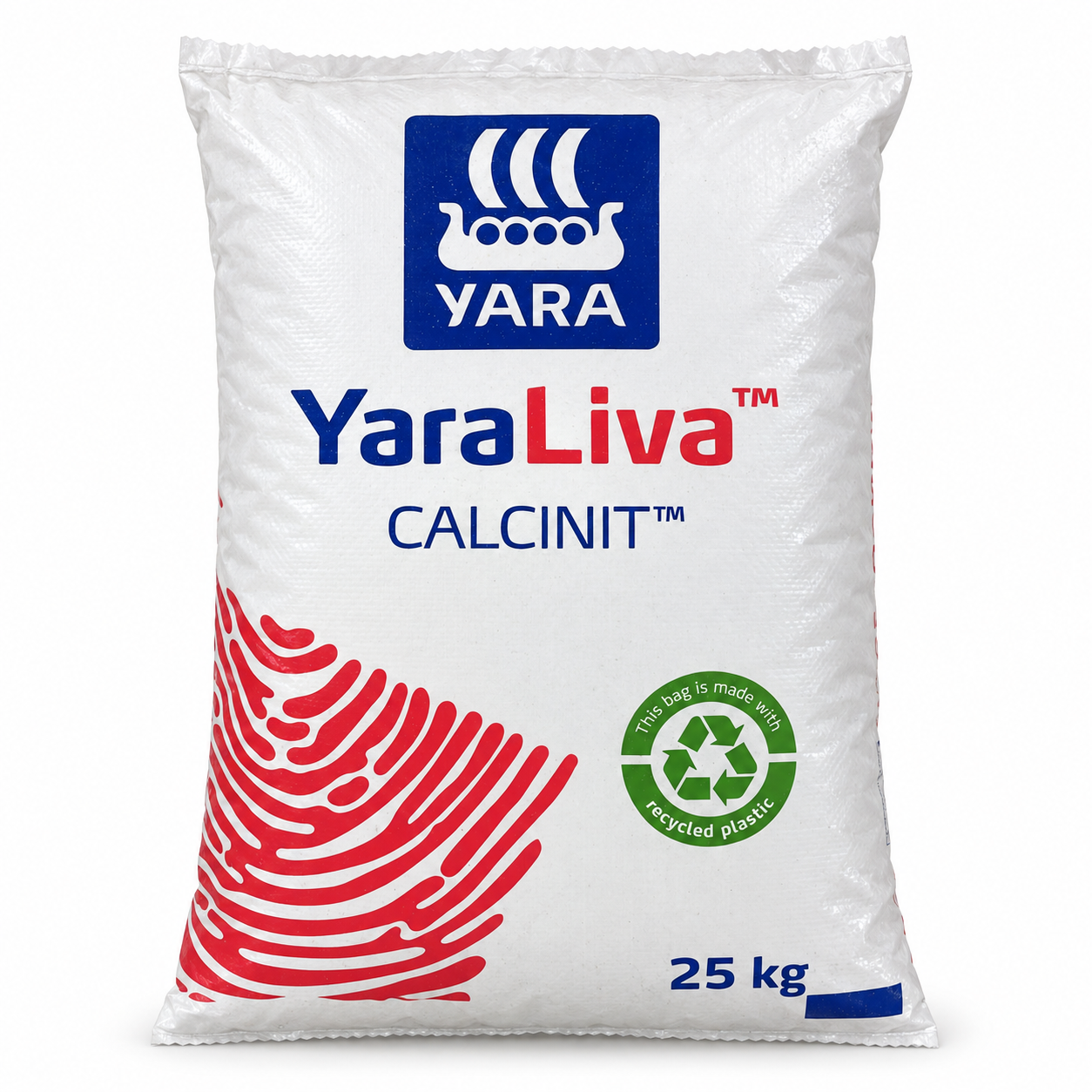
The second calcium nitrate we stock, Yamfert, gives 15% nitrogen and 19% calcium on its page, also in a 25 kg bag. Its page asks buyers to verify the product’s complete water solubility and compatibility with irrigation equipment before drip use, and to confirm solubility and purity before hydroponic use, and it gives no origin or registration number. For side-dressing a soil bed that matters less; for a drip or hydroponic system we would choose the product that states full solubility.
Before ordering, have these details ready.
- The crop and growing medium, plus the number of plants or planted area.
- The irrigation method and water volume used per application.
- The current fertilizer names and amounts.
- Any recent soil, substrate or irrigation-water analysis.
- The exact bag label and an appropriate crop-specific application recommendation.
A 25 kg bag is a substantial purchase for a few patio pots. Work out the justified quantity before ordering. The product page gives no universal dose for every crop and water supply, so a general spoon-per-pot recipe would be unreliable.
Calcium products in our range compared
Several calcium and calcium plus boron products in our store mention blossom-end rot. Given what Clemson, Kentucky, UGA and UF/IFAS say about foliar calcium, we do not recommend any spray as a fix for it, and we have not boxed products whose pages claim they prevent it without evidence.
| Product | Analysis on page | Pack | Use | Rate on page | Harvest interval on page | Who it suits |
|---|---|---|---|---|---|---|
| YaraLiva Calcinit | 15.5% N (14.4% nitrate, 1.1% ammonium), 26.5% CaO (about 19% Ca) | 25 kg | Fertigation, drip, hydroponics, soil | None; set by crop, stage, water and analysis | None given (fertilizer) | Farms, greenhouses, hydroponics, or several gardeners sharing a bag |
| Yamfert Calcium Nitrate | 15% N, 19% Ca | 25 kg | Soil and fertigation | None | None given | Soil side-dressing; check solubility before drip use, as the page asks |
| PERT FERT Humi-Cal Granular | 23% Ca, 18% S, 5% humic acid (from gypsum and humate) | 25 kg | Soil conditioner | Vegetables 50 g per m2 before planting, then 30 g per m2 every 3 to 4 weeks; pots 3 g per litre of pot volume monthly, not for pots under 10 L | None given | Only where a soil test shows low calcium; adds no nitrogen |
| Dragon CaliBo | 30% Ca complexed with carboxylic acids, 1% B | 1 kg | Foliar and fertigation | Vegetables: 300 to 600 g per 200 L foliar, 4 to 5 kg per feddan fertigation, from fruit set every 15 days | None given | Farms; not a fix for blossom-end rot as a spray |
| Calamin Bore | About 10% CaO, about 1% B (page uses “~”) | 1 L | Foliar and drip | 2 to 3 ml per litre foliar; 1 to 2 L per acre drip | None given | Not boxed: page says it prevents blossom end rot, and calls itself bio-organic and residue-free without support |
| CABROM Calcium + Boron | No percentages | 1 L | Foliar and soil | 2 to 3 ml per litre foliar; 2 to 5 L per hectare soil | None given | Not boxed: no analysis, and a prevention claim the evidence does not support |
| Agrimax Brocal | Calcium nitrate and boric acid, no percentages | 1 L | Not stated | None | None given | Not boxed: no analysis or rate |
Boron has its own role in flowering and fruit set, and a calcium plus boron product can make sense where a tissue or soil test shows boron is low. That is a separate question from blossom-end rot, and we would not add boron without a test showing it is needed.
How much calcium nitrate: working it out without guessing
Neither calcium nitrate page we stock gives an application rate, so we will not invent one. There are two honest ways to arrive at an amount.
Method 1: use a university side-dress guideline
New Mexico State University’s Guide A-231 on blossom-end rot says to side-dress nitrogen only if needed to keep a normal green colour and moderate growth, and to use calcium nitrate or ammonium sulfate at 1/4 pound per 100 square feet. Converted to metric, that is 113 g per 9.3 m2, or about 12 g per square metre for one side-dressing. This is NMSU’s general guideline for a nitrogen side-dress, not a product label rate, and it replaces a nitrogen feed rather than adding to one.
| Area | Calcium nitrate (NMSU guideline, about 12 g per m2) | Nitrogen supplied (Calcinit 15.5%) | Calcium supplied (19%) |
|---|---|---|---|
| 30 cm pot (top area about 0.07 m2) | about 0.9 g | about 0.13 g | about 0.16 g |
| 40 cm pot (top area about 0.13 m2) | about 1.5 g | about 0.24 g | about 0.29 g |
| 1 m2 bed | 12 g | about 1.9 g | about 2.3 g |
| 100 m2 plot | about 1.2 kg | about 190 g | about 230 g |
How to apply it: weigh the amount on a kitchen scale (spoon weights vary too much at these small doses), scatter it in a band a hand’s width or so from the stems on moist soil, and water it in straight away. For pots, dissolving the weighed amount in the normal watering is easier and spreads it more evenly. Do not repeat a side-dress until the plant shows it needs nitrogen again.
The bag maths is worth seeing: at 12 g per m2, a single 25 kg bag covers about 2,050 m2 for one side-dressing. For a balcony with six pots, that is decades of supply. A farm, a community garden, or a group of neighbours sharing one bag makes more sense than a single household buying it for a few plants.
Method 2: calculate from a nitrogen recommendation
If a soil lab, an agronomist or your fertigation recipe gives a nitrogen target, convert it with the analysis on the bag:
- Grams of product = grams of nitrogen needed divided by 0.155 for Calcinit (or 0.15 for Yamfert). A recommendation of 2 g nitrogen per m2 becomes about 13 g of Calcinit per m2.
- For fertigation: 1 g of Calcinit dissolved in 1 litre supplies 155 mg of nitrogen and about 190 mg of calcium per litre. So each 100 mg per litre of nitrogen that comes from calcium nitrate needs about 645 g per 1,000 L of irrigation water. This is arithmetic, not a recommendation: the target itself has to come from your crop recipe or adviser.
- Subtract what you already apply. If your tomato feed already supplies nitrogen, calcium nitrate replaces part of it. Adding both doubles the nitrogen, which is one of the causes of the problem.
For drip systems, UGA advises injecting soluble calcium from bloom until the fruit reaches about golf-ball size, which in practice means each new truss. Keep calcium nitrate in its own stock tank, away from concentrated phosphate or sulphate feeds, as both product pages and Yara state, or a white solid can form and block emitters.
UAE timeline for tomatoes and peppers
| Period | What is happening | What to do |
|---|---|---|
| October to November | Sowing and transplanting; nights cooling; plants small | Mix organic matter into sandy beds; get water or soil tested if you use borehole water; set the timer and mulch after planting; avoid heavy nitrogen at planting |
| December to January | First flowers and first fruit; mild days, humid nights | The first truss is the most at risk, so check moisture before each watering; if growth is pale, use calcium nitrate as the side-dress instead of another nitrogen feed |
| February | Fruit set in full swing; water use climbing | Lengthen timer runs as plants grow; check drippers for blockage; remove any damaged fruit |
| March to April | Days reach the 30s; wind and low humidity raise water use sharply | Add a second daily cycle for pots and sandy beds; light shade for fruit; this is when blossom-end rot often returns |
| May to September | Too hot for most outdoor tomatoes; peppers may survive in shade | Flush pots with plenty of water to remove salts before replanting; outdoor plants left over summer need daily checks |
Balcony pots: the highest risk because small volumes swing from wet to dry quickly. Use the largest pots you can manage for tomatoes, group pots so they shade each other, and check pots at mid afternoon, not only in the morning. Villa beds: sandy soil and long drip runs mean the last emitters on a line often deliver less, so test the flow at the end of the line. Farms and greenhouses: salty water and fertigation are the main levers; test the irrigation water and build calcium into the injection plan rather than reacting to rotten fruit. For pepper growers, NMSU notes that shorter, rounder pepper types tend to be more tolerant than long-fruited ones; our pepper and chilli guide covers variety choice and watering in more detail.
Common mistakes
- Spraying calcium on the leaves. It fails because leaf calcium cannot travel to the fruit. Put any calcium in the root zone and fix the watering.
- Adding calcium nitrate on top of a full tomato feed. Extra nitrogen makes more leaves, which pull more calcium away from the fruit. Replace a nitrogen feed instead.
- Doubling the water after seeing rot. A soaked root zone is short of air and the roots take up less. Aim for steady moisture, not more water.
- Treating magnesium and potassium as harmless extras. Kentucky and NMSU list both as competitors with calcium. Epsom salt added “just in case” can make things worse; our Epsom salt guide explains when magnesium is really needed.
- Leaving rotten fruit on the plant. Kentucky advises removing it, as it will not recover and the plant keeps spending resources on it.
- Mixing concentrates in one bucket. Calcium nitrate with concentrated phosphate or sulphate feeds forms a precipitate. Dissolve each separately, or use separate stock tanks.
- Measuring small doses with spoons. At about 1 g per pot, a spoon can easily put in several times the intended amount. Weigh it.
Troubleshooting: if the rot keeps coming back
- Check the new fruit, not the old. Fruit that was already damaged when you made changes will still rot. Judge success on fruit that set after the change.
- Measure the water. Catch the output of the affected plant’s dripper for 10 minutes and compare with another one. A partly blocked dripper is a common hidden cause.
- Look for salt. White crust on pot rims, brown leaf edges and a slow decline after each feed point to salts. Water a pot until a large volume drains out of the base to flush it, then go easy on feed.
- Look at the roots. Brown, soft or sparse roots mean the plant cannot take up water however well you water. Check for waterlogging or root disease before feeding.
- Get a test. If rot continues with steady watering and a sensible feed, a soil or substrate analysis and an irrigation water analysis will show calcium, sodium and salt levels. UGA and Kentucky both start management with a soil test.
- Ask for help. Farms with repeated losses should involve an agronomist who can read a tissue test; UGA gives tissue calcium sufficiency ranges for tomato and pepper at early bloom that a lab can compare against.
Safety, handling and storage
- Protective equipment: both calcium nitrate pages say to wear gloves and eye protection and avoid inhaling dust. Add the same when weighing or dissolving it.
- Harvest interval: neither page gives one, as this is a fertilizer rather than a pesticide. Apply it to the soil, not onto fruit, and rinse produce as normal.
- Children and pets: both pages say keep it away from children. Store it where pets cannot reach the bag, and sweep up spilled granules from patios.
- Storage: the pages say to store in a cool, dry, well-ventilated place with the bag tightly closed and protected from moisture, away from incompatible materials. Ask the supplier for the safety data sheet if you store a 25 kg bag in a garage or store room.
- Water and fish: do not tip leftover solution into drains, ponds or fish tanks. Use it on beds instead, at the planned rate.
- Bees: calcium nitrate is a fertilizer, not an insecticide, and neither page gives a bee warning. For any other product you spray on flowering crops, follow that product’s own label.
- Wash hands after handling, as the pages advise.
Frequently asked questions
Will a calcium spray repair the dark patch?
The damaged tissue will not recover. Focus on the next developing fruit and correct the underlying water or nutrient problem.
Can I add calcium nitrate on top of my usual feed?
Review the combined nitrogen supply first. Adding another fertilizer changes the feeding programme even when calcium is your reason for buying it.
Can I mix it with an NPK stock solution?
Check the exact formulation. Yara excludes phosphate- and sulphate-containing stock solutions from compatibility with Calcinit. Use a documented nutrient recipe and preparation instructions for your equipment.
How quickly will calcium nitrate stop blossom-end rot?
It cannot save fruit already affected. Because calcium is laid down while the fruit is small, improvements show only on fruit that sets after the change. If watering was the cause, steady watering alone often brings the same improvement.
Are eggshells or milk a substitute?
None of the university sources we read recommends either. Clemson notes the disorder appears even where soil calcium is adequate, so in most gardens the fix is steady watering and sensible feeding rather than another calcium source.
How much calcium nitrate per tomato plant?
Neither product page we stock gives a rate. NMSU’s side-dress guideline works out to about 12 g per square metre for one nitrogen side-dressing, so roughly 1 g for a 30 cm pot and 1.5 g for a 40 cm pot, used instead of another nitrogen feed and only when the plant needs nitrogen.
Does the same advice apply to peppers, squash and watermelon?
Yes. Kentucky and NMSU list peppers, squash and watermelon among the crops affected, and the causes are the same: uneven water, salts and too much nitrogen or potassium. For any crop, calcium nitrate is a nitrogen and calcium source that must fit the existing feed plan.
What should I send GreenAsh before choosing a product?
Send clear fruit photos, your watering record, crop details and fertilizer labels. Where testing or specialist crop advice is needed, obtain that before choosing an application amount. Follow the bag’s handling and storage instructions whenever using the product.
Next step: tonight, squeeze a handful of soil from beside your tomato before it is watered, and check that every dripper is running. If the watering is steady and the plant still needs feeding, message us with photos and your current fertilizer labels, and we will help you decide whether calcium nitrate fits your garden.
