
Blog
Drip Irrigation for UAE Home Gardens: How to Set Up and Test a Line

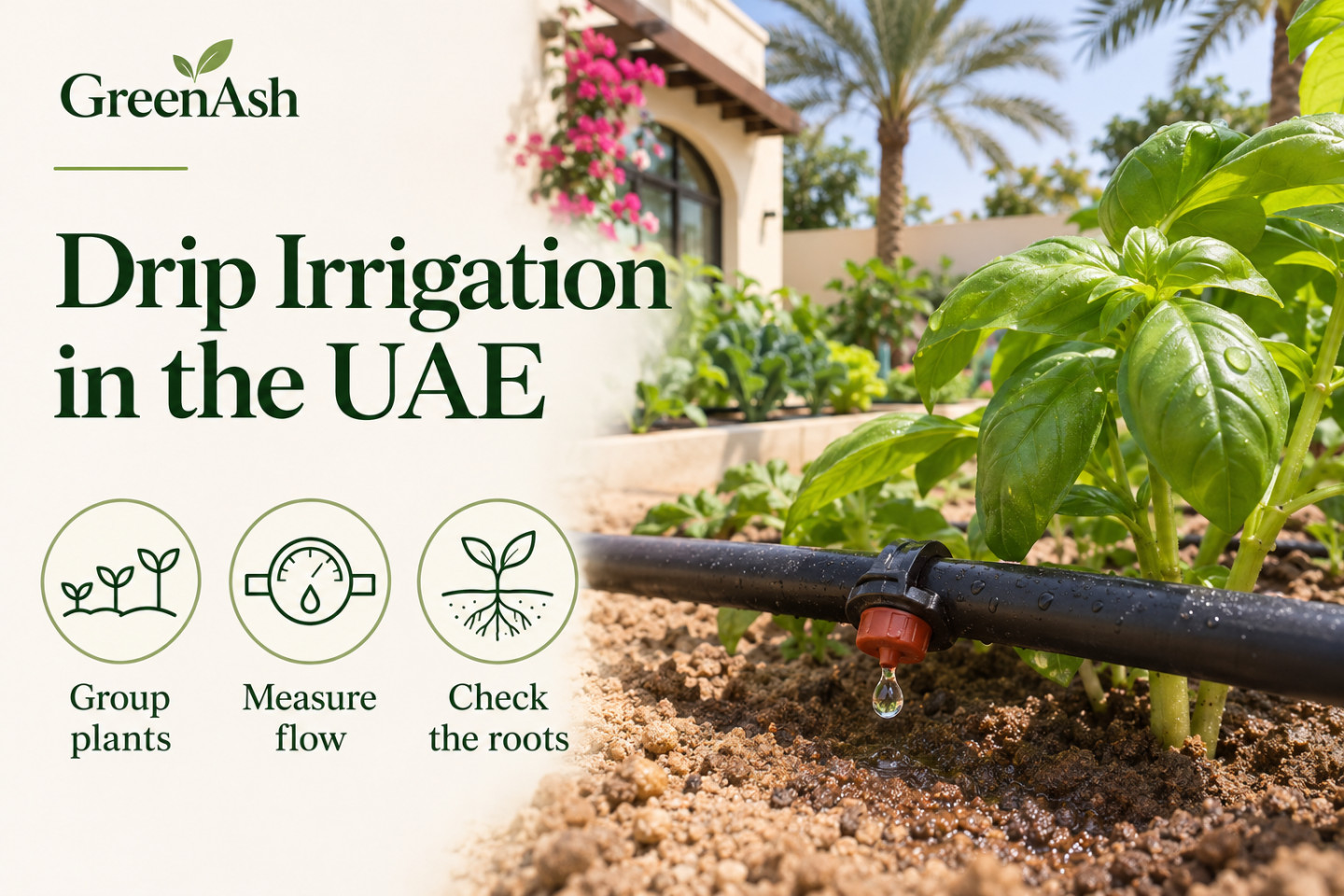
A sunny row of basil pots and a shaded shrub border can share a garden tap, but they may need water on different days. Before buying pipe or programming a timer, decide which plants you can water together. Then test a short run of tubing. A measuring jug and a trowel will tell you more about the right settings for your UAE garden than a preset summer schedule.
The short answer: a drip line gives each plant a measured number of litres, and the timer only converts litres into minutes. Measure what your emitters really deliver, work out how many litres a pot, a bed or a garden needs today, then divide one by the other. By the end of this article you will be able to plan a zone, test the flow with a jug, calculate run times for a pot, a 1 m2 bed and a 100 m2 garden, and adjust them between January and July without guessing.
Plan one watering zone at a time
A zone is the group of outlets that turn on together. Sketch the route from the tap and mark each pot, vegetable row or shrub you want to reach. Group plants with similar exposure, soil and watering needs. If your pots dry out while the bed is still damp, give them independently controlled zones or hand-water the pots. Two branches on one open tee still run on the same schedule.
The University of Arizona’s drip guide makes the same point for desert landscapes: group plants with similar water needs, and put trees, shrubs, groundcovers and lawn on separate valves. It also says most of a landscape can be watered by drip except turf areas, so a lawn stays on sprinklers. Colorado State University adds two rules that save a lot of trouble later: do not mix drip emitters with sprinklers or microsprays on one zone, and buy all your emitters from one manufacturer, because colour codes for flow rates differ between brands.
Decide whether drip suits the spot
| What you are watering | Drip a good fit? | Why | What to do instead or as well |
|---|---|---|---|
| Vegetable beds and rows | Yes | Water goes to the root zone; Colorado State gives drip over 90% efficiency against 50 to 70% for sprinklers | Space emitters about 30 cm apart in sand |
| Shrubs, hedges, young trees | Yes | Each plant gets its own number of emitters | Move emitters outward as the canopy grows |
| Balcony or courtyard pots | Yes, with care | Small soil volume; one blocked emitter can kill a plant in a hot week | Check drainage from every pot after each change |
| Bermuda or paspalum lawn | No | The University of Arizona leaves turf areas out of drip | Sprinklers on their own zone; see our UAE lawn guide |
| Cacti and succulents mixed with vegetables | Not on the same zone | One schedule will drown one group or starve the other | Separate zone or hand watering |
How water moves from an emitter in sandy UAE soil
An emitter releases water at one point. Gravity pulls it down, and the fine pores in the soil pull it sideways. In clay and loam the sideways pull is strong, so a single emitter wets a wide, shallow bulb. In sand the pores are large, so water drops quickly and spreads only a short way. That is why Colorado State spaces emitters about 30 cm (12 inches) apart in sand, 45 cm in loam and 60 cm in clay, and suggests two or three emitters per plant in sand where one or two would do in clay.
The second thing sand changes is storage. A UC Master Gardener handout from Solano and Yolo counties lists how much plant-available water each soil holds per foot of depth: very coarse sands hold 0.40 to 0.75 inches, coarse and fine sands and loamy sands 0.75 to 1.25 inches, sandy loams 1.25 to 1.75 inches. Converted to metric, the top 30 cm of loamy sand holds about 19 to 32 mm of usable water, and very coarse sand only about 10 to 19 mm. One millimetre over one square metre is one litre, so a 1 m2 sandy bed holds roughly 10 to 32 litres in the root zone when full. Anything you add beyond that drains below the roots.
The University of Arkansas fact sheet on drip maths (FSA6174, 2026) uses the same logic to set a maximum run time per watering: once the root zone is refilled, extra minutes are lost. This is why a long weekly soak, which many drip calculators suggest, can suit loam and fail in Gulf sand. In sand you usually water less per session and more often.
Salt is the third factor. UC Agriculture and Natural Resources explains that under drip, water moves outward and salts collect at the edges of the wetted zone. Mains water usually carries less salt than farm well or borehole water, but every source and every feed adds some. A small share of water draining past the roots, called the leaching fraction, carries those salts down. We come back to the numbers below.
Choose pipe, emitters and tap fittings that work together
For individual pots or unevenly spaced shrubs, plain lateral pipe lets you place a separate emitter at each watering point. For a closely planted vegetable row, tubing with built-in emitters can simplify installation. Check the description before buying a roll. Diameter and roll length alone do not tell you whether it has outlets.
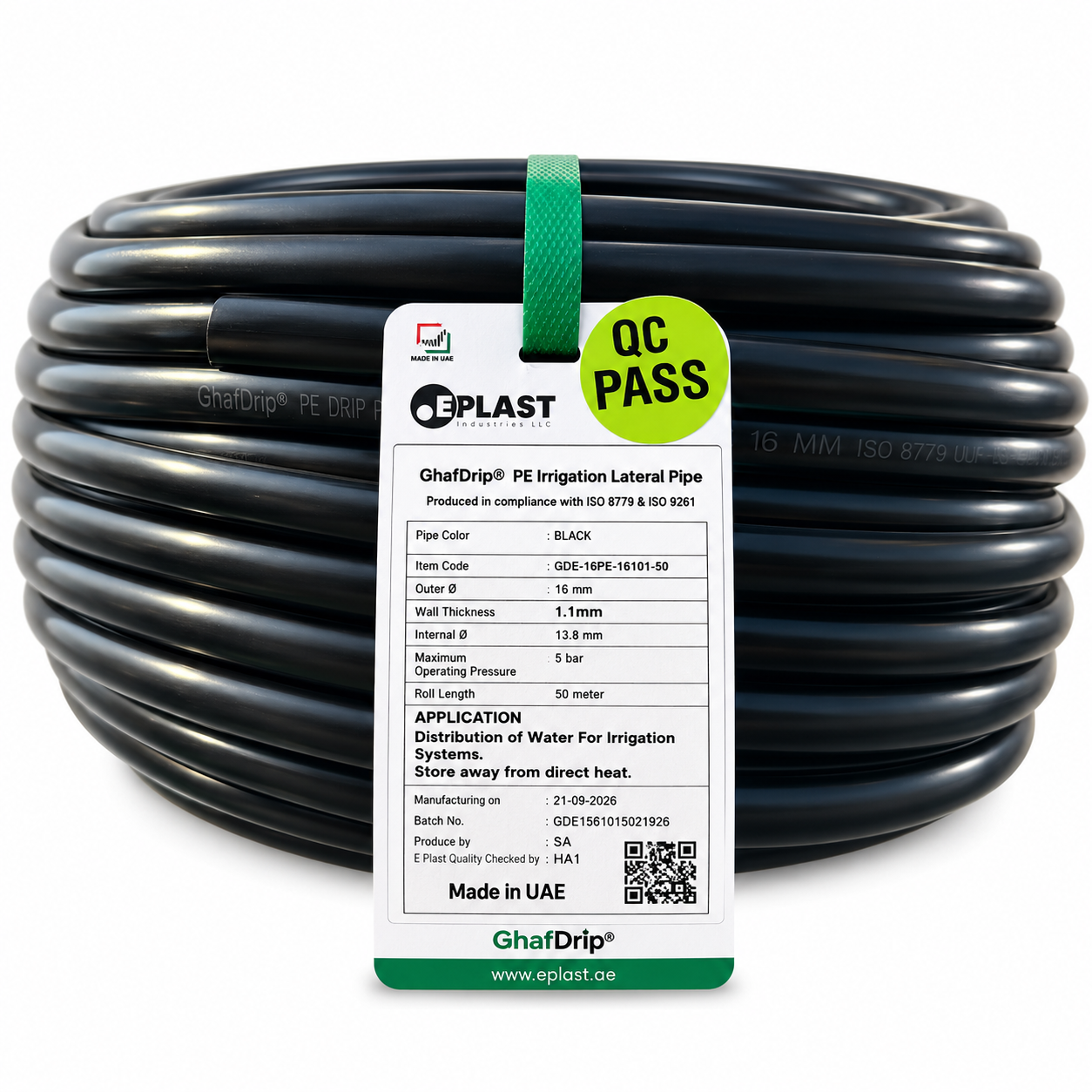
- Pipe and connectors. The GhafDrip PE lateral pipe is listed as 16 mm, with a 1.1 mm wall, in a 50 m roll. Measure the route including turns, and check fitting compatibility against the pipe dimensions. Its 5 bar rating describes the pipe. Use the emitter manufacturer’s operating range to select the regulator.
- Tap assembly. Match the tap thread, backflow protection, filter and pressure regulator to the water supply and system. Use the manufacturers’ installation order and filtration specifications. Leave the filter and line ends accessible for cleaning and flushing.
- Timer. The Orbit Buddy single-port digital tap timer controls one outlet. It suits a group of plants that can share a schedule. You can also start the test by turning the water on manually.
The order of parts at the tap
Colorado State lists the order for a permanent drip head as backflow prevention device, then the control valve (here, the timer), then the filter, then the pressure regulator, with the lateral pipe after that. Both Colorado State and the University of Arizona say a backflow preventer is required; check what your building or water supplier asks for. For clean municipal water, Colorado State suggests a 150 to 200 mesh filter, and a Y or T filter so you can clean the screen without taking the line apart.
Pressure is the part most people skip. The University of Arizona says drip needs about 20 psi (about 1.4 bar) while household supplies run at 50 to 75 psi (about 3.4 to 5.2 bar); Colorado State gives about 20 to 30 psi (1.4 to 2.1 bar) as the typical drip operating range. The top of that household range is above the 5 bar maximum on the GhafDrip page, which says the limit must not be exceeded. A regulator matched to your emitters protects both the pipe and the fittings.
Emitter types and flows
Emitters are usually sold at 0.5, 1, 2 or 4 US gallons per hour, which is about 1.9, 3.8, 7.6 and 15.1 litres per hour. Colorado State explains that pressure compensating emitters hold a steady flow over a wide pressure range, while simpler emitters give more water at higher pressure. On a long line or a sloping villa garden, pressure compensating emitters make the far end match the near end. The University of Arizona keeps the thin 1/4 inch microtube from the lateral to the plant under about 1.5 m (5 ft).
We checked the GreenAsh store on 10 November 2026 and found no emitters, drippers, filters, pressure regulators, end caps or drip fittings listed. You will need to buy those from an irrigation supplier, matched to the 16 mm pipe. For the hose side, our garden hose and fittings guide explains thread sizes at the tap, and the store lists Beorol tap adaptors such as the GASP34 (titled 1/2 and 3/4 inch); its page gives no pressure rating, so check the fit by hand before relying on it.
How much line one tap can feed
Colorado State gives three limits per zone. Keep each zone’s supply line under about 61 m (200 ft). A 1/2 inch polyethylene line carries up to about 200 gallons per hour, which is about 757 litres per hour. And never plan to use more than 75% of what the tap delivers. Measure your tap with a bucket: run it fully open, time how long a 10 L bucket takes to fill, then divide litres by seconds and multiply by 3,600. A bucket that fills in 40 seconds means 900 L/h, so the most you should ask of that tap is about 675 L/h. The 16 mm GhafDrip pipe has a 13.8 mm bore, slightly wider than a nominal 1/2 inch, so the Colorado figure is a fair guide, but the emitter and fitting makers’ tables should have the final say.
Measure how much water actually comes out
- Lay out a short section. Flush loose debris out of the open end before closing it. Run the system and check for leaks at joins.
- Place containers under equal-rated emitters near the start, middle and far end. Collect water for the same 15 minutes at each point and measure each volume. Return each outlet to its planting position afterwards.
- Multiply litres collected by four to get litres per hour. For example, 500 mL in 15 minutes equals 2 L/h. Two emitters delivering that measured flow would give one planter 2 L in half an hour. This calculation tells you the amount delivered. The soil check below tells you whether it was enough.
If the far outlet gives much less water, inspect the line for a kink, a leak or a blocked emitter. Compare your run length and total emitter flow with the manufacturer’s limits before extending the run time for every plant.
A quicker spot check for one emitter: time how long it takes to fill a 15 mL tablespoon. The UC Master Gardener handout gives 14 seconds for a 1 gallon per hour emitter. At the 2 L/h in our example, a tablespoon takes about 27 seconds. If one emitter in a row takes twice as long as its neighbours, clean or replace it before you touch the timer.
Write the results down: the date, the three measured flows and the average. A well balanced line gives three similar numbers. A big gap between the first and last emitter usually means pressure loss along a long line, a partly blocked filter or emitters that are not pressure compensating.
How many litres do plants need? From weather to litres per plant
Plants lose water through their leaves and the soil surface. Irrigation scientists call this evapotranspiration, and they express it in millimetres per day. Because 1 mm over 1 m2 is exactly 1 litre, the number converts straight into litres per square metre per day. Two figures give you the daily need: the reference rate for the weather (ETo) and a crop coefficient (Kc) for how much leaf the planting has.
We have not found a published monthly UAE table that we can link, so we use a close desert benchmark. A King Fahd University of Petroleum and Minerals study (Abdullah and Chowdhury, 2016) reports Riyadh reference rates of 8.5 to 10.9 mm per day from May to August and 3.2 to 5.4 mm per day from December to March. University of Arizona figures for Phoenix turf run from about 1.3 mm per day in December to about 6.4 mm per day in June. Coastal UAE is more humid than Riyadh, so treat these as a planning range, then let the soil check correct you.
Crop coefficients come from the UN Food and Agriculture Organization’s Irrigation and Drainage Paper 56. For small vegetables Kc is about 0.7 at the start, 1.05 at full leaf and 0.95 at the end. For tomato it is 0.6 at the start, 1.15 in mid-season and 0.70 to 0.90 at the end. Peppers reach 1.05, lettuce 1.00. Young transplants use much less than a full canopy because most of the bed is still bare.
Finally, add the leaching share. UC ANR’s leaching table shows that to let 10% of applied water drain below the roots you apply 111% of what the plants use, 118% for 15% and 125% for 20%. With mains water, 10% is a sensible planning figure. With salty well water, ask for a water test; the same UC ANR paper lists salt thresholds of 2.5 dS/m for tomato, 1.5 for pepper, 1.3 for lettuce and 1.0 for strawberry, and its formula raises the leaching share as water salinity rises.
The formula
Litres per day = ETo (mm per day) x Kc x area (m2) x leaching factor (1.11 for 10%).
Run time (hours) = litres needed ÷ measured litres per hour of all emitters on that plant or bed.
Litres per plant: starting points
For shrubs and trees, where the area is hard to define, Colorado State gives weekly volumes per plant. We have converted them to litres per day. These are Colorado figures, where summer is milder than ours, so treat them as a floor in UAE heat and confirm with the trowel test.
| Plant | Colorado State weekly volume | Litres per week | Litres per day (average) | Emitters suggested by Colorado State |
|---|---|---|---|---|
| Annuals and moderate water perennials | 2 gallons | 7.6 | about 1.1 | Two 0.5 gph (1.9 L/h) at the base |
| Shrub the size of a 5 gallon container | 4 to 6 gallons | 15 to 23 | about 2.2 to 3.2 | Two 1 gph (3.8 L/h), 30 cm from the base |
| Large shrub | 10 to 12 gallons | 38 to 45 | about 5.4 to 6.5 | Three 1 gph for shrubs over 1.5 m |
| Newly planted sapling (whip) | 1 to 2 gallons | 3.8 to 7.6 | about 0.5 to 1.1 | Two 0.5 gph |
| Established tree | Up to 10 gallons per inch of trunk | Up to 38 per 2.5 cm of trunk | Up to about 5.4 per 2.5 cm of trunk | Four emitters 60 cm from the trunk for a medium tree |
Colorado’s spacing figures are for clay or loam. In sand, add emitters rather than minutes so the wet zone is wide enough.
Worked run times: a pot, a 1 m2 bed and a 100 m2 garden
All three examples use emitters measured at 2 L/h with the jug test. Replace that figure with your own measurement; every run time scales with it.
1. A 30 cm pot on a balcony
Pots are easier to measure than to calculate. Water the dry pot slowly by hand with a jug until the first drops leave the drainage hole, and note the volume; say it was 1.2 L. That is roughly what the mix had lost. Add 10% for leaching: 1.2 x 1.11 = about 1.3 L.
With two emitters at 2 L/h, the pot receives 4 L/h. 1.3 ÷ 4 = 0.33 hours, so set 20 minutes. A University of Arizona Master Gardener handout says containers of non-desert plants may need water every day or two in summer, so in July that pot may use about 1.3 L a day; in January the same refill may last two or three days, which works out at roughly 0.4 to 0.7 L a day. Repeat the jug refill test each season rather than trusting the summer setting.
Pots also collect salt faster than beds, because the same small volume of mix receives every litre of water and every feed. UC Master Gardeners advise leaching a pot with water equal to twice its volume, letting it drain completely, at least every 4 to 6 months, and to watch for a white or yellow crust on the surface or a ring at the soil line or drainage hole.
2. A 1 m2 tomato bed in January
Two drip lines run 50 cm apart along a 1 m bed, with emitters every 30 cm (four per line, eight in total). Eight emitters x 2 L/h = 16 L/h for the bed.
- Just after transplanting (Kc 0.6, ETo taken as 4 mm per day, inside the 3.2 to 5.4 winter range): 4 x 0.6 x 1 x 1.11 = 2.7 L per day. 2.7 ÷ 16 = 0.17 hours, about 10 minutes a day.
- Full canopy in mid-season (Kc 1.15): 4 x 1.15 x 1 x 1.11 = 5.1 L per day. 5.1 ÷ 16 = 0.32 hours, about 19 minutes a day.
Now check storage. Half the usable water in 30 cm of very coarse sand is about 5 to 9.5 L per m2; in loamy sand it is about 9.5 to 16 L. In loamy sand you could give 10 L every second day (38 minutes) without losing much below the roots. In very coarse sand, 10 L at once is more than the root zone can hold, so stay with daily watering. Steady moisture also matters for fruit: our tomato growing guide covers how uneven watering affects the crop.
3. A 1 m2 bed in July
Few vegetables grow well in a UAE summer, but heat tolerant crops and shrub beds still need water. Take ETo as 10 mm per day (inside the 8.5 to 10.9 summer range) and Kc 1.05: 10 x 1.05 x 1 x 1.11 = 11.7 L per day. At 16 L/h that is 44 minutes. That volume is more than half the storage of very coarse sand, so split it into two runs of about 22 minutes, early morning and late afternoon. Shade over the bed lowers the need; see our green shade net guide for what the research says about shade percentages.
4. A 100 m2 vegetable garden
Ten rows, each 10 m long and 1 m apart, need 100 m of lateral: two 50 m rolls of GhafDrip for the rows and part of a third for the supply line along the end. Emitters every 30 cm give 34 per row, 340 in total. At 2 L/h each, that is 680 L/h.
Check the tap. With the bucket result above (900 L/h, so 675 L/h usable), 680 L/h is just over the limit, and it is also close to the roughly 757 L/h Colorado State gives for a 1/2 inch line. Split the garden into two zones of five rows, 340 L/h each, and run them one after the other. A single-port timer controls one outlet, so two zones need either two timers on two taps or a controller with two outlets.
- January, full canopy (ETo 4, Kc 1.05): 4 x 1.05 x 100 x 1.11 = 466 L a day for the whole garden, 233 L per zone. 233 ÷ 340 = 0.69 hours, about 41 minutes per zone.
- Hot month, if the plot is still planted (ETo 10, Kc 1.05): 1,166 L a day, 583 L per zone. 583 ÷ 340 = 1.7 hours, about 103 minutes per zone, split into two or three runs so each stays inside what the sand can hold.
| Case | Emitters (2 L/h each) | Flow | Litres per day | Run time per day |
|---|---|---|---|---|
| 30 cm pot, refill 1.2 L | 2 | 4 L/h | 1.3 (summer, daily) | 20 min |
| 1 m2 bed, new transplants, January | 8 | 16 L/h | 2.7 | 10 min |
| 1 m2 bed, full tomato canopy, January | 8 | 16 L/h | 5.1 | 19 min |
| 1 m2 bed, July | 8 | 16 L/h | 11.7 | 44 min, split in two |
| 100 m2 garden, January (two zones) | 340 (170 per zone) | 340 L/h per zone | 466 | 41 min per zone |
| 100 m2 garden, hot month (two zones) | 340 (170 per zone) | 340 L/h per zone | 1,166 | 103 min per zone, split |
These are starting settings, not answers. The trowel check below decides whether they stay.

Set the timer by checking the roots
After a trial watering, let the water soak in. Open a narrow slit with a trowel beside the root ball, avoiding the main roots. Check both below the emitter and sideways towards the next plant. Water tends to spread less sideways in sand. A wet spot on the surface can hide a dry strip where the roots are growing.
- Deep wet spot, dry soil on either side? Reposition outlets or add another watering point to widen coverage. Recheck before increasing run time.
- Moist across the bed but dry at the bottom of the root ball? Try a slightly longer run and check the same points again.
- Still wet before the next scheduled watering? Delay that cycle and check again. Use this check when the weather cools or a pot moves into shade.
How deep should the water reach? University of Arizona Extension guidance for Cochise County says to wet about 30 cm (1 ft) for bedding plants, 60 cm (2 ft) for shrubs and 90 cm (3 ft) for trees. It suggests pushing a thin metal rod into the soil about an hour after watering: the rod slides easily through moist soil and stops at dry soil. Colorado State suggests checking moisture at root depth the day after watering.
Sandy beds that will not hold water
If the run times above leave the bed dry by afternoon even when split, the soil is the problem, not the timer. Organic matter raises how much water sand holds between waterings. Texas A&M’s Earth-Kind guidance suggests working organic material into shrub and flower beds and mulching to cut evaporation; Colorado State adds that mulch over drip lines hides them, limits sun on the pipe and reduces trip hazards. Our vermicompost guide covers amounts for beds and pots, and our hydrogel article explains how to test whether water absorbing granules help in your soil before buying for a whole bed.

UAE watering timeline
The Arizona Master Gardener handout gives desert frequencies that fit the UAE pattern well: high water users such as vegetables every day or two in summer; non-desert shrubs once or twice a week in summer, every 7 to 10 days in spring and autumn and every two weeks in winter dry spells; transplants daily for a week, every other day for two weeks, then twice a week for two more weeks.
| Period | Weather benchmark | Drip action | Villa garden | Balcony | Farm or large plot |
|---|---|---|---|---|---|
| October | Falling from summer levels | Flush lines, clean filter, re-run jug test, plant out | Cut shrub run times step by step as nights cool | Repeat pot refill test | Check well water salinity before sowing |
| November to February | About 3.2 to 5.4 mm a day (Riyadh benchmark) | Short daily runs for transplants, longer as canopy fills | Shrubs every 1 to 2 weeks | Pots every 2 to 3 days | Split zones; check tap or pump flow |
| March and April | Rising fast | Increase run times as crops reach full leaf; trowel check weekly | Move emitters out to the canopy edge | Watch south and west facing pots | Plan a leaching run if salts crust the surface |
| May to September | About 8.5 to 10.9 mm a day | Split runs morning and late afternoon; inspect emitters monthly | Trees to 90 cm depth; shrubs to 60 cm | Pots daily; shade helps | Run zones in sequence so the supply keeps pressure |
Humidity matters too. On a humid coastal day in August, plants lose less water than on a dry, windy inland day with the same temperature, so an Al Ain garden can need more than a Dubai Marina balcony. That is another reason to trust the trowel over the calendar.
Common mistakes
- Setting minutes before measuring flow. A 20 minute run means nothing until you know the litres per hour. Measure with a jug first.
- Adding minutes when a plant wilts. A longer cycle sends extra water to every working emitter. Check the wilting plant’s emitter and soil first.
- One emitter per plant in sand. The wet bulb is narrow, so roots on the far side stay dry. Colorado State suggests two or three per plant in sand.
- One long weekly soak in sand. Sand holds only about 10 to 32 litres per m2 in the top 30 cm. Water beyond that drains away. Shorter, more frequent runs keep it in the root zone.
- Skipping the regulator. Supply pressure can sit above the 5 bar limit on the GhafDrip page and well above what emitters need. Fittings pop off and emitters spray instead of drip.
- Mixing pots, beds and shrubs on one timer. One group will always be over or under watered. Separate zones or hand water the odd ones out.
- Never letting any water drain. Under drip, salts gather at the edge of the wet zone. A 10% leaching share, and a deeper flush when crust appears, keeps them away from the roots.
- Leaving the summer setting on in December. Winter need is roughly half of summer or less. Re-run the calculation each season.
Troubleshooting
| Symptom | Likely cause | What to check | Fix |
|---|---|---|---|
| Far end of line gives much less water | Line too long, too many emitters, partly blocked filter | Jug test at start, middle and end; total flow against tap limit | Shorten run, split zone, clean filter, use pressure compensating emitters |
| One plant dry, neighbours fine | Blocked or missing emitter | Tablespoon test on that emitter | Soak and flush the emitter, or replace it |
| Soil wet but plant wilting | Root damage from constant wet, or heat stress at midday | Smell and colour of roots; is it still wilted in the evening? | Lengthen the gap between runs; shade in summer |
| White crust on surface or around pot holes | Salt build up | Water source; how much drains | Leach with a deeper watering; check water salinity |
| Fittings blow off or water sprays | Pressure too high or wrong fitting size | Regulator present? Fitting made for 16 mm OD? | Add regulator; use fittings matched to the pipe |
| Timer does not start | Batteries, programme, or inlet filter | Display, manual mode test | Replace batteries; clean inlet filter (the Orbit page lists both) |
Call an irrigation contractor when you need a permanent buried system, a pump on a well, more than two or three zones, or a design that has to meet building rules on backflow. For a farm on salty well water, a soil and water test from a laboratory is worth more than any change to the timer.
Safety and care
- Backflow and drinking water. A backflow preventer stops garden water being drawn back into the house supply, which matters most if you ever feed fertiliser through the line. Do not drink from drip outlets or from the line.
- Pressure. Do not exceed the pipe’s stated 5 bar limit. Use a regulator matched to your emitters.
- Heat and sun. The GhafDrip page says to store the pipe away from direct heat. Mulch over the line also limits sun exposure, according to Colorado State.
- Trip hazards. Colorado State notes that drip tubing can trip children and dogs, and is less of a problem under mulch. It suggests wire stakes every 60 to 90 cm (2 to 3 ft).
- Pets. Thin microtube is easy for a dog to chew through. Run it where pets cannot reach it, or under mulch.
- Batteries. The Orbit page advises removing batteries if the timer is stored for a long time. Dispose of old batteries through a battery collection point.
- Compost and soil products. The vermicompost page asks you to keep it away from children and pets, avoid breathing the dust, wear protective gear and wash hands after use. Gloves and a dust mask cover that.
Products in this article compared
| Product | What it is | Key specs on the page | Pack | Settings or rate on the page | Harvest interval | Who it suits |
|---|---|---|---|---|---|---|
| GhafDrip PE lateral pipe | Plain lateral pipe, no built-in emitters | 16 mm OD, 13.8 mm ID, 1.1 mm wall, 5 bar max, ISO 8779 and ISO 9261 | 50 m roll (page also lists 100 and 200 m, but only 50 m is sold) | Not applicable | Not applicable | Beds, rows and shrub lines |
| Orbit Buddy single-port timer | Battery tap timer | LCD and dial; start time, duration, frequency; manual mode; rain delay | One unit | No duration range given | Not applicable | One zone |
| Digital Garden Water Timer | Tap timer | Frequency, duration, start time, manual mode | One unit | No duration range given | Not applicable | Not boxed: the page body is headed Orbit Buddy II Two Port and lists no brand or port count |
| AgriGuru Earth’s Bounty Vermicompost | Worm compost | Says it improves soil structure, water retention and aeration | 1 kg and 5 kg | 1 part to 2 parts soil for new plantings | None stated | Sandy beds and pots that dry fast |
| Agriguru Organic Hydrogel | Water absorbing granules | Up to 400 times its weight in water (manufacturer claim) | 250 g | No rate given | None stated | Not boxed: no rate on the page; see our hydrogel article |
Common questions
Can I use one emitter in a wide planter?
Test the far side of the planter at root depth. If only the nearest plant gets water, distribute the outlets across the planted area and measure the combined flow again. Make sure excess water can drain from the pot.
Should I increase the timer if one plant wilts?
First check its soil and catch water from its emitter. If neighbouring plants are moist and their outlets deliver normally, focus on the affected plant and its outlet. A longer cycle sends extra water to every working emitter.
What should I check before going away?
Watch one programmed cycle from start to finish. Check the timer opens and closes, water reaches the last outlet, pots drain freely and joints stay dry after shutoff. Keep a hose handy for individual plants while adjusting the system. Our garden hose and fittings guide explains what to match at the tap.
How many litres does a tomato plant need per day in the UAE?
Work it out per square metre. A full tomato canopy in January needs about 5.1 L per m2 per day using a 4 mm per day weather benchmark and FAO’s mid-season coefficient of 1.15, plus 10% for leaching. Divide by the number of plants in that square metre. Young transplants need roughly half.
How long should I run drip irrigation in summer?
There is no fixed number. Calculate litres (ETo x Kc x area x 1.11), divide by the measured flow, and split anything that exceeds about half the root zone’s storage into two runs. In our 1 m2 example at 16 L/h, July works out at 44 minutes a day in two runs.
Is morning or evening watering better?
Early morning suits most gardens, with a second late afternoon run in summer if the volume needs splitting. Colorado State recommends a controller and warns against running drip overnight on the idea that slow water needs long hours; the litres, not the hours, are what count.
Can I use drip with salty well water?
Yes. Texas A&M’s Earth-Kind guidance says drip allows safer use of water with a high salt content. You still need a leaching share; UC ANR’s formula raises it as water salinity rises. Get the water’s EC measured and choose tolerant crops.
How often should I clean the filter and flush the line?
Colorado State says to flush the line and clean the filter before the season starts, after any repair, and more often with well water. The University of Arizona suggests inspecting emitters monthly.
For more on component selection and emitter layout, see Colorado State University Extension’s home drip guide and the University of Arizona’s guide to drip irrigation in desert landscapes. For salt and leaching, UC ANR’s Managing Salts by Leaching gives the full formula and tables, and the University of Arkansas drip maths fact sheet shows how soil storage limits each run.
Ready to start? Lay out one zone, grab a jug and a trowel, and measure before you programme. The pipe, timer and vermicompost above are on the GreenAsh store; buy the emitters, filter and regulator from an irrigation supplier, matched to 16 mm pipe.
