
Blog
Choosing a Garden Sprayer in the UAE: Handheld, Pressure or Knapsack?


Choosing a garden sprayer in the UAE starts with the job, the liquid you intend to apply and the weight you can comfortably carry. A bigger tank saves refills, but it does not automatically improve coverage. For a few pots, a small handheld model may be easier to control; a larger planted area may justify a lance or backpack design.
The short answer: a 2 L handheld sprayer for a balcony or a few pots, a 10 L pressure sprayer with a lance for villa beds and shrubs, and a 12 to 22 L knapsack only when you regularly treat a large garden or farm plot and can carry 12 to 22 kg of liquid on your back. By the end of this article you will be able to pick the size, measure exactly how much your sprayer puts out per square metre, turn a label rate into millilitres per tank, and clean the sprayer so it does not damage the next plant you spray.
This guide compares three GreenAsh options and explains the checks to make before buying. Equipment choice does not establish whether a pesticide or fertilizer is suitable: the exact product label and sprayer manual must both permit the intended use.
Compare handheld, pressure and knapsack sprayers
| Type | When to consider it | Main trade-off | GreenAsh option |
|---|---|---|---|
| Small handheld pump sprayer | A few pots or a limited spot-treatment job | Easy to move, but frequent refilling on larger jobs | GDM Eva, listed as 2 L |
| Pressure tank with lance | Beds and shrubs where a hose and lance improve reach | More liquid to carry; check handle and carrying arrangement | GDM Professional MARY 10, listed as 10 L |
| Knapsack sprayer | Larger areas where backpack carrying suits the operator | Greater filled weight and more equipment to clean | GDM Rosy, listed in 12 L, 16 L and 22 L options |
| Hose-end nozzle (no tank) | Watering and washing only | Cannot hold a measured mix, so it is not a way to apply a pesticide | Beorol GPS6 nozzle set |
These are purchase comparisons, not fixed garden-size rules. Two gardens of the same area can require very different spray volumes. Check the model’s usable filling limit rather than assuming every quoted capacity is the permitted working fill.
A quick decision path
- What are you spraying, and how much of it? Treating six pots on a balcony needs well under a litre of mix. A hibiscus hedge 15 m long, or a 120 m2 vegetable plot, needs several litres per round. The calibration section below shows how to measure this instead of guessing.
- Can you carry it full? Water weighs about 1 kg per litre, so the liquid alone in a full 10 L tank is about 10 kg, a 16 L knapsack about 16 kg and a 22 L knapsack about 22 kg, before the weight of the sprayer itself. None of the three product pages gives an empty weight, so ask before you order if this matters to you.
- Will you use it for weed killer? If yes, plan on two sprayers: one marked for herbicide only, and one for everything else. A small 2 L sprayer is often the sensible second one.
- Where will you store it? A 2 L sprayer fits in a balcony cupboard. A knapsack needs a shaded, locked space in a store room or garage, away from children and food.
What a sprayer is not the right tool for
- Routine watering. A hose, watering can or drip line moves far more water with less effort. See our garden hose guide.
- Soil drenches by the bucketful. If a label asks for a measured volume poured around each plant, a watering can with a measuring jug is easier to control than a fine spray.
- Treating a problem you have not identified. A sprayer applies a decision; it does not make one. If leaves are yellowing from salty water or a nutrient gap, no spray of insecticide will help. Our insecticide selection and label-reading guide covers identifying the pest first.
Three options to compare at GreenAsh
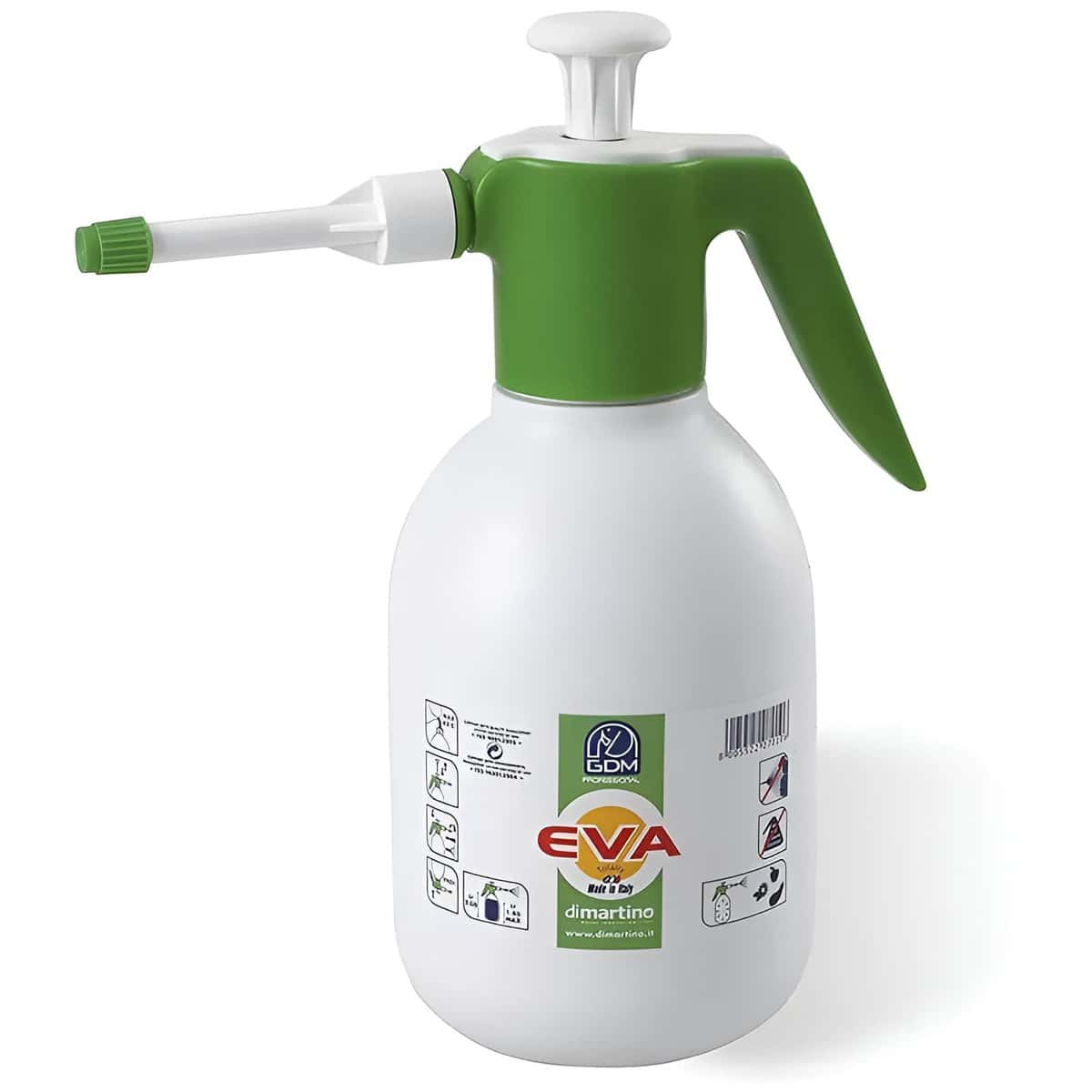
GDM Eva 2 L: a compact starting point
The GDM Eva handheld pressure sprayer is listed with a pump mechanism, ergonomic handle and adjustable nozzle. Consider it when your treatment area is small and carrying a larger tank would add unnecessary work. Its adjustable pattern does not mean every nozzle setting suits every product. The page describes a polyethylene body and a nozzle that adjusts from a fine mist to a direct stream; it gives no pressure rating, empty weight or spare parts list. The description heading calls it the Di Martino Eva, and the brand attribute is Dimartino, so GDM and Di Martino on this page refer to the same maker.
At the example output worked out in the calibration section (45 ml per m2), a full 2 L tank covers about 44 m2 of low plants, which is several balcony troughs or a small courtyard bed. That is also why a 2 L sprayer makes a good dedicated herbicide sprayer for spot treating weeds between paving.
GDM Professional MARY 10: a tank and lance
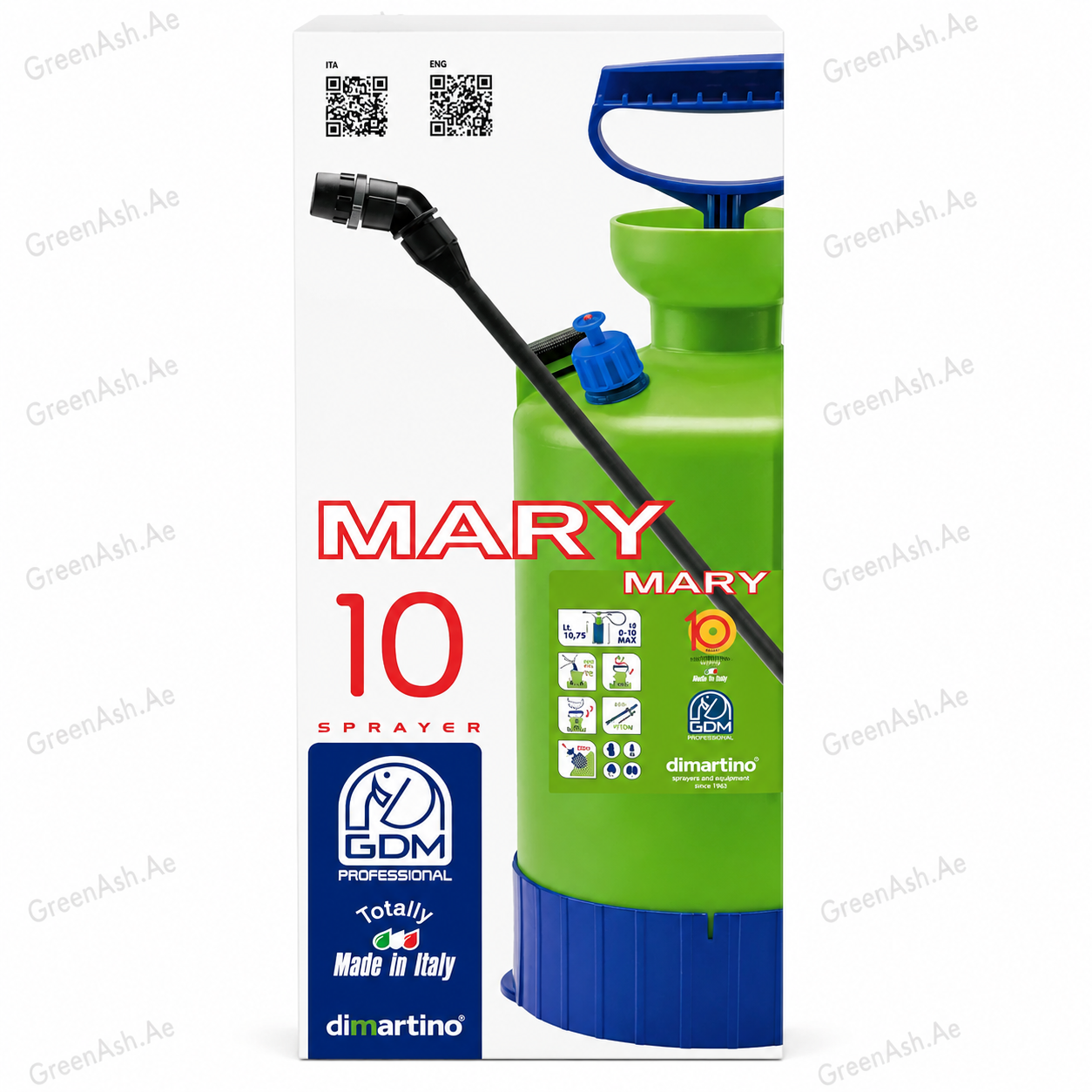
The GDM Professional MARY 10 pressure sprayer is listed as a manual 10 L model with an adjustable nozzle and lance. Compare it when reach around beds or shrubs matters. Confirm the supplied carrying arrangement, pressure limits and chemical compatibility before ordering.
The page’s specification table gives the manufacturer as Dimartino and the country of origin as Italy, and lists it for pesticides, fertilizers and fungicides. Its storage notes are worth following exactly: wash after use, do not store chemicals in the tank, store in a cool dry place out of direct sunlight, and inspect the nozzle and seals regularly. It does not state the tank material, the working pressure or the empty weight. A lance matters more than people expect: it lets you reach the underside of leaves, where whiteflies and spider mites sit, without bending into the plant, and keeps the nozzle closer to the target, which cuts drift.
GDM Rosy: backpack capacity choices
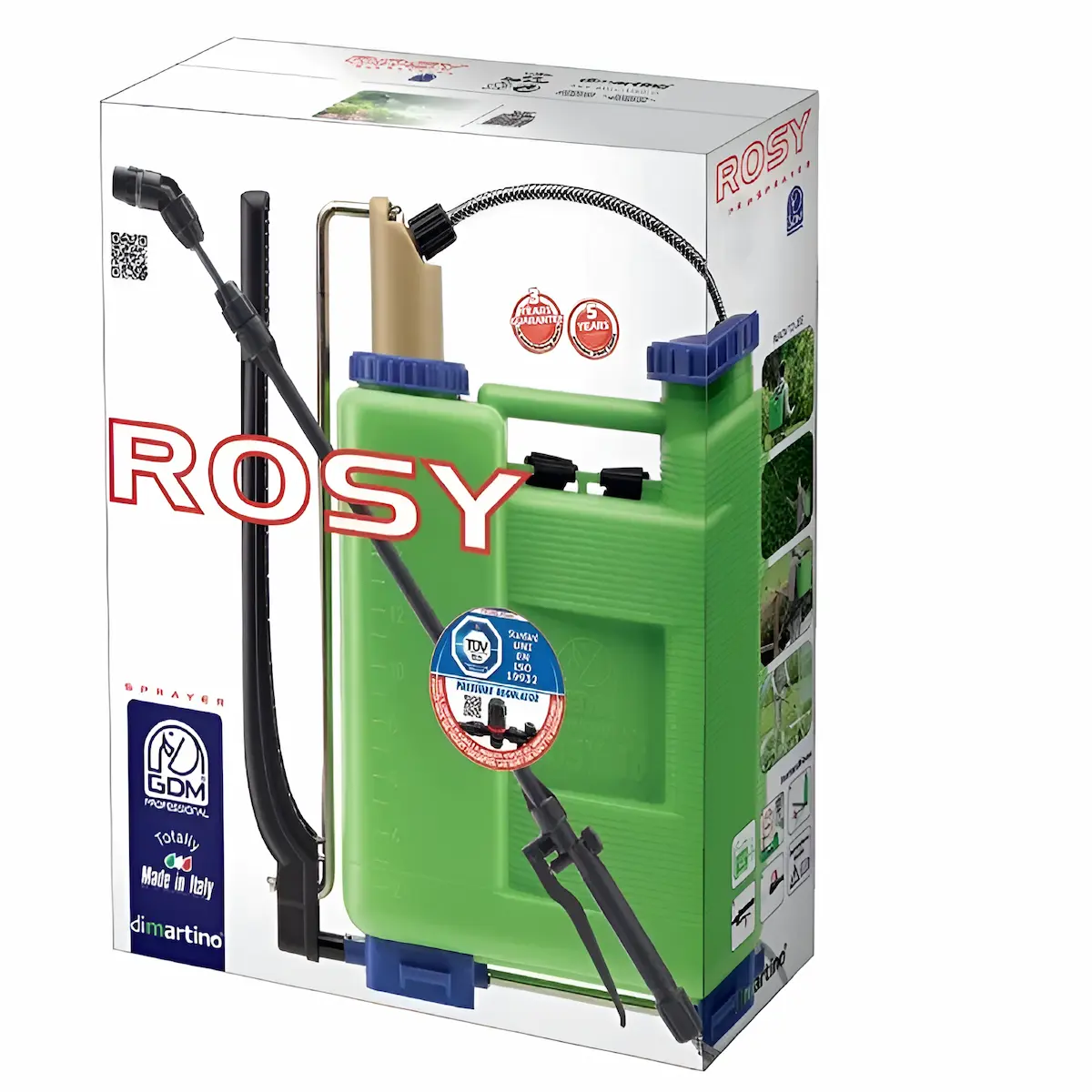
The GDM Rosy knapsack sprayer listing offers 12 L, 16 L and 22 L variants, shoulder straps and a flexible hose. Choose the exact variant deliberately. Water alone weighs approximately one kilogram per litre, before adding the equipment: a large filled tank can be demanding to carry, especially during outdoor work.
The page describes a high-density polyethylene tank, padded shoulder straps, an adjustable pressure system and a corrosion resistant adjustable nozzle. Like the other two, it gives no pressure figure, empty weight or warranty, and the description heading names it the Di Martino Rosy. For most villa owners the 12 L variant is the realistic upper limit: you can still fill it part way for small jobs, and a half-filled knapsack is far easier to manage on a ladder or a sloping bed than a full 22 L one.
The products side by side
| Product | Type and capacity | Material on page | Pressure or flow on page | Use listed on page | Rate or PHI | Who it suits |
|---|---|---|---|---|---|---|
| GDM Eva (29795) | Handheld pump, 2 L | Polyethylene body, corrosion resistant nozzle | Not stated | Watering, fertilizers, pesticides, cleaning | Not applicable: follow the label of the product you spray | Balcony, pots, spot weeding |
| GDM Professional MARY 10 (60226) | Manual pressure sprayer with lance, 10 L | Not stated (“durable pressure-resistant tank”) | Not stated | Pesticides, fertilizers, fungicides | Not applicable | Villa beds, shrubs, small trees |
| GDM Rosy (29801) | Knapsack, 12, 16 or 22 L | High-density polyethylene tank | “Adjustable pressure”, no figure | Fertilizers, pesticides, herbicides, disinfection | Not applicable | Large gardens, farm plots |
| Beorol GPS6 (29678) | Hose-end nozzle, no tank | ABS body, rubber grip | Flow control, no figure | Watering, cleaning, car washing | Not for pesticides | Watering only |
None of these four product pages lists a pressure rating, empty weight, warranty or spare parts. If you need seals or a replacement nozzle later, ask the team before buying so you know what can be sourced.
What to check before buying
- Intended liquid: ask whether the seals, tank and nozzle suit the exact formulation. A general “garden sprayer” description is not proof of compatibility with solvents, disinfectants or every pesticide.
- Nozzle and pressure: check whether the equipment can deliver the pattern and pressure the treatment requires. Maximum pressure is not a target for every job.
- Comfort and access: consider grip, straps, pathways and where you can place the tank securely. A longer lance does not make overhead spraying appropriate.
- Maintenance: ask about replacement seals, filters and nozzles. Inspect the manual’s cleaning and pressure-release procedure.
- Storage: allow secure space away from children, food and direct sunlight.
- Markings: a tank with clear volume marks makes calibration and mixing far easier. If yours has none, mark 1 L steps with a waterproof pen, using a measuring jug.
How a pump sprayer works, and why that matters
All three GDM sprayers work the same way. Pumping the handle pushes air into the sealed tank. That compressed air pushes the liquid through the hose and out of the nozzle, where it is broken into droplets. As you spray, the liquid level falls, the air expands and the pressure drops, so the output slowly falls too unless you top up the pressure with a few more strokes.
Three things follow from this. First, the amount you put on a square metre depends on pressure, nozzle setting and how fast you move, not on the size of the tank. Second, pumping to the same feel each time, and re-pumping at the same point, keeps your output steady; NC State Extension advises keeping walking speed constant and adjusting pressure or the nozzle instead. Third, nozzle setting changes droplet size. Health Canada’s drift guidance says droplets under 150 micrometres are the most likely to drift, and that lower pressure and larger nozzle openings give a coarser spray. A fine mist looks thorough, but more of it can end up on a neighbour’s car, a fish pond or your own face.
Test with clean water before mixing a treatment
With a new or correctly cleaned sprayer, check for leaks and practise the intended technique using clean water. Keep nozzle setting, distance and movement consistent. Measure the water used over a known test area or a representative group of plants, then estimate the volume needed for the actual job.
Penn State Extension’s calibration guidance explains why measuring output matters. Tank size alone cannot tell you how much concentrate to add. A label rate per area and a dilution rate per litre are different instructions; follow the one specified for the approved application. Recheck output after changing a nozzle or technique.
Mix only the required amount, following the product’s mixing order and the sprayer’s filling instructions. Use dedicated measuring equipment. Do not assume all products can be combined or that a universal “half-fill, add, top-up” sequence covers every formulation.
Calibrate your sprayer: the 1/128 acre method in metric
University extension services teach a neat shortcut for backpack and handheld sprayers. The University of Kentucky’s ounces to gallons method (ENTFACT-806, 2025) has you spray 340 square feet, about 1/128 of an acre, for example a plot 10 by 34 feet. Because a US gallon holds 128 fluid ounces, the number of ounces you used equals your output in gallons per acre. Utah State University Extension (2022) uses an 18.5 by 18.5 foot square for the same trick, and NC State Extension’s AG-576 describes both this method and a plain area method.
In metric units, 1/128 of an acre is about 31.6 m2 (a plot of roughly 3.05 by 10.4 m), and the result comes out in US gallons per acre, which then needs converting again. There is a simpler metric version built on the same idea: 10 m2 is exactly one thousandth of a hectare, so the millilitres you use on 10 m2 equal your output in litres per hectare. Divide by 10 and you have millilitres per square metre.
Step by step
- Mark the test area. On paving, dry sand or lawn, mark a rectangle 2 m by 5 m (10 m2). For a hedge, mark a stretch of face that adds up to 10 m2, for example 1.5 m high by 6.7 m long. Penn State’s spot spray video uses the same idea for a wall of shrubs.
- Fill with clean water only to a marked line, at least 1 L for a 2 L sprayer and 3 to 4 L for a larger one, and pump to your normal working pressure.
- Spray the area exactly as you would on the day: same nozzle setting, same distance from the target, same walking pace and the same overlap. Kentucky suggests overlapping passes by about 20%. For spot spraying, Penn State and NC State both say to wet the leaves lightly and stop before liquid runs off.
- Measure what you used. Refill to the line from a measuring jug and note the millilitres you added.
- Repeat twice more and take the average. Kentucky, Utah State and Penn State all average several runs.
- Write it down with the date, nozzle setting and sprayer. Utah State recommends recording each calibration. Recheck when you change nozzle setting, sprayer or operator, and at least twice a season, as Health Canada advises for sprayers generally.
Worked example
Say your three runs on the 10 m2 rectangle use 430 ml, 470 ml and 450 ml. The average is 450 ml. That means:
- Output: 450 litres per hectare, which is 45 ml per m2, or 4.5 L per 100 m2.
- A 20 m2 rose bed needs about 0.9 L of mix per round.
- A 120 m2 vegetable plot needs about 5.4 L per round.
| Tank filled to | Area covered at 45 ml per m2 | Typical fit |
|---|---|---|
| 1 L | about 22 m2 | A few troughs or one small bed |
| 2 L (GDM Eva) | about 44 m2 | Balcony or courtyard |
| 5 L | about 111 m2 | A villa vegetable plot |
| 10 L (GDM MARY 10) | about 222 m2 | Beds and shrubs round a villa |
| 16 L (GDM Rosy 16 L) | about 356 m2 | Large garden or farm block |
Your own figure will differ. Someone who walks faster or uses a narrower cone will put on less; someone spraying dense shrubs will put on more. That is the whole point of measuring.
The same method in the original units
If a label or video gives rates in gallons and acres, the conversion is: 1 gallon per acre is about 9.35 litres per hectare, and 1 fluid ounce is about 29.6 ml. Penn State’s backpack video works through an example of a sprayer putting out 20 gallons per acre with a label rate of 32 ounces per acre: 32 divided by 20 gives 1.6 ounces of product per gallon of water, about 5.6 ounces in a 3.5 gallon tank. In metric that is 2.34 L of product per hectare at 187 L of water per hectare, which works out at 12.5 ml per litre, or about 166 ml in a 13.2 L tank. The answer is the same whichever units you use, as long as you do not mix them.
Turning a label rate into millilitres per tank
Labels give rates in one of two ways, and the arithmetic is different for each.
Rate per litre of water
This is the easy one: the concentration is fixed, and calibration only tells you how much mix to make. The Vembu Neem Oil 80% EC page gives 2 to 3 ml per litre for vegetables, field crops, turf and ornamentals, and 4 to 5 ml per litre for fruit trees and date palms.
| Sprayer volume | Vegetables and ornamentals (2 to 3 ml/L) | Fruit trees and date palm (4 to 5 ml/L) |
|---|---|---|
| 1 L | 2 to 3 ml | 4 to 5 ml |
| 5 L | 10 to 15 ml | 20 to 25 ml |
| 16 L | 32 to 48 ml | 64 to 80 ml |
Using the worked calibration above, the 20 m2 rose bed needs about 0.9 L of mix, so make up 1 L with 2 to 3 ml of neem rather than a full 10 L tank you will have to dispose of. The page says no pre-harvest interval is required; it also asks you not to contaminate water bodies, so keep spray and rinse water away from ponds and pools.
Rate per area
Here calibration decides the concentration, so skipping it means guessing the dose. The Uniform fungicide page, for example, gives 1 to 2 L per hectare for root and soil borne diseases, lists soil drench, irrigation, furrow treatment or surface spray as methods, and does not state a water volume. The arithmetic is: product per hectare divided by your output in litres per hectare gives product per litre of water.
- At 450 L per hectare: 1 L per ha gives about 2.2 ml per litre; 2 L per ha gives about 4.4 ml per litre.
- That is 2.2 to 4.4 ml in a 1 L sprayer, 11 to 22 ml in 5 L, and 36 to 71 ml in a 16 L knapsack.
- If you walk twice as fast and your output drops to 225 L per hectare, the same label rate needs 4.4 to 8.9 ml per litre. Use the 450 L figure by mistake and you apply only half the dose.
- For a 20 m2 bed (0.002 ha) the total product is only 2 to 4 ml, which is why a 1 ml or 5 ml syringe beats a bottle cap.
We use Uniform only to show the sum. Because its page gives no water volume or harvest interval and lists several methods, read the printed label for the method and volume that apply to your crop before using it, and follow that instead of this example if they differ.
Choose the spray pattern and conditions carefully
A fine mist is not automatically the best option. Small droplets are more prone to drifting away from the target. Use the nozzle, droplet category and pressure appropriate to the product label and application; a strong jet can also give poor coverage or runoff.
For UAE balconies and villa gardens, consider neighbouring plants, open windows, paths and water features before starting. Time of day alone is not a safety test. Check wind direction, temperature and all label restrictions. Health Canada’s drift guidance explains that even very still conditions can involve temperature inversions that increase drift risk. It also advises avoiding very hot, dry conditions and watching the wind for two to three minutes before you start. Postpone an application when suitable conditions cannot be established.
Clemson Extension’s advice for herbicides gives a useful wind range: about 3 to 7 mph (roughly 5 to 11 km/h), and never above 10 mph (about 16 km/h). Clemson also warns that some herbicides, naming 2,4-D and dicamba, can turn to vapour and move in hot, low humidity weather, conditions common in the UAE from May to October.
Wear the protective equipment required for mixing, spraying and cleaning. Keep other people and animals away as directed by the label.
A UAE spraying calendar
| Period | What to do with your sprayer |
|---|---|
| October | Check seals, hose and nozzle after the summer. Run the 10 m2 water test and record the result before the first treatment of the cool season. |
| November to February | Main growing and spraying season for vegetables, roses and bedding plants. Mild days make it easier to find calm, cool spells. Make up only what the bed needs. |
| February | Second calibration of the season (Health Canada advises at least two). Replace a nozzle that sprays a lopsided pattern. |
| March and April | Temperatures climb. Spray early in the morning and recheck the label for any temperature limit, especially for oils and herbicides. |
| May to September | Very hot, dry conditions raise drift and, for some herbicides, vapour movement. Spray only when the label allows it, use a coarser setting, and keep the empty, clean sprayer out of the sun with the pressure released. |
Balcony, villa and farm
- Balcony: a 2 L sprayer is enough. Spray with the plants moved away from the railing, a tray or old towel underneath, and windows on your side and the balcony below in mind. Use a coarser setting so drips land in the pot, not on the neighbours.
- Villa: a 10 L sprayer with a lance suits beds, hedges and small citrus trees. Keep spray off the swimming pool, the barbecue and children’s play areas, and remember the gardener’s own exposure if someone else sprays for you.
- Farm or large plot: a 16 or 22 L knapsack makes sense, and calibration matters most here because the volumes are large. Keep a separate, labelled sprayer for herbicides, and record each calibration with its date.
Keep herbicide equipment separate
Clearly dedicate and label a sprayer for weed killers rather than routinely switching it to valued ornamentals or vegetables. Residues in tanks, hoses and filters can injure plants later. Clemson Extension describes this contamination risk and notes that some herbicides require specific tank cleaners.
Separate equipment still needs proper cleaning. Likewise, a sprayer used for insecticides is not automatically suitable for fertilizer after a quick rinse. Check the previous product’s clean-out instructions and the next product’s requirements. If the equipment’s history is unknown, do not assume it is clean enough for sensitive plants.
UF/IFAS Extension’s sprayer clean-out publication adds two details that matter for small sprayers too. Some rubber hoses can absorb herbicide, which makes it harder to rinse out, and every tank keeps a little liquid in its lowest point. UF/IFAS notes that some growers keep a dedicated sprayer for the herbicides that injure plants at very low doses, such as 2,4-D, dicamba and triclopyr. Write HERBICIDE on the tank in large letters and store it apart.
Clean and store it after use
- Follow the sprayer manual to release pressure safely before opening or servicing it.
- Clean promptly, wearing the required protective equipment and following the chemical label’s clean-out procedure.
- Include the tank, hose, lance, filters and nozzle. A tank rinse alone leaves other parts untreated.
- Manage leftover mixture and rinse water according to the label and local disposal requirements. Do not pour them into drains or water features, or apply extra liquid beyond a permitted application rate.
- Dry and store the equipment as its manual directs, securely and away from direct sun. Check for damage before the next use.
Do not improvise cleaning-chemical mixtures. A generic triple rinse is not a guarantee that every residue has been removed. Penn State’s sprayer-cleaning guidance explains how old residues can become a problem during later applications, including how some adjuvants loosen old residue from tank walls and hoses.
How much rinse water to use
Clemson HGIC’s Sprayer Clean-Out page (2024) describes a triple rinse for home sprayers: fill the sprayer about one fifth to one quarter full of clean water, close it and swirl, spray or drain it where the label allows, then repeat twice more, and clean the nozzle, screens and filters separately. Clemson also says to do this away from children and pets, wearing long sleeves, long trousers and gloves.
| Sprayer | Water per rinse (1/5 to 1/4 full) | Total for three rinses |
|---|---|---|
| GDM Eva 2 L | 0.4 to 0.5 L | 1.2 to 1.5 L |
| GDM MARY 10 | 2 to 2.5 L | 6 to 7.5 L |
| GDM Rosy 16 L | 3.2 to 4 L | 9.6 to 12 L |
UF/IFAS adds that pesticide should never be left in the spray system overnight, and that at the very least you should empty the sprayer and run clean water through it after each use unless the label says otherwise. The MARY 10 page says the same in plain words: do not store chemicals inside the tank.
For the rest of your equipment, see our garden hand-tool selection and care guide.
Common mistakes
- Filling the tank first and working out the area later. You end up with several litres of leftover mix and nowhere legal to put it. Calibrate, measure the bed, then mix only what the area needs.
- Using the tank size to set the dose. A label rate per hectare cannot be turned into millilitres per tank without your own output figure. Run the 10 m2 test first.
- Turning the nozzle to the finest mist “for better coverage”. Fine droplets drift more, as Health Canada notes. Use the setting the label calls for, or a medium cone, and get closer to the leaves with a lance.
- Spraying until it drips. NC State and Penn State both say runoff means too much. The extra lands on the soil, not the pest.
- Clearing a blocked nozzle by blowing through it. Utah State Extension says to clear blockages with a tool or compressed air, never with your hands or mouth. Keep a soft brush or a spare nozzle in the kit.
- Leaving a pressurised sprayer in the sun. The MARY 10 page says to keep the sprayer out of direct sunlight when not in use. Release the pressure, empty it and store it in the shade.
- Using the weed killer sprayer “just once” for the roses. Trace herbicide residue is enough to cup and twist leaves. Keep one sprayer for herbicide only.
Troubleshooting
| Problem | Likely cause | What to do |
|---|---|---|
| Will not hold pressure | Lid seal dirty, dry or seated wrongly; loose hose connection | Release pressure, clean and reseat the seal, tighten connections. If it still leaks, stop using it and ask for a replacement seal. |
| Spray pattern lopsided or streaky | Partly blocked or worn nozzle | Clean with a soft brush in water. NC State advises replacing a nozzle whose output is more than 10% off, and UF/IFAS notes that many manufacturers suggest the same. |
| Output much lower than last time | Blocked filter, lower pumping pressure or a faster pace | Clean the filter, re-pump at the same point, and repeat the 10 m2 test. |
| Calibration result far from what the label expects | Wrong nozzle setting or walking speed | NC State: if the error is under 10%, adjust pressure; if larger, change the nozzle setting. Aim to be within 5% of the label rate. Do not change your walking speed to compensate. |
| Leaves twisted or cupped after a spray | Herbicide residue or drift | Stop using that sprayer for ornamentals, clean it to the herbicide label’s procedure, and keep it for weeds only. |
| Liquid on hands or arms after spraying | Leaking lance, too fine a mist, or spraying above head height | Fix the leak before the next use, wash skin straight away, and follow the first aid section of the product label. |
Call a professional when the job means spraying trees above head height, treating inside the house, or using any product whose page or label says restricted use or certified applicators only. Those are not jobs for a hand pump sprayer.
Safety
- Protective equipment: the label of the product you are spraying names what you need. As a minimum for mixing and cleaning, Clemson lists long sleeves, long trousers and gloves; use chemical-resistant gloves, closed shoes and eye protection when you pour a concentrate. The Vembu Neem and Uniform pages both ask for suitable protective equipment.
- Harvest interval (PHI): check the label before spraying anything you will eat. The Vembu Neem page says no pre-harvest interval is required; the Uniform page states no harvest interval at all, so read the printed label.
- Re-entry: keep people and pets off treated areas for the time on the label, and until the spray has dried if the label gives no time.
- Bees: do not spray open flowers while bees are working them unless the label allows it.
- Fish and water: keep spray, leftover mix and rinse water away from ponds, pools, drains and fountains.
- Children and pets: mix and clean where they cannot reach, and never leave a filled sprayer unattended.
- Storage: store the clean, empty, depressurised sprayer and all concentrates locked away, out of the sun and away from food. Never decant concentrate into a drinks bottle.
- Disposal: make up only what you need. Use leftover mix on another area the label allows, at no more than the label rate, and follow local rules for empty containers.
Frequently asked questions
Is a 10 L sprayer the right size for every villa?
No. Base the choice on the actual treatment, measured spray volume and carrying comfort. A few pots may justify a smaller model even at a large property.
Does a larger tank mean a stronger treatment?
No. Tank capacity describes liquid storage. Treatment strength and application rate come from the product instructions, not the tank’s size.
Why does my sprayer lose pressure?
Possible causes include a seal problem or a leaking connection. Stop using leaking equipment, depressurise it as instructed and follow the manufacturer’s troubleshooting procedure. Do not compensate by repeatedly over-pumping.
Can I use a sprayer for ordinary watering?
A dedicated clean-water sprayer may suit small tasks, but routine root-zone watering is often easier with a watering can or hose. See our garden hose guide. Do not repurpose equipment contaminated with treatments as an ordinary watering tool.
How do I calibrate a sprayer without a big open area?
Use 10 m2 of anything flat: a strip of paving 1 m wide and 10 m long works as well as a 2 by 5 m rectangle. For a hedge, use a section of face that adds up to 10 m2. The millilitres used equal litres per hectare.
Can I use the same sprayer for fertilizer and insecticide?
Yes, if it is cleaned between products to each label’s instructions, and if neither product is a herbicide. Liquid feeds are covered in our liquid fertilizer guide.
Which sprayer is best for spider mites and aphids?
Both live mainly under leaves and on soft tips, so reach matters more than tank size: a lance on the MARY 10 helps on shrubs, and the Eva is enough for pots. Before choosing a product, read our guides to spider mites and aphids, as both start with rinsing and checking before spraying.
How often should I recalibrate?
Whenever you change the nozzle setting, sprayer or the person spraying, and at least twice a season. In the UAE that fits October and February.
Before you order
Choose the intended treatment first, estimate the liquid volume, and note your carrying and storage limits. Compare the linked GreenAsh models and ask the team to confirm any unclear compatibility, filling limit or included part before purchase.