
Blog
Coco Coir for UAE Gardens: Washed, Buffered and Ready to Use?

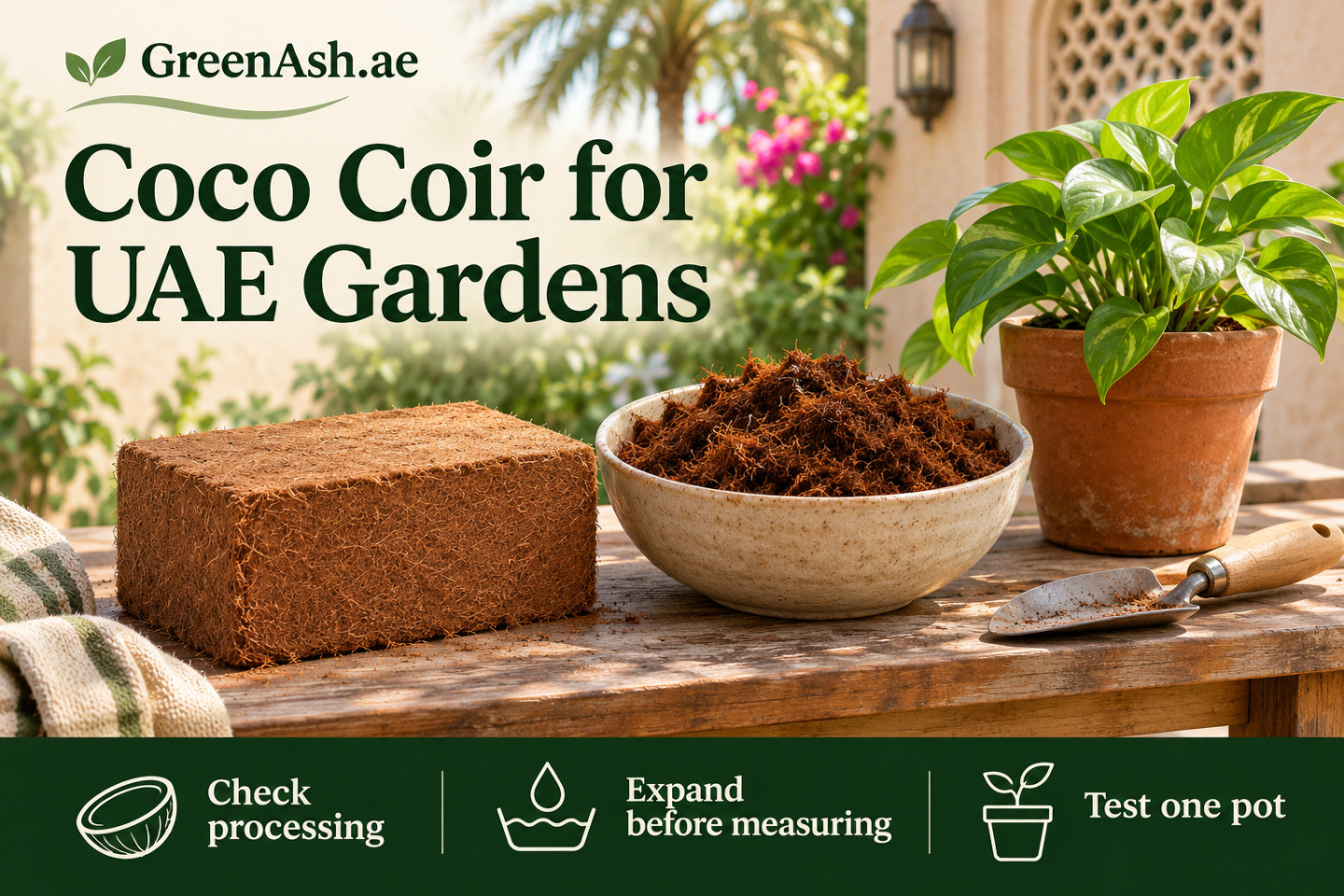
Coco coir, often sold as coco peat, can be useful in a UAE container garden, but a compressed block and a finished bag of potting mix are different purchases. Before filling a balcony planter, check what the material is, how it has been processed and what else your plants will need.
This guide focuses on evaluating coir and preparing a small trial. It does not prescribe a universal mix for every plant or a hydroponic nutrient recipe.
What is coco coir?
Coir comes from coconut husks. RHP, the growing-media quality organisation, distinguishes fine coir pith from coarser chips and fibres. Pith is used as a growing medium or blend ingredient; chips create a more open structure. Two bags labelled “coconut” can therefore behave differently when watered.
Write down the intended job before shopping: filling a seed tray, making a houseplant mix or supporting a long-term patio plant. Ask for the grade intended for that use rather than choosing only by block weight.
Washed and buffered: what should the label say?
Coir can contain unwanted salts. RHP explains that processing and buffering help control the salts released during cultivation. The RHS discussion of coir distinguishes washing with water from buffering, which involves adjusting the salt balance using calcium nitrate. These descriptions are not interchangeable.
For home use, ask the supplier whether the product is horticultural grade, already washed and suitable for your chosen plants. If a crop or growing system needs buffered coir, obtain a product with that specification. Do not assume that a quick soak at home reproduces an industrial buffering process.
An EC figure describes electrical conductivity, which helps assess dissolved salts. Ask for the test method as well as the number; a bare value without sampling details is difficult to interpret. Our soil pH and water alkalinity guide explains why pH, alkalinity and EC answer different questions.
Coir block or ready-made potting mix?
A block is a raw ingredient unless its label says otherwise. A blend may already contain coir alongside several other materials. For example, the GreenAsh listing for Terreau Substrate 50 L names coco-coir, peat materials, bark, perlite and clay. This is a mixed substrate, not a pure coir block. Check current availability and the bag instructions before choosing it.
That distinction matters when comparing prices: compare the usable volume and suitability of the finished growing medium, not simply kilograms of compressed material against litres of a loose blend. Also check whether feed has been added and, if so, how long the manufacturer says it lasts. Do not infer a complete feeding programme from the word “natural”.
Prepare a block before measuring your mix
Oklahoma State University Extension describes compressed coir as a material that expands when soaked and notes that processing varies between suppliers. Follow the block’s own water quantity and preparation instructions rather than assuming every block produces the same volume.
- Read the pack first. Confirm the intended use, expansion instructions and whether any rinsing is required.
- Use a clean container with spare room. Choose a tub that can hold the declared expanded volume.
- Hydrate as directed. Allow the material to soften, then gently separate remaining compressed sections. Do not measure a hard, partly hydrated lump as finished coir.
- Check consistency. Aim for an evenly prepared material before blending, following the manufacturer’s directions on draining excess water.
- Label what you made. Record the product, date and quantities so you can repeat or change the next batch.
For a UAE apartment, prepare only the amount you can handle neatly in a suitable work area. Keep loose material out of household drains and avoid leaving a tub of preparation water where children can reach it.
Does coir need perlite?
Not automatically. Iowa State University Extension explains that particle size, container shape, handling and watering all influence a potting medium’s performance. Perlite is commonly used to add air-filled spaces; it cannot compensate for every problem in a pot.
GreenAsh lists Desert Energy Natural Perlite, 10 L, whose page describes blending with coco peat and other media. Use the pack directions and your plant’s requirements to select a mix. For a comparison of mineral amendments, see perlite versus vermiculite.
Before buying another ingredient, check whether your existing mix already contains it. Adding material without knowing the starting recipe makes it harder to understand the result.
Run a small trial in your actual growing position
Keep a simple record for one representative pot: plant, pot size, mix, watering dates and observations. A sheltered indoor container and a sun-exposed terrace planter should not be assumed to need the same watering schedule.
Check moisture within the growing medium as well as at its surface, and confirm that excess water can leave the container. Iowa State advises against pressing media firmly into pots because this reduces air spaces. Fill consistently so that differences between pots are not simply differences in packing.
Evaluate new growth and watering behaviour before changing every container. If plants decline, check roots, drainage, watering and the feeding instructions before adding more fertilizer. For the practical pot-change process, use our repotting guide.
Frequently asked questions
Is coco peat the same as peat moss?
No. Coir is a coconut-husk material. The similar name does not mean it comes from peat deposits or has identical properties.
Can plants grow in pure coir?
Oklahoma State describes both standalone and blended uses. That does not make a plain block a complete plant-care system: choose an appropriate watering and nutrition programme for the crop and follow the product guidance.
Must every washed block be rinsed again?
Follow its preparation instructions. Ask the supplier if the treatment status is unclear instead of repeatedly rinsing a product that may already be prepared for use.
Will coir fix salty irrigation water?
Do not treat it as a water-treatment product. If salinity is a recurring concern, have the water and growing medium assessed before replacing all your pots or adding nutrients.
A useful purchase starts with a clear specification: the right grade, known processing, declared expanded volume and instructions suited to your plants. Test that choice in one pot before scaling up.