
Blog
Grass Seed in the UAE: Which Seed to Sow, When to Sow It and How Much You Need

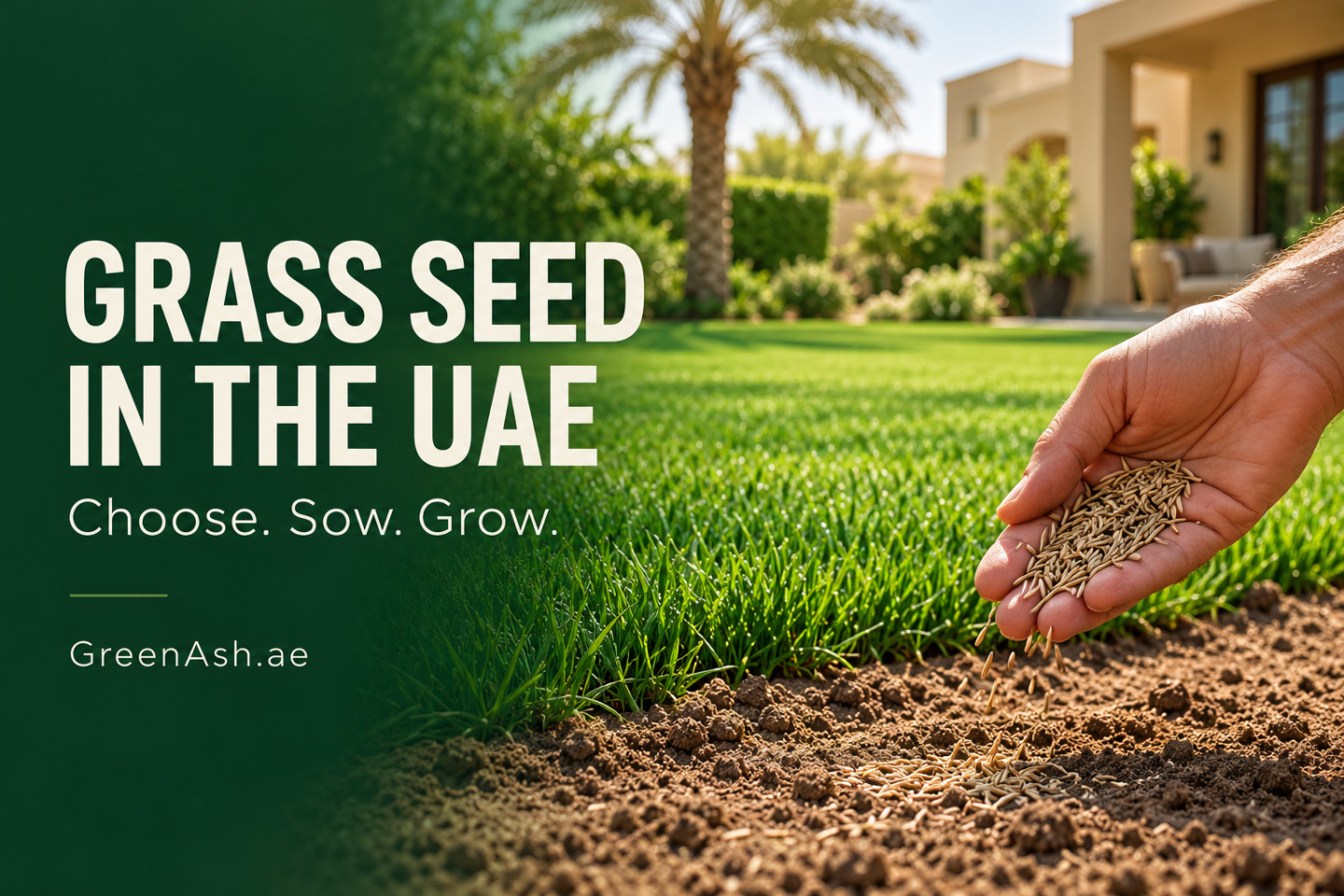
If you want a lawn that stays green through a UAE summer, build it on Bermuda grass (Cynodon dactylon). If you want green grass this winter, sow a mix that contains ryegrass and fescue once daytime highs settle at about 27 to 29°C, and accept that those grasses will fade when the heat comes back in May and June. Almost every other decision, from how much seed to buy to how often you water, follows from that one choice.
By the end of this article you will know which seed suits a sunny villa lawn, a shaded strip, a winter overseed or a farm paddock, how to read what is really inside a seed box, how many grams to weigh out for 1 m², 60 m² or 100 m², and what to do day by day until the first mow. We also say plainly where a product page is missing something you need.
The short answer: which grass seed for which job
| What you want | Seed to choose | When to sow in the UAE | What to expect |
|---|---|---|---|
| A lawn that lasts all year in full sun | Pure common Bermuda seed, such as Semillas Fitó Gobi Bermuda (ask for the date on the pack first, see below) | Warm soil: roughly March to May, or September and early October | Slow start, then a dense, fine carpet that spreads by runners |
| Fast green cover this winter | A mix of Bermuda with cool season grasses, such as Prime Green | November to mid December, once daytime highs settle at about 27 to 29°C | Quick green within a few weeks; the ryegrass and fescue thin out as summer heat builds |
| Shaded corners under trees or beside high walls | Eurogarden Sombra shade mix | Outside June to August | The page gives germination in about three weeks; species are not listed, so read the box |
| Bare patches in an existing lawn | The same grass your lawn already is, or the Franchi Rigenerazione repair mix for a cool season patch | Match the season to the grass type | Patches only blend in when the grass type matches |
| Fodder or a pasture on a farm | Ranger Rhodes grass, Mombasa or Super Mombaca | Warm months for Rhodes; the Mombasa page suggests roughly October to March | Tall forage grass. Not a lawn grass |
You can compare every option we stock in our grass seed range. Cat grass packs in the same range are for pets on a windowsill, not for lawns.
Decide before you buy: four questions
- Does the area get direct sun for most of the day? Bermuda is a sun grass. Under a ghaf tree, on the north side of a high wall, or in a courtyard that sees two hours of sun, a Bermuda lawn thins out whatever seed you use. Choose a shade mix for those spots, or plan for groundcover or gravel instead.
- Do you need it green in July? If yes, the lawn must be mostly Bermuda. Cool season grasses are winter guests in the UAE.
- Was your existing lawn laid from turf rolls? Ask the landscaper which grass it is. The University of Arizona Cooperative Extension notes in its desert lawn guide (AZ1817, 2020) that hybrid Bermudas are sterile and cannot be grown from seed; only common Bermuda can. If your lawn is a hybrid, seed sown into it will grow, but it will look a different shade and texture. For small holes in a hybrid lawn, plugs taken from the edge often match better than seed.
- How salty is your irrigation water? Bermuda handles salt better than ryegrass and far better than tall fescue (figures below). If you water with a borehole or treated sewage effluent (TSE) supply, lean towards Bermuda.
When the problem is not the seed
When a sowing “fails”, the cause often lies elsewhere. Use this table before you buy again.
| What you see | Likely cause | What to do |
|---|---|---|
| Nothing after 3 weeks, soil surface pale and crusted | Seed dried out between waterings, or was buried deeper than about 1 cm | Scratch the surface: if seeds are swollen but dead, it was drying. Resow and water 3 to 4 short times a day |
| Green stripes with bare bands between | Seed spread in one direction only, or sprinkler pattern missing bands | Sow in two crossed passes; check that sprinkler sprays overlap, as our lawn guide explains |
| Seed collected in low spots and along edges | Heavy watering washed it, or the bed was not levelled and firmed | Rake level, firm, and water lightly until roots hold |
| Seedlings came up, then fell over at soil level | Damping off fungi in wet, warm, crowded conditions | Water less often once up; see our damping off guide |
| Thick tall clumps that never knit together | Forage seed (Mombasa or Mombaca) sown as a lawn | Remove and resow with a lawn grass |
| Lovely in February, brown patches in June | Cool season grasses dying back in heat: expected, not a disease | Overseed with Bermuda in spring, or accept a winter only lawn |
| Poor germination across the whole area, even with good care | Old seed, or seed stored hot | Check the production and expiry dates on the pack before sowing |
Warm season or cool season: why it decides everything
Lawn grasses fall into two groups, and in the UAE the difference is not academic. It decides whether your lawn survives August.
Bermuda grass: the summer workhorse
Bermuda is a warm season grass. It uses a form of photosynthesis (called C4) that keeps working efficiently in heat and strong light, and it spreads sideways through runners above ground (stolons) and below ground (rhizomes). That is why a Bermuda lawn knits into a tight carpet and recovers from football and barbecues. The Gobi product page gives its best growth at 30 to 35°C and says it loses colour below 15°C.
The catch is timing. Bermuda seed needs warm soil. NC State Extension advises seeding once the soil reaches about 18°C (65°F) and keeping the seed no deeper than about 6 mm (1/4 inch); the Gobi page also gives soil above 18°C. The University of Arizona’s desert lawn guide calls the summer months ideal for planting Bermuda and says a seeded lawn takes about a month to establish, with several waterings a day. In the UAE, the practical window is spring (March to May), when the soil is warm but the evaporation is not yet brutal, or September into early October. Sowing in July works biologically but needs so much water that few gardens can keep the seed moist.
Ryegrass, fescue and bluegrass: the winter green
Perennial ryegrass, tall fescue and Kentucky bluegrass are cool season (C3) grasses. They grow best in mild weather and slow down, then thin and die, in sustained heat. In desert climates they are grown as winter grass. The University of Arizona overseeding publication (Kopec and Umeda, 2015) recommends sowing when daytime temperatures are around 27 to 29°C (80 to 85°F) and nights about 13°C (55°F). Sow too early and the Bermuda is still growing hard, so it crowds out the young winter grass; sow too late and seedlings grow slowly into the coolest weeks. Arizona’s lawn guide also notes that hotter May and June temperatures should burn out the winter grass.
On the UAE coast, in Dubai, Abu Dhabi and Sharjah, nights often stay above 13°C well into December, so waiting for the night figure alone can push sowing too late into the short cool season. Use the daytime highs as the main cue: when the forecast from the National Center of Meteorology shows highs settling at about 27 to 29°C, it is time to sow. Inland towns such as Al Ain cool sooner than the coast, so go by the forecast for your own area.
Salt: why Bermuda copes with UAE water better
The USDA Agricultural Research Service salinity database lists the soil salinity (ECe) at which growth of each grass starts to fall, and how fast it falls after that. These figures come from forage yield trials, so treat them as a ranking rather than a promise for your lawn:
| Grass | Growth starts to fall above | Loss for each extra dS/m | USDA rating |
|---|---|---|---|
| Bermudagrass | 6.9 dS/m | 6.4% | Tolerant |
| Perennial ryegrass | 5.6 dS/m | 7.6% | Moderately tolerant |
| Tall fescue | 3.9 dS/m | 5.3% | Moderately tolerant |
| Rhodes grass | No threshold given | No figure given | Moderately tolerant |
Tall fescue starts losing growth at a salinity little more than half of Bermuda’s. In a mix that is 40% tall fescue, expect the fescue to be the first part to suffer if your water is salty. Seashore paspalum is often sold in the region as the salt grass, and UF/IFAS describes its salt tolerance as excellent but says it needs so much maintenance that it is not recommended for home lawns. We do not currently stock a paspalum seed, and none of the lawn mixes we sell lists paspalum on its page.
Why seed rates differ so much
Bermuda seed is tiny, so a few grams hold thousands of seeds, and the plants spread sideways to fill gaps. Ryegrass and fescue seeds are much larger and the plants grow as clumps that do not spread far, so you need many more grams to get a dense cover. That is why Gobi is sown at 10 g per m² and Prime Green at 35 g per m². UC IPM gives an even lower Bermuda rate of 1 lb per 1,000 sq ft, about 5 g per m². Follow the pack: seed weights vary between suppliers, and some seed is coated, which adds weight without adding seeds.
Read the label: what is actually in the box
Two lawn seeds can both say “for UAE gardens” and behave completely differently, because the grass species inside are different. These are the details on the product pages, as of November 2026.
Prime Green: a five grass mix
The Prime Green product page lists its composition as:
- 25% Bermuda (Cynodon dactylon, variety Gobi)
- 25% perennial ryegrass (Lolium perenne, Ringles)
- 40% tall fescue (Festuca arundinacea: Terrano 25% and Bizem 15%)
- 10% Kentucky bluegrass (Poa pratensis, Prafin)
So three quarters of the mix by weight is cool season grass. The page describes the blend as drought, heat, shade and disease resistant and “suitable for all seasons”. We cannot support those claims as written: the cool season share will thin out in a UAE summer, and the USDA figures above put tall fescue, the biggest single component, as the least salt tolerant grass in the mix. What the mix does well is give fast green cover in the cooler months, with a Bermuda share that can carry part of the lawn into summer. Expect it to look thinner in its first summer than a pure Bermuda lawn.
The page gives 35 g per m² for a new lawn and 40 to 50 g per m² for overseeding, about 25 to 30 m² per 1 kg pack, a cover of 0 to 1 cm of soil, a first mow at about 10 cm and a maintenance height of about 30 mm. It does not give a sowing temperature, which is why we use the Arizona temperature guide above.

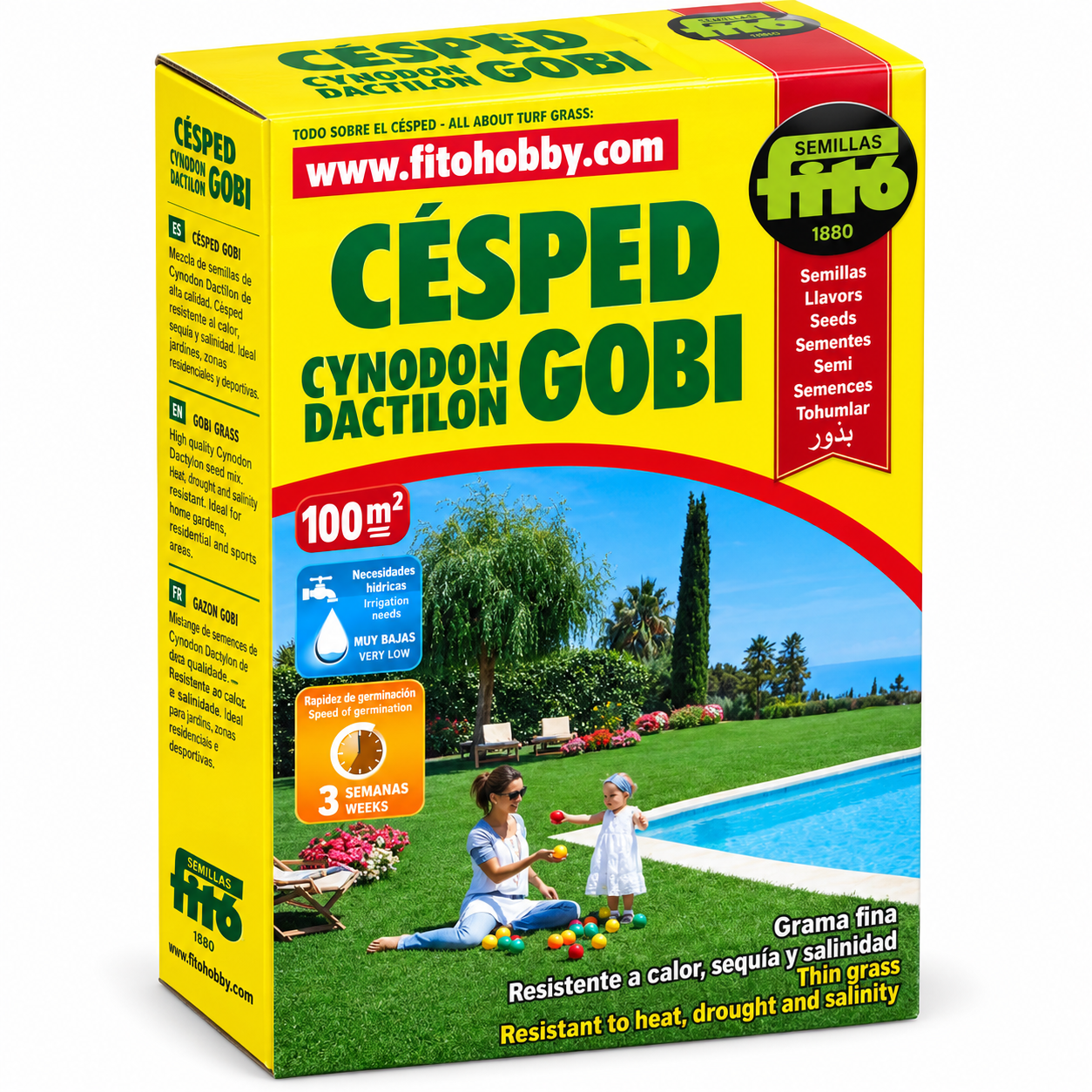
Gobi Bermuda: one grass, one job, but check the date
The Gobi page describes 100% Cynodon dactylon, sown at 10 g per m², so a 1 kg box covers about 100 m². It gives minimum germination of 85% and purity of 98% from the photographed pack, germination in about three weeks, sowing in spring once the soil is above 18°C, and a first mow at about 10 cm.
There is a catch we want you to know before you buy. The photographed pack on the page shows a production date of 01/2021 and an expiry date of 01/2023, and the page itself asks that the expiry date and germination of the actual stock be verified. Grass seed loses germination with age, faster when stored warm. Until the current stock date is confirmed, we are not recommending Gobi as a pick. If you want a pure Bermuda lawn from seed, message us and ask for the production and expiry dates on the box in stock before you order. It is also not the best month for it: in November the soil is cooling, Gobi sown now will come up slowly, and the page itself says it loses colour below 15°C.
Franchi and Eurogarden boxes
The Italian Franchi Jolly Universale, Franchi Sunny and Franchi Rigenerazione boxes each say they cover 40 m², and so does the Eurogarden Sombra shade mix. None of the four product pages lists the grass species inside. Here is what each page does say:
- Franchi Jolly: sow February to April or September to November; avoid June to August unless the soil can be kept constantly moist; germination 7 to 14 days in good conditions; loosen the top 2 to 3 cm; first cut at 6 to 8 cm, down to 3 to 5 cm. No species, no pack weight.
- Franchi Sunny: 1 kg covering up to 40 m², which works out at 25 g per m²; germination 7 to 12 days; same sowing months; low shade tolerance. The page claims heat resistance “up to 45 to 48°C”, which we cannot check without knowing the species.
- Franchi Rigenerazione: a repair mix for up to 40 m². No species, rate, weight or sowing time on the page.
- Eurogarden Sombra: shade tolerant, up to 40 m², germination in about three weeks. No species or rate.
Italian lawn mixes are usually built from cool season grasses, but we will not guess. When the box arrives, read the composition printed on it. If it is mostly ryegrass, fescue or bluegrass, treat it as a winter lawn and sow it in the cool season, as described above.
Rhodes, Mombasa and Mombaca: forage, not lawn
Rhodes grass (Chloris gayana) and Mombasa and Mombaca (Panicum maximum) are pasture and fodder grasses. They grow tall and coarse, which is exactly why they are wrong for a lawn and right for a farm.
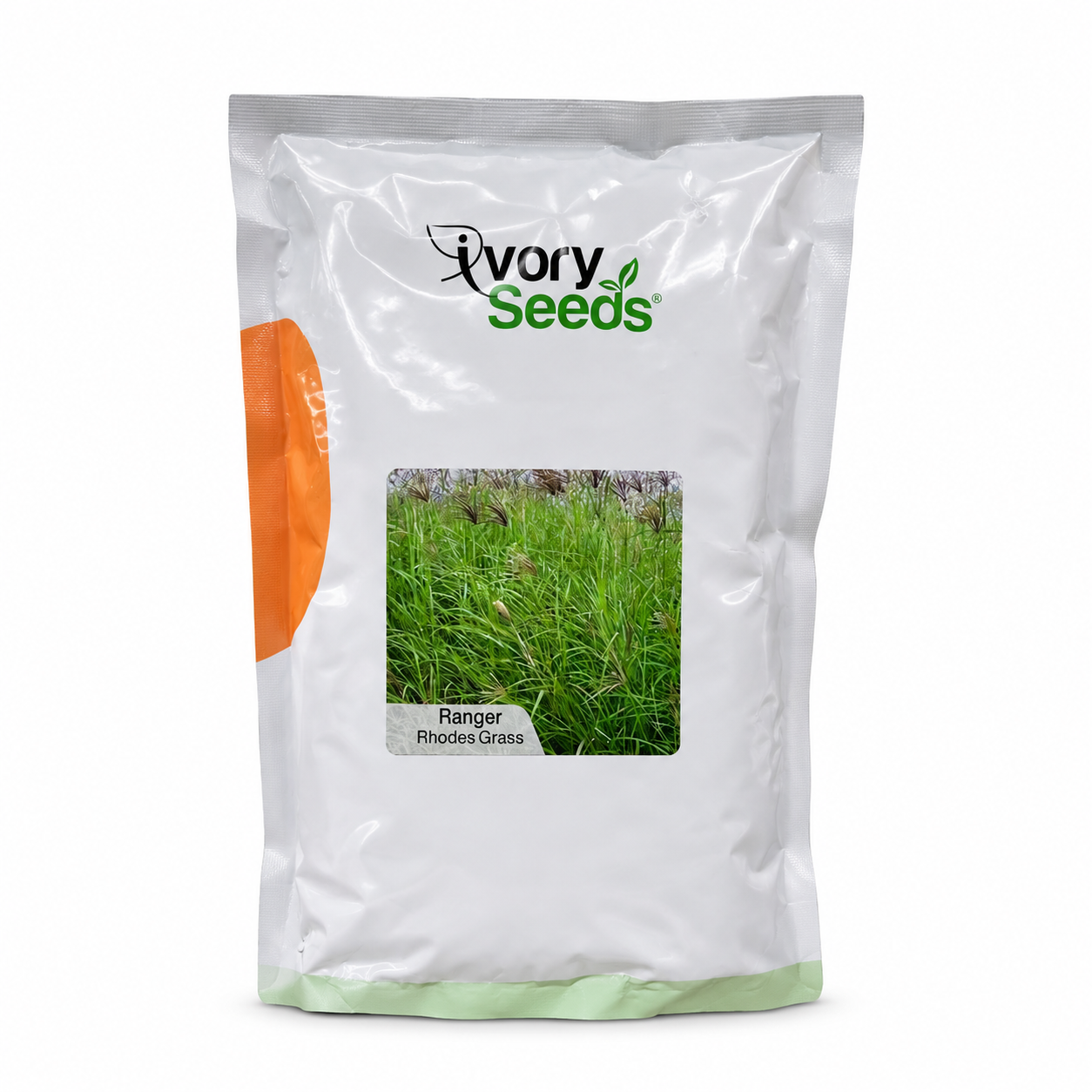
The Ranger Rhodes page is the most complete seed label in our grass range: non-hybrid, 90% purity, 85% germination, metalaxyl seed treatment, USA origin, lot IS-100362, tested February 2026, produced March 2026 and expiring March 2028. It is for open field planting only and gives no sowing rate, saying to follow local agronomic advice. The Western Australia Department of Primary Industries and Regional Development suggests 2 to 5 kg per hectare of good quality seed sown alone, drilled 5 to 10 mm deep or broadcast onto a firm, fine seedbed and rolled. It gives optimum germination at 15 to 40°C, growth greatly reduced below about 18°C by day and 13°C by night, and advises not grazing in the first year until plants and runners are well anchored.
Super Mombaca lists 96% germination and 98% purity in a 300 g pack; the Mombasa page describes treated seed in a 1 kg pack but names neither the treatment nor the germination. Neither page gives a sowing rate.
Comparison of the grass products in this article
Everything in this table comes from the product pages in November 2026. None of these is a pesticide, so there is no harvest interval; where a page lacks a rate or a date, we say so.
| Product | Species or analysis on the page | Pack | Rate on the page | Germination and dates on the page | Who it suits |
|---|---|---|---|---|---|
| Prime Green (60503) | Bermuda 25%, perennial ryegrass 25%, tall fescue 40%, Kentucky bluegrass 10% | 1 kg | 35 g per m² new; 40 to 50 g per m² overseeding | 1 to 3 weeks; no pack date given | Winter lawns and overseeding (boxed) |
| Gobi Bermuda (63133) | 100% Cynodon dactylon Gobi | 1 kg | 10 g per m² | About 3 weeks; photographed pack produced 01/2021, expiry 01/2023, page asks to verify stock | Sunny year round lawns, once the stock date is confirmed (not boxed) |
| Franchi Jolly (33137) | Not listed | Box for 40 m² | One box per 40 m² | 7 to 14 days; no date | Read the box species first (not boxed) |
| Franchi Sunny (33140) | Not listed | 1 kg | 1 kg per 40 m² | 7 to 12 days; no date | Full sun only, per the page (not boxed) |
| Franchi Rigenerazione (29070) | Not listed | Box for 40 m² | Not given | Not given | Patch repair in a matching cool season lawn (not boxed) |
| Eurogarden Sombra (29062) | Not listed | Box for 40 m² | Not given | About 3 weeks; no date | Shaded areas (not boxed) |
| Ranger Rhodes (64300) | Chloris gayana Ranger, metalaxyl treated | 1 kg | Not given | 85% germination; expires March 2028 | Farms and paddocks (boxed) |
| Premium Mombasa (30005) | Mombasa grass, treated (chemical not named) | 1 kg | Not given | Not given | Farms (not boxed) |
| Super Mombaca F1 (30156) | Panicum maximum Mombaca F1 | 300 g | Not given | 96% germination; no date | Farms (not boxed) |
| Floranid Twin Turf (33920) | 20-5-8 + 2 MgO, slow release N | 25 kg | 25 to 40 g per m² | Not applicable | Feeding established lawns (boxed) |
How much grass seed do you need?
Measure the lawn first. Multiply length by width in metres, split odd shapes into rectangles and add them up. For a curved bed, measure the longest length and the average width. Then:
Area in m² × sowing rate in g per m² = grams of seed
All rates below come from the product pages.
| Seed and page rate | 1 m² patch | 10 m² strip | 60 m² villa lawn | 100 m² lawn |
|---|---|---|---|---|
| Gobi Bermuda, 10 g per m² | 10 g | 100 g | 600 g (one 1 kg pack) | 1 kg (one pack) |
| Prime Green new lawn, 35 g per m² | 35 g | 350 g | 2.1 kg (three 1 kg packs) | 3.5 kg (four packs) |
| Prime Green overseeding, 40 to 50 g per m² | 40 to 50 g | 400 to 500 g | 2.4 to 3 kg (three packs) | 4 to 5 kg (four or five packs) |
| Franchi Sunny, 1 kg per 40 m² (25 g per m²) | 25 g | 250 g | 1.5 kg (two boxes) | 2.5 kg (three boxes) |
| Franchi Jolly, Rigenerazione or Sombra, one box per 40 m² | a small handful from one box | a quarter of a box | 1.5 boxes (buy two) | 2.5 boxes (buy three) |
A kitchen scale and a mug make this easy. Weigh how many grams of your seed fill a mug once, then count mugs rather than weighing every pass. Round up rather than down: running out halfway through a sowing day leaves a visible line in the lawn for months, and the leftover seed is useful for patching.
For comparison, Arizona’s overseeding guide uses 12 to 15 lb of ryegrass per 1,000 sq ft, which is about 59 to 73 g per m². Prime Green’s page rate of 40 to 50 g per m² for overseeding is lower, and the mix is not pure ryegrass. Stick to the rate on the pack you are using, not a rate written for a different seed.
For a farm, the WA guide’s 2 to 5 kg per hectare equals 0.2 to 0.5 g per m², so 1 kg of Rhodes seed would cover roughly 2,000 to 5,000 m² at those rates. That is a government pasture guide for Western Australia, not a rate from the Ranger pack, so check it with your local agricultural extension office before sowing a large area.
How to sow a new lawn, step by step
- Clear the area. Remove stones, roots, old weeds and builder’s rubble from the top 10 to 15 cm. Builder’s rubble and cement residue left after construction hold grass back for years, so dig them out now.
- Improve the top layer. UAE sand holds little water or nutrient. Work organic matter into the top 10 cm before sowing, then rake level. Our vermicompost guide explains how much to use.
- Level and firm. Rake out humps and hollows, then walk the area or roll it. NC State’s simple test: if your shoe sinks more than about 3 mm, the bed is too loose. A loose bed dries fast and lets seed sink too deep.
- Water the day before. Sow into soil that is moist, not wet or dusty.
- Weigh the seed using the table above, and split it into two equal halves.
- Sow in two directions. Spread the first half walking up and down, the second half walking across. Both the Prime Green and Gobi pages describe this, and it is the single best way to avoid stripes. Pick a still morning; afternoon sea breezes blow fine Bermuda seed off target.
- Cover lightly. Rake gently so the seed sits under 0 to 1 cm of soil, as both pages say. Then roll or press with the back of a rake so each seed touches soil.
- Keep the seed moist. For the first 7 to 10 days, the University of Arizona advises watering 3 to 4 times a day so the seed never dries out. Each watering should be short: just enough to darken the surface without puddles or runoff. A tap timer or a sprinkler on a short cycle makes this realistic, and a hose gun on a fine mist setting is gentler on seed than a jet.
- Stretch the gaps once it is up. When most seedlings are visible, cut to 2 waterings a day for a week, then once a day, then move towards deeper watering every second or third day. Arizona’s overseeding guide aims to keep the top 15 cm moist once grass is established: a long screwdriver should slide in that far and come out damp.
- First mow at about 10 cm, as the Prime Green and Gobi pages advise, with a sharp blade on dry grass. Never remove more than a third of the height at once, then lower gradually to the maintenance height. Prime Green gives about 30 mm; UC IPM gives 2.5 to 4 cm (1 to 1.5 inches) for seeded Bermuda.
- Keep off it for at least four to six weeks. A seeded lawn takes about a month to establish, according to Arizona’s desert lawn guide, and longer in cool weather.
First feed for a new lawn
Arizona’s lawn guide advises a fertilizer with more phosphate in the month of seeding, and its overseeding guide applies the first feed two weeks after the seedlings emerge. Don’t spread a strong nitrogen feed onto bare seed. Once the grass has been mown two or three times, a slow release lawn feed is a better fit than repeated strong doses. Our guide to fertilizer NPK numbers explains what the three numbers mean and how to compare feeds, and the slow release fertilizer guide explains why coated and slowly dissolving nitrogen suits sandy soil.
The Floranid Twin Turf page gives 25 to 40 g per m² depending on turf condition, spread on dry grass and watered in immediately, repeated every 8 to 10 weeks in the growing season. It does not give a separate rate for new lawns, so for a young lawn use the low end:
| Lawn size | Floranid at 25 g per m² (young lawn) | Floranid at 40 g per m² (top of page range) |
|---|---|---|
| 1 m² | 25 g | 40 g |
| 60 m² | 1.5 kg | 2.4 kg |
| 100 m² | 2.5 kg | 4 kg |

Overseeding a Bermuda lawn for winter green
Bermuda lawns go dull and straw coloured in the cooler weeks. If you want green through winter, you can overseed with a cool season mix instead of digging the lawn up. The University of Arizona sets out a timed preparation that we have converted to a calendar:
| When | What to do (University of Arizona, 2015) |
|---|---|
| 30 days before sowing | Stop nitrogen feeding so the Bermuda slows down |
| 14 days before | Raise the mowing height by 30 to 40% and cut irrigation by about 30% |
| 1 to 3 days before | Stop watering, then mow back down at the original height |
| Sowing day | Mow another 25 to 30% lower, leave the clippings, sow half the seed one way and half across, and work it in by dragging a mat or raking lightly |
| Days 1 to 10 | Water 3 to 4 times a day until seedlings emerge |
| 2 weeks after emergence | First light feed |
| When ryegrass is about 7 cm tall | First mow, dry turf, sharp blade |
The Prime Green page describes a similar process: mow short, open the thatch so seed reaches the soil, sow at 40 to 50 g per m² in two crossed directions, top dress thinly with fine soil or compost, roll, then water often and lightly. For a 60 m² lawn that is 2.4 to 3 kg of Prime Green, so three packs.
The spring hand back. In March and April, Arizona’s advice is to lower the mowing height by about 35%, keep feeding lightly and keep watering so the Bermuda grows back through the winter grass. The Bermuda then needs about 100 days of active growth before it is overseeded again. If your Bermuda is thin or weak, skip overseeding for a winter so it gets that full season of growth.
UAE timeline for grass seed
| Months | Lawn (villa garden) | Balcony or roof planter | Farm or paddock |
|---|---|---|---|
| Late September to mid October | Last good window for pure Bermuda from seed while soil is warm | Too hot for cool season seed on a sunny balcony | Rhodes can still be sown while days are warm; irrigation is essential |
| November to mid December | Sow cool season mixes and overseed Bermuda once daytime highs settle at about 27 to 29°C | Sow a small trough of a cool season mix in a bright spot | The Mombasa page suggests roughly October to March |
| December to February | Mow overseeded lawns, feed lightly, water less often; Bermuda is dull or dormant | Turn troughs for even light; water when the top 2 cm is dry | Rhodes growth slows sharply below about 18°C by day |
| March to May | Main window for Bermuda seed and repairs; start the spring hand back on overseeded lawns | Expect cool season grass to decline from May | Sow Rhodes as soil warms; do not graze new stands early |
| June to August | Avoid sowing unless you can water several times a day; mow Bermuda often and water early morning | Most balcony grass will not survive full afternoon sun | Water by deep cycles; heat favours warm season grasses |
Coastal humidity. In Dubai, Sharjah and Abu Dhabi, autumn and spring mornings can be very humid, and the surface stays wet longer. Cut the number of daily waterings once seedlings are up, because damp, crowded seedlings are where damping off starts.
Salty water. If your irrigation water is salty, sow Bermuda rather than a fescue heavy mix, water a little more deeply at each session to push salt below the roots, and ask your landscaper for an EC reading of the water before choosing seed.
Sandy soil. Seed in pure sand dries out within hours on a sunny afternoon. Organic matter in the top 10 cm and a light top dressing after sowing buy you time between waterings.
Mistakes that waste grass seed
- Using forage seed for a lawn. Mombasa, Mombaca and Rhodes are grown for bulk, not for a fine surface. Mown short, they make a coarse, uneven cover. Use them on farms only.
- Sowing pure Bermuda in December. The seed sits in cool soil and germinates slowly; the Gobi page gives soil above 18°C for sowing and colour loss below 15°C. Wait for March, or sow a cool season mix now.
- Sowing a ryegrass mix in September heat. Arizona’s guide says sowing while it is still warm favours the Bermuda and keeps the winter grass from establishing. Wait for daytime highs of about 27 to 29°C.
- Letting the seed dry out. A seed that has swollen and started to germinate dies if it dries. One missed watering on a hot afternoon can cost much of the sowing.
- Burying the seed. Grass seed is small. Deeper than about 1 cm and many seedlings never reach the light. Rake lightly, do not dig the seed in.
- Feeding bare seed with strong nitrogen. Concentrated fertilizer near germinating seed can scorch the young roots, and it feeds weeds first. Feed after emergence, at a modest rate.
- Using a grass killer near a new lawn. Herbicides for grassy weeds, such as clethodim, are made to kill grasses and will kill lawn grass too. Even lawn weed killers often carry label limits for newly sown grass. Read the label before spraying anything on or beside a new lawn.
- Buying by the box picture. “UAE climate” on a box tells you nothing. Read the species and the dates.
Troubleshooting: if it did not work
No germination after the time on the pack. Scrape away a little soil in three places. If you find hard, dry seed, it was not kept moist or was sown too cool; keep watering for another week before you resow. If seed is swollen and soft or mouldy, it was kept too wet or was old. Check the dates on the pack.
Patchy cover after six weeks. Rake the bare patches lightly, resow at the same page rate, and keep those patches moist. For a Bermuda lawn in summer, small gaps often close by themselves as runners spread; give it a month before resowing.
Yellow seedlings. Pale, evenly yellow seedlings in sandy soil often just need their first light feed. Yellow stripes between green veins on the newest leaves can point to a shortage of iron instead. Yellow at the edges of the lawn near paving can come from heat reflected off the tiles and faster drying.
Weeds coming up faster than the grass. Common in imported topsoil and manure. Hand pull while small and mow regularly once the grass is up; many annual weeds are weakened by regular mowing while grass recovers. Do not spray a new lawn without a label that allows it.
When to call a professional. If the lawn has failed twice in the right season with good watering, the problem is likely below the surface: compacted fill, cement residue, very salty water or poor drainage. A landscaping company can test the soil and water and dig a test hole. For a large lawn that needs to be usable within weeks, turf rolls or sprigs are faster than seed, and they are the only way to get a hybrid Bermuda lawn, because hybrids cannot be grown from seed.
Safety and storage
- Treated seed. The Ranger Rhodes page says the seed is treated with metalaxyl, must not be used for human or animal consumption, must not be mixed with grain or feed, should be kept away from children and animals, and that you should wash hands after handling and use protective equipment. We suggest nitrile gloves and a dust mask when pouring and sowing treated seed, and wash hands before eating or smoking. The Mombasa page also describes treated seed without naming the chemical; handle it the same way.
- Livestock. Never feed leftover treated seed to animals or pour it into a feed bin. Keep animals off a newly sown paddock until the grass is established; the WA guide advises no grazing of new Rhodes stands until plants are well anchored.
- Fertilizer. The Floranid page says to keep children and pets off the lawn until the granules are watered in and to store the bag out of their reach. Sweep granules off paving and back onto the lawn so they do not wash into drains, pools or fish ponds.
- Pets and children. Keep dogs off a seeded area until after the first few mowings; digging and urine kill seedlings, and cats like freshly raked soil.
- Storage. Heat shortens seed life. The Rhodes page says store below 25°C, sealed, away from sunlight and moisture. A UAE garage or garden shed in summer is far hotter than that, so keep opened seed indoors in a sealed jar or bag.
- Disposal. Empty seed and fertilizer bags go in household waste. Do not burn treated seed bags. Unwanted treated seed should not be scattered for birds.
- Bees and wildlife. Sowing grass seed does not involve spraying, but avoid spraying insecticide on lawns where clover or other weeds are in flower.
Frequently asked questions
When is the best time to sow grass seed in the UAE?
For Bermuda, March to May or September to early October, when the soil is above about 18°C but water demand is manageable. For ryegrass and fescue mixes, November to mid December, once daytime highs settle at about 27 to 29°C, the figure the University of Arizona uses for desert overseeding.
Can I sow grass seed in summer in the UAE?
Bermuda can germinate in summer heat, but keeping the seedbed moist in June to August takes several waterings a day. The Franchi Jolly page advises avoiding those months unless the soil can be kept constantly moist. Cool season mixes should not be sown in summer at all.
How long does grass seed take to germinate?
According to the product pages: Franchi Jolly 7 to 14 days, Franchi Sunny 7 to 12 days, Prime Green 1 to 3 weeks, and Gobi and Sombra about three weeks. Cool soil, drying out and deep sowing all slow it down.
What is the best grass seed for a lawn in Dubai or Abu Dhabi?
For a lawn that must get through summer in full sun, Bermuda. For quick green cover in winter, a mix with ryegrass and fescue, ideally one that also contains Bermuda, such as Prime Green. For shade, a shade mix, and accept that heavily shaded spots may never hold a thick lawn.
How much grass seed do I need for 100 square metres?
At the page rates: 1 kg of Gobi Bermuda (10 g per m²), 3.5 kg of Prime Green for a new lawn (35 g per m²) or 4 to 5 kg for overseeding, or three 40 m² Franchi or Sombra boxes.
Can I grow paspalum from your seed?
No. None of our lawn seed pages lists seashore paspalum, and the Franchi Jolly page lists no species at all, so do not expect it to be paspalum. UF/IFAS describes paspalum as very salt tolerant but too high maintenance for most home lawns.
Why is my new lawn dying in May?
If it was sown from a cool season mix, the ryegrass, fescue and bluegrass are reaching the end of their season. That is normal in UAE heat. Overseed with Bermuda in spring if you want summer cover.
Is Mombasa or Rhodes grass good for a garden lawn?
No. Both are tall forage grasses for grazing and fodder. Choose Bermuda or a turf mix for a lawn, and keep forage seed for paddocks.
Next step
Once the new grass has filled in, our guide on maintaining a healthy lawn in the UAE takes over with sprinkler checks, mowing heights and a month by month feeding plan. Not sure which seed suits your garden? Send us a photo of the area, how many hours of sun it gets and its size in square metres, and we will help you choose a pack from our grass seed range and work out how much you need.
