
Blog
Vermicompost in the UAE: What It Does, How Much to Use and Which Pack to Buy


Vermicompost is compost made by earthworms. The worms eat organic waste and leave behind dark, crumbly castings that smell like forest soil. For UAE gardens, where sandy soil drains fast and holds few nutrients, it is a simple way to build a better root zone. The short answer on quantity: mix it in at 10 to 20% of the soil volume in beds, use 1 part to 4 parts potting mix for seedlings, top dress pots with about 2 tablespoons per litre of mix every 2 to 4 weeks, and spread about 0.34 kg per m² on an established lawn. More is not better, and vermicompost is a soil improver first and a feed second.
By the end of this article you will be able to tell whether vermicompost is the right fix for the problem in front of you, work out how much to buy for a pot, a bed or a lawn, use it through the UAE seasons, and avoid the mistakes that waste it.
Is vermicompost the answer? Check the problem first
Vermicompost fixes poor soil. It does not fix every yellow leaf. Before buying a bag, match what you see to the likely cause.
| What you see | Likely cause | Is vermicompost the answer? | What to do |
|---|---|---|---|
| Water runs straight through the bed and plants wilt by afternoon | Sandy soil with almost no organic matter | Yes, as part of the fix | Mix in vermicompost or compost, mulch the surface and check your watering |
| New beds or pots filled with plain sand or tired old mix | No structure, little soil life | Yes | Mix at 10 to 20% by volume before planting |
| Older, lower leaves turn evenly pale yellow on a growing plant | Often nitrogen shortage | Only partly; it is slow and low in nutrients | Use a fertilizer with a stated NPK, then keep vermicompost for soil building |
| Newest leaves yellow with green veins | Usually iron chlorosis in alkaline soil | No | Treat the iron problem; adding castings will not correct it |
| White crust on the soil, brown leaf tips and edges | Salt build up from water or fertilizer | No; it can add salts of its own | Water deeply to flush salts below the roots and cut back on feeding |
| Seedlings fall over at the soil line | Damping off, a fungal disease | No | Start again with a clean mix and clean trays |
| Tiny black flies around pots after top dressing | Fungus gnats breeding in a wet organic surface | Vermicompost is part of the cause here | Let the top of the mix dry between waterings |
If your problem sits in the bottom four rows, vermicompost will not solve it, and spending on it first delays the real fix. Our guide to fertilizer NPK numbers explains how to choose a feed when the plant is short of a nutrient rather than short of good soil.
What vermicompost does, and what it does not
Think of vermicompost as a soil improver first and a gentle feed second.
How worms make it
Ordinary compost heaps heat up. Microbes break the material down at high temperature over several months. Vermicomposting works differently. NC State University’s vermicomposting specialist Rhonda Sherman describes it as a mesophilic process, meaning it runs at moderate temperatures, while ordinary composting is thermophilic. The usual worm, the red wiggler Eisenia fetida, does best at roughly 16 to 27 °C and tolerates about 0 to 35 °C, according to the same NC State material. Her slides put vermicomposting at 2 to 3 months, against 6 to 9 months for a hot compost heap, and stress that the two are separate methods that should not be combined.
The worms grind and digest the feedstock, and what comes out is fine, even, and near neutral in pH. That fine texture is why vermicompost mixes so easily into pots and seed trays, where chunky compost would leave air pockets.
Why it helps sandy UAE soil
Most garden soil in the UAE is sand. Sand grains are large, the gaps between them are wide, and water drains through before roots can use it. Colorado State University Extension notes that sandy soils have low water retention and benefit from amendments such as compost that hold moisture.
The size of the effect in Emirati sand is striking. In a project in Dubai, the International Center for Biosaline Agriculture (ICBA) measured water retention in local sandy desert soil and in compost. At the same suction, the original sand held 5.1% water and the compost held 61%. That trial used ordinary compost and zeolite, not vermicompost, but the principle is the same: organic matter is where sand gets its water holding from. Combinations of compost and zeolite raised barley growth in pots by 20 to 86% over unamended sand at reduced irrigation, which the authors describe as preliminary results needing field checks.
The University of Florida IFAS, working with sandy Florida soils, found that each 1% rise in soil organic matter raised the water holding capacity of sand by about 2.3%. That sounds small, and it is honest: one bag of vermicompost will not turn sand into loam. Building organic matter is a season by season job, which is why the amounts below are repeated rather than dumped in once.
What is in it
Sherman’s NC State slides list humic acids, plant growth regulators (gibberellins, cytokinins and auxins), enzymes and beneficial microbes, alongside plant available macro and micronutrients. What none of the vermicompost pages we stock gives is a figure: no NPK analysis, no organic matter percentage, no salt reading. Nutrient content depends on what the worms were fed, so treat any pack as a low and variable source of nutrients unless the label states an analysis.
What the research says about the right amount
Researchers at Ohio State University’s Soil Ecology Laboratory ran some of the best known trials. Atiyeh, Arancon, Edwards and Metzger (2000, Bioresource Technology) replaced 10 to 100% of a commercial potting medium with pig manure vermicompost for greenhouse tomatoes. The highest marketable yield came at 20% vermicompost, while seedlings grown in 100% vermicompost were shorter, with fewer leaves and less weight than the controls. A second Ohio State paper (Atiyeh and colleagues, 2000, Pedobiologia) found that 10 or 20% vermicompost in the potting medium increased marigold and tomato seedling growth.
Two details matter. First, every plant in those trials also received a complete nutrient solution, so the benefit came on top of normal feeding, not instead of it. Second, the response peaks and then falls. That is the evidence behind the 10 to 20% rule, and the reason a richer mix is not a better mix.
Salt: the hidden limit
All composts carry some soluble salts, and manure based ones can carry a lot. Colorado State University Extension treats amendments with up to 10 dS/m of salts as acceptable when mixed into low salt soil, calls anything above that questionable, and advises cutting rates for manure or biosolid composts unless a lab shows them to be low in salt. Its separate fact sheet on soil amendments suggests about 1 inch (2.5 cm) of a high salt amendment against 2 to 3 inches of a low salt one. No vermicompost page in our store gives a salt reading, so in a UAE garden that may already be watered with slightly salty water, stay at the lower end of every range until you see how your plants respond.
How much vermicompost to use
The clearest practical rates come from vermicomposting specialist Rhonda Sherman of NC State University (2021 slides, hosted by Washington State University Extension). These are general extension rates, not instructions printed on any one pack. Where a product page gives its own rate, we show that too. Measure by volume unless the line says kilograms.
| Where | How much (NC State guidance) | How often |
|---|---|---|
| Garden beds, new or refreshed | 10 to 20% of the final mix by volume: 1 part vermicompost to 9 parts soil, up to 1 part to 4 parts | At preparation; reassess before adding more |
| Seedlings and seed trays | 1 part vermicompost to 4 parts potting mix | When you fill the trays |
| Established pot plants | 2 tablespoons per quart of potting mix, which is about 30 ml (2 tablespoons) per litre, worked into the surface and watered in | Every 2 to 4 weeks in the growing season |
| Planting holes | Half a cup for small transplants; 1 to 2 cups for larger plants, shrubs and trees | At planting |
| Established lawn | 7 lb per 100 sq ft, about 0.34 kg per m² | Reassess before repeating |
| New lawn before sowing or turfing | 10 lb per 100 sq ft, about 0.49 kg per m² | Once, before sowing |
Product rates differ. The AgriGuru Earth’s Bounty product page suggests 1 part vermicompost to 2 parts soil for new plantings, which is about 33% of the mix and above the 10 to 20% range in the NC State guidance and the Ohio State trials. If you follow the page, we suggest using that ratio for planting holes and new beds of robust plants, and the lower NC State ratio for seedlings and salt sensitive plants. The Vermi Power and AgriGuru Enriched pages give no amount per pot or per square metre.
Worked examples: pots
Based on the NC State top dressing rate of about 30 ml per litre of potting mix:
| Pot size (litres of mix) | Top dressing every 2 to 4 weeks | Mixing in at potting (1 part to 4 parts, 20%) | Earth’s Bounty page ratio (1 part to 2 parts) |
|---|---|---|---|
| 1 L (small herb pot) | About 2 tablespoons (30 ml) | 200 ml vermicompost + 800 ml mix | About 330 ml vermicompost + 670 ml soil |
| 5 L | About 150 ml (10 tablespoons) | 1 L vermicompost + 4 L mix | About 1.7 L vermicompost + 3.3 L soil |
| 20 L (large balcony planter) | About 600 ml (2.5 cups) | 4 L vermicompost + 16 L mix | About 6.7 L vermicompost + 13.3 L soil |
Worked examples: a 1 m² bed and a 100 m² area
- A 1 m² bed, mixed 15 cm deep: the final mix is 150 litres. At 10% that is 15 litres of vermicompost; at 20% it is 30 litres. In NC State’s terms, 10% is a 1.5 cm layer dug into 13.5 cm of soil, and 20% is a 3 cm layer dug into 12 cm. At the Earth’s Bounty page ratio of 1 to 2 it would be 50 litres.
- A 100 m² vegetable plot mixed 15 cm deep: 10% means 1,500 litres, one and a half cubic metres. That is far more than most people will buy in bags. For an area this size, use bulk plant based compost as the main amendment and keep vermicompost for planting holes and seed rows.
- A 100 m² established lawn: at 0.34 kg per m² you need about 34 kg, so seven 5 kg bags. A new lawn at 0.49 kg per m² needs about 49 kg, ten 5 kg bags.
- One 5 kg bag on a lawn: covers about 14.6 m² of established lawn or about 10 m² of new lawn.
Packs are sold by weight, but bed and pot rates are by volume, and no page in our store gives a bulk density. To convert, fill a 1 litre jug level with the product and weigh it on a kitchen scale. If a litre weighs 0.5 kg, for example, a 5 kg bag holds about 10 litres. That one minute check tells you exactly how many bags a bed needs.
How to use vermicompost, step by step
- Water the bed or pot the day before. Slightly moist soil is easier to dig and mix evenly than dust dry sand.
- Measure, do not guess. Use the tables above. For a bed, mark out the area and work out the litres; for a pot, read the volume printed on its base.
- Dampen the vermicompost before you open it fully. NSW Health advises wetting compost and potting mix to keep dust down. Wear gloves and a dust mask.
- Mix it in thoroughly. In beds, spread the layer and dig or fork it to the full depth so the final mix is even. Colorado State warns against leaving compost in lumps, which interferes with root growth and water movement. In established pots, scratch it into the top 2 to 3 cm without tearing roots.
- Water it in well. This settles the castings around the roots and moves soluble nutrients down. The Vermi Power and Earth’s Bounty pages both say to water after applying.
- Mulch beds. A layer of mulch over the amended soil slows drying and keeps the organic matter you just added from baking at the surface.
- Let the surface dry between waterings in pots. A permanently wet organic top layer is where fungus gnats breed.
- Reassess before repeating. Look at growth, leaf colour and how long the soil stays moist. Colorado State advises reducing compost rates as soil organic matter builds.
Using liquid vermicompost
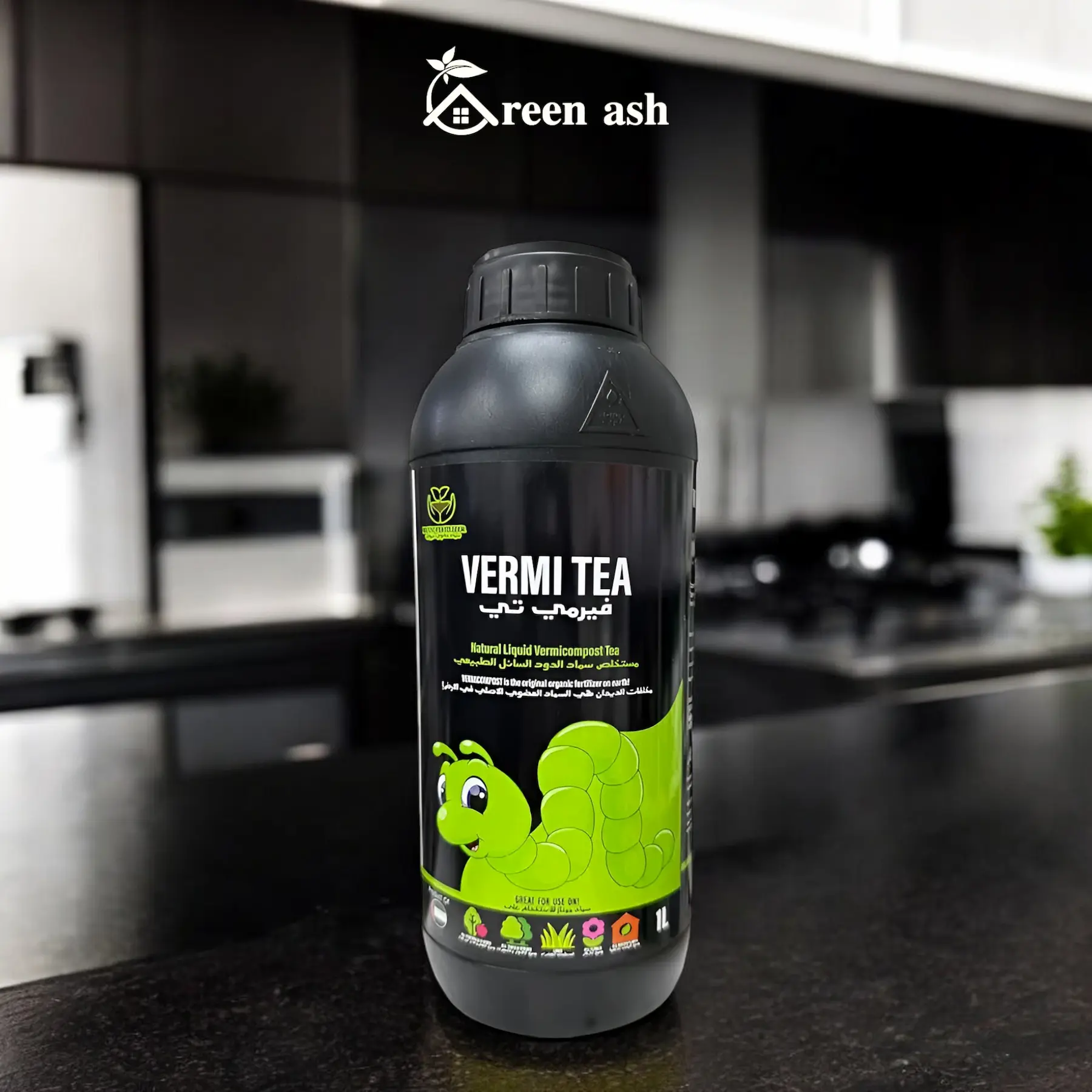
Liquid products are diluted and poured onto the soil rather than mixed in. They suit established pots and beds where you cannot dig. The Vermi Tea product page gives 50 ml per litre of water, applied every two weeks to the soil around the base of the plant. Worked out from that rate:
| Watering can or sprayer | Vermi Tea (page rate 50 ml per litre) |
|---|---|
| 1 L jug or hand sprayer | 50 ml |
| 5 L watering can or sprayer | 250 ml |
| 16 L knapsack | 800 ml |
A 1 litre bottle therefore makes 20 litres of diluted solution. Use a separate sprayer from the one you use for pesticides. The page does not give a nutrient analysis, so this is a supplement, not a full feed. NC State advises against using home brewed worm tea on food crops, so on vegetables and herbs we would apply any liquid vermicompost to the soil only, keep it off leaves and fruit, and wash produce before eating.
Which vermicompost to buy
We stock three bagged vermicomposts and one liquid. None of the pages states a nutrient analysis, organic matter content or salt reading, so you are choosing on pack size, form and whether a usable rate is given.
| Product | Analysis on page | Form and pack | Use on page | Rate on page | Harvest interval on page | Who it suits |
|---|---|---|---|---|---|---|
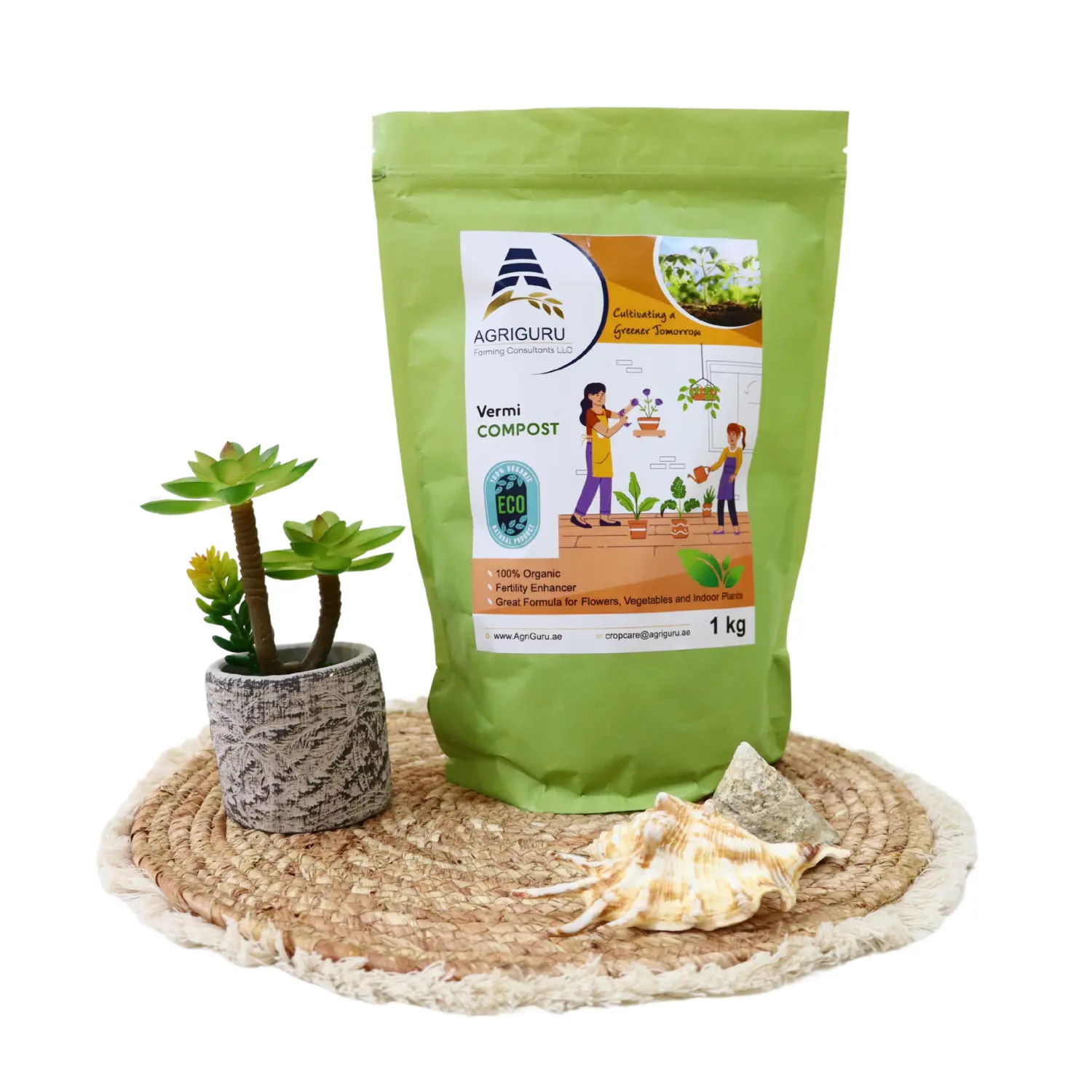
| AgriGuru Earth’s Bounty Vermicompost | None stated | Solid, 1 kg and 5 kg | New plantings; layer around established plants | 1 part to 2 parts soil for new plantings | Not stated | New beds and planting holes; the 1 kg pack for a few pots |
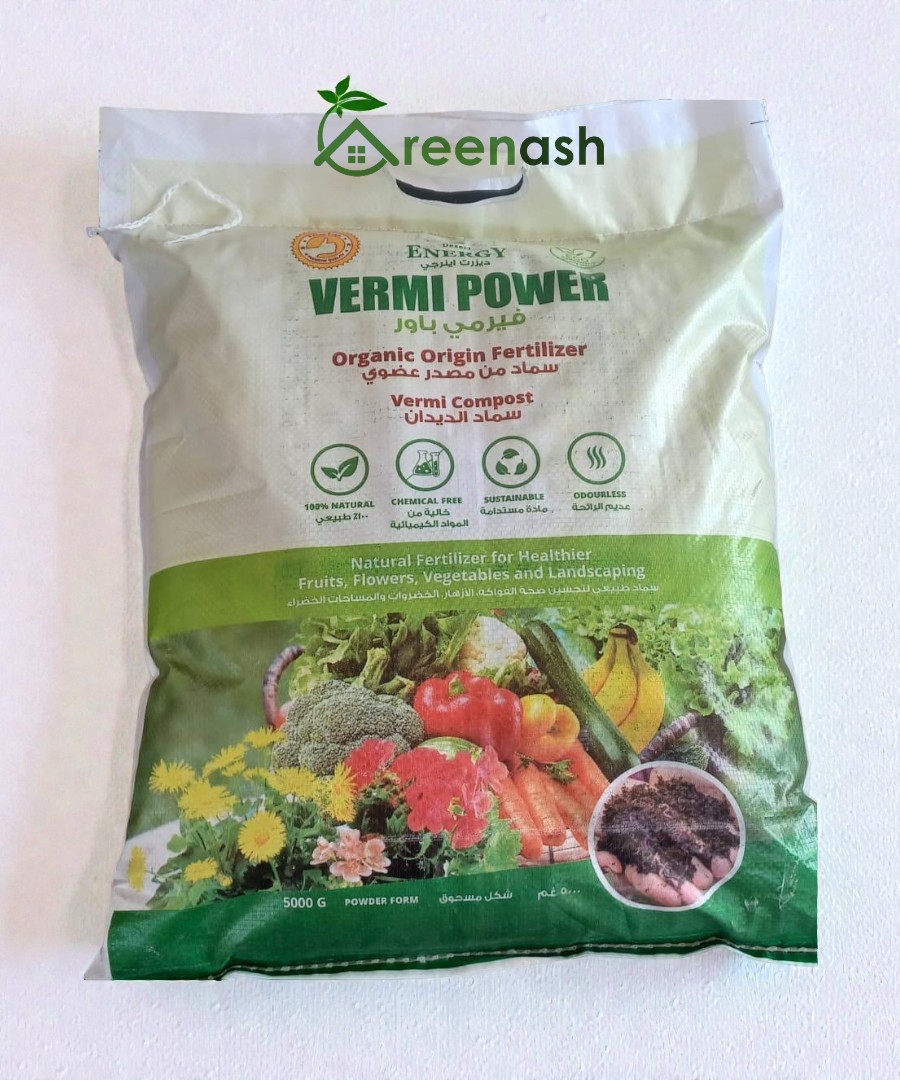
| Vermi Power Organic Vermicompost | None stated | Fine powder, 5 kg | Mix in at planting or top dress | No rate given | Not stated | Lawns and larger beds, using the NC State rates |
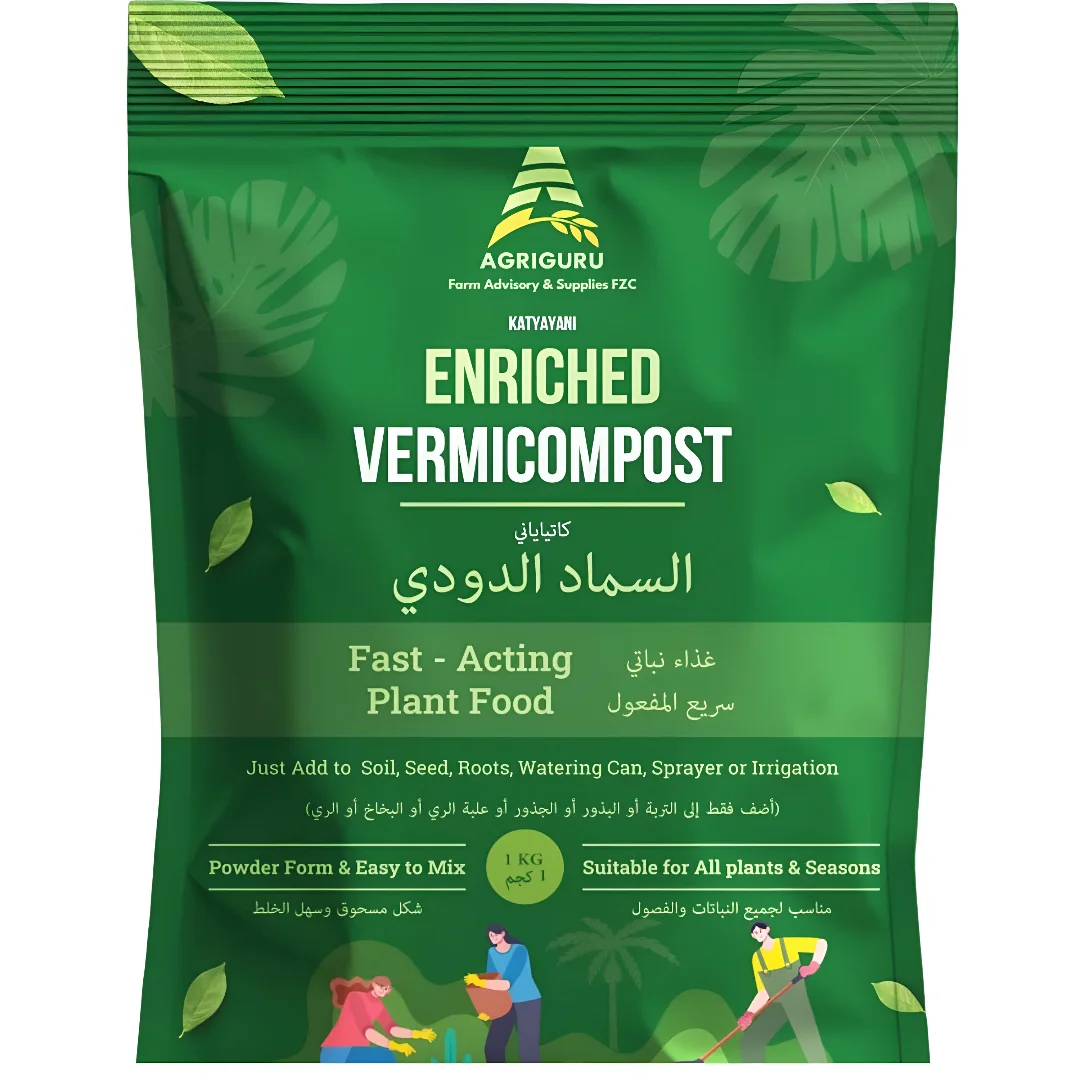
| AgriGuru Enriched Vermicompost | None stated | Powder, 1 kg | Soil, pots and beds | No amount; every 2 to 4 weeks, refers to the label | Not stated | A few pots, if you follow the pack label |
| Vermi Tea Liquid Vermicompost | Says it contains N, P and K; no figures | Liquid, 1 L | Diluted onto soil around the base | 50 ml per litre of water, every two weeks | Not stated | Established pots and beds you cannot dig |
For a balcony with a handful of pots, a 1 kg pack is the sensible size: at about 30 ml per litre, ten 5 litre pots take roughly 1.5 litres per round, and weighing a litre of the product tells you how many rounds the pack gives. For a lawn, only the 5 kg bags make sense. If you are comparing packs from different shops, ask for a written analysis. A pack that states nitrogen, organic matter and salt content lets you calculate; one that does not leaves you guessing.
Vermicompost through the UAE year
October and November: prepare
This is the main window. Dig vermicompost into new vegetable and flower beds at 10 to 20% before sowing, mix it into fresh potting mix for seed trays at 1 to 4, and refresh pots that sat through summer. Top dress Bermuda lawns as night temperatures drop and growth is still active.
December to February: maintain
Plants are growing hard in the cool weather. Top dress established pots every 2 to 4 weeks, or use a liquid vermicompost every two weeks on beds you cannot dig. Watch for fungus gnats indoors, where pots dry slowly in winter.
March and April: last rounds before the heat
Give a final top dressing to pots and perennial beds while plants can still use it, then mulch. Lawns that will carry on through summer can take a thin dressing in spring as growth picks up.
May to September: hold back
In summer, most vegetable beds are empty or shaded, and organic matter breaks down faster in hot, moist soil. Keep feeding to what irrigated ornamentals and shaded plants need, and do not dig large amounts into beds that will sit fallow until October. Store opened bags indoors: the Earth’s Bounty page asks for a cool, dry place away from sunlight. If you keep your own worm bin, it needs to be indoors in air conditioning; NC State gives about 35 °C as the upper limit red wigglers tolerate, which a shaded balcony exceeds for months.
Villa, balcony and farm
- Villa garden: beds on imported sand gain most from repeated yearly additions. Combine vermicompost in planting holes with bulk compost and mulch across the bed, and pair it with drip so water reaches the improved root zone.
- Balcony: pots dry fast in wind and sun. Vermicompost at 20% of the mix helps them hold water between irrigations, but do not exceed it: in the Ohio State tomato trial yield peaked at 20%, and seedlings in pure vermicompost were smaller.
- Farm: at field scale, vermicompost in bags is usually used in nursery mixes and planting rows, with bulk compost doing the soil building. The ICBA Dubai trial tested compost at 30 and 60 tonnes per hectare (3 and 6 kg per m²), which gives a sense of the quantities needed to change sand.
If your irrigation water is salty, vermicompost will not cancel it. Water deeply enough now and then for some water to drain below the roots, which carries salts down, and keep vermicompost rates modest.
Common mistakes
- Using it as the only feed. The Ohio State trials that showed benefits also fed every plant a full nutrient solution. Vermicompost improves the soil; a fertilizer with a stated analysis supplies the nutrients. Use both.
- Making the mix too rich. Tomato seedlings grown in pure vermicompost were smaller than the controls in the Ohio State work, and yield peaked at 20%. Stay at 10 to 20% for pots and seed trays.
- Leaving it as a dry layer on top. Unmixed castings dry, crust and blow away on a windy balcony. Scratch it in and water it in.
- Keeping the surface constantly wet. UC IPM names compost, organic fertilizers and mulches as favourite fungus gnat breeding spots and advises letting the container surface dry between waterings.
- Expecting it to fix yellow new leaves or salt burn. Those are iron and salt problems. Check the diagnosis table before buying.
- Buying by weight without converting to volume. Weigh a litre once so you know how many bags a bed really needs.
- Storing opened bags in the sun. Close the bag and keep it cool and dry so the castings do not dry to dust.
- Handling dusty material without protection. Wear gloves and a mask and dampen the material first.
Troubleshooting
No visible change after a month. That is normal for a soil improver. Look instead at how long the soil stays moist after watering, and compare with an untreated pot. If plants are pale, the problem is probably nutrients; add a fertilizer at its label rate.
Plants look worse after a heavy application. Leaf tip burn, wilting in moist soil or slow seedlings after a rich mix suggest too much salt or too much material. Water deeply to flush the root zone, and next time drop to 10%.
Small flies around indoor pots. Let the top 2 to 3 cm dry out between waterings, empty saucers, and skip the next top dressing. UC IPM gives a generation time of about 17 days at 24 °C, so keep the surface drier for at least a few weeks before judging whether numbers are falling.
Water still runs straight through. One application rarely changes sand much. Add mulch, check your watering times and repeat the amendment each season. Our article on hydrogel in sandy soil covers other water saving options and what the evidence says about them.
When to get help. If a whole bed declines despite good watering, send a soil sample and a water sample to a soil testing laboratory before adding anything else. Salt, pH and drainage problems need measuring, not guessing. If someone in your household develops a fever, cough or breathing difficulty after handling compost or potting mix, see a doctor and mention the gardening.
Safety
- Protective equipment: wear gardening gloves and a dust mask, an N95 or FFP2 type, when opening and mixing bags. NSW Health advises a mask and gloves before opening potting mix or compost, dampening it to keep dust down, and washing hands with soap afterwards because the Legionella bacteria linked to these materials can still be present. The Earth’s Bounty page also advises protective gear and not inhaling the product.
- Harvest interval: none of the product pages gives one. For edible crops, mix solid vermicompost into the soil rather than onto leaves, keep liquid products on the soil, and wash all produce.
- Re-entry: no re-entry period applies to vermicompost. Let watered in top dressing settle before children play on a lawn.
- Children and pets: the Earth’s Bounty and AgriGuru Enriched pages both say to keep the product away from children and pets. Store bags closed and off the floor.
- Bees and fish: vermicompost is not an insecticide, so bees are not a concern. Keep run off and leftover liquid out of fish ponds and drains, as nutrient rich water feeds algae. Use leftover diluted liquid on soil the same day.
- Storage: cool, dry and out of direct sun, as the Earth’s Bounty page says. Never leave bags in a car or on a sunny balcony in summer.
- Disposal: unused vermicompost can go into any bed. Empty bags go in general waste.
Frequently asked questions
Is vermicompost better than regular compost?
Both add organic matter. Vermicompost is finer and more even, which suits pots and seed trays. NC State’s figures show vermicompost costing many times more per cubic yard than ordinary compost, so compost is the practical choice for large beds. Plant based composts tend to be lower in salts. Many gardens use both: compost for volume, vermicompost where texture matters.
Can I use vermicompost on indoor plants?
Yes, in small amounts. Work about 2 tablespoons per litre of potting mix into the surface every 2 to 4 weeks in the growing season and water it in. Let the surface dry between waterings to avoid fungus gnats.
Can vermicompost burn plants?
Not in the way a strong chemical fertilizer can, but salt content varies, and seedlings grown in pure vermicompost were smaller in an Ohio State trial. Stay at 10 to 20% of the mix and water it in.
Can I plant directly into pure vermicompost?
No. Tomato seedlings grown in 100% vermicompost in the Ohio State trial were smaller than those in standard potting medium. Always mix it with soil or potting mix.
When is the best time to add vermicompost in the UAE?
October and November, when you prepare beds and pots for the cool season, then light top dressings through to April. Hold back in summer except for irrigated pots and shaded plants.
How much vermicompost does a lawn need?
NC State gives 7 lb per 100 sq ft for an established lawn, about 0.34 kg per m², and 10 lb per 100 sq ft before sowing, about 0.49 kg per m². A 100 m² lawn needs about 34 kg, or 49 kg if new. Our UAE lawn care guide covers feeding and watering alongside it.
Is vermicompost the same as humic acid?
No. Vermicompost contains humic substances along with organic matter, microbes and nutrients. Humic acid products are extracts. Our article on humic acid for sandy soil explains when an extract is worth buying.
Can I make vermicompost at home in the UAE?
Yes, with a bin kept indoors. Red wigglers do best around 16 to 27 °C and tolerate up to about 35 °C, so an outdoor bin is unlikely to survive a UAE summer. Feed fruit and vegetable scraps, keep the bedding moist, and expect harvests in months, not weeks.
Ready to improve your soil?
Pick the pack that matches your job: a 1 kg bag for a few pots, a 5 kg bag for a bed or lawn, or a liquid for established plants. Then pair it with a proper feed. Browse our organic fertilizers, and if you are sowing this season, read our guide to damping off in seed trays before you fill the trays. Message us with your pot sizes or bed area and we will help you work out how much you need.