
Blog
Growing Beetroot in the UAE: Seed Clusters, Thinning and Harvest

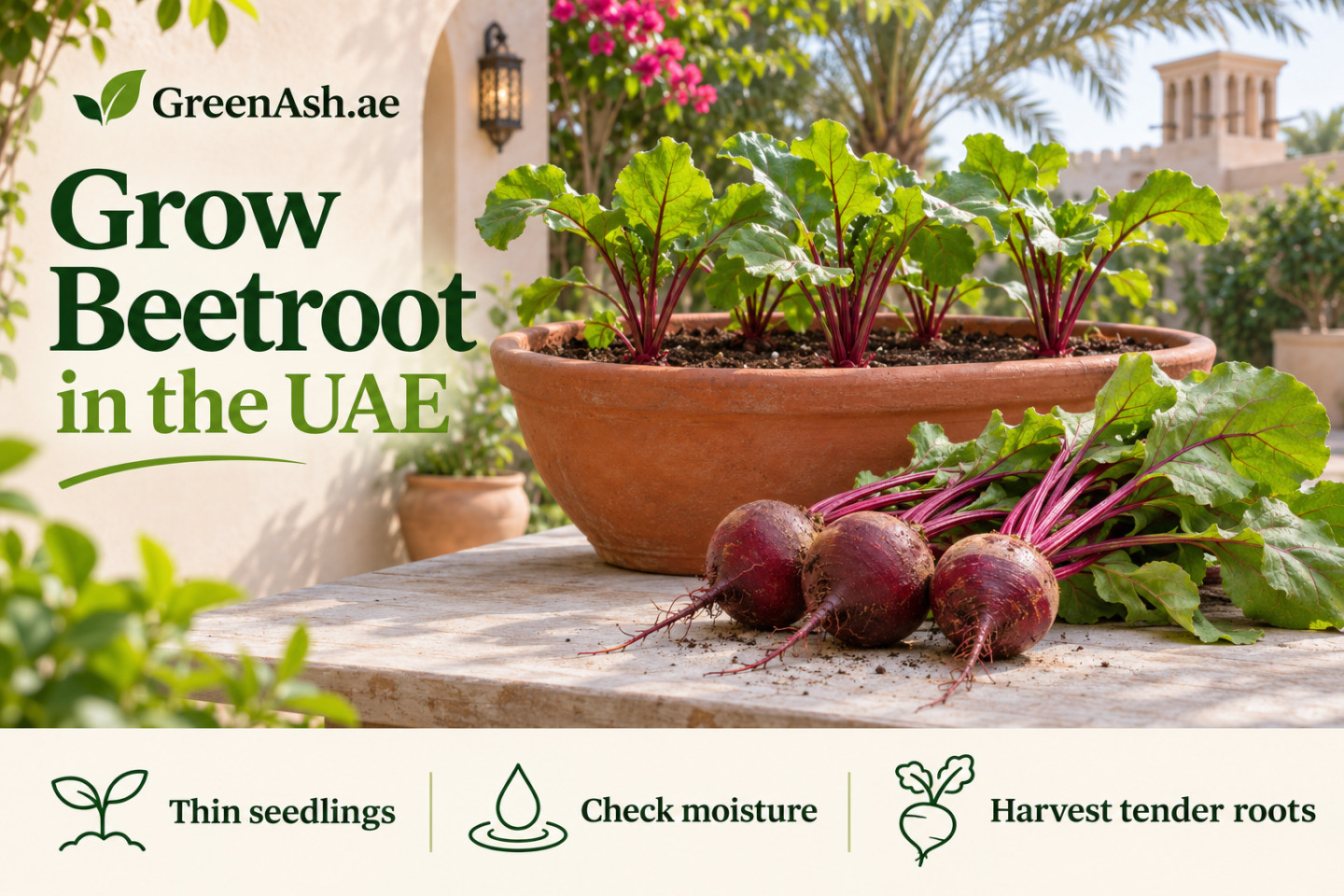
Growing beetroot in the UAE starts with a useful distinction: a beet “seed” can produce more than one seedling. A neat-looking sowing can therefore become a crowded row, with plenty of leaves but too little space for roots to enlarge. For a first crop, plan the final spacing before opening the packet.
This guide covers a small home crop in a garden bed or container, with particular attention to thinning, watering and deciding when to harvest.
When to plant beetroot in the UAE
The Ministry of Climate Change and Environment’s UAE vegetable planting calendar lists October–November for beetroot and a general harvest interval of 75–80 days. Treat this as a local planning reference, not a guaranteed maturity date for a particular packet.
For a November sowing, write down the date and begin observing root development as the crop grows. A balcony facing a hot wall and a sheltered garden bed will not behave identically. Record where you planted as well as when, so the next sowing builds on your own results.
Choose seed and plan the space
GreenAsh lists Kysar Beetroot Sweety F1 Hybrid Seeds in a 50-seed packet. The live listing was in stock when checked on 16 November 2026. Use the original packet for any variety-specific instructions. Neither packet quantity nor a germination statement guarantees the number of roots you will harvest.
Decide whether you want baby roots or larger cooking-size roots. For a straightforward first trial, allow approximately 10 cm between the plants you keep. A one-metre row with planting positions 10 cm apart gives roughly ten positions, allowing for margins at the ends. It does not need the whole packet.
Keep unused seed in its labelled packet and follow our vegetable seed storage guide. Saving part of the packet also lets you correct a crowded or poorly positioned first sowing without buying again.
Prepare a bed or a generous container
Choose a sunny position with loose, well-drained soil. Break up compacted lumps and remove weeds before sowing. Iowa State notes that a hard surface crust and dry soil can interfere with emergence, so the condition of the seedbed matters as much as the packet. Read Iowa State’s beet-growing guide.
For containers, the RHS beetroot guide recommends a large container at least 40 cm wide and, for planting out, at least 40 cm deep. Round-rooted varieties are a practical choice for container growing. Provide drainage holes and a suitable container growing medium. Measure the usable soil depth rather than the outside height of a decorative planter.
Sow, then inspect each seedling cluster
- Mark the row and label it. Record the variety, sowing date and intended final spacing.
- Sow at the appropriate depth. Iowa State gives about 1.3 cm; Maryland describes approximately 1.3 cm in fine soil or 2.5 cm in sandy soil. Follow any specific instructions on your packet and avoid burying seed deeply.
- Water gently. Keep the seed zone moist through emergence without leaving the bed saturated.
- Check each position. Several shoots together may come from one seed ball. Identify the beet seedlings before removing neighbours.
- Thin for the roots you want. For larger individual roots, leave the stronger seedlings with approximately 8–10 cm between plants.
The University of Maryland guide explains the difference between ordinary seed balls with several embryos and seed specifically designated “monogerm.” Do not assume an F1 label means monogerm. The GreenAsh listing does not establish that distinction for Sweety F1, so inspect the seedlings that actually emerge.
Intentional clusters can be grown for baby beets, as the RHS describes, but that is a different harvest plan. If your aim is larger roots, leaving every seedling tightly packed works against it.
Water by checking the soil
Use your fingers and a visual check to judge moisture around the plants. UC IPM advises careful irrigation, especially when plants are small, to avoid overwatering while maintaining a loose surface. Read UC IPM’s beet care guidance.
In a UAE pot, check the exposed edges as well as the middle. If one side dries much sooner, review the position and how evenly you apply water. For a bed supplied by drip, confirm that moisture reaches the whole row; our drip irrigation setup guide explains checking the line before relying on a timer.
Remove weeds while small, working shallowly near the crop. Maryland cautions that deep cultivation can damage beet roots. Before adding fertilizer, check what the soil or potting mix already supplies. Iowa State notes that fertile soil may need little or no additional fertilizer; this does not mean an unamended sandy bed will have the same nutrient supply.
Harvest a sample instead of waiting for every root
Use the expected harvest period as a reminder to inspect. UC IPM gives a general harvest size of about 2.5–7.5 cm across and warns that oversized roots or roots left too long can become tough. Carefully loosen the soil and lift a sample without stabbing the root.
Cook and assess that first root before deciding how much longer to leave the rest. Record its size and tenderness beside the sowing date. Remove the tops from roots intended for storage and refrigerate them; use harvested greens promptly, following UC IPM’s advice.
Quick troubleshooting
| Problem | First check |
|---|---|
| Patchy emergence | Look for a dry or crusted seedbed and compare sowing depth across the row. |
| Many seedlings but little room for roots | Count plants within each cluster and restore the intended spacing. |
| Split or woody roots | Review uneven watering, dry periods and delayed harvesting; the RHS identifies these as relevant causes. |
| Plants forming flowering stems | Review weather stress and variety choice. Bolting diverts growth from the root. |
Frequently asked questions
Why did several seedlings grow from one seed?
Many beetroot varieties are sold as seed balls containing several embryos. Thin according to the root size you intend to harvest.
Can beetroot be transplanted?
Yes. The RHS describes starting it in modules and moving young plants with minimal root disturbance. Direct sowing is a simple option when your final bed is ready.
Does a 50-seed packet mean 50 finished beetroots?
No. Emergence, thinning, growing conditions and losses affect the final crop. Plan planting positions first and keep a record of the result.
Should I leave every root until the calendar’s harvest date?
No. Check size and tenderness. The calendar is a planning aid; the actual crop and variety should guide harvesting.