
Blog
Insecticides in the UAE: How to Choose the Right One for Your Plants, and How to Read the Label

The right insecticide is the one whose label names your pest and your plant. That sounds obvious, but it is where most mistakes start: a strong spray bought for “insects” that does nothing to mites, a household cockroach concentrate used on tomatoes, or a systemic product sprayed on a herb you plan to eat tomorrow. So the order is always the same: identify the pest, pick a product whose label covers that pest on that plant, check the harvest interval and the protective equipment, then measure the dose for your sprayer.
By the end of this article you will be able to tell sucking insects from mites and from heat or salt damage, read a UAE pesticide label section by section, work out the exact grams or millilitres for a 1 L, 5 L or 16 L sprayer from the rate printed on the pack, and plan sprays around the UAE growing season, bees and your harvest date.
Step 1: Identify the pest before you buy anything
Turn over a few affected leaves, look at the undersides and the new growth, and match what you see to one of these groups. A x10 hand lens costs very little and settles most arguments. Hold a sheet of white paper under a shoot and tap it: aphids and thrips drop as moving specks, and spider mites show up as tiny dots that crawl slowly across the paper.
| What you see | Likely pest group | What that means for your choice |
|---|---|---|
| Clusters of tiny soft insects on shoots, sticky leaves | Aphids (sucking insects) | Products labelled for aphids; systemic or contact |
| Clouds of tiny white flies when you brush the plant | Whiteflies (sucking insects) | Products labelled for whitefly; follow treatment intervals and maximum applications |
| White, cottony clumps in leaf joints | Mealybugs (sucking insects) | Products labelled for mealybugs; the waxy coat makes them hard to hit |
| Fine webbing, speckled or bronzed leaves | Spider mites | Mites are not insects. You need a miticide or acaricide labelled for mites |
| Holes in leaves, chewed edges, droppings | Caterpillars or beetles (chewing) | Products labelled for caterpillars or beetles |
| Silvery streaks, distorted flowers | Thrips | Products labelled for thrips |
| Pale winding tunnels inside the leaf | Leaf miners (larvae inside the leaf) | Contact sprays rarely reach them; check the label names leaf miners on your crop |
| Hard brown or grey bumps on stems that do not move | Scale insects | Target the crawlers, the young mobile stage; oils and products labelled for scale |
If you are not sure, take a clear photo of the pest and the damage. Getting this step right saves money, because a product that is not labelled for your pest may simply not work on it.
When it is not an insect at all
Many UAE plants look attacked when the real cause is heat, water or salt. Spraying an insecticide on these plants adds cost and risk and fixes nothing. Check this table before you mix anything.
| Symptom | Points to insects or mites if | Points to something else if | What to do instead |
|---|---|---|---|
| Brown, crispy leaf edges | You also find live insects, honeydew or webbing | Edges brown on the sunny side first, after a hot week, with no pests under the leaf | Check watering depth and shade first |
| Yellow leaves | Fine speckling made of tiny dots, mites on the underside | Yellow between green veins on new leaves, or yellowing of old leaves only | Likely nutrition (iron or nitrogen); feed, do not spray insecticide |
| Curled new leaves | Aphids or thrips sit inside the curl | Curl after a herbicide spray nearby, or on every plant in a row at once | Look for drift or a nutrient cause |
| Black film on leaves | Sticky honeydew from aphids, whiteflies, mealybugs or scale above it | No sticky layer and no insects | Treat the sap feeder; the sooty mould follows it |
| White crust on soil or pot rim | Never | Salt build up from hard or brackish water | Leach the pot with a deep watering |
For a closer walk through the two pests that cause the most confusion, read our posts on checking leaves for spider mites and aphids on roses and vegetables. Both explain when rinsing or pruning is enough and no spray is needed.
How insecticides actually work, and why it changes what you buy
An insecticide has to reach the pest and then interfere with something the pest needs. Products differ on both counts, and that difference decides whether a spray works on your problem.
How it reaches the pest. Contact products kill or disable what they touch, so a mealybug hidden in a leaf joint survives if the spray never lands on it. Stomach poisons work when the pest eats treated tissue. Systemic products are taken into the plant and move in the sap, so sucking insects that feed on that sap are exposed even when they sit under a leaf you missed. The KINPLAN acetamiprid product we stock describes itself as contact and stomach acting, and the University of California (UC IPM) describes acetamiprid as a systemic, broad spectrum neonicotinoid. Physical products such as Siltac EC, according to its product page, work through silicone polymers rather than a conventional poison; oils and soaps also act physically, by coating or disrupting soft bodied insects, so they need full coverage and often a repeat.
Where it acts. Each chemical class hits one target in the pest, and the international system groups products by that target into numbered mode of action groups. Neonicotinoids such as acetamiprid and imidacloprid are group 4A; flupyradifurone (Sivanto Prime) is 4D; spinosad is group 5; abamectin is 6; Bt is 11A. The University of Florida (UF/IFAS) explains that these numbers appear on labels and that resistance builds when the same group is used on generation after generation of a pest. Two different brands of the same group count as the same tool.
How long it lasts. Some actives break down within days on leaves. The National Pesticide Information Center (NPIC) gives a half life of 1 to 2.5 days for azadirachtin, the main active part of neem, on plant leaves, one reason neem products need repeating. Longer residual products protect for longer but also stay hazardous to bees and natural enemies for longer.
Why mites are different. UC IPM points out that mites are not insects but arachnids, relatives of spiders and ticks. Many insecticides do little to them, and UC IPM notes that broad spectrum insecticide treatments for other pests frequently cause mite outbreaks by killing the mites’ natural enemies. Mites also favour hot, dusty conditions, which describes many UAE gardens in the hot months. A miticide such as bifenazate, or an oil or physical product whose label lists mites, is the right tool.
Step 2: Choose the right type of product
Agricultural insecticides and public health insecticides are not the same
This is the most important distinction on the pesticide shelf. Some products are made for crops and plants. Others are made for public health pests, such as cockroaches, mosquitoes and flies, in and around buildings, and say so on the label. Do not assume a product sold for public health pests is suitable for edible plants. Use it on a crop only when that exact product’s current UAE label explicitly permits the crop, pest and application. Our insecticides for plants and our household and public health pest control insecticides are listed separately for exactly this reason.
Some products in our range also carry restricted use wording on their pages, meaning retail and use are limited to certified applicators. We do not recommend those for home gardens, and if a page you are reading says restricted use, treat that as a stop sign for DIY use.
Contact or systemic
- Contact insecticides work on the pests they touch. Coverage matters: you need to reach the undersides of leaves where most sucking pests hide.
- Systemic insecticides are taken up by the plant and move through it, so pests feeding on the sap are affected. Whether they suit your pest depends on the product label. Harvest intervals matter for both contact and systemic products.
Do not infer permitted uses from an active ingredient or brand name alone: formulations and country specific labels can differ.
Organic and biological options
For light infestations, first consider nonchemical measures such as removing affected leaves where practical, or a firm jet of water on aphids. If a pesticide is needed, compare suitable labelled options, including our organic insecticides and biopesticides ranges. “Organic” is not a safety guarantee for children, pets or edible crops. They still have rates, intervals and precautions. UC IPM lists soaps, oils, Bt for caterpillars, spinosad and neem products among its less toxic insecticides, and it notes that azadirachtin has limited effectiveness, so expect to repeat it and to use it early, before numbers build.
Mites need a miticide
Because spider mites are not insects, many insecticides do little to them. Look in our miticides and acaricides range and check that the label lists mites.
A quick decision path
| Your situation | Start with | Step up to | Avoid |
|---|---|---|---|
| A few aphids on a balcony herb you pick daily | Rinse, pinch off the shoot | A neem or oil product whose label lists aphids and gives no or a short harvest interval | Any product with a harvest interval longer than you can wait |
| Whitefly or thrips on tomato, cucumber or pepper beds | Remove badly infested lower leaves, check twice a week | A crop insecticide that lists your crop and pest, used no more often than the label allows | Household concentrates; repeating one group all season |
| Spider mites with webbing in hot, dry weather | Hose the undersides, raise humidity around pots | A miticide or a product that lists mites | Broad spectrum insecticides that kill mite predators |
| Caterpillars chewing leaves | Hand pick in the evening | A product labelled for caterpillars on that crop | Sucking pest products that do not list caterpillars |
| Pests inside the house | Find the source; clean and seal | A licensed pest control company for heavy infestations | Garden crop products used indoors |
What we stock, compared honestly
The table below covers the plant insecticides and miticides we checked for this article. Every rate and harvest interval comes from the product page; where a page does not give one, we say so. The printed label on the pack takes precedence over any web page.
| Product | Active or type | Strength | Pack | Pests on the page | Rate on the page | Harvest interval on the page | Suits |
|---|---|---|---|---|---|---|---|
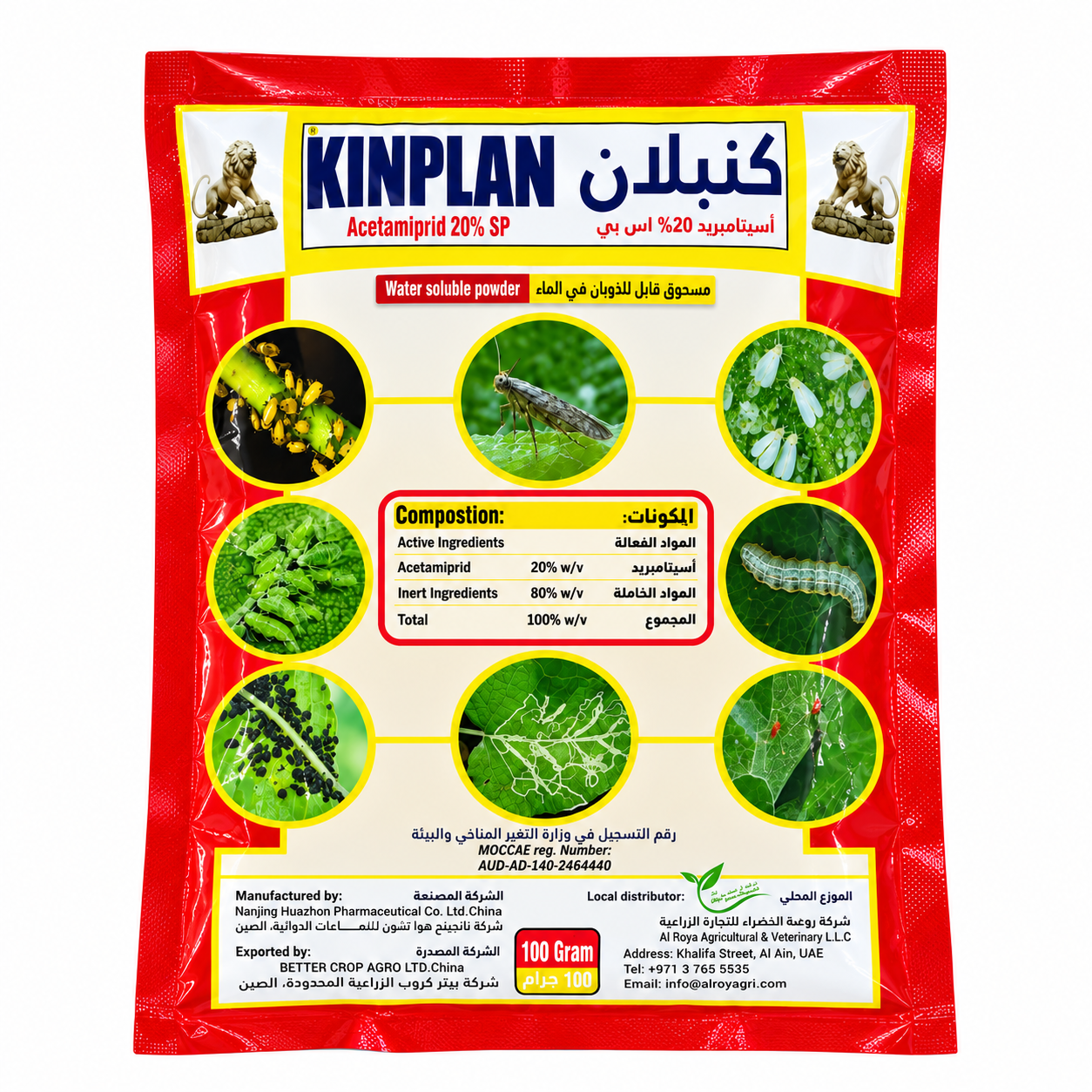
| KINPLAN Acetamiprid 20% SP | Acetamiprid (neonicotinoid, group 4A) | 20% soluble powder | 100 g | Aphids, thrips, whiteflies; potato tuber moth; citrus leaf miner | 2 to 6 g per 10 L, by crop | 3 days | Vegetable beds and citrus with a confirmed sucking pest; not on flowering plants |
| Vembu Neem Oil 80% EC | Neem oil | 80% emulsifiable concentrate | 1 L | Mites, whiteflies, thrips, aphids, mealybugs, scale, worms, Tuta absoluta and others | 2 to 3 ml per L (vegetables, ornamentals); 4 to 5 ml per L (fruit trees, date palm) | Page says none required; check the pack label | Early, light infestations and repeat programmes on pots and beds |
| Siltac EC | Silicone polymers, physical action | Not stated | 1 L | Aphids, spider mites, scale larvae; reduces thrips and whiteflies | 100 to 150 ml per 100 L (vegetables, ornamentals) | Not given on the page | Mites and aphids where you want a non conventional option; test on sensitive plants first |
| WOPRO Bifenazate 240 SC | Bifenazate (miticide) | 240 g per L | 250 ml | Spider mites | Do not exceed 40 ml per 100 L | Not given on the page | Confirmed spider mite outbreaks; ask us for the label harvest interval before use on food crops |
| Tracer Spinosad 480 SC | Spinosad (group 5) | 480 g per L | 100 ml | Caterpillars, thrips, leaf miners | 150 to 250 ml per hectare; no water volume given | “Follow crop specific” intervals; no figure | Farms that can read the full label; the page gives no garden scale dilution |
| Sivanto Prime 200 SL | Flupyradifurone (group 4D) | 200 g per L | Not stated | Aphids, whiteflies, mealybugs, scale, thrips and others | 50 to 100 ml per 100 L | Not given on the page | Farms with the full label in hand; not boxed because the page gives no harvest interval |
Two products earn a recommendation box here. KINPLAN is the only plant insecticide we checked whose page gives a crop by crop rate, a harvest interval, a maximum number of sprays and a UAE registration number together. Vembu neem is the softer first step for pots and beds where you want to start with an oil.

Step 3: Read the label before you open the pack
Check the exact product’s current UAE registration and approved label before purchase. The Emirates Drug Establishment pesticide registration service provides current registration information. A foreign registration or a shop category is not proof that a product is approved for your intended UAE use. Registration is not a formality: in June 2026 the Emirates Drug Establishment recalled two household insect sprays that had been sold without registration, one of which contained a prohibited active ingredient, as reported by Gulf News.
The Oregon State University Extension guide to reading pesticide labels explains common label sections using US examples, and calls the label a legally binding document. Use it to understand the concepts, then follow your product’s approved UAE label:
- Signal word. US labels may use CAUTION, WARNING or DANGER to indicate acute hazards, with POISON added for certain highly toxic products. Follow all hazard statements and pictograms on your actual label; signal words do not describe every risk.
- Directions for use. Which plants or sites it can be used on, which pests it controls, how much to use and how often. If your plant or pest is not listed, choose another product.
- Pre-harvest interval. The number of days between the last spray and picking anything to eat. For vegetables and fruit, this decides whether a product is practical at all.
- Protective equipment. Wear the exact protective equipment specified for mixing and application, including the required glove material, eye protection and respiratory protection where stated. Ordinary clothing alone may be insufficient.
- Environmental hazards. Warnings for bees, fish and other wildlife, and any restrictions near water.
- Storage and disposal. How to keep it safely and how to get rid of leftovers and empty containers.
What the signal word tells you, and what it does not
The signal word reflects acute toxicity, measured mainly in laboratory animals. NPIC sets out the categories used on US labels:
| Signal word | Category | Acute toxicity | Oral LD50 range (mg per kg body weight) |
|---|---|---|---|
| DANGER (with POISON in red for highly toxic products) | I | High, or corrosive to eyes or skin | 50 or less |
| WARNING | II | Moderate | Over 50 to 500 |
| CAUTION | III | Low | Over 500 to 5,000 |
| CAUTION or none | IV | Very low | Over 5,000 |
Two points follow. A CAUTION product is not harmless: the word only describes short term toxicity, not long term effects, bees or fish. And the word belongs to the formulated product you hold, not to the active ingredient, so read it on your own pack rather than assuming it from a similar product.
Harvest interval and re-entry: two different clocks
Health Canada defines the pre-harvest interval as the minimum time between the last application and harvest, set so that residues on the produce stay at or below the maximum residue limit. It is tied to the crop on the label. The re-entry interval is a separate clock: how long people should stay out of a treated area. A product can have a 3 day harvest interval and still ask you to keep children off the bed until the spray has dried, or longer. Harvesting means walking into the treated bed, so on picking day both clocks must have run out.
For a family vegetable bed, work backwards from the harvest. KINPLAN’s page gives 3 days. If you planned to pick cucumbers on Friday, the last spray could go on no later than Tuesday, and any cucumbers ready before then should be picked first.
A label check you can do in the shop
- Find the registration number and the name of the registrant.
- Find your plant in the directions table. If it is not there, stop.
- Find your pest next to that plant. If it is not there, stop.
- Read the rate, the water volume and the maximum number of applications.
- Read the harvest interval for your crop and the re-entry statement.
- Read the protective equipment box and check you have each item.
- Read the bee and fish warnings and any flowering restriction.
Step 4: Measure and mix for your sprayer
Rates on labels are written per litre, per 10 litres or per 100 litres. Convert to your tank size before you open the pack. The table uses only the rates on our product pages; if your pack label gives a different rate, the pack wins.
| Product and rate on the page | 1 L hand sprayer | 5 L sprayer | 16 L knapsack |
|---|---|---|---|
| KINPLAN, tomato or cucumber: 4 to 6 g per 10 L | 0.4 to 0.6 g | 2 to 3 g | 6.4 to 9.6 g |
| KINPLAN, pepper, eggplant or citrus: 2 to 4 g per 10 L | 0.2 to 0.4 g | 1 to 2 g | 3.2 to 6.4 g |
| Vembu Neem, vegetables and ornamentals: 2 to 3 ml per L | 2 to 3 ml | 10 to 15 ml | 32 to 48 ml |
| Vembu Neem, fruit trees and date palm: 4 to 5 ml per L | 4 to 5 ml | 20 to 25 ml | 64 to 80 ml |
| Siltac EC, vegetables and ornamentals: 100 to 150 ml per 100 L | 1 to 1.5 ml | 5 to 7.5 ml | 16 to 24 ml |
| WOPRO Bifenazate: not more than 40 ml per 100 L | 0.4 ml at most | 2 ml at most | 6.4 ml at most |
Look at the KINPLAN figures for a 1 L sprayer: 0.2 to 0.6 g. A kitchen scale that reads in whole grams cannot measure that. Either use a scale that reads to 0.01 g, or mix the smallest batch your scale can measure accurately, such as 5 L, and only if you can use all of it on the listed crops that day. Never guess a “pinch” of a concentrated powder. For liquids, a 5 ml or 10 ml syringe kept only for pesticides is far more accurate than a cap or spoon. UC IPM advises keeping measuring tools only for pesticides, clearly marked, and away from the kitchen.
Mixing order
- Put on the protective equipment the label names before opening the pack.
- Half fill the sprayer with clean water.
- Measure the product and add it. Rinse the measuring tool into the tank.
- Top up to the final volume and shake or agitate. Emulsifiable concentrates such as neem turn milky; if oil floats, keep shaking during spraying.
- Close the tank, pump, and spray the same day. UC IPM advises mixing only what you will use immediately.
KINPLAN’s page says not to mix it with alkaline substances, so do not tank mix it with other products unless the label allows that combination.
Step 5: Apply it properly
- Measure exactly. Use the rate on the label. Do not exceed it: stronger mixtures can increase exposure, residues and plant damage without reliably improving control.
- Use a proper sprayer. A 2 litre hand sprayer suits pots and balconies; a 10 litre pressure sprayer or a knapsack sprayer suits gardens and farms. Confirm chemical compatibility with the sprayer instructions. Keep pesticide equipment separate from cleaning and watering equipment, and label it. Our garden sprayer guide covers calibration and clean out.
- Spray in the cool of the day. In UAE heat, spray dries fast and stressed leaves scorch more easily. UC IPM says not to apply oils to water stressed plants or above 90°F (about 32°C), so water the day before and spray oils only when the forecast stays below that. Choose suitable conditions within the label’s temperature, wind and rainfall restrictions. Avoid drift; cool conditions alone do not make spraying appropriate.
- Cover the undersides of leaves. That is where aphids, whiteflies and mites live. Spray until leaves are wet, not dripping.
- Protect pollinators. Follow any bee warnings on the label, and avoid spraying open flowers when bees are active.
- Keep people and pets off treated areas for the full label specified re-entry period and any other restrictions. Dry spray is not permission to enter if a longer interval applies.
- Check results. Look under the same marked leaves 3 to 5 days later and count live pests before deciding on a repeat.


Step 6: Do not rely on the same product every time
Using the same type of insecticide again and again gives resistant pests the chance to build up, which is a common reason sprays seem to “stop working” on whiteflies and mites. Many labels print a mode of action group number. Follow the label’s resistance management instructions and local advice.
The University of Florida guide to managing diamide resistance in tomato uses treatment windows based on pest biology. For whitefly it uses a five week window, roughly one week as eggs, two as nymphs and two as adults. A group can be used more than once inside one window if the label allows, but the next window gets a different group or no treatment. This is not simply switching brands or automatically changing group after every spray.
Labels build this in too. KINPLAN’s page limits it to two applications per season, 20 days apart. That means one product cannot carry a whole winter of whitefly on its own; plan for cultural control and a product from a different group for the rest of the season.
A UAE season by season plan
Pest pressure in the UAE follows the planting season, not the calendar most foreign guides assume.
- October and November. Seedlings and transplants go in as temperatures drop. Aphids, whiteflies and caterpillars arrive on new growth. Check twice a week, rinse early colonies, and remove heavily infested leaves. Oils are still risky on hot afternoons in October, so spray early evening.
- December to February. The main growing window. Thrips and whitefly build on tomatoes, cucumbers and peppers; aphids on brassicas and roses. This is when a labelled crop insecticide is most often justified. Watch flowering: KINPLAN’s page says do not apply during the flowering period, and fruiting vegetables flower for weeks, so use it on young plants before bloom and choose other tools once flowers open.
- March and April. Rising heat favours spider mites, which UC IPM says prefer hot, dusty conditions. Switch from oils to products that list mites once days pass 32°C, and stop spraying crops you are about to finish harvesting.
- May to September. Few vegetables survive outdoors. Mites and mealybugs persist on ornamentals, hibiscus and citrus, often under shade nets. Spray only at dusk, after watering, and only plants that are not wilting.
Villa, balcony and farm
Balcony. Drift lands on neighbours, washing and AC units below. Use a 1 or 2 L sprayer, move pots to a corner, shield with a sheet of cardboard and spray at low pressure. Choose products with short or no harvest intervals for herbs you pick daily.
Villa garden. Children, pets and pools are close. Spray when the garden can be closed off until the label’s re-entry period ends, keep spray away from the pool and fish ponds, and mark the bed you treated.
Farm. Volumes are large enough to justify the full label, calibrated knapsacks, written spray records with dates and groups, and attention to bees kept nearby. Rates per hectare on pages such as Tracer only work if you know your water volume per hectare.
Common mistakes and what to do instead
- Spraying mites with an insecticide. It fails because mites are not insects, and it kills their predators. Confirm mites with a lens, then use a product that lists mites.
- Adding “a little extra” for luck. Overdosing raises residues and leaf burn without reliable gain. Measure with a syringe or a 0.01 g scale.
- Spraying at midday. Spray dries before it spreads, and UC IPM advises against oils above about 32°C. Spray in the evening after the plant has been watered.
- Missing leaf undersides. Most sucking pests live there. Angle the nozzle upward and turn branches.
- Using the same product all season. Resistance builds. Plan treatment windows and rotate groups.
- Spraying open flowers. It harms bees and may break a label restriction. Treat before bloom, and follow any flowering restriction on the label.
- Using a household concentrate on vegetables. The label does not list your crop, so there is no harvest interval for it. Use a crop product.
- Storing mixed spray for next week. Mixed solutions can degrade. Mix only what you need.
Troubleshooting: it did not work
- Pests still there after 5 days. Recheck the identification. Mites, scale and mealybugs are the usual surprises. Then check coverage: did the spray reach the leaf undersides and leaf joints?
- Numbers fell, then came back. Eggs hatched after a product with short residual. Repeat within the label’s interval and maximum, or move to the next treatment window with a different group.
- Leaves spotted or burned after spraying. Too hot, too strong, or a sensitive plant. Siltac’s own page warns of damage on some tomato, geranium, gerbera and chrysanthemum cultivars. Test any product on a few leaves and wait two days before spraying the whole plant.
- The same product used to work and now does not. Suspect resistance. Change mode of action group, not brand.
- Whole plant collapsing. Look at the roots and stem base. Wilting with no pests often means root rot, heat or salt, not insects.
When to call a professional
For cockroaches, bed bugs, termites and other pests inside the home, especially heavy infestations, a licensed pest control company is often the safer route. In Dubai, the Dubai Municipality public health pest control section issues approvals for and oversees pest control companies, and can be reached on 800900. Call a professional or an agricultural adviser too if a pest keeps returning after two correctly applied products from different groups, if a large tree or palm needs treatment beyond your sprayer’s reach, or if the only product labelled for your pest is marked restricted use.
Safety: what to wear and what to protect
Protective equipment. Wear what the label names. UC IPM sets a minimum for home use of rubber gloves, eye protection, a long sleeved shirt, long trousers and closed shoes, and warns against cotton gloves and lightweight dust masks, which soak up spray and hold it against the skin. KINPLAN’s page names protective clothing, gloves and a mask. Shower after spraying and wash work clothes separately.
Harvest interval. Count days from the last spray, per crop, and pick ripe produce before you spray. Wash produce anyway; washing does not replace the interval.
Bees. The Pacific Northwest extension guide on reducing bee poisoning (PNW 591) advises spraying in the late evening after bees stop foraging, warns that residues can stay toxic to bees at least twice as long when unusually low temperatures or dew follow, and lists neonicotinoids such as imidacloprid and thiamethoxam and pyrethroids such as deltamethrin and lambda-cyhalothrin among the highly toxic groups. UC IPM says systemic neonicotinoids are very toxic to bees and parasitic wasps, especially on flowering plants. Acetamiprid is a neonicotinoid, and KINPLAN’s page bars its use during the flowering period.
Fish and ponds. NPIC rates neem oil as slightly toxic to fish and azadirachtin as moderately toxic, and UC IPM warns that pyrethroids reach waterways and kill aquatic life. Keep every spray, rinse water and drift away from pools, ponds and drains.
Pets and children. Keep them indoors while you mix and spray, and off the treated area for the label’s re-entry period. Never leave a pressurised sprayer where a child can reach the trigger.
Storage. Keep products in their original containers, locked, ventilated and out of sunlight, away from food and animal feed. UC IPM warns never to store pesticides in a drink bottle. The KINPLAN and Vembu pages both say to store the product somewhere cool and dry, so a garden shed or car boot in a UAE summer is the wrong place; use a locked indoor cupboard.
Disposal. Buy pack sizes you will use. Never pour leftovers or rinse water into drains, onto soil or into the bin; UC IPM directs them to household hazardous waste collection, so ask your municipality how it accepts pesticide waste. Rinse empty concentrate containers three times and add the rinse water to the spray tank, then never reuse or burn them.
Poisoning. Keep the label with you if you call for help. In the UAE, call 998 for an ambulance and take the pack or label to the hospital.
Frequently asked questions
Can I use one insecticide for all garden pests?
Rarely. Each product is labelled for specific pests, and mites in particular need a miticide. Identify the pest first, then choose a product labelled for it.
Can I spray insecticide on vegetables I am about to harvest?
Only if the label lists that vegetable and you respect the pre-harvest interval. If the interval is longer than you can wait, choose a different product. With a 3 day interval, as on KINPLAN’s page, pick everything ripe first, spray, and resume picking on day 4.
Is organic insecticide completely safe?
No pesticide is completely safe. An organic origin does not determine the risk of a formulated product. All products have label rates and precautions. Follow them as carefully as you would any other product. Neem, for example, is rated slightly toxic to fish by NPIC.
Why is my insecticide not working?
The usual reasons are the wrong product for the pest (especially mites), poor coverage of leaf undersides, the wrong rate, or resistance from using the same product repeatedly.
What is the best time of day to spray in the UAE?
Late evening, after bees stop foraging and once the heat has dropped, on plants watered earlier that day. Avoid oils whenever the temperature is above about 32°C, and never spray in wind.
How do I know a pesticide is registered in the UAE?
Look for the registration number on the pack and check it with the Emirates Drug Establishment registration service. Our KINPLAN and Vembu pages show MOCCAE registration numbers; check that the number on your pack matches.
Can I use a cockroach or mosquito spray on my plants?
Not unless that exact product’s label lists your plant and pest. Public health products are made for buildings and may have no harvest interval for food crops.
How long after spraying can my dog or children go in the garden?
Follow the re-entry period on the label. If the label gives none, keep them out at least until the spray has fully dried, and longer if the label’s precautions say so.
Not sure what is eating your plants? Send us a clear photo of the pest and the damage, and we will help you identify it and choose a product whose label fits.
