
Blog
Spider Mites in UAE Gardens: How to Check Leaves and Stop the Spread

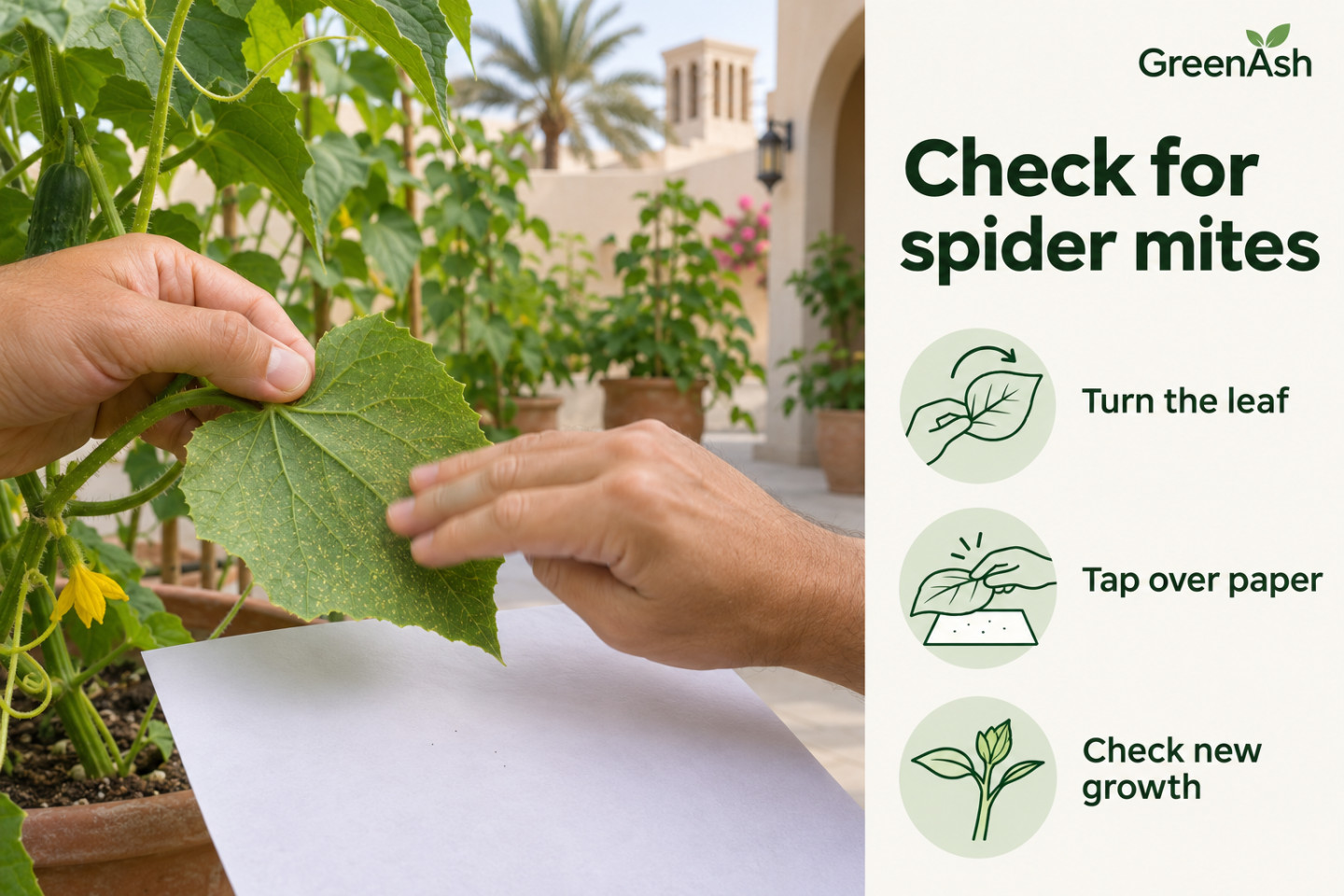
Turn a speckled cucumber leaf over before buying a spray. If spider mites are feeding, the first clue on top may be a dusting of pale pinpricks while the colony is tucked underneath. On a UAE balcony, where one pot may sit beside a hot wall and another beside a working dripper, checking a few leaves and the water supply can save you from treating the wrong problem.
The short answer: confirm live mites under the leaf with a lens or the white paper test, then rinse the undersides with water every day for a week, fix any dry root ball and keep dust down. Spray only if colonies keep growing on new leaves, and then choose a mite product whose label names your plant, never a general insecticide. By the end of this article you will be able to tell spider mites from the problems that look like them, mix neem, Siltac or bifenazate correctly for a 1 L, 5 L or 16 L sprayer, and plan mite checks around the UAE seasons.
How to check a leaf for spider mites
- Compare leaves. Pick a speckled leaf, a nearby leaf that still looks healthy and a leaf from the next plant. Look underneath each in good light. Use a hand lens if you have one; UC IPM suggests a 10x lens. Look for a cluster of tiny moving specks around the damaged area. Fine silk stretched across the leaf surface is another clue.
- Try the white paper test. Hold plain white paper beneath the leaf and tap the stem gently. Lay the paper on a steady surface and watch for movement. Use a clean patch of paper for the next plant so you can tell where the specks came from.
- Read the clues together. Movement tells you something alive fell onto the paper. Some mites eat other mites, so movement alone cannot identify a pest. A colony underneath stippled leaves, especially with fine webbing, provides a better basis for action. Photograph the underside through a lens if the identification is uncertain.
Do this before washing the foliage. If you find old pale patches but no live colony, mark the leaf and inspect neighbouring growth again in a few days. A single strand of spider silk between pots is a poor reason to spray a whole balcony.
What you are looking at through the lens
The two-spotted spider mite is the species most garden guides describe. The University of Minnesota gives its size as about 1/50 of an inch, roughly half a millimetre, and describes it as yellow to orange with a dark spot on each side of the body. UC IPM says adult females are under 1/20 of an inch, with eight legs and two red eyespots. Newly hatched larvae have only six legs, and the eggs are round, clear at first and cream coloured just before they hatch. Under a lens a colony on the leaf underside looks like a scatter of tiny round eggs with the eight legged adults moving slowly among them, often under a fine layer of silk.
Predatory mites are the main look-alike on the paper. UC IPM notes that some mites eat other mites, and the University of Arizona suggests checking for predatory mites as well, because their presence changes whether you need to spray at all. If you are unsure which is which, photograph both and keep rinsing rather than spraying.
Is it spider mites, or something else?
Pale speckles, bronze leaves and leaf drop have several causes in UAE gardens. Use this table before you treat, because a mite spray does nothing for a salt or iron problem.
| What you see | Likely cause | How to confirm | What to do |
|---|---|---|---|
| Fine pale dots on top of the leaf, moving specks and eggs underneath, silk between leaf and stem | Spider mites | Lens or white paper test shows slow eight legged mites | Rinse daily, fix water stress, spray a labelled miticide only if colonies keep growing |
| Silvery patches with tiny black dots of droppings, slender insects in flowers | Thrips | Tap a flower over white paper: thin, cigar shaped insects | Treat as thrips, not mites |
| Small white insects fly up when the plant is shaken, sticky honeydew | Whitefly | Look for oval scales and adults under young leaves | Treat as whitefly |
| Green insects clustered on shoot tips, sticky leaves, ants | Aphids | Insects visible without a lens | See our aphid guide |
| New leaves twisted, cupped or hardened, no webbing, nothing visible even with a lens | Possibly broad mites (smaller than spider mites) | Needs a strong lens or microscope; photograph new growth | Seek advice before spraying; do not assume spider mite treatment will work |
| Yellow between green veins on new leaves, no speckles | Iron chlorosis | Pattern on the youngest leaves, no mites on paper | Check soil pH and feeding, not pests |
| Brown, crisp leaf edges, salt crust on the pot or soil | Salt build up or drought | No live mites; damage on edges rather than speckles | Leach the pot with a deep watering, check irrigation |
| White powder that wipes off the top of the leaf | Powdery mildew | Rubs off on a finger, no moving specks | Treat as a fungal disease |
| One thick strand of silk between pots, no stippling | A true spider | Spider visible, leaves clean | Leave it; spiders eat pests |
Why spider mites explode in heat and dust
Spider mites are arachnids, closer to ticks than to insects. They push their mouthparts into leaf cells and suck out the contents. Each emptied cell turns pale, which is the stippling you see first. When enough cells are empty the leaf bronzes, yellows and drops. UC IPM notes that one colony on a leaf underside can hold hundreds of mites.
The numbers are what make them hard. The University of Arizona says a female can produce about 300 offspring over a life of up to 30 days, and that nearly all of the population is female, so almost every mite adds to the next generation. UC IPM says a generation can be completed in less than a week when temperature and food suit them. The University of Minnesota says that above 90°F (about 32°C) colonies can reach high numbers in less than two weeks. Put those figures together and a few mites on one pepper plant can build into a heavy infestation within two weeks of hot weather.
Three conditions push them along, and all three are common in the UAE:
- Water stress. UC IPM says damage is usually worse on water stressed plants. A pot on a hot wall that dries out by mid afternoon is a classic starting point.
- Dust. UC IPM and Arizona both link dusty conditions with outbreaks. Both advise mulch, ground covers and wetting dusty paths to keep it down.
- The wrong spray. UC IPM says broad spectrum insecticides frequently cause mite outbreaks, often within a few days when applied in hot weather. Pyrethroids and some organophosphates kill predators, and UC IPM notes they can raise leaf nitrogen, which favours mites. The University of Minnesota names bifenthrin and permethrin as products that can make mite problems worse over time.
That last point changes what you buy. A general insect spray on a mite problem can remove the predatory mites, lady beetles and lacewing larvae that were holding the colony back, and leave the spider mites to rebound.
The natural enemies worth protecting
UC IPM lists predatory mites (including Phytoseiulus species and the western predatory mite), the spider mite destroyer lady beetle Stethorus, sixspotted thrips, minute pirate bugs, bigeyed bugs and lacewing larvae. Where predators are bought and released, UC IPM gives a guide of one predator for every 10 spider mites. In a home garden the practical step is simpler: avoid broad spectrum sprays, so the predators already present survive.
What to do when you find live mites
For a few affected leaves on a sturdy plant, start with plain water. Support each leaf and direct water upwards at its underside. Begin gently, then increase the flow enough to dislodge mites without tearing the leaf. Try one leaf before rinsing a delicate plant. UC IPM Quick Tips advise misting or spraying the undersides of infested leaves at least once a day. A hose is convenient for a villa bed. For a few pots, use whatever clean water sprayer you can aim comfortably under the foliage.
Rinse in the morning so leaves dry before the hottest hours, and keep going daily for at least a week. Eggs are not washed off as easily as adults, and new mites keep hatching, so a single rinse is not enough.
If you already own a hose, an adjustable attachment such as the Beorol GPP9 multi-pattern nozzle lets you change the spray pattern. Check the connection against your hose fittings before buying. Keep any equipment previously used for weedkiller out of this job.

Check the roots separately. A rinse on the leaves does little for a dry root ball. Feel the growing mix below the surface and check whether each emitter delivers water to the pot. If one end of a bed repeatedly dries out, use the GreenAsh drip irrigation flow check before extending the timer for the entire bed. Pay particular attention to plants beside dusty paths and exposed walls.
Remove the worst leaves. Leaves that are bronzed and heavily webbed will not recover. Cut them off, bag them and put them in the bin rather than the compost. On a cucumber or melon vine, cutting out a badly webbed runner removes the mites on it in one go.
Cut the dust. Wet down dusty paths beside the bed, mulch bare soil and, on a balcony, wipe dust off railings and the floor near the pots. These are the UC IPM and Arizona dust measures adapted to apartments.
How to tell whether control is working
Choose a few affected shoots and photograph them. At your next inspection, use the same leaves for comparison and check the newest expanded leaves as well. Record where you find live colonies, whether webbing has spread and whether previously clean leaves now show stippling. The University of Minnesota suggests checking garden plants every three to five days, especially in dry conditions.
- Fewer live mites and clean new leaves: continue inspecting. Existing speckles can remain visible after feeding has stopped.
- A new patch on the next pot: check both plants, including the sheltered sides facing each other. Rinse affected foliage where practical and check again.
- Increasing colonies or heavily webbed growth: take clear photographs and identify the host plant before seeking treatment advice. For an edible crop, say what you grow and when you expect to harvest it.
A simple rule we suggest: if, after seven days of daily rinsing and fixed watering, the newest fully opened leaves on a plant still carry live colonies, move to a spray. If the new leaves are clean, keep rinsing and checking instead.
Before buying a miticide
Spider mites belong to the arachnid group. A general insect spray may miss the pest while removing predators that were feeding on it. If treatment is warranted, check the actual pack for the named pest, plant and use site. A direction for ornamental roses does not establish a use on edible cucumbers. Look up harvest and re-entry intervals, protective equipment, application limits and heat restrictions before opening the pack. The GreenAsh pesticide label guide explains how to check those details.
Three product types make sense for home gardens, and they work in different ways:
- Oils (neem). UC IPM lists plant based oils such as neem with insecticidal oils and soaps: they kill only the mites they touch, so coverage of the leaf underside is everything, and repeat sprays are usually needed. NPIC says azadirachtin, the most active part of neem, breaks down on leaves in about 1 to 2.5 days, so neem gives little lasting protection.
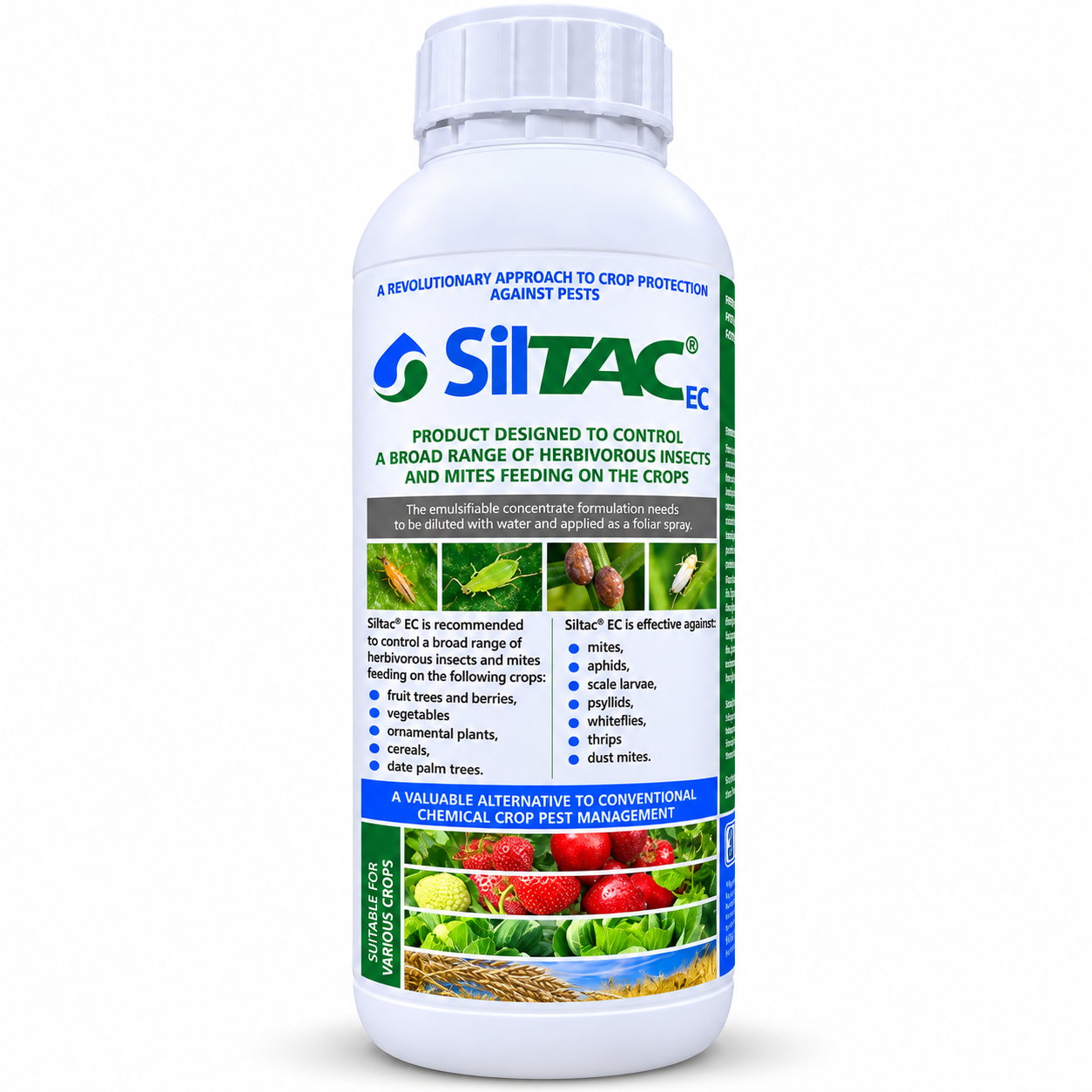
- Physical action sprays (Siltac EC). Its product page says it contains silicone polymers and does not contain the active ingredients of conventional plant protection products. It works by contact, like an oil.
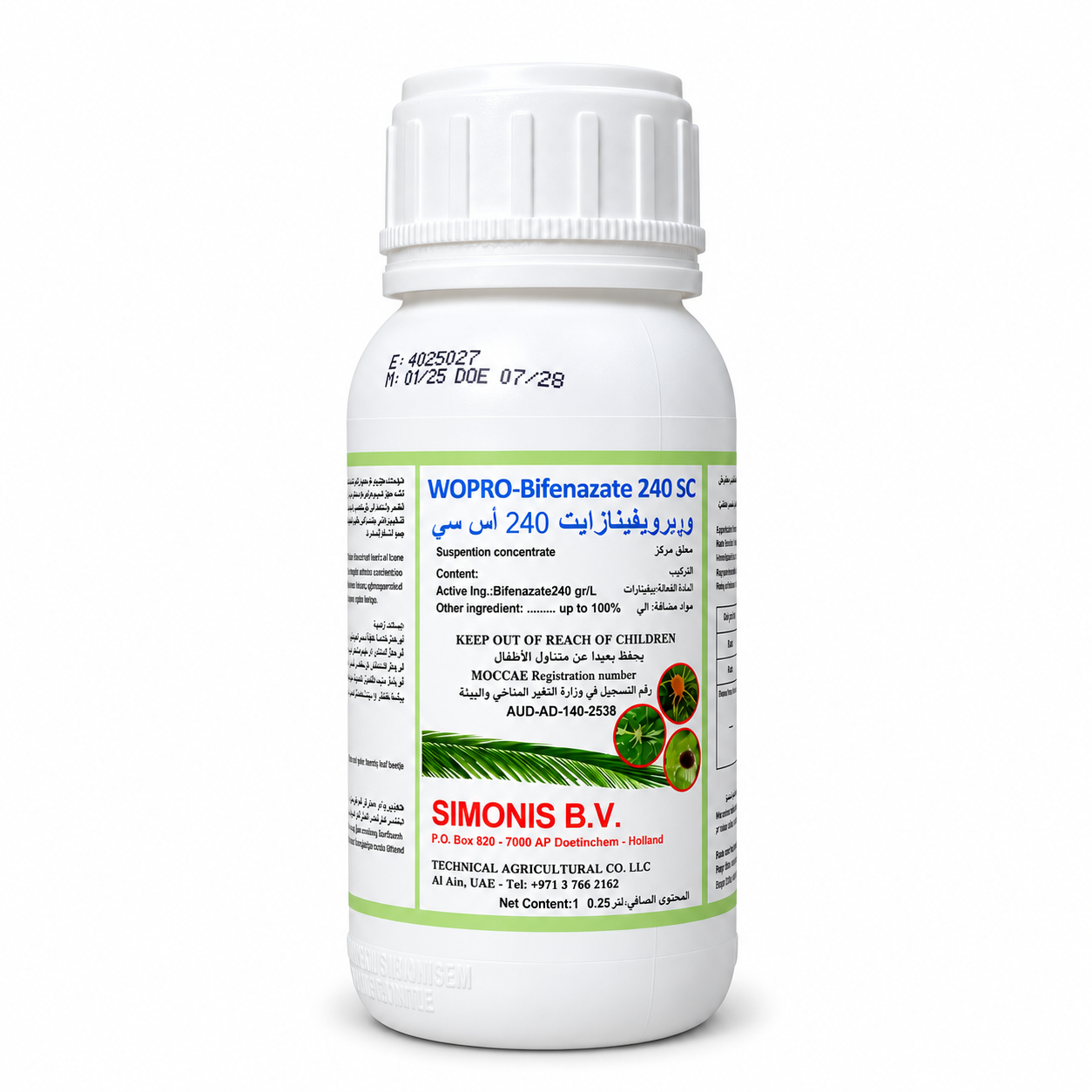
- A selective miticide (bifenazate). In the UC IPM relative toxicity table for grapes, bifenazate is rated narrow in selectivity, low in toxicity to predatory mites, and short in residue. That combination is why it is the step up when water and oils have not held a colony.
We do not recommend R-MITE for this job. Its page claims zero synthetic chemical residues and that it is safer for applicators without support, and its name says 25% while its composition table adds up to 23% active material.
Step by step: spraying spider mites
- Water the day before. UC IPM says not to use soaps or oils on water stressed plants, and the University of Minnesota advises watering thoroughly before spraying.
- Check the temperature. UC IPM says not to use soaps and oils when temperatures exceed 90°F (32°C). In the UAE that rules out midday sprays for most of the year. Spray at first light or in the early evening.
- Test first. Spray one or two leaves, or one plant, and wait a few days for scorch before treating the rest. UC IPM recommends this for oils and soaps, and the Siltac page warns of leaf damage on some tomato cultivars and petal damage on some flowering plants.
- Measure exactly. Use a syringe or measuring cup marked in ml, never a kitchen spoon. Half fill the sprayer with water, add the product, then top up and shake. The WOPRO page says to add the product to the tank while mixing, fill with water and use the mix the same day.
- Spray from below. Hold the nozzle under the canopy and point it up, so the underside of every leaf is wet. Mites on the top surface are a minority.
- Repeat by the label. The Siltac page gives 1 to 2 repeats every 7 to 10 days on ornamentals. The neem page says to repeat based on pest pressure and monitoring. The WOPRO page gives no interval, so do not repeat it without checking the label on the bottle.
- Rotate. The UC IPM table assigns modes of action by IRAC group (bifenazate is group 20D, abamectin group 6) and advises rotating groups and not using the same group more than twice a season. The University of Arizona advises keeping miticide use to a minimum to limit resistance.
Worked doses for 1 L, 5 L and 16 L sprayers
These figures are calculated only from the rates on each product page. Check them against the label on your bottle before you mix.
| Product and use | Rate on the product page | 1 L sprayer | 5 L sprayer | 16 L knapsack |
|---|---|---|---|---|
| Vembu Neem Oil 80% EC: vegetables, turf, ornamentals | 2 to 3 ml per litre | 2 to 3 ml | 10 to 15 ml | 32 to 48 ml |
| Vembu Neem Oil 80% EC: fruit trees, date palms | 4 to 5 ml per litre | 4 to 5 ml | 20 to 25 ml | 64 to 80 ml |
| Siltac EC: vegetables, ornamentals | 0.1 to 0.15% (100 to 150 ml per 100 L) | 1 to 1.5 ml | 5 to 7.5 ml | 16 to 24 ml |
| Siltac EC: sensitive ornamentals | 0.1% (100 ml per 100 L) | 1 ml | 5 ml | 16 ml |
| Siltac EC: fruit trees, berries, date palms | 0.15% (150 ml per 100 L) | 1.5 ml | 7.5 ml | 24 ml |
| WOPRO Bifenazate 240 SC | Do not exceed 40 ml per 100 L | 0.4 ml at most | 2 ml at most | 6.4 ml at most |
Two notes on the maths. First, 0.4 ml of bifenazate is too small to measure reliably with a kitchen tool; a 1 ml syringe works, but it is easier to mix 5 L with 2 ml and use only what you need that day. At that maximum each litre of spray carries 96 mg of bifenazate (240 g per litre times 0.4 ml). Second, the WOPRO page gives only the maximum, not a minimum or a water volume per plant, so the label on the bottle should decide the final figure.

The products compared
| Product | Active or type | Strength | Pack | Mites on the page | Rate on the page | Harvest interval on the page | Who it suits |
|---|---|---|---|---|---|---|---|
| Vembu Neem Oil | Neem oil, EC | 80% | 1 L | Red, broad and two-spotted mite | 2 to 3 ml/L; trees 4 to 5 ml/L | Page says none required; check the label | Balcony pots, roses, light colonies |
| Siltac EC | Silicone polymers, physical action | Not stated | 1 L | Spider mites | 0.1 to 0.15% | Not on the page | Vegetables, ornamentals, date palms, mixed pests |
| WOPRO Bifenazate 240 SC | Bifenazate, SC | 240 g/L | 250 ml | Spider mites | Max 40 ml per 100 L | Not on the page | Persistent colonies on strawberry, cucumber, pepper, tomato, flowers |
| Killmec 1.8% EC | Abamectin, EC | 1.8% | 250 ml | Spider mites | None given | Not on the page | Not boxed: no rate or harvest interval |
| Abamectin 1.8% EC | Abamectin, EC | 1.8% w/v | 1 L | Two-spotted and European red mites | Per hectare for most crops; citrus 15 to 25 ml per 100 L | 3 days peppers, strawberries, tomatoes; 7 days citrus; 14 days apples, pears | Farms only; page says professional agricultural use |
Why abamectin is not boxed. Abamectin is a real miticide, but the UC IPM active ingredient database rates its acute hazard to people as high (the DANGER signal word level) and its hazard to aquatic life as high, and the UC IPM table gives it the strictest bee rating, with no drift onto flowering plants. The 1 L page describes itself as suitable for professional agricultural pest management and mentions restricted entry requirements without giving a figure, and most of its rates are per hectare with no spray volume, so they cannot be worked down to a garden sprayer honestly. On citrus, the page rate of 15 to 25 ml per 100 L works out to 0.15 to 0.25 ml in 1 L, 0.75 to 1.25 ml in 5 L and 2.4 to 4 ml in 16 L, with a 7 day harvest interval. Killmec gives no rate at all. For a farm with a trained sprayer operator, read the full label first; for a garden, start with the boxed products.
UAE timeline: when to check for spider mites
The extension sources above come from places with cold winters, where mites overwinter as eggs or resting females. UAE gardens rarely get that break, so it helps to think in terms of temperature, dust and water stress rather than a fixed pest season.
| Period | What happens | What to do |
|---|---|---|
| October to November | Days are still hot, new seedlings and transplants go in, and summer survivors carry mites into the new season | Inspect bought transplants under the leaves before planting. Check every 3 to 5 days. Spray only at dawn or dusk while days stay above 32°C |
| December to February | Cooler days slow breeding; mites can persist on sheltered plants, plants by hot walls and indoor pots near windows | Weekly checks. The best window for oil sprays, as temperatures sit below the UC IPM 32°C limit for much of the day |
| March to April | Warming, dust and wind; cucumbers, beans, tomatoes, strawberries and roses at full size | Back to checks every 3 to 5 days. Rinse dust off leaves, mulch, keep drippers running evenly. Watch harvest intervals on edible crops |
| May to September | Heat and water stress favour fast generations; afternoon temperatures make oil and soap sprays risky | Prioritise water: deep, regular irrigation and shade for exposed pots. Rinse leaves at first light. If you must spray, do it at dawn, after watering, and test a leaf first |
Villa, balcony and farm
- Balcony: pots dry fast, dust settles on railings and reflected heat from glass and walls adds stress. A 1 L or 2 L hand sprayer is enough; mix the smallest quantity you will use the same day. Moving a stressed pot back from a hot wall, or under a shade net in summer, is often worth more than a spray.
- Villa garden: mites tend to start on the hottest, dustiest edge of a bed or on plants at the dry end of a drip line. Wet the paths, mulch, and use the hose nozzle for daily rinses. A 5 L pressure sprayer suits roses and a vegetable bed; our garden sprayer guide covers calibration and cleaning.
- Farm or greenhouse: cucumbers, melons, strawberries and beans can carry large colonies, and repeated sprays build resistance. Keep a written log of every product, its IRAC group and date, and rotate groups. Read the harvest interval on each label before every spray, and keep sprayers used for herbicides separate.
Common mistakes
- Spraying a general insecticide. Pyrethroids and some organophosphates kill predators and, according to UC IPM, often trigger mite flare ups. Use a product that names mites.
- Spraying the top of the leaf. Contact products only kill mites they touch, and the colony lives underneath. Aim the nozzle up from below.
- Spraying in the afternoon. Oils and soaps can scorch leaves above 32°C. Spray at dawn or dusk, and only on watered plants.
- Using washing up liquid. The University of Minnesota warns that homemade soap solutions can burn plants. Use plain water or a labelled product instead.
- Judging success by old leaves. Stippled leaves stay pale after the mites are gone. Judge by live mites and by new leaves.
- Doubling the dose. Extra product adds scorch risk and residue, and goes beyond what the label allows. Stick to the page or label rate; for bifenazate the page sets a maximum.
- Repeating the same miticide. Mites with a generation in under a week can build resistance quickly. Rotate IRAC groups and use water and oils between miticide sprays.
- Ignoring watering. A plant that wilts every afternoon will keep favouring mites whatever you spray.
Troubleshooting: when it is not working
- Still live mites after a week of rinsing: check the root zone and the dripper first, then move to neem or Siltac, sprayed from below on a watered plant at dawn.
- Still live mites after two oil or Siltac sprays: look at coverage before the product. Were the undersides actually wet? If yes, change to a different mode of action such as bifenazate, on a crop the label names.
- Leaves scorched after a spray: stop, rinse the plant with water, and next time test one leaf and spray only below 32°C. Check the dilution.
- New growth twisted with no visible mites: this may be broad mites or a different problem. Photograph it and ask for identification rather than repeating a spider mite spray.
- Mites keep coming back on one plant: some plants in a hot corner may never be worth the fight in summer. Moving, shading or replacing that plant can protect the rest.
- A whole hedge, large tree or commercial crop is webbed: call a licensed pest control company or an agricultural advisor. Spraying tall plants by hand puts mist in your face, and farm products such as abamectin are not suited to untrained use.
Safety
- Protective equipment: the Vembu page asks for appropriate protective equipment, and the WOPRO and Siltac pages name none. UC IPM advises chemical resistant gloves (such as nitrile), long sleeves and goggles as a minimum when a label is silent. Add a mask when spraying above head height.
- Harvest interval: the Vembu page says no pre-harvest interval is required, but the WOPRO and Siltac pages give none at all. For edible crops, read the harvest interval on the bottle before spraying, and if it is missing, do not spray a crop you plan to pick soon. Wash produce before eating.
- Re-entry: none of the three boxed pages gives a re-entry interval. Keep people and pets off sprayed plants until the spray has dried, and longer if the label says so.
- Bees: the UC IPM table gives neem oil and bifenazate a bee rating that allows spraying only between sunset and midnight where the label permits, and abamectin a stricter rating. Do not spray open flowers in the day, and remove flowering weeds first.
- Fish and pools: NPIC rates neem oil as slightly toxic to fish and azadirachtin as moderately toxic, and UC IPM rates abamectin high for aquatic hazard. Keep sprays and rinse water away from fish ponds, pools and drains.
- Pets and children: mix outdoors, keep them away while you spray and until leaves are dry, and never use drinking bottles for mixes.
- Storage: keep products in their original containers, closed, locked away and out of direct sun. A hot car or a sun-baked balcony store is not suitable.
- Disposal: mix only what you will use that day. Spray any small leftover on a labelled plant, triple rinse the empty bottle into the sprayer, and never pour concentrate into drains. Follow municipal guidance for empty containers.
Frequently asked questions
Can spider mites be present without visible webs?
Yes. Fine stippling may be easier to see early on. Inspect the underside with a lens and try the paper test while the leaf is dry.
Should I use washing up liquid on my plants?
Household detergents can injure foliage, and the University of Minnesota warns that homemade soap solutions can burn plants. Use plain water for a rinse. If considering insecticidal soap, check the formulated product’s label for the crop and pest, including any warnings for heat or stressed plants.
Can I judge success by whether an old leaf turns green again?
Compare live mite activity and fresh damage. An older leaf can still look bronze while new leaves expand cleanly.
Does neem oil kill spider mites?
Neem oil kills mites it touches when it coats them, and the Vembu page lists two-spotted, red and broad mites. It needs full coverage of the leaf underside and repeat sprays, because eggs survive and NPIC says azadirachtin breaks down on leaves in 1 to 2.5 days. Spray below 32°C on watered plants.
How fast do spider mites spread?
Fast in heat. UC IPM says a generation can take less than a week, and the University of Minnesota says colonies can reach high numbers in under two weeks above 32°C. Check neighbouring pots whenever you find one infested plant.
Can spider mites live on indoor plants in the UAE?
Yes. Indoor plants can get them too, especially on sunny windowsills where pots dry out quickly. Check the undersides of leaves on plants near windows, rinse them in the shower, and keep pots evenly watered.
Are spider mites harmful to people or pets?
Plant feeding spider mites do not bite people or pets. The risk to your household comes from sprays, so follow the label and the safety steps above.
Which vegetables get spider mites most in the UAE?
The WOPRO page names strawberry, cucumber, pepper and tomato among its crops, and UC IPM notes damage is often worse on annual plants. Cucumbers, melons, beans and aubergines in hot, dusty spots deserve the closest checks. Our cucumber growing guide covers drip watering in sandy soil.
Need help?
Turn over three leaves on your most stressed plant today and try the white paper test. If you find a live colony, start daily rinsing and fix the watering; if new leaves are still infested a week later, choose neem, Siltac or bifenazate from the boxes above, and check that the label on the bottle covers your plant.
Identification and monitoring references include the University of California spider mite pest notes, the UC IPM spider mite quick tips, the University of Minnesota guide to twospotted spider mites, the University of Arizona spider mite factsheet and the NPIC neem oil fact sheet.
