
Blog
Humic Acid for Sandy UAE Soil: Is It Worth Using?

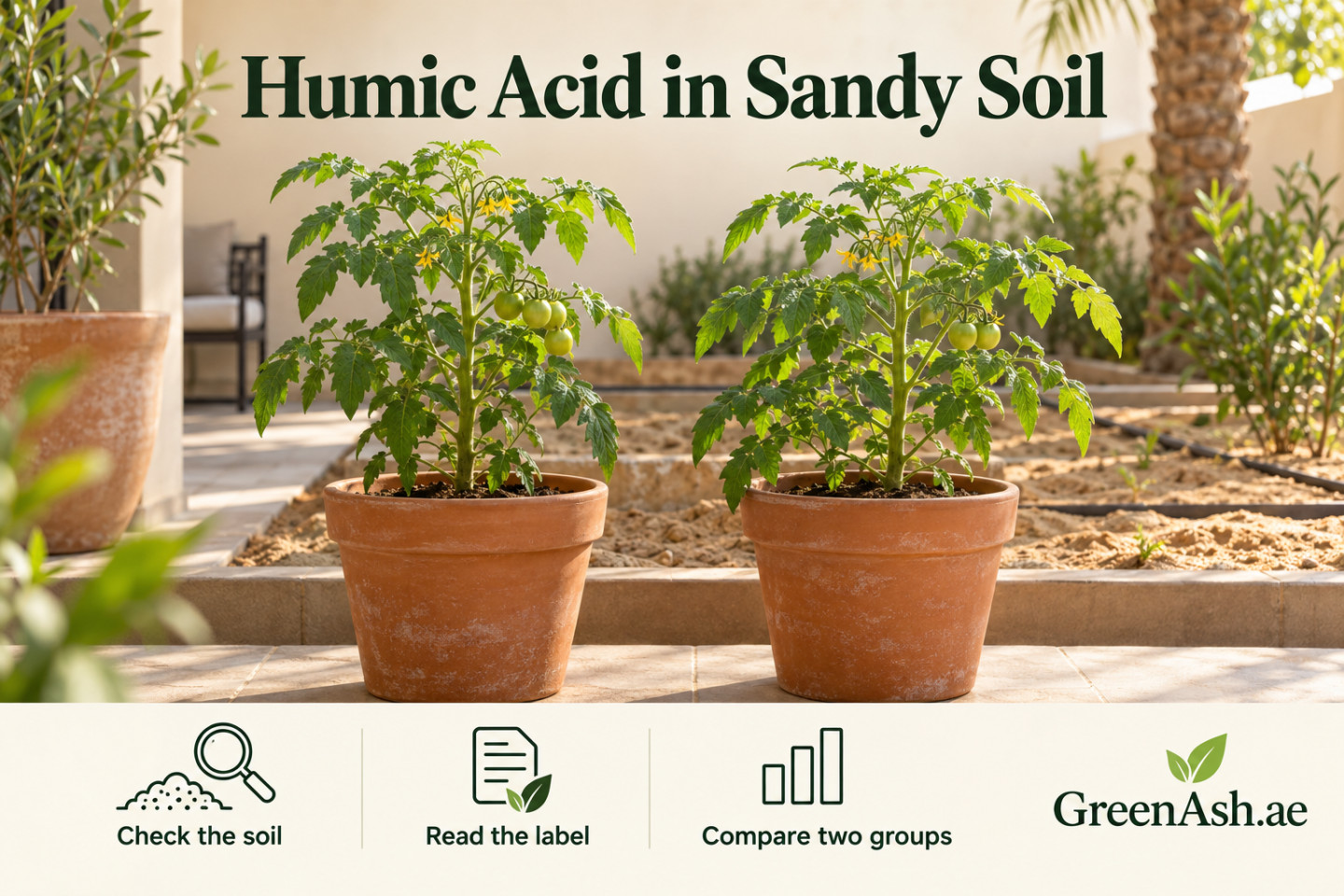
Short answer: for most sandy UAE gardens, humic acid is not the first thing to buy. Fix the watering and add compost first, because that is where the measurable gains in water and nutrient holding come from. Then, if you still want to try humic acid, test it on a few plants beside untreated ones before you buy enough for the whole garden. University field trials have found little or no yield benefit at normal label rates, so a small trial is the honest way to find out if it pays in your soil.
If your tomato bed dries out between drip cycles, should you buy humic acid or compost? Start by digging beside an emitter after watering. A narrow wet patch surrounded by dry sand points to a watering problem. If the bed wets evenly but holds little moisture, mature compost can help build its capacity to retain water. A bottle of humic acid serves a different purpose. It is an optional addition you can test once roots have access to water and the crop’s nutrient needs are met.
By the end of this article you will be able to tell which of those situations you have, read a humic product’s analysis properly, work out a dose for a watering can, a knapsack sprayer or a 100 m2 bed straight from the product page, and set up a fair trial on your own plants.
Is humic acid the right fix? A quick decision table
Most of the problems people hope humic acid will solve in sandy soil have a cheaper or more direct fix. Use this table before you buy anything.
| What you see | Most likely cause | What to do first | Where humic acid fits |
|---|---|---|---|
| Wet ring only a hand width around each dripper, dry sand between | Water runs straight down in coarse sand; too few emitters or runs too short | Add emitters, lengthen runs, check the line (see our drip irrigation guide) | Not the fix; more emitters or longer runs are |
| Bed wets evenly but is dry again a day later | Very low organic matter, little water holding | Work in mature compost before planting | Optional trial after compost is in |
| Pale or yellow leaves on several plants | Feeding gap, iron chlorosis in alkaline soil, root damage or overwatering | Check feed history and leaf pattern (see below) | Not a substitute for fertiliser. CDFA’s only accepted claim is that it may aid micronutrient uptake |
| White crust on the soil, leaf edges brown and crisp | Salt build up from water or fertiliser | Leach with a deep watering, cut feed, test water | Not proven to protect plants from salt; the salt still has to be washed out |
| Hard crust, water ponds on top | Fine silt or sodium in the surface, or compaction | Loosen, mulch; a soil test tells you if sodium is the cause | Not the fix on its own |
| Plants watered and fed well, growing normally, and you want to know if a biostimulant adds anything | Nothing wrong | Keep the routine | This is the case for a small side by side trial |
What it is NOT: humic acid is not a fertiliser in the NPK sense, not a wetting agent, and not a salt remover. California’s fertiliser regulator, CDFA, requires humic acid labels there to carry the words NOT A PLANT FOOD INGREDIENT. If a plant is short of nitrogen, potassium or iron, it needs that nutrient. Our guide to NPK numbers explains how to read what a feed supplies, and the iron chlorosis guide covers yellow leaves with green veins.
What can humic acid do in sandy soil?
Humic acid is one fraction of the organic material formed as plant and animal residues break down. Garden products may contain humic acid alone or combine it with fulvic acid and nutrients. A small application of concentrate adds little bulk to a sandy bed. If your aim is to improve water retention, the amount of organic matter you incorporate matters. University of Minnesota Extension explains how compost improves water and nutrient retention, and notes that organic matter helps moisture spread sideways from drip emitters so roots can reach further.
For crop performance, the evidence is mixed. A UC Davis team tested five commercial formulations. In two seasons of California processing-tomato trials, none increased fruit yield. In a greenhouse trial, lettuce grew better with humic acid plus phosphorus than with phosphorus alone in one of four soils. These results give a UAE grower a reason to test a small area before buying enough for a full plot. Read the original trial report (PDF).
Where commercial humic acid comes from
Most bagged and bottled humic products are extracted from leonardite or other oxidised brown coal deposits with an alkaline solution, then sold as liquid or as potassium humate powder. CDFA lists leonardite, oxidised lignite, humalite, peat and similar deposits as accepted sources. University of Adelaide researchers Lyons and Genc (Agronomy, 2016) point out that these extracts are chemically different from the humus that builds up in a living soil: they carry almost none of the proteins and sugars that feed soil life, and lignite humic acids are richer in carbon and less soluble than humic acids from compost.
That matters for sandy UAE soil. Soil humus is a by-product of a lot of organic matter rotting in place. A humic concentrate is a small dose of one extracted fraction. An extension soil scientist answering growers’ questions at a Utah State University small farms conference in 2021 put it plainly: humates do not break down further in soil and do not feed microbes; they can add exchange sites in very sandy soil, but most soils cannot take enough to change much, so raw organic materials do more for structure.
What the research found, in numbers
- UC Davis field trials (Hartz, FREP report, 2010). Five commercial products were applied to processing tomatoes at 1.1 and 3.4 kg of humic acid per hectare in 2008 and 2009. There was no gain in plant growth, phosphorus uptake, fruit yield or soluble solids (sugar content) in either year. Phosphorus fertiliser did raise yield in 2008, from 49.8 to 55.2 tons per acre, which shows the trial could detect a real effect when there was one. Humic acid also had no effect on seed germination, which was above 98% in every treatment.
- Greenhouse lettuce, same project. In four low phosphorus soils, humic acid alone never increased growth. With phosphorus, it helped in one soil only (3.44 g against 2.69 g dry weight), and it did not raise phosphorus uptake in any soil.
- Why the doses may be too small. In the peer reviewed write up (Hartz and Bottoms, HortScience, 2010), the authors note that typical commercial rates are under 5 kg per hectare, often 2 to 3 kg, while an earlier estimate (Chen and colleagues, 2004) put the amount needed to reach growth stimulating levels in the root zone at more than 50 kg per hectare.
- The meta-analysis. Rose and colleagues (Advances in Agronomy, 2014) pooled 81 studies and found an average gain of about 22% in shoot weight and 21% in root weight. The spread was wide: about half of the shoot studies showed gains under 5%, humic substances from brown coal gave about 12% against 25 to 29% for compost and soil derived material, peat gave no significant shoot effect, and woody perennials such as fruit trees showed no shoot gain and often a negative response at high rates. Plants under stress responded more (about 28%) than unstressed ones (about 18%), but few studies were field trials grown to harvest.
- Label accuracy. Lyons and Genc cite a survey of 10 liquid humic products in which the measured humic acid content differed from the advertised figure by more than 800% in some cases.
The fair reading: humic substances can change plant growth in pots, sand culture and stressed conditions, but field gains at label rates are small or absent in most trials. A sandy, low organic matter soil is one of the places where an effect is more plausible, which is exactly why a trial in your own bed is worth more than any brochure, including ours.
Why the dose matters: a worked comparison
Take the YAMFERT HUMFERT page as an example. It states 15% humic acid W/V, which means 15 g of humic acid per 100 ml, or 150 g per litre of product. The page’s vegetable rate is 10 to 15 L of product per hectare per application. That is 1.5 to 2.25 kg of humic acid per hectare, squarely inside the 1.1 to 3.4 kg range that gave no yield gain in the UC Davis tomato trials. To reach the 50 kg per hectare figure from the Chen estimate you would need about 333 L of this product per hectare, or 3.3 L on a 100 m2 bed in one go. Nobody applies that, and the page does not suggest it.
The Dragon HV page gives 1.5 to 2 kg of product per feddan (about 4,200 m2) for open field vegetables. At 55% humic and fulvic acids, that works out to roughly 2.0 to 2.6 kg of humic plus fulvic acids per hectare, again in the same range as the trials. The point is not that these products are weak. It is that label rates of any humic concentrate add very little humic material compared with what compost adds, so expect a subtle effect, if any, and measure it.
How to read the percentage on the pack
- W/V or W/W. A liquid at 15% W/V holds 150 g per litre. A powder at 55% W/W holds 550 g per kilo. You cannot compare the two numbers directly without that conversion.
- Humic alone, or humic plus fulvic. A combined figure measures something different from a figure for humic acid alone. HUMFERT lists them separately (15% and 5%); Dragon HV gives one combined figure (55%).
- Test method. CDFA found in 2009 that more than half of the humic products it sampled over 18 months held less than their guarantee, and since then has required guarantees based on its own test method, with 90% of the label figure as the minimum. None of the product pages we read names the test method behind its figure. Treat the percentage as the maker’s figure, not an independent result.
- Claims. The only claim CDFA accepts for humic acid is that it “may aid in the uptake of micronutrients”. Its 2003 notice says the department had received no efficacy data supporting wider claims. Where a page promises heat, drought or salt tolerance, read that as marketing until the maker shows trial data.
Improve the soil first: compost and water before concentrates
ICBA’s soil survey brief for Abu Dhabi notes that sandy soils cover nearly 75% of the UAE landscape and salinity affects over 34% of UAE soils. Sand holds little water because its particles are large and its organic matter is low. UF/IFAS soil scientists (Bhadha and colleagues, 2017) report that raising soil organic matter by just 1% can give a significant increase in water holding capacity. The amount of material involved explains why compost does what a bottle cannot.
Colorado State University Extension gives these routine compost rates, which we have converted to metric:
| Situation | Compost layer before mixing (CSU) | Mix into (CSU) | Volume per m2 |
|---|---|---|---|
| New vegetable or flower bed | 3 to 4 inches (about 7.5 to 10 cm) | 8 to 12 inches (20 to 30 cm) | About 75 to 100 L |
| Existing bed, every year | 0.25 inch (about 6 mm) | 8 to 12 inches | About 6 L |
| Lawn, one time before seeding | 1 to 2 inches (about 2.5 to 5 cm) | 6 inches (15 cm) | About 25 to 50 L |
Compare 75 L of compost per square metre with 1 to 1.5 ml of HUMFERT per square metre at its vegetable rate. Even though compost is mostly not humic acid, it adds thousands of times more organic material, and it rots in place into real soil humus over the season.
Two cautions from the same sources. CSU warns that products made with manure or biosolids are often very high in salts, and the Minnesota page advises testing compost for soluble salts and taking care above 2 mmhos/cm, and avoiding large amounts of compost above pH 7.4. In the UAE, where irrigation water may already carry salt, a plant based compost or vermicompost is the safer choice for vegetable beds. Our vermicompost guide covers rates for pots and beds, and the hydrogel article looks at another water saving product with the same test first approach.

Choose a product you can measure for your garden
First identify the intended application on the pack. A label giving instructions for a greenhouse area may be inconvenient for someone treating three balcony pots. Check the measuring equipment you have and whether the smallest labelled batch is practical. If the directions do not cover your crop or method, choose a product that does.
- For a liquid option, GreenAsh lists YAMFERT HUMFERT in a 5 L container. Its page gives a per litre dilution, so it is the easiest to measure for a watering can or sprayer.
- For a comparison by weight, look at the 1 kg Dragon HV humic and fulvic acid product. Its listing also identifies potassium. Account for that when comparing it with your current feed or interpreting a trial, because a plant short of potassium will respond to the potassium, not the humic acid.

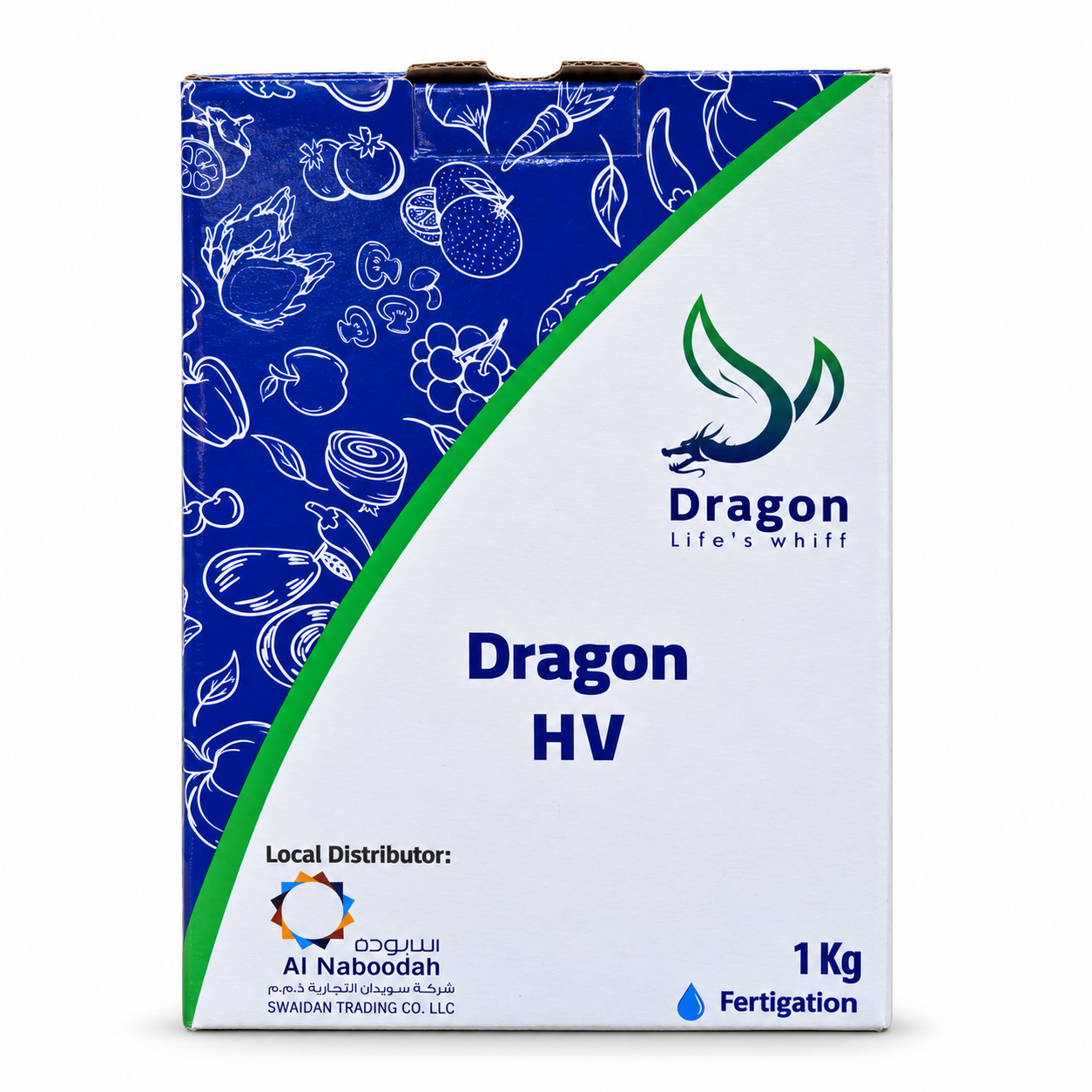
A percentage for combined humic and fulvic acids measures something different from a percentage for humic acid alone. Also look for whether the figure is by weight or by volume. Compare the cost of treating your actual bed at the labelled rate, rather than choosing the pack with the largest number.
Every humic product we stock, compared
We read the full page of each humic product in stock on 10 November 2026. Rates are as the product pages give them; none of these is a pesticide, so there is no harvest interval on any page.
| Product | Analysis on page | Pack | Use on page | Rate on page | Registration on page | Who it suits |
|---|---|---|---|---|---|---|
| YAMFERT HUMFERT 15% (60280) | 15% humic, 5% fulvic, W/V | 5 L liquid | Irrigation or foliar spray | 400 to 600 ml per 100 L water; vegetables 10 to 15 L/ha; every 3 to 4 weeks | None given | Villa beds and drip lines; measurable by the ml |
| Dragon HV (63997) | 55% humic plus fulvic, 14% K2O, W/W | 1 kg powder | Fertigation | Nurseries 2.5 to 5 kg per 1,000 L water; open field vegetables 1.5 to 2 kg per feddan | DXB-APH-34-3440701 | Gardeners who mix by weight and count its potassium |
| COSMOCEL H-85 (47032) | 48% humic, 37% fulvic (basis not stated) | 1 kg powder | Fertigation or foliar | Vegetables 1.0 to 1.5 g per litre every 15 to 20 days; fruit trees 60 g per tree | None given | Table only: clear per litre rate, but the page says both “100% soluble” and “Solubility 15%” and names no manufacturer |
| PERT FERT Humi-Cal (62606) | Ca 23%, S 18%, “Humic Acid (C)” 5% | 25 kg granules | Soil applied gypsum and humate | Vegetables 50 g/m2 before planting, then 30 g/m2 every 3 to 4 weeks; pots 3 g per litre of pot volume monthly | None given | Mainly a gypsum product; see the salt section before buying |
| KHUMIC KFULVIC-AG (60840) | Organic matter 75%, humic 36%, fulvic 13%, K 3.5% | 20 kg granules | Soil application | Field crops about 250 kg/ha; fruit trees about 400 kg/ha | None given; no maker or origin | Farms only; no garden scale rate |
| KHUMIC-100 (29519) | No percentages | 1 kg | Soil or irrigation | None given | None given | Not recommended until the page gives an analysis and rate |
| Natural Humic Acid (29405) | No analysis | Title 1 L; size field 500 ml | Soil drench | None given | None given | Not recommended until the page gives an analysis and rate |
Why COSMOCEL is not boxed even though its per litre rate is handy: the solubility statements contradict each other, which matters if it goes through a drip line, and the page gives neither a registration number nor a manufacturer. Why the KHUMIC lines are not boxed: no registration, maker or origin on either page, and KHUMIC-100 and the 1 L Natural Humic Acid give no rate at all, so we cannot give you a dose.
Worked doses, calculated only from the product pages
These figures come straight from each page’s own rate. Where a page gives no rate for your situation, we say so rather than guess.
YAMFERT HUMFERT 15%: watering can and sprayers
The product page gives 400 to 600 ml per 100 L of water, which is 4 to 6 ml per litre.
| Mix volume | HUMFERT at 4 ml/L | HUMFERT at 6 ml/L |
|---|---|---|
| 1 L hand sprayer or small can | 4 ml | 6 ml |
| 5 L sprayer or watering can | 20 ml | 30 ml |
| 16 L knapsack | 64 ml | 96 ml |
YAMFERT HUMFERT 15%: by area
The page gives 10 to 15 L per hectare for vegetables, 15 to 20 L for fruit trees, vines and ornamentals, and 20 to 40 L for greenhouses. One hectare is 10,000 m2, so:
| Crop (page rate) | 1 m2 bed | 10 m2 bed | 100 m2 garden |
|---|---|---|---|
| Vegetables (10 to 15 L/ha) | 1 to 1.5 ml | 10 to 15 ml | 100 to 150 ml |
| Fruit trees, vines, ornamentals (15 to 20 L/ha) | 1.5 to 2 ml | 15 to 20 ml | 150 to 200 ml |
| Greenhouse (20 to 40 L/ha) | 2 to 4 ml | 20 to 40 ml | 200 to 400 ml |
The two page rates fit together. At 4 to 6 ml per litre, the vegetable dose for 1 m2 sits in about 250 ml of water, so a 5 L can mixed at the page dilution covers about 20 m2 of vegetable bed. Over an October to April season, at the page’s interval of every 3 to 4 weeks, that is about 7 to 10 applications, or roughly 0.7 to 1.5 L of product for a 100 m2 vegetable garden. For a pot, the page gives no amount per pot, only the per litre dilution, so use the diluted solution in place of one normal watering.
Dragon HV: by weight
The page’s nursery rate is 2.5 to 5 kg per 1,000 L of water, which is 2.5 to 5 g per litre.
| Mix volume | Dragon HV at 2.5 g/L | Dragon HV at 5 g/L |
|---|---|---|
| 1 L | 2.5 g | 5 g |
| 5 L | 12.5 g | 25 g |
| 16 L | 40 g | 80 g |
The open field vegetable rate of 1.5 to 2 kg per feddan (about 4,200 m2) works out to about 36 to 48 g per 100 m2, or 0.36 to 0.48 g per m2. That amount also supplies about 5 to 7 g of K2O per 100 m2 from the 14% potassium. A kitchen scale that reads to 1 g is enough for the 100 m2 figure; for a single square metre you would be weighing less than half a gram, so mix for the whole bed at once.
One honest warning: the page’s greenhouse rate of 4 to 5 kg per greenhouse of about 500 m2 is 800 g to 1 kg per 100 m2, about 17 to 28 times the open field figure, and the page does not say whether either figure is per application or the total for the growth cycle. Until the label clears that up, start from the per litre nursery rate, which is unambiguous.
Run a small comparison on a UAE patio or in a raised bed
Lyons and Genc recommend that growers keep careful records and run their own trials, because published results vary so much between soils and products. This is a simple version for a home garden.
- Pick one question. For example, does adding this product to your usual feed increase the weight of tomatoes you harvest? Choose the outcome before starting.
- Make two comparable groups. Use several plants of the same variety and age if possible. Pair pots with similar sun exposure, especially near a warm villa wall. Assign one pot in each pair to receive the product.
- Keep everything else alike. Give both groups the same soil mix, total irrigation water and usual feed. Apply the product only to the marked group, following its label. Record how much you used and when. If you use Dragon HV, give the untreated group the same amount of potassium from your normal feed, or you are testing potassium, not humic acid.
- Measure at harvest. Weigh fruit from each plant and compare the average per plant in each group. Note any blocked emitters or unusual shade. If the difference is small or inconsistent across pairs, repeat before treating the whole garden.
A few practical points make the result more trustworthy. Use at least four pairs; with one or two plants a side, one sick plant decides the outcome. Label the treated plants with a tag that survives sun. Water the untreated plants with the same volume of plain water on treatment days. For a lawn, mark two strips of at least 2 m by 2 m and compare colour and how many days each strip lasts before it shows dry patches. For tomatoes, see our tomato growing guide for spacing and a feeding routine you can keep identical in both groups.
A rough rule for deciding: if treated plants do not beat their pairs by more than the difference you see between untreated plants themselves, you have no evidence the product helped. Rose and colleagues treated gains under 5% as agronomically insignificant, which is a sensible bar for a garden too.
UAE timeline: when a trial makes sense
| Period | Soil and water work | Humic trial |
|---|---|---|
| Late September to October | Prepare beds: work in compost at the CSU new bed rate, check drip coverage, leach salt with a deep watering | Plan pairs and label plants at transplanting |
| November to February | Main growing season; top up compost on existing beds (about 6 L per m2 each year) | Apply at the page interval (HUMFERT every 3 to 4 weeks) to the treated group only |
| March to April | Harvest; record yields; heat starts to rise | Weigh and compare; decide whether to buy more |
| May to September | Shade, mulch and steady watering; many vegetable beds rest | Not a good test period: heat stress swamps small effects. Store products indoors |
Villa gardens
Many villa beds are sand over compacted fill. Compost and drip layout give the biggest return here. If you trial HUMFERT through a drip line, follow the injection points in our drip guide and flush the line with plain water afterwards.
Balconies and pots
Potting mix already has far more organic matter than desert sand, and Hartz and Bottoms suggest that native dissolved organic matter in richer soils may mask any added humic effect. That makes a gain in a good potting mix less likely. Pots also dry and heat fast on a south or west facing balcony, which makes it hard to keep the two groups equal, so pair pots side by side.
Farms and large plots
On a farm with sandy soil and salty well water, the potential effect is worth testing because the cost scales with area. Leave untreated control rows, record yield per row and test both the soil and water before and after the season. The 20 kg granular products and per hectare rates were written for this scale.
Salt, sodium and the stress tolerance claims
Several product pages, including HUMFERT and Dragon HV, say their product helps plants tolerate heat, drought or salinity. None of the pages shows trial data for that. Salt in the root zone has to be washed below the roots by water. The Purdue Landscape Report notes that about 15 cm (6 inches) of water leaches roughly half of the salt that has built up, and that gypsum followed by heavy irrigation is used where sodium is the problem. Gypsum adds calcium, which can displace sodium, but it is itself a salt and does not remove salts on its own.
That is the context for PERT FERT Humi-Cal. By its own analysis it is mostly gypsum (23% calcium, 18% sulphur) with 5% humic material. It may suit a bed where a soil test shows high sodium, but it is not a humic acid product in the sense of this article, and adding it to a bed that is salty but not sodic adds more salt. Get a soil test that reports sodium before buying 25 kg.
Common mistakes
- Buying humic acid to fix dry sand. At label rates it adds grams of material per square metre against the tens of litres of compost that change water holding. Put compost in first.
- Using it instead of fertiliser. CDFA requires humic acid labels in California to say it is not a plant food. Feed the crop properly, then test humic acid on top.
- Comparing percentages across products. 15% W/V, 55% W/W and 85% combined are three different measures. Convert to grams per litre or per kilo first.
- Ignoring the potassium in Dragon HV. At the open field rate it supplies about 5 to 7 g of K2O per 100 m2. Count it in your feeding plan and in your trial.
- Doubling the dose because nothing happened. The meta-analysis found woody plants often responded negatively to high rates. Stay within the page rate.
- Judging it in summer. Heat stress, salt and irregular watering cause far bigger swings than any humic effect. Run the comparison in the cool season.
- Treating every plant. Without untreated plants to compare, you cannot tell whether the product did anything.
Troubleshooting: when it does not seem to work
- No difference after a full season. That matches most field research. Drop the product and put the money into compost, mulch and drip parts.
- Plants still dry out fast. Dig beside an emitter an hour after watering. If the wet zone is a narrow cone, add emitters or lengthen run times; humic acid will not change that.
- Leaves still yellow. Check whether old or new leaves yellow first. Old leaves point to a nitrogen, potassium or magnesium gap; new leaves with green veins point to iron in alkaline soil. Treat the nutrient.
- Brown, crisp leaf edges and white crust. That is salt. Leach the bed, reduce fertiliser and test your water’s salinity.
- Dark residue or a blocked dripper after fertigation. Stop injecting, flush the line with clean water and check the filter. The Dragon HV page tells you to check compatibility before mixing with other products and to flush the system where appropriate.
- When to call a professional. If a whole bed or a palm declines despite good water and feed, or you see wilting with wet soil, have a soil and water test done by an agricultural laboratory, or ask your municipality’s agriculture section for help. Root rot, nematodes and severe salinity need a diagnosis, not a biostimulant.
Safety, storage and disposal
Humic products are fertiliser materials, not pesticides, so there is no harvest interval or re-entry period on any of the pages. Still handle the concentrates with care.
- Protective equipment. The HUMFERT page says to wear protective gloves when handling and mixing, and to avoid contact with eyes and skin. The COSMOCEL page asks for gloves, goggles and a mask during mixing. For powders, the KHUMIC KFULVIC-AG page warns against inhaling dust. Nitrile gloves and safety glasses are a sensible minimum for all of them, plus a dust mask when tipping powder.
- Children and pets. Every boxed product page says to keep the product out of reach of children; the KHUMIC KFULVIC-AG and vermicompost pages add pets. Store above floor level and do not leave a mixed can where a dog can drink from it.
- Bees and fish. None of the pages gives bee or fish toxicity data. Spray foliar mixes in the early morning or evening, keep drift off flowering plants, and never rinse equipment into a pond, a drain or the street.
- Heat. HUMFERT says not to expose the product to direct sunlight and to store it cool, dry and ventilated. Dragon HV asks for 7 to 30 C storage, away from food, animal feed and flammable materials. In UAE summer an outdoor shed is well above 30 C, so keep these indoors.
- Food and containers. Measure with a dedicated cup or syringe, never a kitchen spoon. The Dragon HV page says not to reuse empty containers and to dispose of packaging according to local environmental rules. Rinse the empty container, use the rinse water on the bed, and put the container in general waste.
Frequently asked questions
My plants have yellow leaves. Should I try humic acid first?
Check whether water reaches the root zone and whether the pot drains. If several plants remain pale despite even watering, review their feeding history and consider a soil or growing-media test. Leaf colour alone cannot tell you which nutrient is missing. The GreenAsh guide to NPK numbers explains how to read the nutrients declared on a feed.
Can I put it through my drip line?
Check for explicit irrigation directions on your particular product. Liquid form alone does not establish suitability for injection or compatibility with other fertilizers. If the label leaves either point unclear, ask the supplier before filling the tank. HUMFERT lists irrigation systems and Dragon HV lists fertigation; both pages tell you to mix well, and Dragon HV adds a compatibility check and a flush with clean water.
Do I need to keep buying it if the plants already grow well?
Choose a result worth paying for, such as more marketable fruit per plant. If your treated plants perform much like their untreated neighbours, you have a practical basis for leaving it out of the next growing cycle.
Is humic acid the same as compost or humus?
No. Soil humus forms slowly as organic matter rots in place, and compost is the raw material for it. Commercial humic acid is a fraction extracted from leonardite or brown coal, and researchers at the University of Adelaide describe it as chemically different from soil humus. A label dose adds a few grams per square metre; a compost dressing adds tens of litres.
Will humic acid lower the pH of alkaline UAE soil?
Not in any useful way at label rates. The amounts are far too small to shift the pH of a calcareous sand. If high pH is causing iron chlorosis, an iron chelate made for alkaline soil is the direct fix.
Does humic acid help plants cope with heat and salty water?
The meta-analysis by Rose and colleagues found larger average responses in stressed plants, but the results varied widely and few were field trials. No product page in our range shows trial data for its heat, drought or salt claim. Shade, mulch, steady watering and leaching remain the basics, and you can test humic acid on top of them.
How often should I apply it?
Only as often as the page says, and only to the plants in your trial. The HUMFERT page says every 3 to 4 weeks in the growing season; the COSMOCEL page says every 15 to 20 days for vegetables. The Dragon HV page says throughout the growth cycle without a number of applications.
Is fulvic acid better than humic acid?
Fulvic acid is the smaller, more soluble fraction, often promoted for foliar use. CDFA does not recognise fulvic acid as a fertilising material in California, and we found no field evidence that it beats humic acid in garden soil. Judge a combined product by the same trial.
Next step
Start with the soil: check your drip coverage, work in compost, and feed the crop to its needs. If you then want to know whether humic acid adds anything in your garden, pick one measurable product, mark untreated plants beside treated ones, and let the harvest decide. If you need help choosing compost, a feed or a humic product for a trial, our team can help you match the pack to the size of your garden.
