
Blog
Best Gardening & Agriculture Store in UAE: Seeds, Fertilizers, Pots, Tools & Pest Control

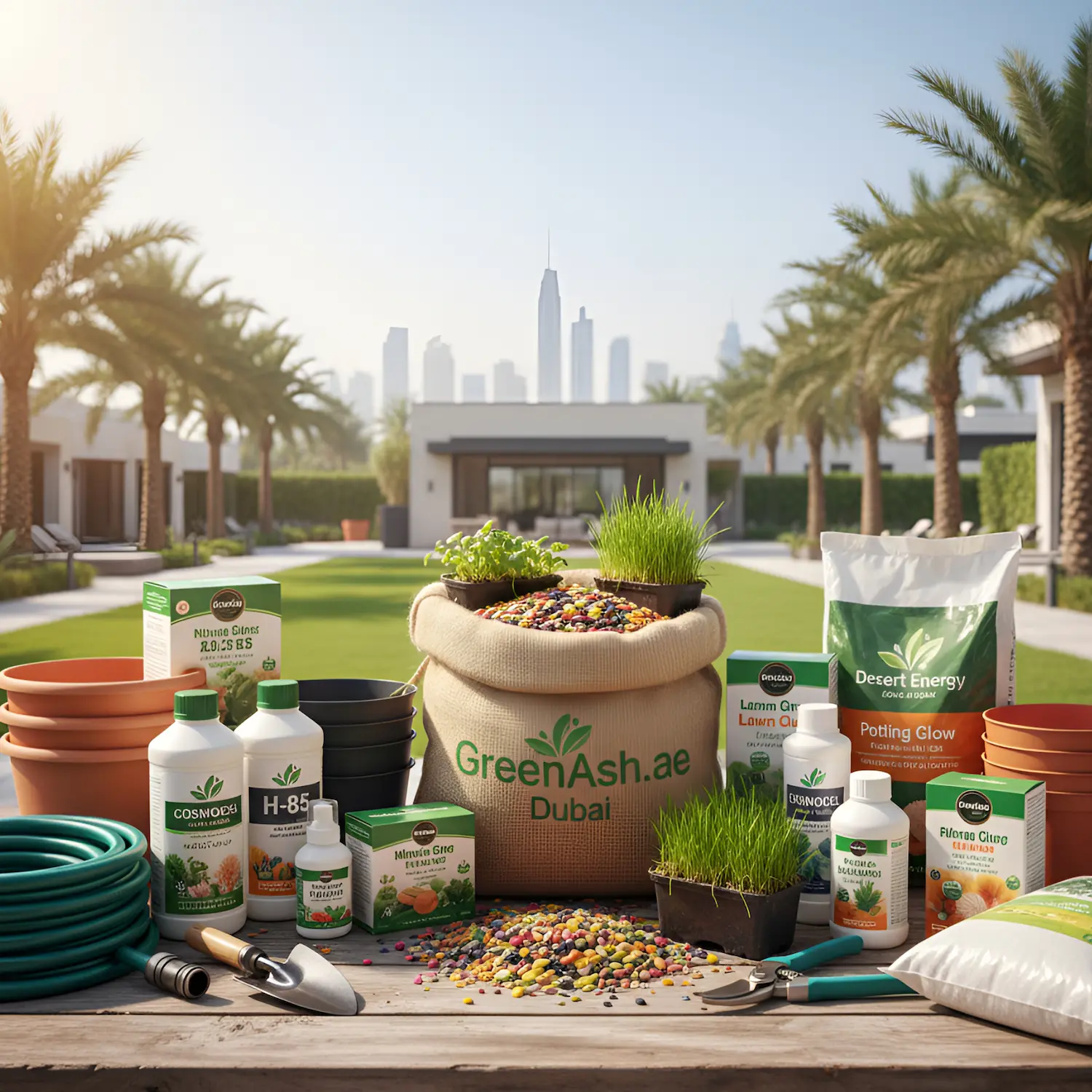
GreenAsh.ae is a Dubai-based online gardening and agriculture store that sells seeds, fertilizers and growing media, garden tools, sprayers and watering gear, crop pesticides and household pest control, with delivery to all seven emirates. The quickest way to shop it is by need: name the plant and the problem, find the matching category in the table below, read the linked guide, then check the product page and the label before you buy. By the end of this page you will know which category answers which job, what to buy in each month of the UAE year, how to read a fertilizer, pesticide or seed label, and how to store what you bring home.
What the GreenAsh range covers, category by category
The store is organised into five main departments. The figures below come from the store’s own category list on 10 November 2026. They count listed products, including some that are temporarily out of stock, so treat them as a picture of the range rather than a live stock report.
| Department | Listed products | Largest sub-categories | Typical buyer |
|---|---|---|---|
| Seeds | 235 | Vegetable Seeds 114, Flower Seeds 55, Herb Seeds 29, F1 Hybrid Seeds 24, Fruit Seeds 18, Grass Seeds 16 | Balcony and villa growers sowing in the cool season; lawn owners |
| Fertilizers | 181 | Liquid 61, Organic 39, Powder 34, Water-Soluble 24, Granular 22, Soil Conditioners 18, Micronutrients 13, Potting Soil 5 | Anyone feeding pots, beds, lawns, palms or farm crops |
| Pesticides | 138 | Insecticides 94, Organic Insecticide 16, Fungicides 27, Miticides/Acaricides 24, Organic Pesticides 10, Herbicides 7, Biopesticides 6, Repellents 6, Molluscicide 5 | Gardeners and farms treating a pest, mite, disease or weed on plants |
| Pest Control | 43 | Household Insecticides 28, Cockroach and Insect Control 8, Rodent Control 4, Fly Baits 1 | Homes and buildings dealing with cockroaches, flies, rodents and other indoor pests |
| Home & Garden | 51 | Garden Tools 23, Adhesive Tapes 9, Irrigation and Watering 8, Pool Cleaning Equipment 4, Lawn Care 3, Hydroponics 2 | Anyone setting up a garden: hand tools, pruners, sprayers, hoses, timers |
Two points stand out from that list. First, the store’s strength is inputs: what goes into the soil, onto the leaf and into the sprayer. Second, there is no separate category for plant pots or planters at the moment, and a search of the store for planters returns nothing. For container growing, the useful part of the range is what fills the pot: potting soil, perlite, slow and soluble feeds, and the small sprayers and tools sized for a balcony.
Pesticides (for plants) and Pest Control (for buildings) are separate departments for a reason. A crop insecticide is labelled for named crops with a harvest interval; a household product is labelled for indoor or structural use. Buying from the wrong department is one of the commonest ways to end up with a product whose label does not cover your situation.
Start here: what you need, which category, which guide to read
Find your situation in the left column. The last column tells you when the product category is the wrong answer, which saves money as often as the right answer does.
| What you need | Category to open | Guide to read first | It is NOT this if… |
|---|---|---|---|
| Sow a new lawn or thicken a thin one | Seeds, Grass Seeds; Home & Garden, Irrigation and Watering | Grass seed in the UAE: which seed, when and how much | The bare patch sits under a dripping AC unit, in deep shade or where the sprinkler does not reach. Fix the water or light first, or seed will fail again. |
| Start vegetables or herbs on a balcony | Seeds, Vegetable or Herb Seeds; Fertilizers, Potting Soil and Soil Conditioners | The seed packet section below, then the fertilizer guide | It is June to August. Most sowing waits for the cooler months; see the calendar. |
| Feed plants that look pale or slow | Fertilizers: Water-Soluble or Liquid for pots, Granular for beds and lawns | Fertilizer NPK numbers and how to choose | Only the new leaves are yellow with green veins (often iron in alkaline soil), or the plant is wilting in wet soil (roots, not food). |
| Make a potting mix drain properly | Fertilizers, Potting Soil and Soil Conditioners | The growing media section below | You are planting straight into sandy villa soil. Sand already drains fast; it needs organic matter first. |
| Stop insects on garden plants | Pesticides, Insecticides or Organic Insecticide | Insecticides: how to choose one and read the label | The damage is mites (fine stippling and webbing), fungus (spots, powder) or sunscorch. An insecticide will not fix those. |
| Treat leaf spots, mildew or rot | Pesticides, Fungicides | The label section below, then the insecticide guide for mixing and safety | The plant is overwatered or salt-burnt at the leaf edges. Change watering before you spray anything. |
| Spray a few pots or a large garden | Home & Garden, Garden Tools | Choosing a garden sprayer | You only need to water. A hose, timer or drip line is the right tool. |
| Water beds and pots while you are away | Home & Garden, Irrigation and Watering | Drip irrigation for UAE home gardens | The plant is already drowning: yellowing lower leaves, sour smelling soil, no drainage hole. |
| Cockroaches, flies or rodents indoors | Pest Control: Household Insecticides, Cockroach and Insect Control, Fly Baits, Rodent Control | The household product’s own label | The pest is on plants outdoors (use the Pesticides department), or the problem is inside walls or a whole building, which needs a licensed pest control company. |
Shopping for seeds
Seeds are the cheapest part of a garden and the easiest to waste. The packet tells you most of what decides success, so read it before you order a second variety.
What to check on the product page and packet
- Variety name and type. F1 hybrid seed is bred from two chosen parents for uniform plants; seed saved from F1 plants will not come true. Open pollinated seed can be saved.
- Sowing method. Some crops go straight into the ground (radish, carrot, beans, cucumber), others are best raised as transplants (tomato, pepper). The University of Arizona planting calendar for the low desert marks each crop as seed or transplant, a useful reference for a climate close to ours.
- Germination temperature. The same calendar notes that many common vegetables germinate best with soil between about 18 and 29°C (65 to 85°F). In much of the UAE, soil in pots and beds is in that range from roughly October to April, which is why that is the main sowing window.
- Packing or test date. Older seed germinates less evenly. If the pack shows a date, note it.
- Sowing rate for lawn seed. Lawn seed is sold by weight and sown by area. Prime Green Premium Grass Seed Mix, for example, gives 35 g per m² for a new lawn and 40 to 50 g per m² for overseeding on its product page. A 10 m² patch needs 350 g; a 100 m² lawn needs 3.5 kg, so four 1 kg packs.
How long seed keeps
SDSU Extension’s advice on storing leftover garden seeds gives rough storage lives for seed kept cool and dry: about 2 years for lettuce, onion, parsley, pepper and okra; 3 years for beans, broccoli, carrot and spinach; 4 years for tomato, cabbage, kale, squash and watermelon; 5 years for cucumber, radish and melon. Humidity matters most: SDSU recommends relative humidity below 60% and warns that temperatures above 32°C (90°F) greatly reduce viability. A villa garden store room or a car boot in May passes 32°C easily, so leftover seed belongs in a sealed jar indoors, or in the fridge. Let a cold jar reach room temperature before opening it so moisture does not condense on the seed.
Fertilizers, potting soil and growing media
The fertilizer department is the biggest after seeds, and the sub-categories describe form, not purpose. Form decides how you apply it:
- Water-soluble powders dissolve fully and go on through a watering can, sprayer or drip system. They suit pots and small beds where you feed every week or two.
- Liquids are measured by millilitre and diluted. Read whether the rate is per litre of water or per area.
- Granular feeds are spread on beds and lawns and watered in. Some release over weeks.
- Organic fertilizers and soil conditioners add organic matter or slow nutrients; they improve sandy soil over time rather than greening a plant in days.
- Micronutrients correct one specific shortage, such as iron. Buy them after you have matched the symptom, not as a general tonic.
The science behind the choice is short. A plant takes up nutrients dissolved in soil water. Sandy UAE soil holds little water and few nutrients, so soluble feed washes past the roots quickly and needs to be given little and often, while organic matter holds both water and nutrients for longer. A pot is a closed system: whatever you add stays until you flush it, so overfeeding shows up as white crust and brown leaf edges.
For balcony pots: start with the mix
Garden soil dug from a villa bed is a poor pot filler. It packs down, and in a pot it either stays wet or dries to a brick. A bagged potting mix is the base, and perlite is the part that keeps air spaces open.
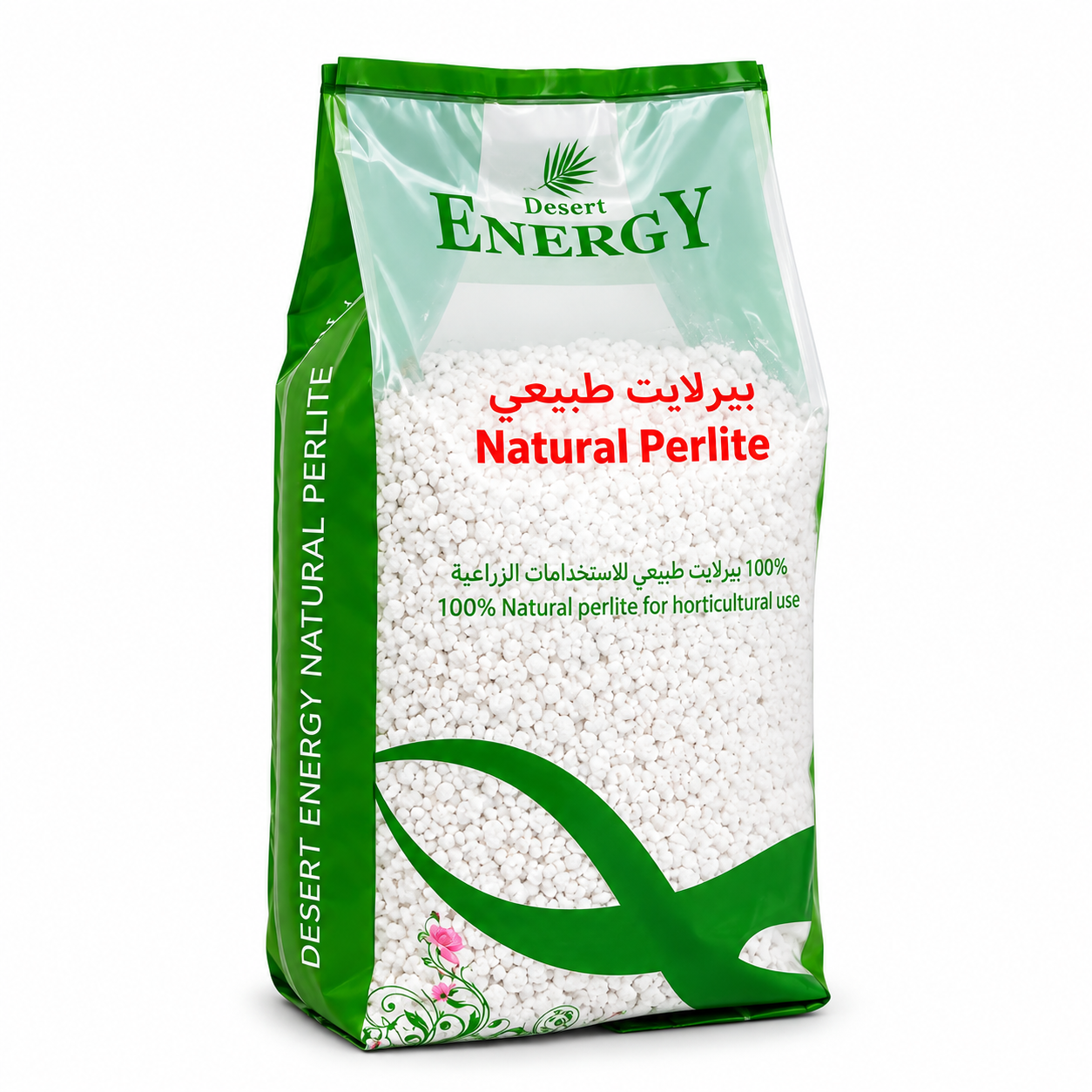
Desert Energy’s perlite page gives three mixing ratios: 1 part perlite to 2 parts potting soil for potting mixes, 1:1 with peat or coco peat for seed germination, and 10 to 20% for soil conditioning. Worked through for real containers:
- A 12 L pot: 4 L perlite plus 8 L potting soil.
- A whole 50 L bag of potting soil at 1:2 needs 25 L of perlite, which is two and a half 10 L bags, and gives about 75 L of mix before settling.
- A seed tray holding 3 L: 1.5 L perlite and 1.5 L of peat or coco peat, per the page’s seed ratio.
The page also suggests 10 to 20% perlite in garden beds and planting holes. In sandy UAE beds we would put organic matter in first: sand already drains fast, and what it lacks is the ability to hold water and nutrients, which compost or vermicompost supplies and perlite does not.
For feeding: read the grade, then the rate
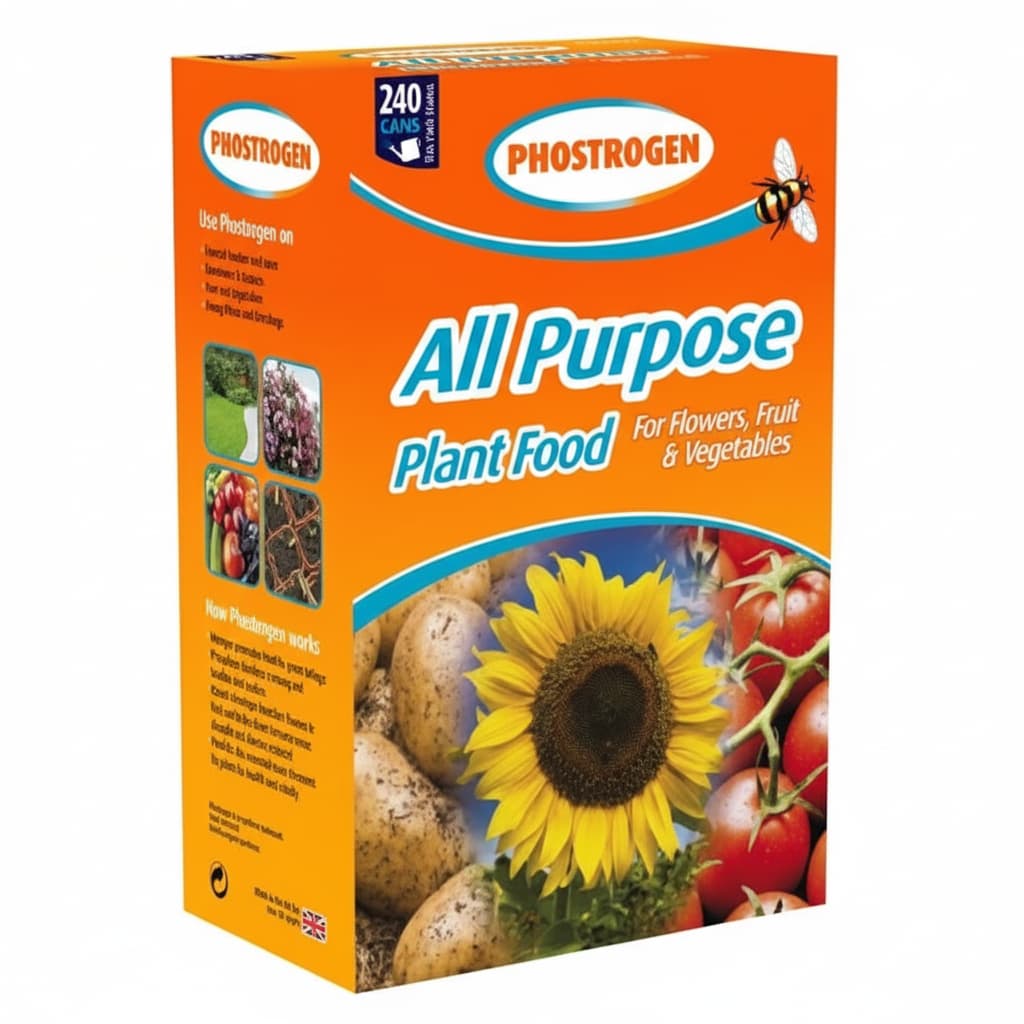
Phostrogen All Purpose Plant Food is a good example of how to work out a dose from a page rate. Its page gives NPK 14-10-27 with 2% magnesium and trace elements, and a rate of 1 level teaspoon (about 5 g) per 4.5 L of water, at half strength for young plants and seedlings. That is about 1.1 g per litre:
| Container | Full strength (page rate) | Half strength for seedlings |
|---|---|---|
| 1 L hand sprayer or jug | about 1.1 g | about 0.6 g |
| 4.5 L watering can | 5 g (1 level teaspoon) | 2.5 g (half a level teaspoon) |
| 5 L sprayer | about 5.6 g | about 2.8 g |
| 16 L knapsack | about 17.8 g (about 3.5 level teaspoons) | about 8.9 g |
The page gives two frequencies, “every 7 to 14 days” and “weekly”. In hot months, when pots are watered daily and nutrients wash through faster, the shorter interval fits; in December and January, growth slows and the longer one is enough. A kitchen scale that reads to 1 g is worth more than any guess with a spoon.
Pesticides and household pest control
Most of this department is crop protection: insecticides, fungicides, miticides, herbicides and a smaller organic and biopesticide range. Shopping it well comes down to three steps.
- Name the pest before choosing the product. NPIC’s advice on buying pesticides starts here: identify the pest and confirm the product works on it. Whiteflies, aphids, mealybugs, mites, caterpillars and fungi each need different products, and a broad insecticide on mites can make the problem worse by killing the predators that keep them down. Our insecticide guide covers this match in detail.
- Check that your plant is on the label. The directions for use list where a product may be used and which pests it targets. A product labelled for cotton or date palms is not automatically labelled for tomatoes on a balcony.
- Check who may use it. Some product pages in the store say “restricted use” or that use is limited to certified applicators. Those products are for licensed professionals, not home gardens, and we do not recommend them for DIY use, whatever the page’s dose table says.
The Pest Control department is for buildings: cockroach gels, fly baits, household insecticides and rodent products. A product here is labelled for indoor and structural use, not for food plants. When an infestation is inside walls, roof spaces or across a whole building, or when rodent bait would be needed where children and pets move about, a licensed pest control company is the safer route.
Tools, sprayers and watering
Home & Garden holds the hardware: hand tools, pruners, pressure sprayers, hoses, hose reels, poly pipe, a sprinkler and a tap timer. Three buying rules save money here:
- Size the sprayer to the area. A 2 L hand sprayer such as the GDM Eva suits a few pots and indoor plants. A garden with hedges, a lawn or a vegetable patch needs a knapsack; every refill of a small sprayer is another chance to mix the wrong dose. Our sprayer guide covers calibration and cleaning.
- Keep one sprayer for weed killer only. Herbicide residue left in a tank can damage the next plant you spray. Label it with a marker.
- Buy pruners by cutting capacity. The Fiskars P90 page gives a 26 mm capacity. Branches thicker than that need loppers or a saw; forcing them strains the blade and crushes the stem.
For watering, a tap timer such as the Orbit Buddy (battery powered, with automatic, manual and rain delay modes on its page) turns a hose or drip line into a system that runs while you travel. The drip irrigation guide explains how to measure what each line delivers, so the timer runs for the right number of minutes.
Products named on this page compared
Everything below was in stock on 10 November 2026. None of these products is a pesticide, so there is no harvest interval to report; the rate column shows exactly what each page gives, and says so when it gives nothing.
| Product | What it is (per page) | Pack | Use | Rate on the page | Who it suits |
|---|---|---|---|---|---|
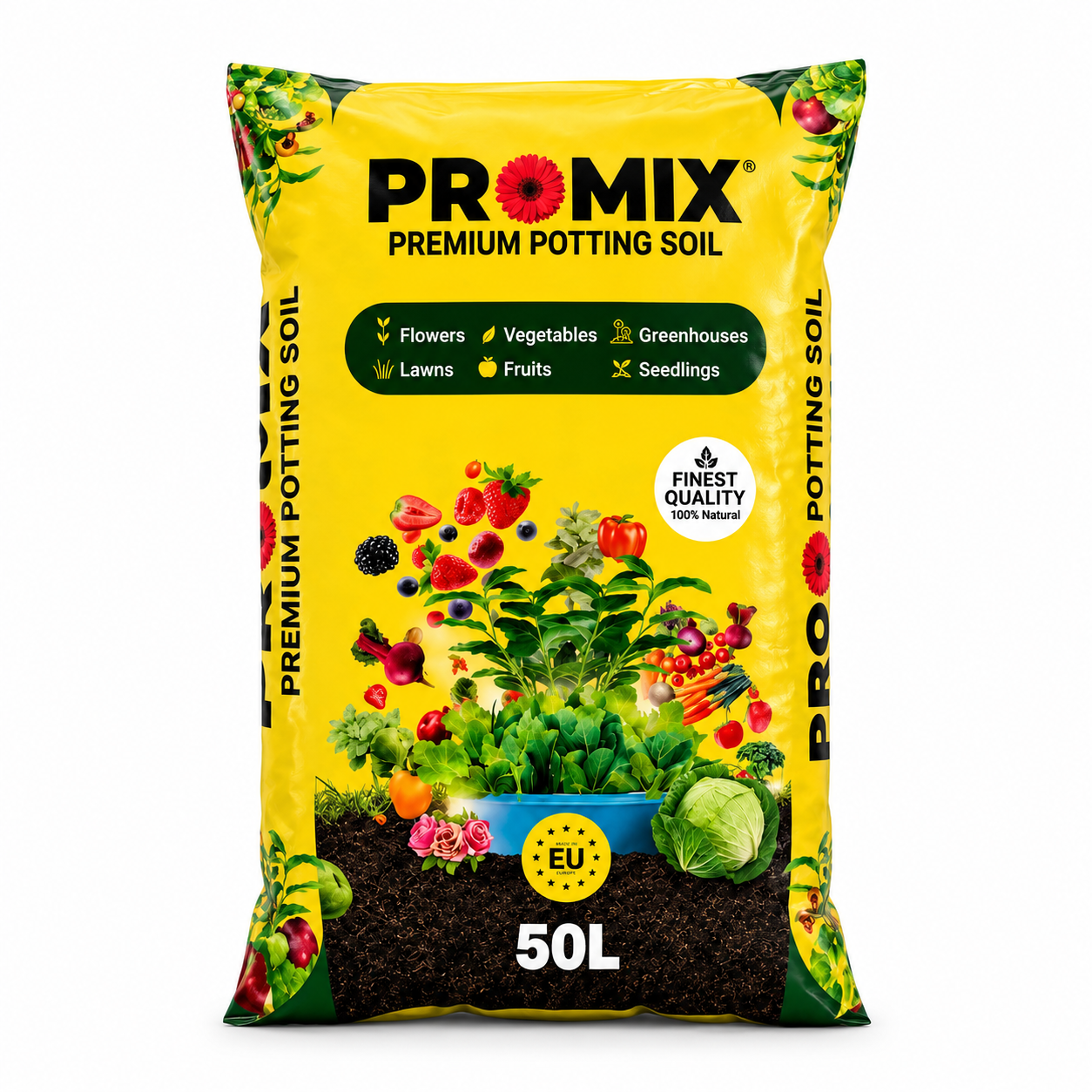
| PROMIX Premium Potting Soil | Ready to use potting soil; no composition, pH or analysis given | 50 L | Pots, seedlings, raised containers | None; page says the back label takes precedence | Balcony and patio growers filling several pots |
| Desert Energy Natural Perlite | Expanded natural perlite, pH 6.5 to 7.5, medium grade | 10 L | Drainage in potting and seed mixes | 1:2 with potting soil; 1:1 with peat or coco peat for seed; 10 to 20% for conditioning | Anyone mixing their own pot or seed mix |
| Phostrogen All Purpose Plant Food | Water-soluble NPK 14-10-27, 2% Mg, trace elements | 400 g, 800 g | Feeding pots, beds, shrubs by can or spray | 1 level teaspoon (about 5 g) per 4.5 L; half strength for seedlings | Mixed home gardens fed every 1 to 2 weeks |
| Prime Green Premium Grass Seed Mix | Blend of five grass varieties, origin Spain | 1 kg (about 25 to 30 m²) | New lawns and overseeding | 35 g/m² new lawn; 40 to 50 g/m² overseeding | Villa lawns sown in the cool season |
| GDM Eva Pressure Sprayer | Handheld pump sprayer, adjustable nozzle | 2 L | Spot spraying pots and indoor plants | Not applicable | Balconies and small patios |
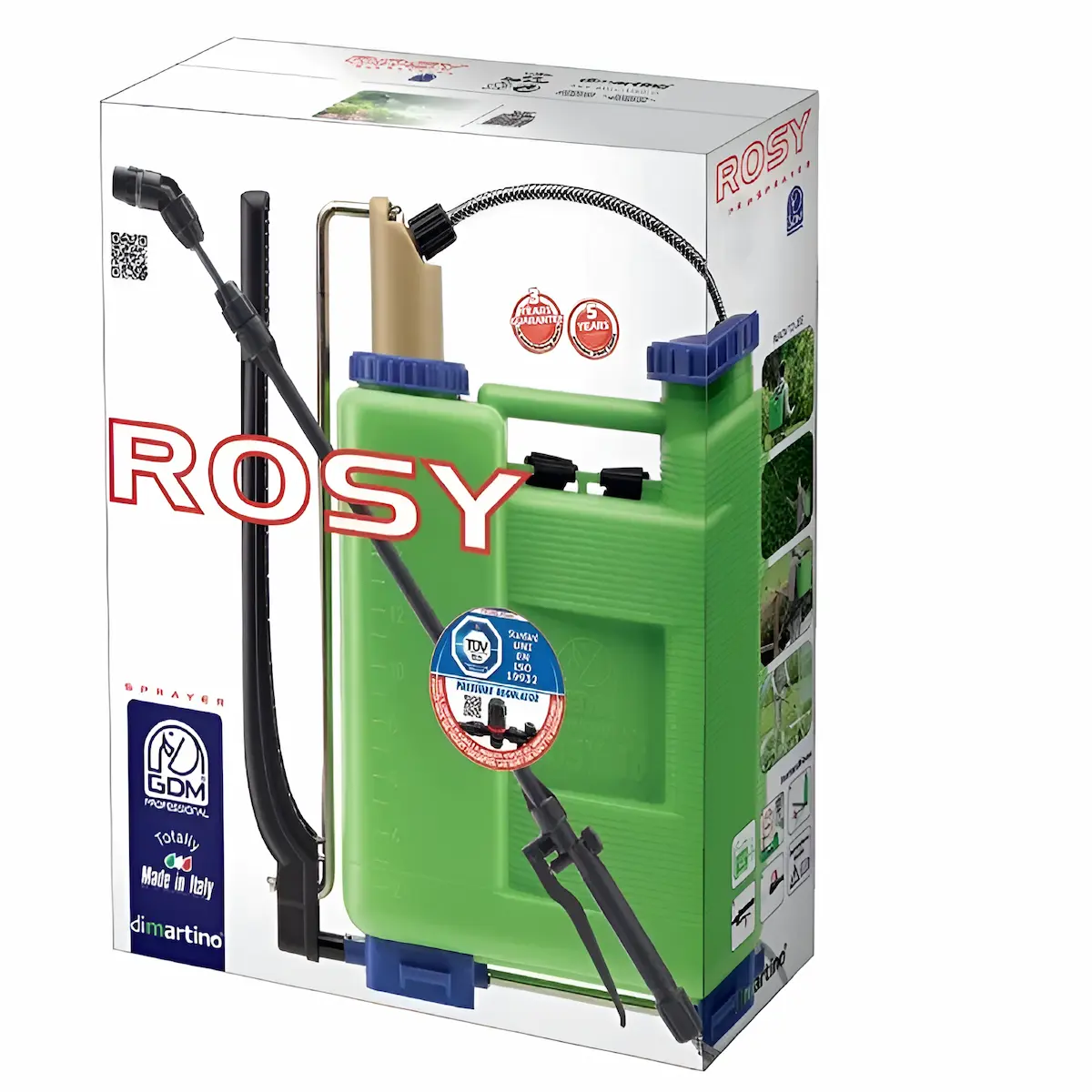
| GDM Rosy Knapsack Sprayer | Backpack pressure sprayer, adjustable pressure | 12, 16 or 22 L | Lawns, hedges, vegetable plots, farms | Not applicable | Villas and small farms |
| 3-Piece Gardening Tool Set | Trowel, rake and fork with metal heads | 3 tools | Planting, weeding, loosening soil in pots and beds | Not applicable | First time gardeners and balcony growers |
| Fiskars P90 Bypass Pruner | Bypass pruner, hardened steel blades, safety catch | 1 pruner | Live stems and branches | Cuts up to 26 mm | Roses, bougainvillea, shrubs |
| Orbit Buddy Single Port Tap Timer | Battery tap timer with automatic, manual and rain delay modes | 1 timer | Hose or drip watering on a schedule | Not applicable | Villas and travellers |
A seasonal UAE shopping calendar
The UAE garden year runs backwards compared with Europe: the growing season is the cool half of the year, and summer is the season of survival. The University of Arizona’s low desert calendar makes the same point for a similar climate, treating autumn and spring as the planting seasons and summer as outside them, and it adds a practical warning: delay autumn planting until whitefly numbers fall with cooler weather.
| Months | What is happening | What to buy or check |
|---|---|---|
| Late August to September | Still hot; nights begin to ease late in September | Order potting soil, perlite and the seed you plan to sow, while you can check stock calmly. Test your sprayer with water. Check timer batteries before the autumn change in watering. |
| October to November | Main sowing and planting window; whitefly can still be active early on | Vegetable, herb and flower seed; transplants; lawn seed for overseeding; a soluble feed for new pots. Inspect leaf undersides before planting near older plants. |
| December to February | Coolest months, slower growth, dew and occasional rain | Feed at the longer interval. Watch new shoots for aphids and leaves for mildew in humid spells. Pruners for roses and shrubs; keep fungicide choices for confirmed disease only. |
| March to April | Warming; harvest of winter crops; spider mites often build up in hot, dry weather | Miticide or insecticide only after checking leaf undersides; shade net before May; a timer or drip line before the heat. |
| May to August | Summer heat and humidity on the coast; little sowing | Irrigation parts, timers and shade. Warm season Bermuda lawns still grow and need feed and water. Move seeds, fertilizers and pesticides out of hot sheds. |
How villas, balconies and farms differ
- Balcony: everything is in pots, so potting mix, perlite and soluble feed matter most. High floors are windier; spray only in still air, and never with a 16 L knapsack where drift reaches neighbours below.
- Villa: sandy beds need organic matter and regular watering; lawns need seed or feed by area, so measure the lawn in m² before ordering. A knapsack sprayer and a timer earn their place here.
- Farm: rates are given per hectare or per feddan on many crop labels, and products are sold in larger packs. Read the label’s water volume and harvest interval for each crop, and keep a written spray record.
How to read a label before you buy
A product page is a summary. The label on the pack is the document that counts, and the PROMIX page says so directly: information on the back label takes precedence. Here is what to look for on each type of product.
Fertilizer labels
Clemson University’s guide to reading a fertilizer label explains the three numbers, called the grade. They are the percentage by weight of nitrogen (N), phosphate (P2O5) and potash (K2O). To find how much of each nutrient you are buying, multiply the pack weight by each percentage. An 800 g pack of a 14-10-27 feed holds 112 g of nitrogen, 80 g of phosphate and 216 g of potash; the rest is the carrier and other elements. Clemson also notes that, under the law it describes, a slow release fertilizer must have at least a third of its total nitrogen in slow release form, often shown as water insoluble nitrogen (WIN). If a page gives no analysis at all, you cannot compare it with anything, and that is worth asking about before you buy. Our NPK guide works through more examples.
Pesticide labels
UC IPM’s guide to reading a pesticide label lists the parts to check, and each one answers a buying question:
- Active ingredient and strength. The trade name does not tell you what is inside; the active ingredient does. Two brands with the same active and strength are the same tool.
- Signal word. CAUTION, WARNING or DANGER describe short term toxicity, from lowest to highest. NPIC’s signal word fact sheet adds that the word covers only acute effects, and that the most toxic products must also carry the word POISON. A CAUTION label is not a promise of safety.
- Directions for use. The crops or sites, the pests, the dose and the water volume. If your plant or pest is not there, the product is not for your job.
- Precautionary statements. The protective equipment to wear, and the hazards to bees, fish and birds.
- Harvest interval and re-entry. Crop labels state how many days must pass between the last spray and picking. If a product page does not state the harvest interval, find it on the pack before you spray anything you will eat.
- Storage, disposal and first aid. Read these before an accident, not after.
Seed packets
Look for the variety, whether it is F1, the sowing depth and spacing, days to harvest and any date on the pack. If the product page omits days to harvest, compare with a regional calendar before sowing so a late variety is not still cropping when May heat arrives.
Safety and storage at home
NPIC’s poison prevention advice is plain: keep pesticides in a locked cabinet out of reach of children and pets, close containers straight after use, and never put a pesticide in a food or drink bottle. UC IPM adds that products should stay in their original containers so the label stays with them.
- Protective equipment. Wear what the label names. For most garden mixing that means chemical resistant gloves, eye protection, long sleeves and closed shoes. Phostrogen’s page asks for gloves even for a fertilizer, and the perlite page suggests a mask against the dust.
- Heat. A UAE store room or car boot in summer can be far hotter than a label’s storage range. Store seeds, fertilizers and pesticides indoors in a cool, dry cupboard, and carry them home in the cabin rather than leaving them in a hot car for hours.
- Children and pets. Keep them away from treated areas until the spray has dried or for the re-entry time on the label, whichever is longer. Keep pets off a lawn until any granules have been watered in, or for as long as the label directs.
- Bees and fish. Do not spray open flowers when bees are working them, and never rinse a sprayer into a pond, a drain or the street.
- Disposal. NPIC’s pesticide disposal page says to follow the label’s storage and disposal statement, never pour rinse water down any drain, never reuse a pesticide container, buy only what you need for the season and mix only what you need for the day. Spray a small leftover onto a site the label allows rather than tipping it out.
Common mistakes when shopping a garden store
- Buying a pesticide before naming the pest. It fails because each product covers a limited list of pests. Look under the leaves, take a close photo and match it first.
- Choosing a fertilizer by brand or colour of the pack. Two packs with the same grade do the same job. Compare the analysis and the rate, then the pack size.
- Treating sandy beds like heavy soil. Drainage aids do little for sand, which already drains freely. Put organic matter into sand first and keep perlite mainly for pots.
- Buying a season’s seed in May. Seed loses vigour in summer heat. Buy close to sowing, or store it sealed and cool.
- Using one sprayer for everything. Weed killer residue damages the next crop you spray. Keep one sprayer for herbicides only.
- Measuring with a kitchen spoon by eye. A heaped spoon holds noticeably more than a level one. Use a scale or a measuring cup and level it.
- Ordering a restricted use product for home use. If the page says certified applicators only, it is not a DIY product, whatever the dose table shows.
When a product did not work
Before you buy a second product, check the first one properly.
- Was it the right diagnosis? Spider mites, thrips and fungal spots are often mistaken for one another. If the pest is still there after a correctly mixed spray, look again with a hand lens.
- Was the dose and coverage right? Recalculate the dose from the label for the volume you mixed, and check that the spray reached the undersides of leaves, where many sap feeders sit.
- Was the timing right? Many treatments need a second application at the interval on the label, because eggs survive the first.
- Is the problem water or salt, not pests or food? Brown leaf edges in summer, white crust on pots and wilting in wet soil point to watering, drainage or salt. Flush pots with plenty of water and check that the drainage hole is clear.
- Know when to stop. Call a licensed pest control company for termites in a building, rodents indoors, or any infestation that has survived two correctly applied label treatments. For a sick tree or a farm crop, a plant clinic or an agricultural adviser can confirm the problem before more money goes into products.
Frequently asked questions
Does GreenAsh deliver outside Dubai?
Yes. The GreenAsh home page states that it delivers to all seven emirates, and the About Us page describes the store as located in Dubai with service extended to the other emirates. Neither page states delivery charges or delivery times, so ask before ordering if timing matters.
Can I return something I ordered?
The Refund and Return Policy, linked in the site footer, asks you to contact info@greenash.ae within 3 days of receiving the order, with the order number and the reason. Items must be unused, undamaged and in their original packaging. Opened or unsealed packaged items, used items, fragile items and items marked final sale are not returnable. Approved refunds go back to the original payment method within 5 to 7 business days after inspection; the original shipping fee and the Stripe payment processing fee are not refunded.
Does the store sell plant pots?
Not as a separate category at the time of writing. For container growing, the range covers the mix that goes in the pot (potting soil and perlite), feeds, small sprayers and hand tools.
How do I know which pesticide suits my plant?
Identify the pest, then check the label’s directions for use for both your plant and that pest, and note the harvest interval if you will eat the crop. If the product page does not list your plant or the harvest interval, ask before ordering. The insecticide guide linked above walks through this step by step.
Is the product page the same as the label?
No. A product page summarises; the label on the pack is the legal instruction for use. Where they differ, follow the label.
When should I buy vegetable seed in the UAE?
Plan in September and buy for sowing from October to early spring, when soil sits in the 18 to 29°C range that suits most vegetables. Store any leftover seed sealed, dry and below 32°C.
How much lawn seed do I need?
Measure the area in square metres and multiply by the rate on the seed’s page. At 35 g per m², a 40 m² lawn needs 1.4 kg. The grass seed guide explains which grass to sow in which month.
How can I get help choosing a product?
The Contact Us page lists a phone and WhatsApp number (+971 50 798 6018), and the returns policy gives info@greenash.ae. Send the plant, a clear photo of the problem, the area or pot size and what you have already applied; that is the information needed to match a product and a rate.
Shop by need
Pick the row in the decision table that matches your garden, open the category, and read the product page and label before you add anything to the cart. Start with Seeds, Fertilizers or Home & Garden for growing, and Pesticides or Pest Control once you have named the pest.
دليل التسوق في GreenAsh حسب الحاجة: بذور وأسمدة وأدوات ومبيدات
GreenAsh.ae متجر إلكتروني للبستنة والزراعة مقره دبي، ويقدم التوصيل إلى الإمارات السبع. يضم المتجر خمسة أقسام رئيسية: البذور (بذور الخضروات والزهور والأعشاب والعشب)، والأسمدة (سائلة وذائبة بالماء وحبيبية وعضوية ومحسنات تربة وتربة أصص)، والمبيدات الزراعية (حشرية وفطرية وأكاروسية وأعشاب)، ومكافحة الآفات المنزلية (الصراصير والذباب والقوارض)، وقسم المنزل والحديقة (أدوات ومرشات وخراطيم ومؤقتات ري).
كيف تختار
- حدد النبات والمشكلة أولا، ثم افتح القسم المناسب.
- لا تشتر مبيدا قبل التعرف على الآفة، وتأكد أن نباتك والآفة مذكوران في الملصق، وانتبه لفترة الأمان قبل الحصاد.
- بعض صفحات المنتجات تذكر أن الاستخدام مقيد بالمطبقين المرخصين، وهذه المنتجات ليست للاستخدام المنزلي.
- في الأسمدة، الأرقام الثلاثة هي نسب النيتروجين والفوسفات والبوتاس بالوزن. مثال: عبوة 800 غرام من سماد 14-10-27 تحتوي 112 غرام نيتروجين.
- البرلايت يناسب خلطات الأصص بنسبة جزء برلايت إلى جزأين من تربة الأصص حسب صفحة المنتج. أما في التربة الرملية في الحدائق فأضف المادة العضوية أولا، لأن الرمل سريع التصريف أصلا.
التقويم الموسمي
موسم الزراعة الرئيسي في الإمارات من أكتوبر إلى أبريل. اشتر البذور وتربة الأصص في سبتمبر وأكتوبر، وجهز المؤقتات والري بالتنقيط وشبك الظل قبل مايو. في الصيف خزن البذور والأسمدة والمبيدات داخل المنزل في مكان بارد وجاف، فالحرارة فوق 32 درجة تضعف إنبات البذور.
السلامة والإرجاع
احفظ المبيدات في خزانة مقفلة بعيدا عن الأطفال والحيوانات الأليفة، وفي عبواتها الأصلية فقط، وارتد القفازات وواقي العينين المذكورين في الملصق، ولا تسكب بقايا الرش في المجاري. سياسة الإرجاع تطلب التواصل عبر info@greenash.ae خلال 3 أيام من الاستلام، مع بقاء المنتج غير مستخدم وفي عبوته الأصلية، ولا تقبل إرجاع العبوات المفتوحة. للاستفسار: هاتف وواتساب +971 50 798 6018.