
Blog
Growing Peppers and Chillies in the UAE: Seedlings, Care and Harvest

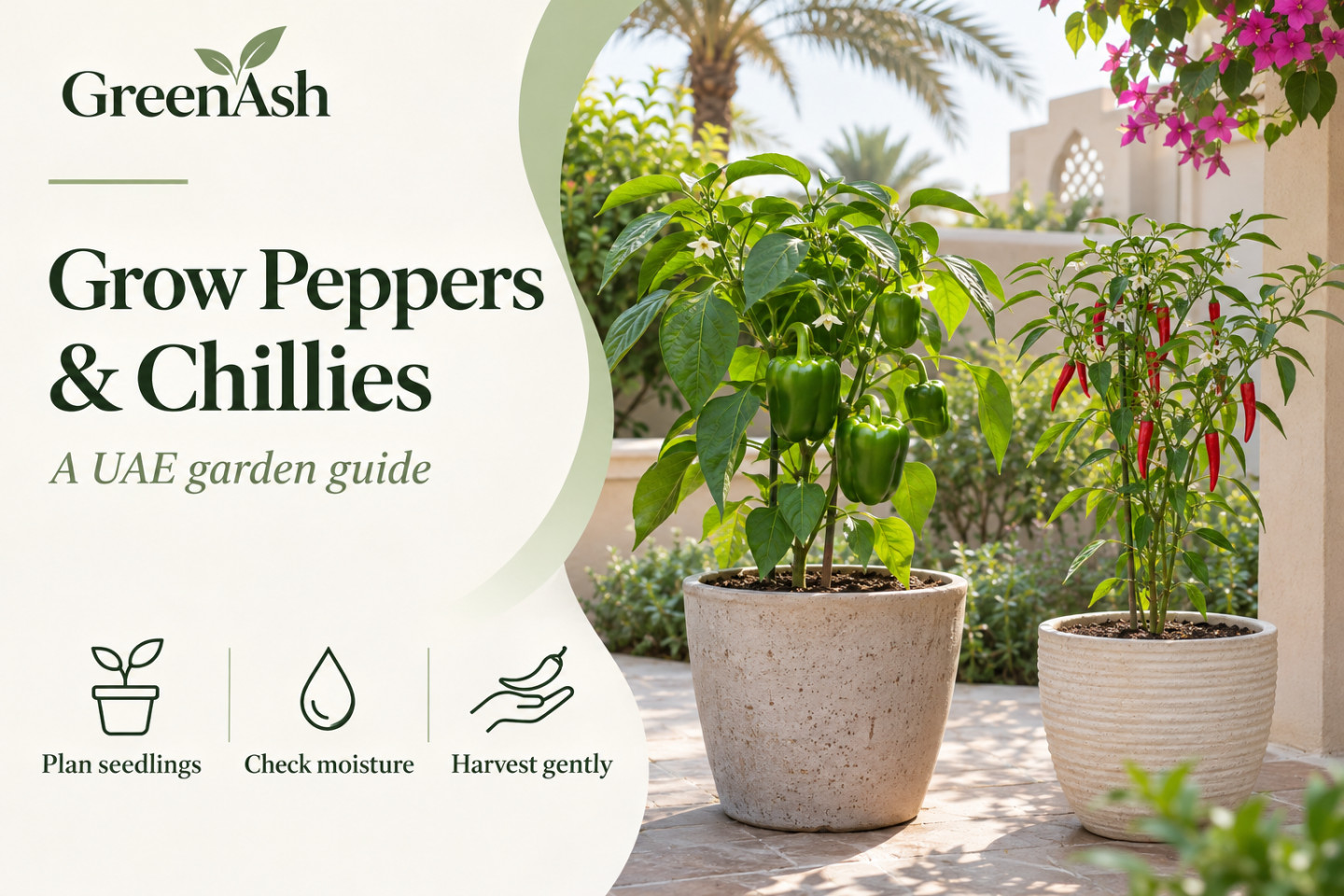
Peppers and chillies grow well in the UAE if their flowering falls in the mild months. In practice that means sowing in a tray from late August to October, planting out from October to early December, and picking from December into April. Sweet capsicum is the fussier of the two; hot chillies forgive more heat. A seed packet and a ready-to-plant seedling begin at different stages, so they should not share the same harvest countdown.
By the end of this guide you will be able to choose between capsicum and chilli seed, raise sturdy seedlings, plant them into a pot or bed with the right spacing, water and feed them with measured amounts, read the warning signs when flowers drop or fruit marks, and plan the whole season month by month for a villa garden, a balcony or a farm plot.
Plan around temperature and the variety
Peppers need warmth, yet extreme heat can interrupt fruit set. Oklahoma State University reports the best yields when fruit sets at 18 to 27°C (65 to 80°F), small and misshapen fruit when it sets above about 29°C, and very little fruit set above roughly 32°C by day or below 16°C at night. New Mexico State University gives an almost identical window for chile: days of 18 to 29°C and nights of 16 to 21°C, with blossoms that may not set below 16°C or above 32°C. The University of Arizona puts the lower night limit a little cooler, at about 13°C, and adds a figure that matters a great deal here: fruit will not set when night temperatures stay above 30°C. The Oklahoma State pepper production guide explains these temperature effects in more detail.
Set those numbers against a UAE year. From June to September, days far above 32°C and warm nights mean a pepper plant can stay alive and green but set little or nothing. From late October, days drop back towards the low 30s and below, and from December to February many coastal days come close to that 18 to 27°C sweet spot. Inland gardens and desert farms can see cold nights in January, so a few weeks of slow growth there is normal. Check conditions at the planting spot, particularly beside a sun-heated wall, because a sunny wall reflects heat back onto the plant.
Before sowing, read whether the variety’s maturity estimate starts at sowing or transplanting. Record both dates. Oklahoma State gives 75 to 80 days from transplanting for bell peppers, about 100 days to mature green for chile types and about 140 days to red ripe. University of Florida gives 60 to 80 days from transplanting, or 80 to 100 days from seed sown in the ground. Leave extra time for germination, establishment and weather delays. For a late start, a healthy transplant reduces the nursery time still ahead of you. Avoid treating a general “days to harvest” figure as a guaranteed picking date.
What this means for sweet peppers versus chillies
Bell peppers carry large, thick walled fruit and need a long run of mild weather to fill them. Long, thin chillies set and ripen smaller fruit, and in our experience they cope better as the heat returns in April. If you can only grow one, and your garden is in full sun with reflected heat, chilli is the safer start. University of Arizona asks for at least eight hours of direct sun, so in a hot spot we suggest full morning sun and light shade only in the late afternoon from April.
Heat in a chilli is set by compounds called capsaicinoids, made in glands on the pale inner tissue that holds the seeds, not by the seeds themselves. NMSU notes that water stress, temperature extremes, disease and insect pressure all change how hot a pod becomes, so the same variety can taste hotter in a stressed pot than in a well watered bed. The University of Arizona lists typical heat ranges: jalapeño 2,500 to 5,000 Scoville heat units, serrano 10,000 to 23,000 and habanero 200,000 to 300,000.
Choose sweet pepper or chilli seed
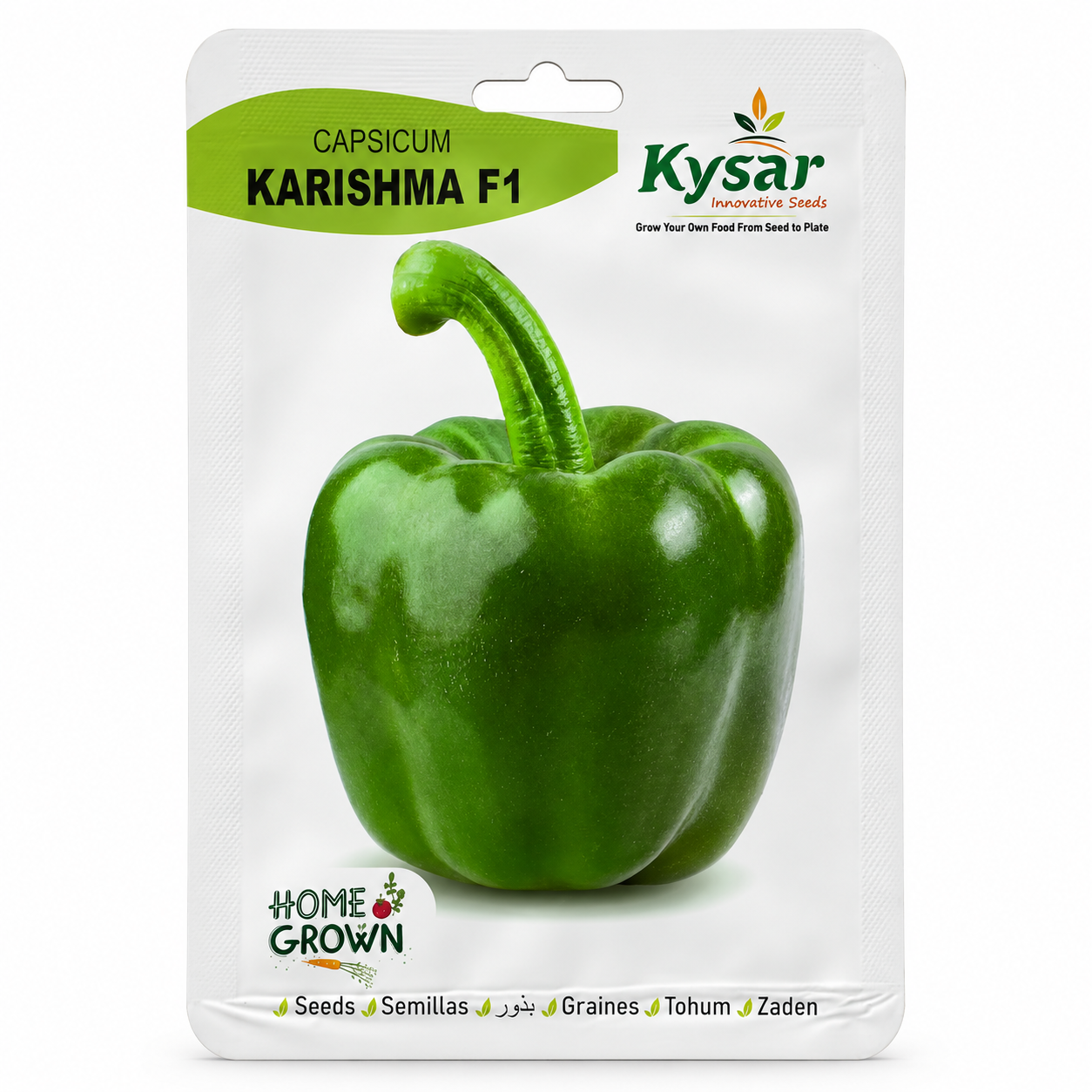
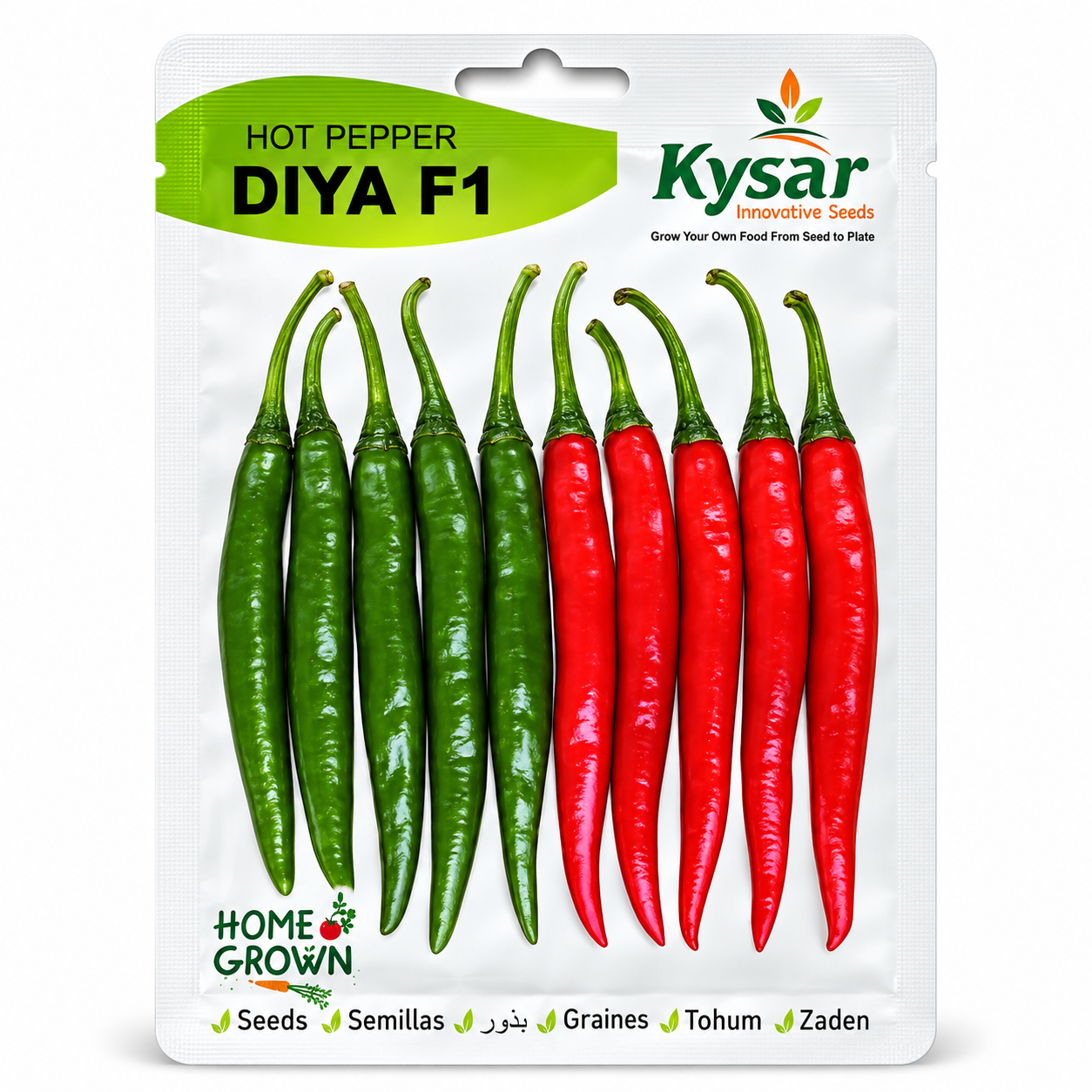
GreenAsh currently stocks one sweet and one hot hybrid. The Agrimax and Hortus pepper lines are out of stock at the time of writing, so we have left them out.
| Your goal | Verified GreenAsh seed option | What the product page says | What to check before ordering |
|---|---|---|---|
| Green bell peppers for cooking | Kysar Karishma F1 Capsicum Seeds, listed as 50 seeds | F1 hybrid, 85% manufacturer-declared germination, large green block shaped fruit on the packet, sow 0.5 to 1 cm deep | The page does not give days to harvest or plant spacing; read the packet when it arrives |
| Hot chillies | Kysar Diya F1 Hot Pepper Seeds, listed as 50 seeds | Hybrid, 85% manufacturer-declared germination, long slender green and red chillies on the packet, sow about 0.5 cm deep | No heat level or days to harvest on the page, so start a few plants first and judge the heat yourself |
Both listings identify F1 hybrids, which means seed saved from your own fruit will not grow true, so buy fresh seed each season. Keep each variety separately labelled from sowing onwards. Sow only the number of plants you can accommodate, with a few spare seedlings if space permits. Seed count describes the packet contents and does not promise the same number of established plants. At the declared 85% germination, 10 seeds sown should give about 8 or 9 seedlings in good conditions; sow 6 to end up with 4 strong plants and a spare.
How to decide what is wrong: a quick diagnosis table
In our climate, heat, water and salt are worth ruling out before you look for a disease. Use this table before you buy anything.
| What you see | Most likely cause | What to do | When it is NOT this |
|---|---|---|---|
| Plenty of flowers, but they yellow and fall off with no fruit | Heat (days above 32°C or nights above about 30°C), or the root zone drying out between waterings | Check soil moisture at root depth each morning; add afternoon shade; wait for cooler weather | If small fruit form and then drop, look at watering first; if leaves are also curled and sticky, check for aphids |
| Flat, pale tan, papery patch on the sunny side of the fruit | Sunscald from direct sun on fruit with too little leaf cover | Keep leaves on the plant, avoid heavy pruning, use light shade in hot spells | A dark, sunken, leathery patch at the tip is blossom-end rot (next row) |
| Dark, sunken patch at the blossom end of the fruit | Blossom-end rot, usually linked to uneven watering | Steady watering and mulch; see our calcium guide | Soft, spreading, wet rot with mould is a fruit rot; remove the fruit |
| Leaf edges brown and crisp, older leaves first, white crust on the pot rim | Salt build-up from irrigation water or overfeeding | Water deeply enough that some drains out; reduce feed; test water if you can | Even yellowing of older leaves with no crisp edges points to a shortage of nitrogen |
| Leaves curled, sticky, black sooty film | Aphids or whitefly feeding | Check the undersides; rinse or treat if numbers build | Pale stippling and fine webbing means spider mites |
| Fine pale speckles, silvery patches, distorted new leaves | Thrips or mites | Look with a hand lens; tap a shoot over white paper | Twisted leaves with bumpy fruit and mosaic colour can be a virus; remove the plant |
| Plant wilts at midday even though the soil is wet | Root damage from waterlogging, or root-knot nematodes in sandy soil | Stop watering until the top few centimetres dry; pull a failed plant and look for knots on the roots | If the soil is dry, it is simply thirst |
| Tall, leafy bush with very few flowers | Too much nitrogen, or too little sun | Switch to a feed with more potassium; give at least 8 hours of direct sun | If the plant is small and pale, it needs more feed, not less |
The science behind flower drop and salt damage
A pepper flower usually pollinates itself, but fruit set happens only within a fairly narrow temperature range. Above about 32°C most flowers drop before they set, which is why a plant covered in buds can stay bare of fruit through a hot spell. Once days fall back into the high 20s, the same plant will set again, and University of Arizona notes that the best crops usually come once the weather cools down.
Salt is the other limit, and peppers are more sensitive to it than many people expect. In the FAO irrigation water quality tables, pepper keeps its full yield only when irrigation water is below about 1.0 dS/m in electrical conductivity. At 1.5 dS/m expected yield falls to about 90%, at 2.2 dS/m to about 75%, and at 3.4 dS/m to about half. Tomato, by comparison, tolerates 1.7 dS/m before losing yield. You can read the full FAO crop salt tolerance table for other vegetables too.
What this means at home: if your garden uses well water, borehole water or recycled water, a pepper may struggle where a tomato copes. A cheap EC meter tells you where you stand. Salt also concentrates in a pot as water evaporates, so a container watered little and often, with nothing ever draining out, builds salt every week. The fix is to water enough that some water runs out of the drainage holes each time, which carries salts down and away from the roots.
Raise compact seedlings
Use clean nursery containers with drainage and a seed-starting medium. The University of Minnesota advises sowing about 6 mm (a quarter inch) deep in a sterile, soilless mix and starting seeds about eight weeks before planting out. It recommends keeping trays at 27 to 32°C until seedlings emerge, then keeping the soil at about 21°C. In a UAE September that warmth is easy; the risk is the opposite, a tray left in a hot room or on a sunny balcony that dries out in hours. The University of Minnesota pepper guide covers nursery care and transplant selection. Its outdoor calendar is for Minnesota, so use its cultivation principles alongside local conditions.
- Write the variety and sowing date on a label before watering the tray.
- Sow 2 seeds per cell, then snip the weaker one at soil level once both show their first true leaves.
- Check moisture before watering again. Make sure surplus water can leave the container.
- Give bright light as soon as seedlings appear. A seedling that stretches tall and pale with a long bare stem is short of light, not water.
- When the first true leaves appear, move seedlings to their own small pots or space them 5 to 8 cm apart.
- As seedlings develop, compare them for compact growth and healthy leaves. Investigate spots or insects before moving plants alongside your main crop.
- Gradually introduce nursery plants to the outdoor light and wind where they will grow. Minnesota suggests a week or two of building up sun exposure; start with a couple of hours of morning sun. Avoid moving tender seedlings straight into an exposed, hot position.
NMSU gives 6 to 8 weeks from sowing to transplant size. NMSU asks for stocky, healthy transplants; we look for dark green leaves and a short, thick stem rather than height. Minnesota also suggests pinching off any flower buds that form while plants are still in the nursery, so the plant puts its energy into roots first.
For the tray mix, a fine, clean potting medium is better than garden soil, which can carry the fungi that cause seedlings to collapse at the base. PROMIX Premium Potting Soil lists seedlings and vegetables on its packaging; the product page does not state its fertiliser content, so watch the seedlings and start a half strength feed once true leaves appear.
Prepare the final pot or bed
Select a sunny position and a draining growing medium. University of Arizona asks for at least eight hours of direct sun. In containers, follow the variety’s space requirements and check that drainage holes remain open after the pot is placed. As a working guide, give each bell pepper a pot of at least 15 to 20 litres and each chilli at least 10 litres; smaller pots dry out within hours in April. Allow room to reach the plant for watering and picking.
In a bed, follow the recommended spacing rather than crowding every spare seedling into the same row. Minnesota spaces plants 45 cm apart in rows 75 to 90 cm apart; NMSU, working in hot, dry New Mexico, plants chile closer, 20 to 36 cm apart in rows 60 to 75 cm wide, so the leaves shade the fruit and soil. In a UAE bed in full sun we prefer the closer NMSU spacing, because a fuller canopy leaves less fruit exposed to sunscald. As a rough guide, a 1 m by 1 m raised bed takes about 4 bell peppers at Minnesota’s 45 cm, or 6 chillies at the closer NMSU spacing.
Sandy UAE soil drains fast and holds few nutrients. Mixing well-rotted compost or vermicompost into the top 20 cm before planting helps it hold water. The sources differ on pH: NMSU accepts 7.0 to 8.5 for chile, while Oklahoma State gives 6.0 to 6.8 as best and Minnesota 6.5 to 7. A soil test tells you where your bed sits before you add anything to change it.
Before planting, test your watering arrangement. Check each outlet if using drip, and keep the root ball intact during transplanting. NMSU suggests transplanting in the early evening and watering in immediately, which gives the plant a cool night to settle before its first full day of sun. Install a support while the plant is small if the variety or exposed location calls for one. A bell pepper loaded with fruit can lose branches in strong winter wind. Our drip irrigation guide explains how to compare emitter flow and check the wetted root zone.
Water and feed through flowering
Check the medium regularly and adjust watering as the plant grows. Dry spells can contribute to flower and small-fruit loss, while excessive irrigation can favour root problems. NMSU links under-watering to blossom drop, smaller fruit and blossom-end rot, and over-watering to Phytophthora root rot. A wilted plant in wet soil deserves inspection before adding more water. Keep a record of watering changes, especially if flowers begin dropping.
How much water? Minnesota suggests about 25 mm a week for an established plant, and Oklahoma up to 38 mm every 7 to 10 days. A millimetre of water over a square metre is one litre, so 25 mm a week is about 25 litres per square metre per week. In UAE sandy soil that water runs through fast, so split it into several smaller waterings: in a December bed, perhaps 3 or 4 waterings a week; in April, daily. Use your finger or a moisture meter at 5 to 10 cm depth rather than a fixed schedule.
Feeding with measured amounts
Use fertilizer directions appropriate to vegetables and the growing medium. Account for nutrients already present in a pre-fertilized potting mix. Excess nitrogen can encourage leafy growth at the expense of fruiting, as Minnesota Extension notes, and University of Florida advises reducing nitrogen once plants set fruit. Choose feeding amounts from the product directions and, for garden beds, soil-test recommendations.
A soluble feed with more potassium than nitrogen suits fruiting peppers. Phostrogen All Purpose Plant Food is listed as NPK 14-10-27 with magnesium and trace elements. Its page gives 1 level spoon (5 g) per 4.5 litres of water, every 7 to 14 days during growth, and half strength for young plants and seedlings. Worked from that rate:
| Container | Established plants (5 g per 4.5 L) | Seedlings, half strength |
|---|---|---|
| 1 litre jug | about 1.1 g | about 0.55 g |
| 4.5 litre watering can | 5 g (1 level spoon) | 2.5 g (half a spoon) |
| 9 litre watering can | 10 g (2 level spoons) | 5 g (1 level spoon) |
A 1 g amount is hard to measure with a spoon, so for a single pot it is easier to make up a full 4.5 litre can and use what you need over a few plants. Water the plant with plain water first if the soil is dry, then apply the feed, so concentrated solution never hits dry roots. Feed weekly from the first flowers (usually November or December), and drop to every 14 days if cold nights stall growth in January.

For beds where you would rather feed less often, a granular slow release such as GrowFast 12-12-17 gives 2 to 3 tablespoons around each outdoor plant every 3 months on its page. That suits a busy villa garden, but it is harder to cut back nitrogen once fruit sets, so we prefer a soluble feed for peppers.
A UAE pepper calendar
This calendar assumes a coastal villa garden. Inland and farm sites run cooler in winter nights and hotter in summer, so shift a couple of weeks either way.
| Month | Villa garden in full sun | Balcony or courtyard pots | Farm or large plot |
|---|---|---|---|
| Late August to September | Sow trays indoors or in bright shade; keep them out of direct afternoon sun | Sow in a bright room near a window; trays dry quickly with air conditioning off | Sow nursery trays under shade net |
| October | Harden off and plant out from mid month once days ease; light shade for the first week | Pot up into 10 to 20 litre containers; morning sun spot | Transplant in the evening; drip lines tested before planting |
| November to December | Main growth and first flowers; start weekly feeding; stake bell peppers | Move pots to full sun now days are mild; watch for aphids on new shoots | Sidedress after flowering starts; scout leaf undersides twice a week |
| January to February | Peak fruit set; pick green bells regularly to keep plants setting | Protect from cold wind on high balconies; reduce watering on cool, cloudy days | Cold nights inland can slow growth; this is normal |
| March to April | Main harvest; chillies ripen to red; add afternoon shade as days pass 32°C | Pots dry out fast; check daily; flowers may begin to drop | Last good picks of bells; chillies continue |
| May to September | Most bell peppers stop setting. Pull them. Chillies can be cut back, shaded and kept alive in the hope of a second autumn crop | Move a chilli pot to bright shade; water deeply in the early morning | Remove spent plants; rotate the bed away from tomatoes, aubergine and peppers |
Shade helps in both shoulder seasons. Light shade over new transplants in October, and again over fruiting plants from April, reduces sunscald and keeps the root zone cooler. Our green shade net guide explains how much shade vegetables handle before yields drop.
Inspect fruit and leaves before reaching for a treatment
Check young shoots and leaf undersides while watering. NMSU lists aphids, thrips, flea beetles, cutworms and leafhoppers on young plants, and caterpillars such as hornworms and loopers later. In UAE cool season gardens, aphids, whitefly, thrips and spider mites are the ones to watch. If you find aphids, our aphid guide helps you decide whether to rinse, monitor or seek a labelled treatment. Fine stippling and webbing calls for the spider mite guide instead. On a food crop, any pesticide choice must match the exact crop, pest and current pack directions, including the harvest interval.
For a light infestation on a few plants, a firm spray of water on the leaf undersides every few days is often enough. If numbers keep climbing, a neem oil product is a reasonable first step for home growers because it acts mainly when insects feed on treated leaves and breaks down within days. Vembu Neem Oil 80% EC lists aphids, whiteflies, thrips and mites on vegetables at 2 to 3 ml per litre of water. Worked from that rate:
| Sprayer | Neem oil at 2 ml per litre | Neem oil at 3 ml per litre |
|---|---|---|
| 1 litre hand sprayer (a few pots) | 2 ml | 3 ml |
| 5 litre pressure sprayer (a bed or a row) | 10 ml | 15 ml |
| 16 litre knapsack (a farm plot) | 32 ml | 48 ml |
Start at the lower rate, mix only what you will use that day, shake the sprayer often, and wet the undersides of the leaves where the insects sit. Spray in the evening, never in midday heat, and test one plant first; oils can mark leaves in strong sun.

A dark patch at the blossom end of a pepper may warrant a watering and root-zone assessment. Our calcium nitrate and blossom-end rot guide explains why extra fertilizer is only one possible part of the response. Photograph unusual damage before changing several aspects of care at once.
Common mistakes and what to do instead
- Planting out in September heat. The plant survives but drops its first flowers and loses weeks. Raise seedlings in September and plant them out in October instead.
- Using a tiny pot. A 3 to 5 litre pot dries out within hours and builds salt quickly. Use 10 litres or more for a chilli and 15 to 20 litres for a bell pepper.
- Watering a little every day without drainage. Salt stays in the root zone and leaf edges brown. Water deeply enough that some runs out of the pot, then let the top few centimetres dry.
- Feeding with a high nitrogen lawn or leaf feed. You get a large green bush with few peppers. Use a feed with more potassium than nitrogen once flowers appear.
- Stripping leaves to “let the sun in”. Exposed fruit sunscalds. Leave the canopy alone and only remove dead or diseased leaves.
- Spraying oil or insecticide in the middle of the day. Oil sprays can mark leaves in strong sun, and azadirachtin breaks down on leaves within 1 to 2.5 days, according to NPIC, so you want it working through the cool hours. Spray in the evening, after checking the label.
- Planting peppers where tomatoes or aubergines grew last season. They share pests and root diseases. University of Arizona recommends rotating these crops around three or four areas of the garden.
Harvest without breaking branches
Pick at the stage appropriate to the variety and your intended use. Peppers do not need to turn red to be eaten; Minnesota points out that many types are used green. NMSU puts mature green chile at about 45 to 55 days after pollination under good conditions. A green bell pepper is ready when it is full size, firm and glossy, and crisp to the touch, which matches the NMSU description of fruit that is fully developed, firm and crisp. Leaving it to turn red adds sweetness but keeps that fruit on the plant for several more weeks.
Use clean snips where needed and support the branch as you cut. Pulling fruit off by hand can tear a side shoot away with it. Pick regularly, because plants keep flowering and setting fruit as you harvest. Handle hot chillies with care, wear gloves when cutting them and keep your hands away from your eyes. Minnesota recommends washing your hands afterwards. Peppers keep for about a week or more in the fridge, but long cold storage can pit the skin. Note the first harvest date so next season’s planning reflects your own growing spot.
Troubleshooting: if your plants are not producing
- Flowers but no fruit for three weeks in March or April: heat is the most likely cause. Add light shade over the plant in the afternoon and keep watering steady. Do not add more fertiliser; it will not help pollen work in heat.
- Flowers but no fruit in January: cold nights below 16°C can also stop fruit set, especially inland. Fruit set should resume as nights warm again.
- Fruit sets but stays small: check for crowded roots in a small pot, water stress, or salt. Measure your water’s EC if you can; at about 2.2 dS/m FAO tables expect roughly a quarter less yield.
- Whole plant yellow, wilting and not recovering after watering: pull it and look at the roots. Brown, mushy roots point to waterlogging and root rot; knobbly swellings point to root-knot nematodes, which NMSU flags as a problem in sandy soil. Do not replant peppers or tomatoes in that spot next season.
- Twisted leaves, mottled colour, lumpy fruit: this may be a virus. There is no cure; remove and bag the plant to protect the others.
- Pests keep returning after two or three neem sprays a week apart: confirm the pest with a hand lens and look for a product whose label names that pest on peppers, with a stated harvest interval. For a farm, ask a licensed agricultural adviser or the Ministry of Climate Change and Environment extension service.
Safety when growing and spraying peppers
- Hot chillies: wear disposable gloves when cutting, deseeding or chopping chillies, and never touch your eyes or face until you have washed your hands. Children should not handle hot varieties.
- Neem oil: wear gloves, eye protection and long sleeves when mixing and spraying. The National Pesticide Information Center notes that neem oil can be slightly irritating to eyes and skin, and is slightly toxic to fish, so never pour leftovers into drains, ponds or water features. It also reports harm to cats treated with neem products for fleas in other countries, so keep pets away from wet sprayed plants.
- Harvest interval: follow the harvest interval printed on the pack label in your hands. The Vembu product page says none is required, but if the label gives none, we suggest picking fruit before you spray rather than after, waiting a few days, and washing all fruit well before eating.
- Bees: NPIC rates neem oil as practically non-toxic to bees because insects must eat treated plant tissue. Spraying in the evening still keeps contact with pollinators to a minimum.
- Fertiliser: the Phostrogen page advises gloves when handling and keeping the pack sealed and out of reach of children and pets.
- Storage and disposal: keep all products in their original containers in a cool, locked cupboard. Rinse sprayers three times and spray the rinse water onto the treated bed, not into a drain.
Products compared
| Product | Active or analysis | Pack | Use | Rate on the page | Harvest interval on the page | Who it suits |
|---|---|---|---|---|---|---|
| Kysar Karishma F1 | Capsicum seed, F1 hybrid, 85% declared germination | 50 seeds | Green bell pepper | Sow 0.5 to 1 cm deep | Not applicable; no days to harvest given | Gardens with mild morning sun |
| Kysar Diya F1 | Hot pepper seed, hybrid, 85% declared germination | 50 seeds | Long chillies | Sow about 0.5 cm deep | Not applicable; no days to harvest or heat level given | Sunny beds and pots (our view) |
| Phostrogen All Purpose | NPK 14-10-27 plus magnesium and trace elements | 400 g or 800 g | Soluble feed | 5 g per 4.5 L every 7 to 14 days; half for seedlings | None stated | Pots and beds fed by can |
| GrowFast 12-12-17 | NPK 12-12-17, slow release granules | 300 g | Granular feed | 2 to 3 tablespoons per outdoor plant every 3 months | None stated | Low maintenance beds |
| PROMIX Premium Potting Soil | Potting medium; analysis not stated | 50 L | Seed trays and pots | Not applicable | Not applicable | Raising seedlings, filling pots |
| Vembu Neem Oil 80% EC | Neem oil 80%, EC | 1 L | Aphids, whitefly, thrips, mites | 2 to 3 ml per litre on vegetables | Page says none required; follow the pack label | Home growers wanting a first line spray |
Frequently asked questions
Can I grow peppers on a balcony?
Yes, provided the location has suitable light, drainage and room for the chosen variety. Check exposure to wind and reflected heat before placing a young plant there. A chilli in a 10 litre pot on a south facing balcony is a realistic apartment crop from November to April.
Why are flowers dropping?
Temperature extremes and water stress are possible causes. Fruit set drops sharply above about 32°C by day, when nights stay above about 30°C, or below about 16°C at night. Compare recent conditions and root-zone moisture before changing the fertilizer programme.
How soon will my seed packet produce peppers?
Use the variety’s instructions and confirm the starting point of any maturity estimate. Nursery time and transplant establishment must be included when planning from seed. As a guide, add 6 to 8 weeks of nursery time to university figures of 60 to 80 days from transplanting for bell peppers.
When is the best time to plant peppers in the UAE?
Sow from late August to October and plant out from October to early December, so that flowering falls between November and March. Seed sown in May or June usually struggles through summer.
Can pepper plants survive the UAE summer?
Chillies sometimes do if they are cut back, shaded in the afternoon and watered deeply in the morning. Expect little fruit until the weather cools, and treat any autumn crop as a bonus. Most bell peppers are better pulled and resown.
Is my water too salty for peppers?
Peppers lose yield once irrigation water passes about 1.0 dS/m, according to FAO tables, and lose about a quarter of their yield at 2.2 dS/m. If your plants show crisp brown leaf edges and a white crust on the soil, test the water and water deeply enough to drain.
Do I need to pollinate pepper flowers by hand?
Usually not. Pepper flowers pollinate themselves, and a breeze or a gentle tap on the stem helps. If flowers fall, heat, cold or water stress is a more likely cause than a lack of pollinators.
Should I pick peppers green or wait for red?
Both are edible. Green fruit is picked sooner and keeps the plant setting new fruit; red fruit is sweeter but takes several more weeks on the plant. For chillies, pick green for a fresh taste or red for a fuller flavour and drying.
Ready to sow?
November is still a good month to plant out transplants or sow a late tray for spring picking. Pick up a packet of Karishma for bell peppers or Diya for chillies, a bag of potting mix for the trays, and a soluble feed for when flowers appear. If you grow tomatoes alongside, our tomato growing guide follows the same season. If a plant is struggling, use the diagnosis table above before you buy a treatment.
