
Blog
Growing Tomatoes in the UAE: A Cool Season Guide from Seed to Harvest

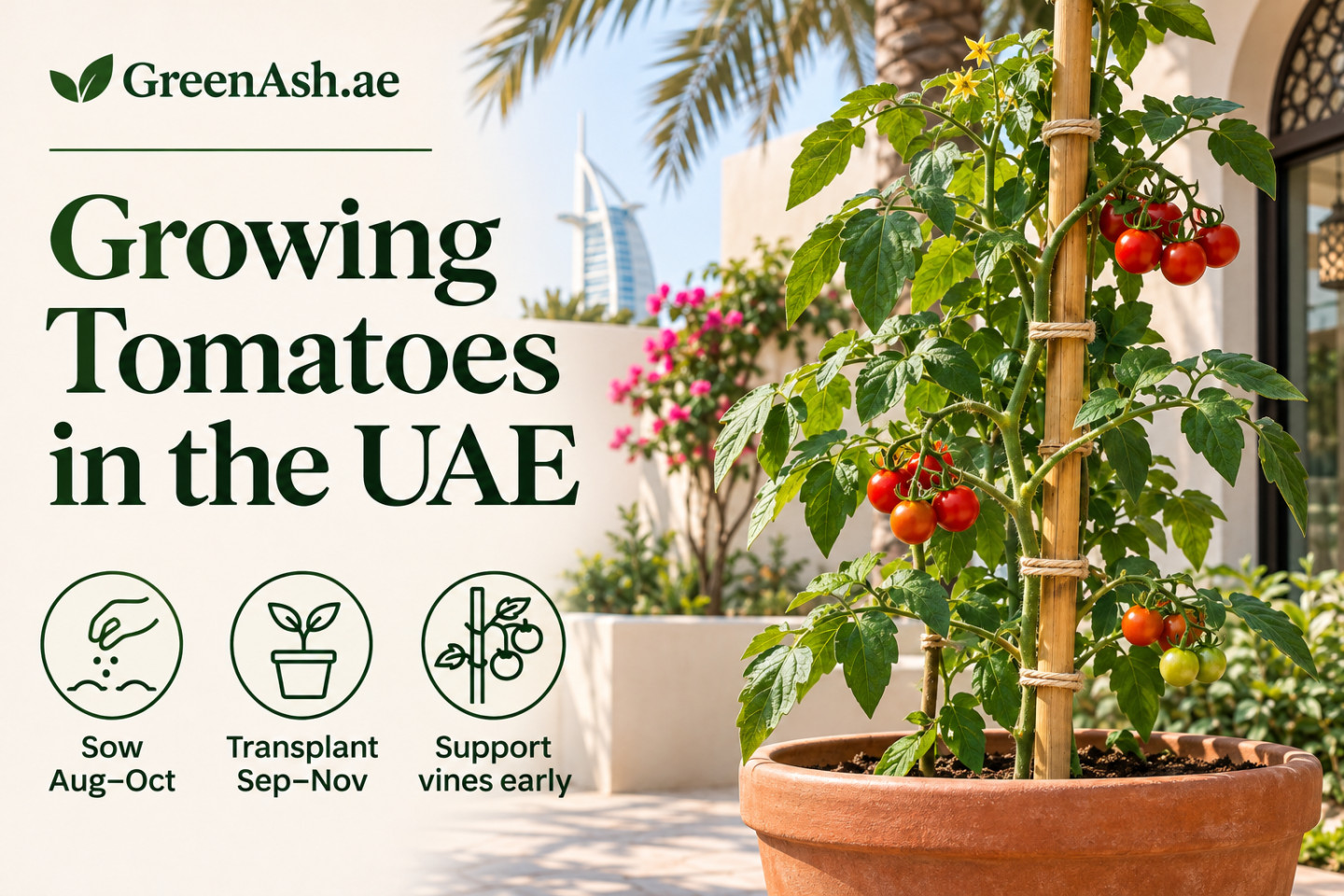
If you have an empty pot and want home-grown tomatoes in November, your first decision is whether to buy seed or a young plant. The UAE Ministry of Climate Change and Environment lists August to October for nursery sowing and September to November for planting tomatoes in the field. A healthy transplant gives you a head start in November. If you start from seed later, allow for the weeks it will spend in a tray before it can make use of your garden space. Plant out by late November, keep the root zone evenly moist, and expect fruit to set best while nights sit between about 13 and 22 °C.
By the end of this page you will be able to pick a variety for your space, work out how many seeds to sow, mix a tomato feed at the right strength for a 1 L bottle, a 5 L can or a 16 L knapsack, read the signs that point to heat, salt, watering or pests, and plan the crop from November to the first hot weeks of spring.
Choose a tomato that fits your space
Before opening a packet, stand where the plant will grow. How much direct sun reaches the leaves in winter? Is there room to reach behind the pot to tie up a stem and pick fruit? A balcony can have plenty of headroom but very little winter light under the floor above.
For a short space, look for a compact or patio variety. Determinate tomatoes tend to produce a concentrated crop. Indeterminate tomatoes keep extending their stems as they flower and fruit. Small fruit can grow on a surprisingly large vine.
The difference is practical, not academic. University of Minnesota Extension describes determinate (bush) plants as reaching about 60 to 75 cm, with the fruit setting and ripening within roughly 4 to 6 weeks, and indeterminate (vining) plants as growing about 0.9 to 1.5 m or more and flowering until the weather turns against them. In the UAE the weather that ends the crop is heat, not frost, so an indeterminate vine planted in November keeps producing until spring warmth stops it setting new fruit. A determinate plant gives you one main flush, which suits a small balcony or anyone who wants a batch for sauce.
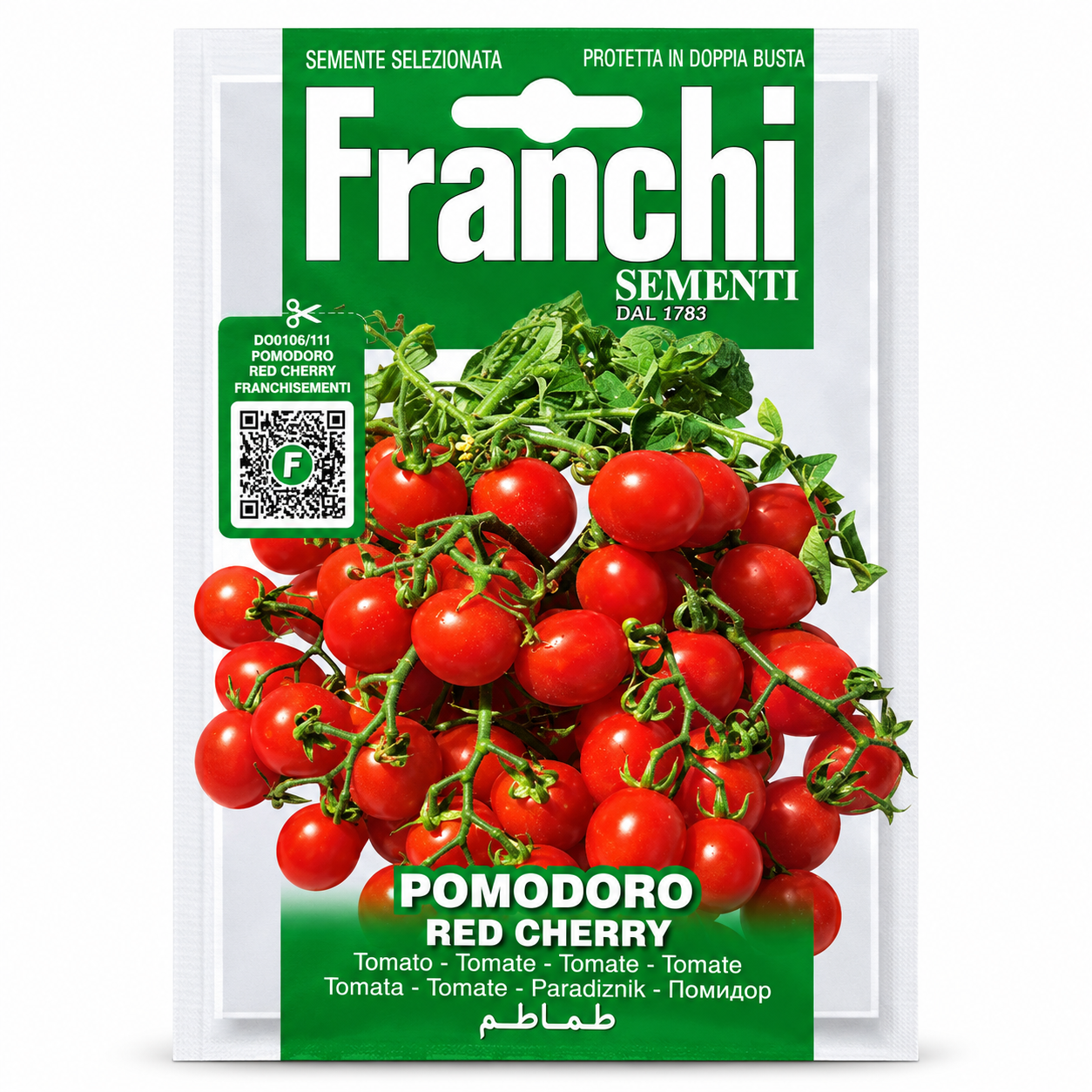
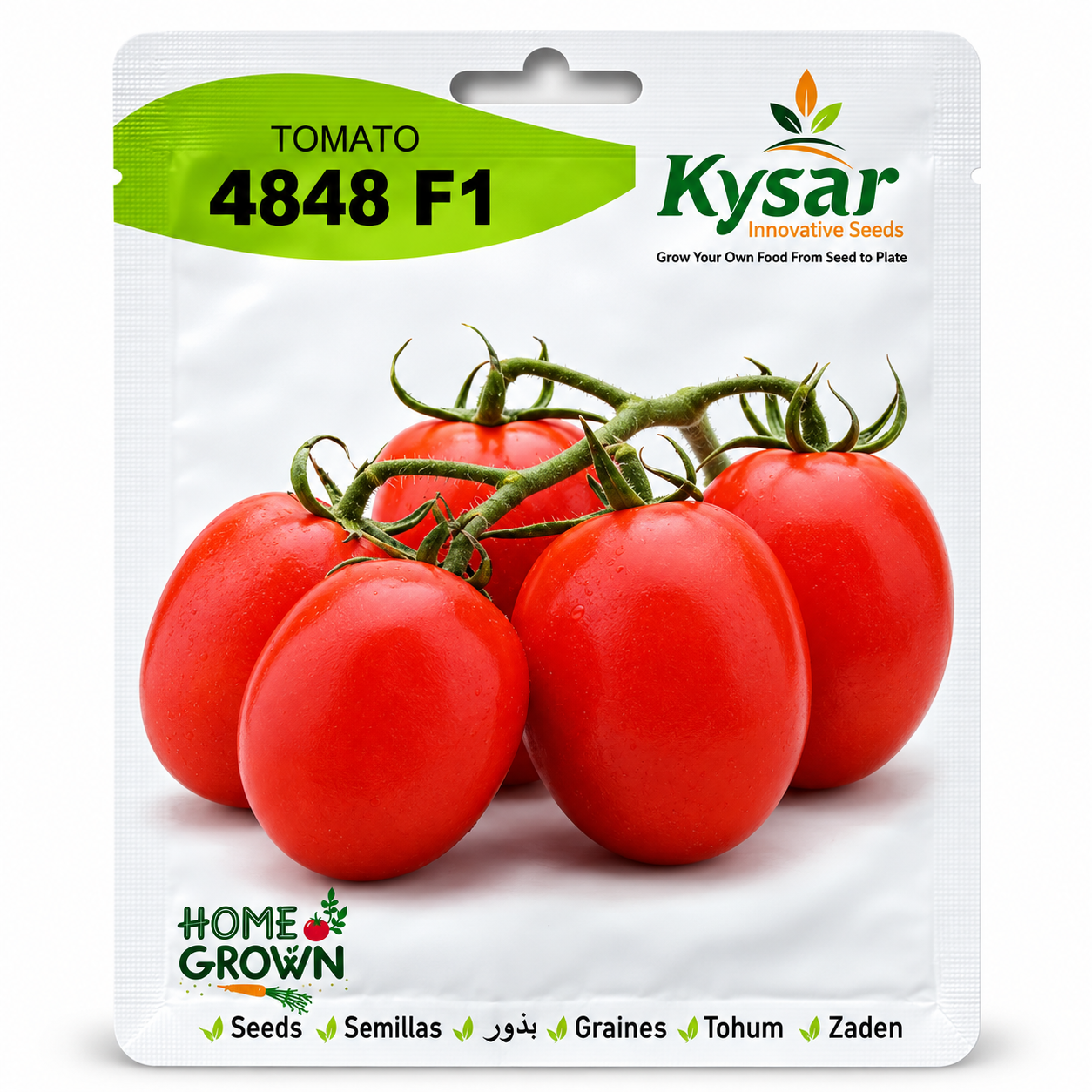
For example, Franchi Red Cherry is an early, indeterminate cherry tomato. Choose it if you have space for a tall support. Kysar 4848 F1 comes in a 100-seed packet. If you only have room for two plants, sow a few spares and keep the rest in their original packet. The F1 designation tells you it is a hybrid. Check the packet separately for spacing and plant habit.
Cherry types have a second advantage in a warm climate. Iowa State University Extension notes that cherry tomatoes tolerate a broader temperature range than most large-fruited varieties, so they tend to keep setting fruit a little longer as spring warms up. The University of Arizona puts cherry and plum types at about 45 to 80 days from transplanting to harvest, and early varieties at 45 to 70 days. Neither of the two seed packets we stock gives a days to harvest figure on its product page, so use those ranges as a planning guide rather than a promise.
When you read other seed catalogues, Alabama Extension suggests looking for the words “heat-set”, “hot-set” or “heat-tolerant”. These varieties were bred to keep setting fruit when nights are warm. Heirloom varieties are, in Alabama’s words, more sensitive to the conditions that cause blossom drop.
How many seeds to sow
The germination figure on the packet tells you how many to sow. Divide the number of plants you want by the germination rate, round up, then add one spare.
- Kysar 4848 F1 (85% germination declared by the manufacturer): for 4 plants, 4 divided by 0.85 is 4.7, so sow 5, plus 1 spare, which makes 6 seeds. That still leaves 94 in the packet.
- Franchi Red Cherry (minimum germination 75%): for 4 plants, 4 divided by 0.75 is 5.3, so sow 6, plus 1 spare, which makes 7 seeds.
Fold the packet closed, put it in a jar and keep it in a cool cupboard rather than a hot car or a sunny window ledge. The Kysar page gives an expiry of September 2030 and the Franchi page an expiry of 12/2028, so a spare packet can cover more than one season if it is stored well.
Is it a tomato problem, or something else?
Most tomato trouble in a UAE winter comes down to five causes: heat, watering, salt, too much nitrogen and a small group of pests. Use this table before you buy anything.
| What you see | Most likely cause | What to check | What to do | What it is NOT |
|---|---|---|---|---|
| Flowers open, then yellow and drop with no fruit | Days above about 29 °C or nights above about 22 °C for more than a week, or nights below 13 °C | A minimum and maximum thermometer next to the plant | Keep watering steady, add 40 to 60% shade in warm spells, wait for the next cluster | Not usually a nutrient shortage; adding more feed often makes it worse |
| Huge leafy plant, few flowers | Too much nitrogen | Whether the potting mix, a slow release product and a liquid feed are all supplying nitrogen | Stop high nitrogen feeds; switch to a feed with more potash than nitrogen | Not lack of sun alone, though shade adds to it |
| Dark, sunken, leathery patch at the bottom of the fruit | Blossom-end rot: water supply to the fruit interrupted | Root ball dryness between waterings, a blocked drainage hole, root damage | Even watering, mulch, judge on new fruit | Not a disease you can spray away; calcium sprays do not reach the fruit |
| Brown, crisp leaf edges on older leaves, white crust on pot rim or soil | Salt build up from water and fertilizer | EC of the drainage water, how often the pot drains through | Water until 10 to 20% runs out the bottom; cut feed strength | Not sunburn, which shows as pale patches on the side facing the sun |
| New leaves small, cupped upward, yellow edges, plant stunted | Tomato yellow leaf curl virus, spread by whiteflies | Tiny white insects flying up when you shake the plant | Remove and bag the plant early; protect the others | Not a nutrient problem and not curable with feed or spray |
| Clear, papery patches in leaves with dark specks, holes in fruit under the calyx | Tomato leaf miner (Tuta absoluta) | Hold a leaf to the light and look for a small caterpillar inside | Pick off mined leaves and damaged fruit and bag them | Not the thin winding trails of other leaf miners |
| Fine pale speckling, webbing under leaves | Spider mites | Tap a leaf over white paper and watch for moving dots | See our spider mite guide | Not salt burn, which starts at the leaf edge |
| Clusters of soft insects on shoot tips, sticky leaves | Aphids | Undersides of young leaves and flower stalks | See our aphid guide before spraying | Not whiteflies, which fly up when disturbed |
| Seedlings fall over at the soil line in the tray | Damping off | A thin, dark, pinched stem just above the mix | See our damping off guide and start again in fresh mix | Not thirst; dry seedlings wilt from the top but the stem stays firm |
The science: why temperature and water decide your crop
Flowers and pollen. A tomato flower contains both male and female parts and is pollinated when it is shaken. The University of Arizona explains that bumblebees and solitary bees do this by vibrating the flower, and that temperatures above about 32 °C reduce the number of pollen grains in each flower. Alabama Extension gives the thresholds that matter most for planning: flowers often abort when days go above about 29 °C or nights stay above about 22 °C, and nights below about 13 °C can also stop fruit set. A week or less of these conditions causes little harm; longer runs do. That is why the UAE tomato season runs from autumn to spring: through the summer both days and nights sit well past these limits. On a balcony with no bees, a gentle tap on each open flower cluster around midday does the shaking for them.
Calcium and water. Clemson Extension explains that calcium travels from the roots to the plant in the water stream, through the xylem. When water uptake is interrupted, the calcium supply to a fast growing fruit is interrupted too, and the bottom of the fruit collapses. Calcium sprayed on leaves cannot move back down to the fruit, and the fruit skin cannot absorb it. That is why the fix for blossom-end rot is steady watering, not a bottle. Virginia Tech notes it is seen most often on fruit at half to two thirds of its final size, so the watering problem behind a rotten fruit happened earlier, while that fruit was growing fast. If you are wondering whether calcium nitrate has a place, our calcium nitrate guide covers when it does and does not help.
Salt. Tomato is rated moderately sensitive to salt in the FAO crop salt tolerance tables (Maas and Grattan data). Yield starts to fall once the salinity of the soil water, measured as ECe, passes 2.5 dS/m, and drops by about 9.9% for every 1 dS/m above that. So at an ECe of 3.5 you can expect about 90% of the full crop, and at 4.5 about 80%. Every gram of fertilizer you add also adds salt, which is why Alabama warns that overfeeding can cause blossom drop on its own. Pepper is more sensitive still, with a threshold of 1.5, which is worth knowing if you grow both in the same bed.
Nitrogen. Arizona and Alabama both warn that excess nitrogen gives lush leaves and fewer fruit. A tomato feed is usually higher in potash (the third number) than in nitrogen (the first). Our GreenAsh guide to NPK numbers explains how to compare labels.
Raise seedlings or choose a transplant
- Fill clean cells with moist seed-starting mix. Sow at the depth printed on the packet, label the tray and water gently so the seeds stay in place. The Kysar page gives about 0.5 cm as a general guideline, and Minnesota Extension advises about 6 mm in a sterile, soilless mix.
- Keep the tray warm until the seeds come up. Minnesota gives 24 to 29 °C for germination, then about 21 °C once the seedlings are up. Check with a thermometer: a warm shelf away from air conditioning vents often reaches this without a heat mat.
- Give emerged seedlings bright light. If two emerge together, snip the weaker one at the surface to spare the other plant’s roots.
- Feed seedlings lightly only once true leaves appear (see the dosing table below for half strength).
- When buying a transplant, choose a sturdy stem with healthy leaves. Look at the undersides and growing tip before bringing it into your garden. Minnesota describes a good transplant as up to about 30 cm tall with a stem about as thick as a pencil. UC IPM advises using whitefly-free transplants, because infected young plants are one of the main ways tomato yellow leaf curl virus travels.
- Gradually expose a sheltered seedling to its outdoor sun and breeze over about a week. Water the root ball before moving it to its final position.
Seedlings from a home sowing usually need 5 to 6 weeks before planting out (Minnesota’s figure). A tray sown on 10 November is ready around mid to late December, which is still a usable start for a cherry tomato, but a later one than the ministry’s September to November field window. If it is already late November, a transplant buys you those weeks back.
Set up the pot and support together
For one plant, a container of about 19 litres is a starting point in the University of Arizona’s desert-growing guide. Give a vigorous vine more room where you can. Use container potting mix and a pot with open drainage holes. On a tiled balcony, plan where excess water will go before filling the container.
Set a stake or cage in place at planting while you can still see the root ball. Use soft, loose ties and check them as stems thicken. In a bed, follow the variety’s spacing so you can reach the fruit without stepping into the root zone.
Worked quantities: pot, 1 m2 bed and a larger plot
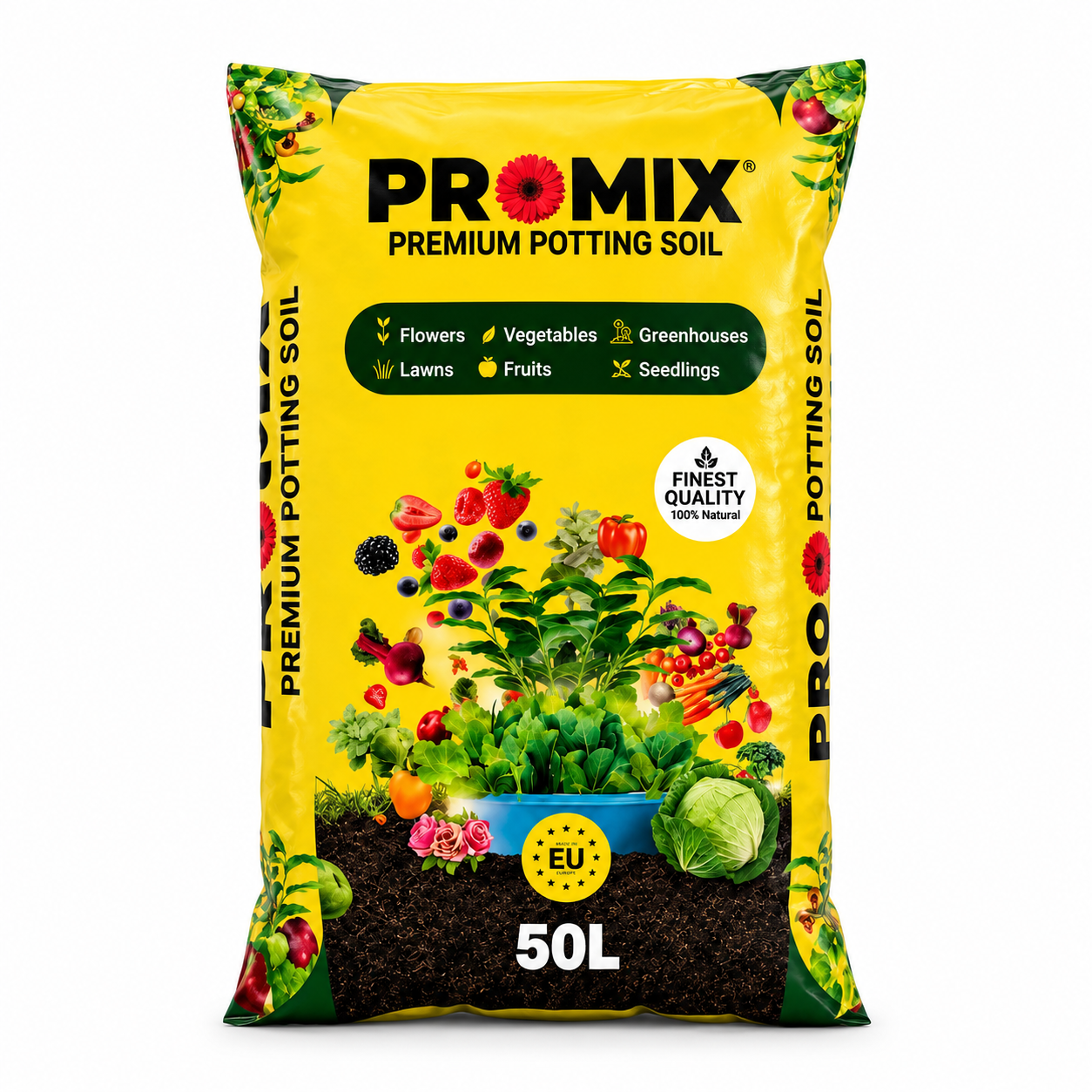
- Two balcony pots: two 19 L containers take about 38 L of mix, so one 50 L bag of potting mix fills both with about 12 L to spare for topping up after it settles.
- A 1 m2 raised bed: Arizona spaces plants 45 to 60 cm apart in rows about 60 cm apart, which works out at about three plants per square metre. Arizona also suggests working in 5 to 7.5 cm of compost about a month before planting, which on 1 m2 is 50 to 75 litres of compost.
- A 100 m2 villa or farm plot: at the same spacing that is roughly 300 plants, far more than a family needs. Arizona’s own guide suggests 8 plants feed a family of four, and 16 if you plan to preserve. Use the spare ground for a second sowing four to six weeks later so the harvest is spread out.
Plant deep. Arizona and Minnesota both suggest burying the stem up to the first set of true leaves, or laying it sideways in a shallow trench; the buried stem grows extra roots. Arizona also advises against pruning tomatoes in the low desert, because the leaves shade the fruit from sunscald. Pinch out only the shoots you cannot tie in.
Water the root ball and check below the surface
Check the original root ball as well as the mix around it during the first week. A wet patch on one side of a pot can hide a dry transplant on the other. Water slowly around the base and let excess drain. Check moisture again before repeating. A windy balcony pot and a mulched garden bed may need water on different days.
Arizona’s rule is that a deep watering every 3 or 4 days is better than a light watering every day, while warning that sandy soils may need water almost daily. Both can be true in a UAE garden: what matters is how deep the water goes. Minnesota notes that 2.5 cm of water wets sandy soil to about 25 cm deep. Push a finger or a trowel 15 cm down beside the plant; if it is dry there, water now, and keep going until the water has reached that depth. Arizona puts the main tomato root zone around 45 cm deep, and a long soak also carries salts down past it.
For pots, we aim for about 10 to 20% of what you pour in to drain out of the base. That small run off carries away the salt left by tap water and fertilizer. In a bed, a timer and a drip line give the steady moisture that Clemson recommends for preventing blossom-end rot; our drip irrigation guide shows how to measure what each emitter delivers. Mulch the surface with 7 to 10 cm of straw or compost (Minnesota suggests 3 to 4 inches), keeping it a hand’s width from the stem.
Feeding: what to use and how to mix it
Check whether the potting mix already contains fertilizer before adding more. Excess nitrogen can produce plenty of leaves with few fruit. If feeding is appropriate, use the vegetable or tomato directions on the pack.
Of the feeds we stock, Phostrogen is the one whose product page gives a clear analysis and a measurable rate. The product page gives NPK 14-10-27 with 2% magnesium oxide and trace elements, and a rate of 1 level teaspoon (approx. 5 g) in 4.5 litres of water, with a half strength solution (1/2 teaspoon per 4.5 L) for young plants and seedlings. Its potash figure is nearly twice its nitrogen figure, which is what a fruiting tomato wants.
All the figures below come from that page rate of 5 g in 4.5 L, which is about 1.1 g per litre. A level teaspoon on the page is approx. 5 g, so a kitchen scale is more accurate for the small volumes.
| Container | Full strength (established plants) | Half strength (seedlings, first two weeks after transplanting) |
|---|---|---|
| 1 L bottle or hand sprayer | 1.1 g | 0.6 g |
| 4.5 L watering can (page rate) | 5 g, 1 level teaspoon | 2.5 g, 1/2 level teaspoon |
| 5 L sprayer or can | 5.6 g, just over 1 level teaspoon | 2.8 g |
| 16 L knapsack or large can | 17.8 g, about 3.5 level teaspoons | 8.9 g |
At full strength each litre of solution carries about 0.16 g of nitrogen and 0.30 g of potash (K2O). Use the solution in place of a normal watering, not on top of one, so the pot still drains a little. The page gives three different intervals (every 7 to 14 days, once a week, and every two weeks for maintenance). For tomatoes in pots we suggest every 7 days once the first fruit has set and every 14 days before that, cutting back if leaf edges brown or a white crust appears. A bed with compost dug in needs less.
The page also lists foliar spraying. Clemson’s point about calcium applies here too: leaf feeding can green up leaves, but it does not fix blossom-end rot.

Two other tomato feeds are in stock, but neither page gives a rate we can work from. Schultz Tomato and Vegetable Plant Food has a useful 17-18-28 analysis, but its page says only to dissolve it “according to recommended dosage”, so follow the printed label on the pack. The Organic Tomato Fertilizer 500 ml page gives neither an analysis nor an amount.
Products compared
| Product | Type or analysis | Pack | Use | Rate on the page | Harvest interval on the page | Suits |
|---|---|---|---|---|---|---|
| Franchi Red Cherry | Indeterminate cherry tomato seed; min. germination 75%, purity 97% | Not stated on the page | Containers and pots (manufacturer), tall support | Sowing depth not on the page; follow the packet | Not applicable | Balcony or villa grower with room for a 1.5 m stake |
| Kysar 4848 F1 | F1 hybrid tomato seed; 85% declared germination | 100 seeds | Home gardening, per the page title | About 0.5 cm deep (page says general guideline); no spacing | Not applicable | Several sowings or a larger plot; habit and days to harvest not stated |
| Phostrogen All Purpose | NPK 14-10-27 + 2% MgO + trace elements | 400 g, 800 g | Soil drench or foliar | 5 g in 4.5 L; half strength for seedlings | Not stated (fertilizer) | Pots and beds from transplanting to harvest |
| PROMIX Premium Potting Soil | Potting mix; no analysis on the page | 50 L | Pots and seedlings | Ready to use | Not applicable | Balcony pots and seed trays |
| Schultz Tomato and Vegetable | NPK 17-18-28 with micronutrients (not listed) | 680 g | Dissolved in water, applied to soil | No rate on the page | Not stated | Only if you follow the printed label |
| Organic Tomato Fertilizer | No analysis on the page | 500 ml | Soil drench | No rate on the page | Not stated | Not recommended until the page gives an analysis and rate |
From first flowers to harvest
Mark the date of the first flowers and look for a tiny swelling behind the petals after they fade. If several clusters drop flowers during a hot spell, keep watering consistent and watch the next cluster before changing your feed. Leave healthy foliage around developing fruit to protect it from direct sun.
For red-fruited varieties, pick when the fruit has developed its characteristic colour and yields slightly to gentle pressure. Support the cluster with one hand as you pick, especially when other tomatoes on the same stem are still green.
Count forward from your planting date. A transplant set out on 15 November and given Arizona’s 45 to 80 day range for cherry types would start ripening somewhere between 30 December and early February. When the first warm spell of March or April arrives, pick fruit as soon as it shows a pink blush. Minnesota notes that fruit that has started to show white or pink usually ripens well off the plant, while fully green fruit will not ripen to good flavour. Ripen it indoors at room temperature in a single layer, with the fruit not touching.
A UAE season, month by month
| Month | Villa garden or farm bed | Balcony pot |
|---|---|---|
| August to October | Nursery sowing window on the ministry calendar. Dig in compost a month before planting. Check water and soil EC. | Sow indoors in trays; buy mix and a 19 L pot. |
| September to November | Field planting window. Plant deep, stake, mulch, set the drip timer. Keep 40 to 60% shade over young plants in hot spells. | Transplant, place where the plant gets the most winter sun, tie in. |
| December to February | Main flowering and fruit set. Feed weekly once fruit sets. Check under leaves weekly for whiteflies, mines and mites. | Tap flowers at midday. Watch for drying from wind and from heaters or air conditioning near the door. |
| March to April | Days pass 29 °C and nights 22 °C more often, so flowers drop. Pick at first blush. Put shade cloth back up. | Move pots to morning sun only. Pick at first blush. |
| May to July | Pull plants, bag diseased material, leave the bed free of tomato and its relatives until autumn. | Empty and wash the pot. Do not keep a tired plant going through summer. |
Coastal gardens often have dewy mornings, so water at the base, not over the leaves, so foliage dries quickly. Inland villas and farms can have cooler winter nights than the coast, so keep a thermometer by the plants and watch for nights below 13 °C, which also stop fruit set. Farms on well water should test the water first, because the FAO thresholds show tomato losing yield once soil salinity passes 2.5 dS/m. Clearing every tomato, potato and eggplant plant in summer is the closest a home grower can get to the host-free period UC IPM recommends for leaf curl virus.
Pests worth knowing by name
Whiteflies and tomato yellow leaf curl virus. UC IPM describes infected plants with small leaves that curl upward, yellow edges and yellow between the veins, and flowers that fall off. Plants infected young are badly stunted, and symptoms can take up to three weeks to show. There is no cure; UC IPM advises resistant varieties, whitefly-free transplants, fine mesh row covers, removing infected plants early and clearing old crops. A fine insect mesh over young plants on a balcony or a small bed is a practical version of this.
Tomato leaf miner (Tuta absoluta). The Canadian Food Inspection Agency describes the larva as a cream caterpillar with a dark head, up to about 7.5 mm long, that tunnels between the leaf surfaces and leaves clear patches with dark frass. Later larvae bore into fruit, often under the green calyx. A female can lay up to 260 eggs, development from egg to adult takes about 40 days at 20 °C, and the moth is now found in Europe and North Africa. Check twice a week, pick off mined leaflets and bag them, and bag any damaged fruit rather than composting it.
Aphids and spider mites. Arizona suggests a strong jet of water, insecticidal soap or horticultural oil for aphids. Spider mites build up in dry, dusty air. Our aphid and spider mite guides linked in the table above walk through rinsing, checking for natural enemies and when a labelled product is justified.
Common mistakes
- Sowing in late November and expecting a long harvest. Seedlings need 5 to 6 weeks before planting out, so the plant flowers into warm spring nights. Buy a transplant instead, or choose a cherry type.
- Feeding harder when flowers drop. Most drop is temperature. Extra fertilizer adds salt and nitrogen, which Alabama links to blossom drop. Check the thermometer first.
- Little and often watering. A daily splash wets the top few centimetres and leaves salt behind. Water deeply, check at 15 cm, and let 10 to 20% drain from pots.
- Calcium sprays for blossom-end rot. They cannot reach the fruit, according to Clemson. Fix the watering and judge on fruit that forms afterwards.
- Stripping lower leaves and suckers. Arizona advises against pruning in the desert because leaves shade the fruit. Remove only diseased or damaged leaves.
- A pot without a saucer plan. On a balcony the run off has to go somewhere. Empty the saucer within an hour so the base does not sit in salty water.
- Composting diseased plants. Leaf curl, leaf miner and wilt diseases carry over. Bag them and put them out with household waste.
Troubleshooting: if it is not working
- No fruit by late January: check the night temperature beside the plant, check for heavy leafy growth, tap flowers at midday for two weeks. If nights are fine and flowers still drop, cut feed to half and water more deeply.
- Fruit cracking: Arizona links it to swings between dry and wet. Even out watering; pick fruit at first blush before a heavy watering or rain.
- Whole plant wilts while the soil is moist and does not recover in the cool of the evening: suspect a soilborne wilt. Arizona says Fusarium wilt has no treatment: remove the plant and do not compost it. Do not grow tomatoes in that soil next season; use a fresh pot and new mix.
- Swollen knots on roots when you pull a plant: root-knot nematodes. Arizona suggests crop rotation, fallow or soil solarization in summer.
- Leaf curl keeps appearing on new plants after you remove the first ones: whiteflies are still carrying it in. Pull the worst plants, cover the rest with fine mesh, and start clean next season with whitefly-free transplants.
- When to call a professional: on a farm, ask a licensed agronomist or an accredited laboratory for a water and soil test or a confirmed virus test, and for advice on any pesticide for leaf miner or whitefly. Pesticides for these pests should come from the label of a product registered for tomatoes, not from a general guide.
Safety
- Fertilizer: the Phostrogen and Schultz pages both say to wear gloves, keep the product out of reach of children and pets, and store it in a cool, dry place; Phostrogen also says to avoid contact with eyes and mouth. Measure over a tray, not over food surfaces.
- Seed: the Kysar page says the seeds are for planting only, not food or feed. Keep packets away from children.
- Any pesticide: read the label before buying. Check that tomato is on it, note the pre-harvest interval (the days you must wait between spraying and picking), and wear what the label names, at least chemical resistant gloves, long sleeves and eye protection. Keep children and pets off sprayed areas until the spray has dried or for the re-entry time on the label.
- Bees: tomatoes rely on buzzing bees. Do not spray open flowers, and spray late in the day if a label permits it.
- Fish and drains: never rinse a sprayer into a pond, a fish tank or a storm drain. Mix only what you need, and rinse the empty container three times into the sprayer.
- Storage and disposal: keep products in their original containers, locked away from children, out of the sun. Dispose of empty packs with household waste unless the label says otherwise.
Common questions
Is November too late to grow tomatoes in the UAE?
November falls within the ministry’s field-planting window. Start with a transplant if you want to make the most of the remaining cool weather. The calendar is a planning guide, and a sheltered courtyard and an exposed terrace can warm up at different rates.
Why is there a black patch opposite the stalk?
A dark, sunken patch at the blossom end can be blossom-end rot. Uneven moisture can interfere with calcium reaching developing fruit. Check for a blocked drainage hole, a dry root ball or missed watering before buying a supplement. Judge improvement on newly developing fruit.
Can I grow a cherry tomato without a tall stake?
Look for a compact variety bred for containers. “Cherry” describes the fruit size. Check the plant habit on the packet before deciding what support to buy.
Why are my tomato flowers falling off?
In the UAE the usual reason is temperature: Alabama Extension gives days above about 29 °C and nights above about 22 °C as the trigger, with cold nights below 13 °C as the other limit. Dry soil, wind and too much nitrogen add to it. Keep watering steady and wait for the next cluster.
How often should I water a tomato in a pot?
There is no fixed number of days. Check 15 cm down; water when it feels dry there, and water until 10 to 20% drains out. In a windy balcony pot in a warm week that may be daily; in a mulched bed in January it may be every 3 or 4 days, as Arizona suggests.
Can I grow tomatoes through the UAE summer?
Not for fruit in the open. Arizona notes that temperatures above about 32 °C cut the pollen in each flower and expects poor fruit in July and August, and Alabama’s thresholds are lower still. You can try to carry a plant through under shade, but we suggest starting fresh in autumn, which also breaks the cycle of whiteflies and leaf miners.
Does tap water hurt tomatoes?
Only through salt build up. Tomato loses about 10% of its yield for every 1 dS/m of soil salinity above 2.5 dS/m, by the FAO figures. Letting each watering drain through the pot keeps the salt moving down and out.
Should I remove tomato suckers?
In the UAE, mostly no. Arizona advises against pruning in desert conditions because the leaves shade the fruit. Remove a sucker only when the plant has outgrown its support.
Ready to sow?
Pick one of the two seed packets above, a 19 L pot and a bag of mix, and get the plants in before the end of November. If you are not sure which seed suits your space, message us with the size of your balcony or bed and how many hours of sun it gets, and we will help you choose.
Growing references
- University of Arizona Cooperative Extension, Growing Tomatoes (AZ2078, 2024)
- Alabama Cooperative Extension System, Blossom Drop in Tomato (ANR-2717, 2023)
- Clemson Cooperative Extension, Gardening Myths: Fix Blossom End Rot with Calcium Sprays (2020)
- UC IPM, Tomato yellow leaf curl
- Canadian Food Inspection Agency, Tuta absoluta fact sheet
Also used: University of Minnesota Extension, Growing tomatoes in home gardens (reviewed 2024); Iowa State University Extension, tomato fruit set FAQ (2025); Virginia Tech, Blossom End Rot of Tomato (450-703, 2009); FAO crop salt tolerance data (Maas and Grattan); the UAE Ministry of Climate Change and Environment planting calendar.
