
Blog
House Flies in UAE Homes: How to Find the Source and Place an Outdoor Trap

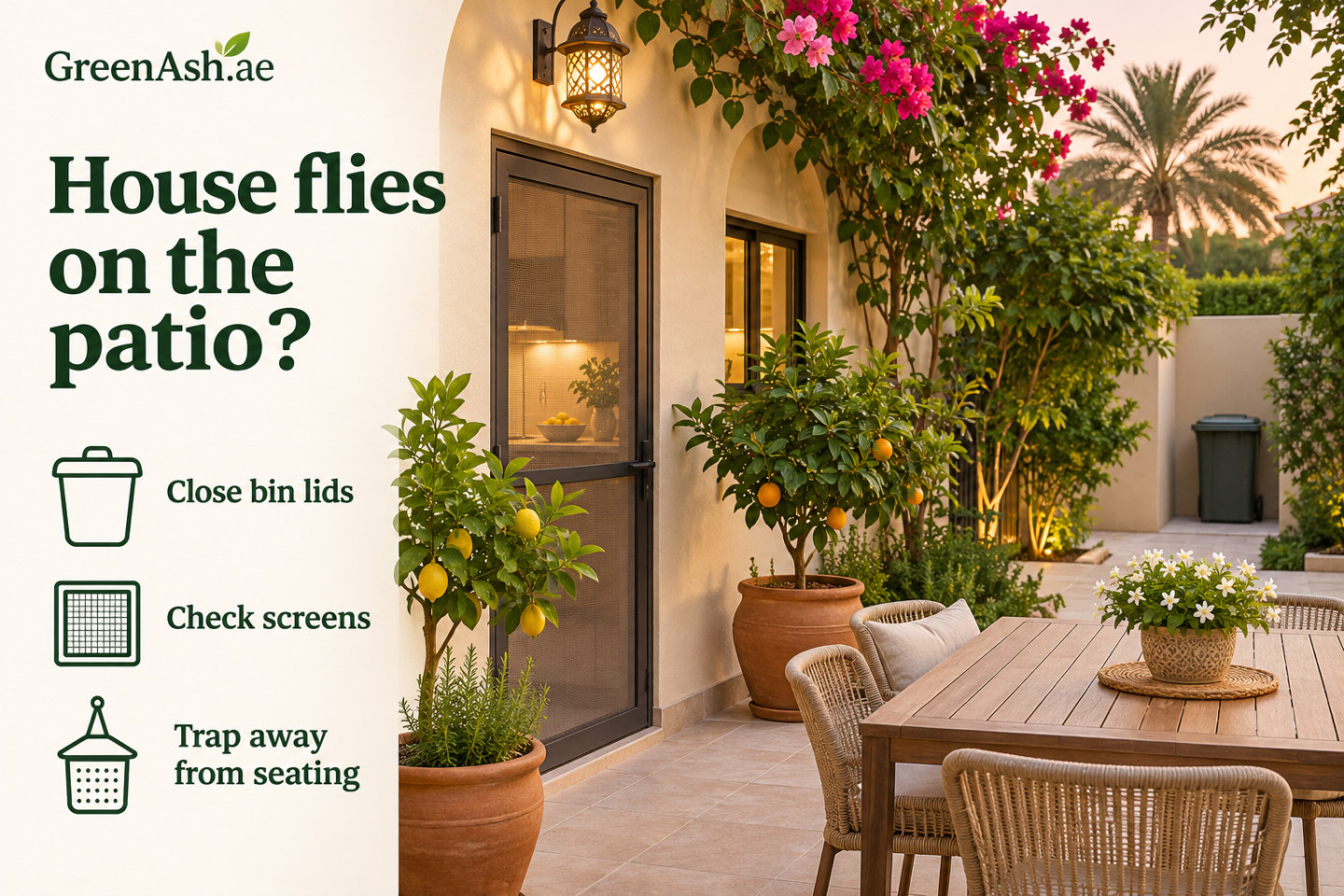
If house flies gather around the patio table every time you eat outdoors, resist the temptation to hang a baited trap beside the chairs. Its job is to attract flies. Before choosing a place for it, follow the route from the kitchen door to the outdoor bin. Spilled bin liquid, a bag caught under the lid or fallen fruit behind a planter may explain why flies keep returning to that side of the house.
The short answer: house flies in a UAE home almost always come from moist, rotting material close by, and a single bin left uncleaned for a week can produce a new generation of adults. Find and remove that material first, keep the door screen closing properly, and only then add a trap or bait well away from where people sit. By the end of this article you will be able to confirm that the fly really is a house fly, trace it to its breeding site, place a trap where it helps rather than hurts, measure bait correctly if you need one, and recognise when the job belongs to a professional or your building management.
Check which fly you have
The common house fly is roughly 6 mm long and has four dark stripes running along the top of its body just behind the head. A close-up photograph of a resting fly can help. Tiny insects lifting off the surface of potting mix, or flies that bite your ankles, warrant a different identification before you buy a house-fly trap. Utah State University’s identification guide includes a photograph for comparison.
House flies cannot bite. They have sponging mouthparts and turn solid food into liquid with saliva before feeding, which is why they land repeatedly on plates, fruit and even sweaty skin. A second clue is the small dark spots they leave on resting surfaces: University of California entomologists describe these fecal and regurgitation spots as most visible on light coloured walls, so look at the pale wall beside a door, the underside of a pergola or the top of a light fitting.
Use this table before you buy anything. Several common “flies” around villas and apartments are not house flies, and a house fly trap will not fix them.
| What you see | Likely insect | Where it breeds | What to do first |
|---|---|---|---|
| Grey fly about 6 mm, four dark stripes behind the head, lands on food and people, does not bite | House fly | Garbage, food waste, pet and animal manure, rotting fruit, damp grass clippings | Follow this article: find the moist waste, then trap or bait outdoors |
| Larger fly with a shiny metallic blue or green body, loud buzz | Blow fly | Dead animals and protein rich waste such as meat or fish scraps, pet waste | Look for a dead rat, bird or lizard, or meat scraps in the bin; remove and bag them |
| Fly that looks like a house fly but bites, mostly at ankles and outdoors | Stable fly | Soggy hay, feed and piles of moist green material | Check animal pens, wet feed and heaps of cut grass or hedge clippings |
| Tiny dark flies rising from potting mix of indoor plants | Fungus gnats | Wet potting media | Let the top of the mix dry between waterings; a house fly trap will not help |
| Very small flies with red eyes hovering over a fruit bowl or bin | Small fruit flies (vinegar flies) | Fermenting fruit and juice residue | Remove overripe fruit and rinse recycling; these need a separate approach |
The breeding sites for house flies, blow flies, stable flies and fungus gnats in this table come from the University of Arizona Cooperative Extension article on nuisance flies (Schalau, 2020) and Purdue’s Fly Control Around the Home (Gibb and Bennett, 2018). If your fly does not match the first row, do not buy house fly products yet.
Why one bin can keep a patio busy: the house fly life cycle
Understanding the timing changes what you do, because the goal is to remove breeding material faster than flies can complete their development in it.
- Eggs. The University of Florida house fly profile (EENY-048, revised 2023) gives up to 500 eggs per female, laid in batches of 75 to 150 over three to four days. The eggs must stay moist, which is why dry trash produces few flies and wet trash produces many. In warm weather they hatch in 8 to 20 hours.
- Larvae (maggots). Cream coloured maggots burrow away from light into the food source. The same profile gives 4 to 13 days for this stage at good temperatures, with the fastest development at 35 to 38 C and the best survival between 17 and 32 C. At 12 to 17 C the stage stretches to 14 to 30 days.
- Pupae. Fully grown maggots leave the wet material and look for a drier, cooler place to pupate. A full grown maggot can crawl up to about 15 metres (50 feet) to find one. That is why you find brown, barrel shaped pupal cases in dry sand beside the bin store, under a doormat or along the edge of paving, not in the wet waste itself. Pupation takes 2 to 6 days at 32 to 37 C.
- Adults. Under warm conditions a full generation takes 7 to 10 days, and the University of California pest note puts egg to adult at as little as 7 days in summer. Adults usually live 15 to 25 days but survive only 2 to 3 days without food.
Two practical points follow. First, if a bin, a pile of clippings or a pet area is cleaned less often than once a week, flies can complete a whole generation in it. University of California advice is to remove organic waste outdoors at least once a week, and the Florida profile goes further for wet manure, advising removal at least twice a week. Second, adults that cannot find food die within days, so cutting off the food smell around the door does more than any trap.
The temperature figures also help explain what you see in the UAE. Our mild winter days fall largely within the 17 to 32 C band where Florida reports the best survival, so breeding does not stop in the cool season; it slows on cold nights and speeds up again as spring warms. In summer, waste rots fast and development is quick, but exposed surfaces in full sun are far hotter than the air. Flies then concentrate in shaded, moist places: under a bin lid, beneath shrubs on an irrigated border or inside a bin store with no air movement.
Trace the source from the door outwards
| Where flies gather | What to inspect | What to change |
|---|---|---|
| At the kitchen or balcony door | Watch the door close by itself. Check the bottom edge, screen corners and sliding track for gaps. | Repair torn mesh and make sure the screen closes fully when someone carries plates outside. |
| Around the bin after collection | Lift out the liner. Look under the rim and at the base for scraps or leaked liquid. | Remove the residue, clean the bin and close the lid over securely bagged waste. Move the bin away from the entrance where space permits. |
| Along a planted border | Look under shrubs for split fruit, pet waste or damp piles of lawn clippings. | Remove the material and check the same shaded spot again during the next garden clean-up. |
| Near a compost heap or worm bin | Lift the top layer. Look for exposed kitchen scraps and for maggots in the wettest part. | Bury fresh scraps under dry material or soil and keep meat and fish out of home compost. |
| Around pet runs, chicken coops or a goat pen on a farm | Check droppings, wet bedding and spilled feed, especially in shaded corners. | Clean droppings daily and change damp bedding every few days; spread manure thinly so it dries. |
Adult flies may visit a table for food even if they developed elsewhere. Finding larvae in moist, decaying material is a stronger clue to a breeding site than finding several adults on a sunny wall. On an apartment balcony, check your own waste and screen first. If flies repeatedly arrive from a shared refuse room, tell building management which door, bin or collection area needs inspection.
The farm and animal row follows the University of Arizona advice for stalls: clean droppings daily, change hay or straw bedding every few days and spread manure no more than 2.5 to 5 cm (1 to 2 inches) deep so it dries out. For compost, the Florida profile lists incompletely composted manure and piles of fruit and vegetable waste among favoured breeding material, and suggests burying refuse under at least 15 cm of soil where it cannot be removed. If you make your own compost or use bought products in beds, our vermicompost guide explains how finished compost differs from raw kitchen waste.
A ten minute source walk
- Start at the door where flies bother you most. Note whether the screen closes on its own and whether there is light under the door.
- Walk to the nearest bin. Lift the liner out completely. Look at the base of the bin, the inside of the lid and the ground underneath for liquid, scraps and maggots.
- Look for pupal cases in dry sand or under mats within about 15 metres of the bin. Finding them confirms that flies are developing there, not just visiting.
- Check shaded, irrigated beds for fallen dates, split citrus, mangoes or pet waste. Irrigation keeps this material moist for days.
- Check where grass clippings and hedge trimmings are piled. A green heap left after a gardener’s visit can stay wet inside even in hot weather.
- Finally, check gutters, drain covers and the area where the building’s collection truck stops, if you can see it.
Write down every site you find. You will use the list again when measuring results.
Close the house: screens, doors and bins
University of California entomologists state that flies found indoors almost always came from outside, and Utah State University advises keeping exterior doors closed, fitting screen doors or automatic door closers, especially on kitchen doors, and sealing gaps with caulk, weather stripping and door sweeps. For a UAE villa, that means three checks:
- Kitchen and service doors. A sliding screen that does not reach the frame leaves a gap a fly will find. Flies can slip in each time someone carries dishes out, so a door closer can help more than a second trap.
- Balcony doors in apartments. Keep the bin inside a lidded cabinet rather than on the balcony itself.
- Bin placement. Utah State advises placing dumpsters at least 15 metres (50 feet) from buildings. Most villa plots cannot do that for household bins, but every metre between the bin and the kitchen door helps, and a bin in shade with a tight lid smells less than one in the sun with the lid propped open.
Store garbage in plastic bags inside containers with tight fitting lids, as University of California advises, and tie bags before they go in. A torn bag that leaks into the bin base can explain why a clean looking bin still breeds flies. Rinse the base, let it dry in the sun and check under the rim where food residue sticks. The same door sweeps and screen checks that keep insects out also cut down on the insects that draw house geckos indoors, which we cover in our guide to keeping lizards outside.
When an outdoor fly trap is worth buying
A trap makes sense when you have cleared exposed waste and can offer it a suitable outdoor position. GreenAsh’s reusable flying insect trap has a hanging hook and a container for attractant. Its listing specifies shaded outdoor placement and cleaning between uses. Check the directions for the attractant you intend to use before filling it.
The science is simple. Baited traps work by smell, and the University of California pest note says baited inverted cone traps are effective only when they are not competing with nearby garbage or animal waste. Because the attractant smells strongly, it advises placing traps some distance from occupied structures. The Florida profile adds that flies do not orient to traps from a great distance, so a trap at the far end of the garden will not pull flies away from a patio that has food on the table. The right place is between the breeding area and the house, close to where flies already gather, but not where people sit.
Stand where guests normally sit and look towards the service side of the garden. Choose a shaded hanging point away from the table, barbecue and open kitchen door, with enough access to remove and clean the container. If the only available hook on a narrow balcony is directly above the table, a well-fitting screen and a closed waste bin are better purchases for that layout.

What to put in the trap
The product page lists sugar solution, fruit or a commercial attractant. The Florida profile names molasses, sugar, fruit or meat as baits for house flies, and the University of Arizona notes that food traps use protein or sugar baits, sometimes with a pheromone. A practical starting point is a little overripe fruit in water or a sugar solution. Protein baits such as meat catch more flies but smell strongly and may also draw blow flies, so keep them for a bin store or animal area well away from the house.
Refresh the bait before it dries out or turns into a solid mass, empty dead flies into a sealed bag in the bin, and wash the container. Wear disposable gloves for this job and wash your hands afterwards, because the contents are rotting bait and dead flies, and University of California notes that house flies carry disease agents picked up from feces and kitchen waste.
Fly bait: where it fits and how to measure it
If a bin store, a farm shed or an animal pen keeps producing flies after cleaning, a granular fly bait is the next step. Bait does not replace sanitation. University of California says baits in trash storage areas may reduce adult numbers only if sanitation prevents immature flies from developing, and Purdue notes that baits kill flies rapidly but stop working quickly unless repeated. Use bait to remove adults while you fix the source, not as a reason to leave the source in place.
The bait we stock is Acetamax Fly Baits. The product page gives imidacloprid 0.5% w/w in a 200 g pack, and two methods: scatter 25 g of bait over approximately 10 square metres using shallow open bait containers, or mix 25 g of bait with 500 ml of clean water for spraying. It does not give a registration number, a manufacturer or a disposal instruction, so read the label on the pack before use and follow it where it differs from what we write here.
Imidacloprid is a nerve poison designed to mimic nicotine. Flies take it in by feeding on the bait; the page says it works through ingestion but does not name the attractant. The National Pesticide Information Center imidacloprid fact sheet describes it as much less toxic to mammals than to insects, but lists vomiting and heavy drooling in dogs and cats that swallow it, and trouble walking and tremors after larger amounts. It is very toxic to honeybees and slightly toxic to fish. Those facts decide placement: in a shallow container out of reach of pets and children, away from flowering plants and ponds, and never on food preparation surfaces, which the product page also forbids.
Worked amounts from the product page rates
All figures below come only from the page rate of 25 g per approximately 10 m2 and 25 g per 500 ml of water.
| Situation | Area or water | Bait amount | How much of a 200 g pack |
|---|---|---|---|
| Small bin enclosure beside a villa | About 2 m2 | 5 g (2 m2 x 2.5 g per m2) | One fortieth |
| Shared refuse room or garage bin area | About 10 m2 | 25 g | One eighth |
| Goat pen or poultry run surround on a farm | About 40 m2 | 100 g | Half a pack |
| Farm shed and waste yard | About 100 m2 | 250 g | More than one pack (1.25 packs) |
| Spray mix, small hand sprayer | 500 ml water | 25 g | One eighth |
| Spray mix, 1 L hand sprayer | 1 L water | 50 g | One quarter |
| Spray mix, 5 L pressure sprayer | 5 L water | 250 g | More than one pack; we would not mix this much at once |
| Spray mix, 16 L knapsack | 16 L water | 800 g | Four packs; not a sensible use of a bait |
The rate is 2.5 g per square metre, so a 200 g pack covers about 80 m2 as scattered bait. A kitchen teaspoon is a volume, not a weight, and granules vary, so weigh the first 25 g on a kitchen scale you then keep only for garden chemicals, mark the level on a small plastic cup, and use that cup afterwards.
The page also suggests spraying the mixture around windows, doors and entrances. We would not do that at a family home. A fly bait at the kitchen door draws flies towards the door, which is the opposite of what this article sets out to do, and a wet bait film on a doorstep is easy for a child or pet to touch. Keep the bait in containers at the source, in the bin store or animal area. If you do spray, keep to the page ratio, use a sprayer kept only for pesticides, and spray only resting surfaces outdoors where people and animals do not touch them. Our guide to reading an insecticide label explains where to find the rate, the protective equipment and the first aid on a pack.

Sprays and why we do not start with them
University of California’s advice is clear: use insecticides only after non chemical methods have been tried, and in most homes pesticides are not needed. Outdoors, a professional can apply a residual insecticide to walls and overhangs where flies rest. There is also a UAE reason to be cautious. A UAE University study led by Dr Mohammad Al Deeb, published in Agricultural Sciences and reported by The National in February 2015, tested 122 house flies from five emirates and found genes linked to pyrethroid resistance in all five, with flies carrying two copies of the resistance gene in 59.5% of the Dubai sample and 41.9% of the Abu Dhabi sample. Deltamethrin and cypermethrin, the actives in the public health fly sprays we stock, are pyrethroids. A spray that kills fewer flies than expected may be meeting resistant flies, and repeating it only selects for more of them.
We sell three public health concentrates that list flies: DOLF EC (deltamethrin 50 g/L), Insectigone Max EC (deltamethrin 2.5%) and New-Wall ME (cypermethrin 4.35% with tetramethrin 0.8%). The Insectigone page states that applications should be carried out by trained personnel, the DOLF page describes itself as a professional public health insecticide and gives no dilution, and the New-Wall page gives no rate either. We therefore list them for pest control operators and farm managers who hold the label, not for home use. If you think a spray is needed around a villa, call a licensed pest control company.
Products compared
| Product | Active | Strength and pack | Use on the page | Rate on the page | Harvest interval on the page | Who it suits |
|---|---|---|---|---|---|---|
| Flying Insect Trap | None (you add the bait) | Reusable, about 11.5 x 19.5 cm | Outdoor only, shaded, away from seating; near bins, compost, animal pens | Not applicable | Not applicable | Villas and farms after the source is cleaned |
| Acetamax Fly Baits | Imidacloprid | 0.5% w/w, 200 g | Scatter in shallow containers, or spray mix | 25 g per about 10 m2; 25 g per 500 ml water | Not stated; keep off food, water and feed | Bin stores, animal areas and farm sheds, out of reach of pets and children |
| DOLF EC | Deltamethrin | 50 g/L, 1 L | Professional public health spray | Not given (“dilute according to label”) | Not stated | Pest control professionals only |
| Insectigone Max EC | Deltamethrin | 2.5% (25 g/L), 1 L | Public health spray; page says trained personnel | 30 ml per 10 L for house flies | Not stated | Trained operators only |
| New-Wall ME | Cypermethrin and tetramethrin | 4.35% and 0.8%, 1 L | Professional public health spray | Not given | Not stated | Pest control professionals only |
None of these is a crop product, so none gives a harvest interval. Keep every one of them off vegetable beds and fruit you intend to eat.
Measure the result where the flies bother you
Before moving the bin or adding a trap, note how many flies land on the cleared patio table during a short observation. Repeat at a similar time after the changes, with the table equally clean. Keep a separate note of flies getting into the kitchen and whether the screen was open. A full trap shows that flies entered it. Fewer landings at meals and fewer flies indoors tell you whether the setup is working for your household.
Give it time. Because a generation takes 7 to 10 days in warm weather, flies already developing as pupae when you clean the bin will still emerge over the following week. Count on day 1, day 7 and day 14. A drop by day 14 means the source work is succeeding; no change means there is a source you have not found.
If the trap fills but the doorway stays busy, check its position and inspect the waste route again. If the problem continues despite cleaning and exclusion, ask a pest professional to identify the fly and locate the source before considering further treatment. The University of California’s fly management guide explains how breeding sites and trap choice differ by species.
A UAE season by season plan
| Period | What changes | What to do |
|---|---|---|
| October to November | Doors and windows open again, outdoor meals start, gardens are replanted and manure or compost is dug into beds | Repair screens before the first patio dinner. Bury manure and compost straight away rather than leaving a pile beside the bed. Hang the trap once bins are clean. |
| December to February | Cooler nights slow development in exposed places, but shaded, wet waste stays warm | Keep the weekly bin wash. Check under hedges and around irrigated fruit trees for windfalls. Farms: keep bedding dry after rain. |
| March to April | Warmer days speed development again; heavy garden clean ups produce piles of clippings | Bag or remove green waste within a few days. Move to cleaning bins twice a week if flies increase. Refresh trap bait more often as it dries faster. |
| May to September | Very hot days, doors kept closed for air conditioning, waste rots quickly in bins and refuse rooms | Keep bins in shade with lids shut, tie bags tightly and rinse the base after each collection. Indoors, rely on closed doors and screens. Report shared refuse rooms to building management promptly. |
Villa, balcony and farm differences
- Villa garden. The usual sources are household bins, pet waste on lawns, irrigated beds with fallen fruit and green waste piles. You control all of them, so cleaning plus one outdoor trap on the service side usually decides the result.
- Apartment balcony. Your own sources are small: a kitchen bin, a pet tray, a plant saucer with rotting leaves. If flies still arrive, they come from a shared bin room or a neighbour, and building management, not a trap on your balcony, is the fix. A baited trap is a poor fit for a small balcony next to seating.
- Farm or animal pens. Manure, wet bedding and spilled feed are the main sources. Daily dropping removal, thin spreading of manure and dry bedding come first, then traps at the pens and bait in containers placed where animals cannot reach them. The product page warns against contaminating animal feed and drinking water.
Common mistakes
- Hanging the trap over the table. The bait draws flies to where you eat. Hang it on the far side of the source from the house, in shade.
- Trapping next to an open bin. A trap cannot compete with garbage, as University of California notes. Clean and close the bin first.
- Emptying the bin but not washing it. Liquid in the base keeps eggs moist. Rinse, dry and check under the rim.
- Spraying the patio. Spraying kills adults on contact but leaves maggots in the waste, and UAE flies may already resist pyrethroids. Fix the source instead.
- Using a fly zapper near food. University of California warns that zappers can throw insect parts several feet. Keep them away from cooking and eating areas.
- Measuring bait by eye. Weigh the first dose. Too much bait is wasted and adds risk to pets.
- Judging success by a full trap. A full trap proves flies are present. Count flies at the table instead.
Troubleshooting
Flies did not drop after two weeks. Repeat the source walk, extending it to the boundary wall, a neighbour’s bin and drain covers. Look for pupal cases in sand within 15 metres of each bin.
The trap catches few flies. The bait may have dried out, the trap may be in full sun or a stronger smell nearby (an open bin) may be winning. Refresh the bait and move the trap closer to where flies gather, still away from seating.
Flies are inside but none outside. Check for a hidden source indoors: a forgotten onion or potato bag, a pet bowl, a blocked kitchen drain trap, a dead rodent behind a cupboard. Large metallic flies indoors often point to a dead animal, since blow flies develop in carcasses.
Flies bite. These are not house flies. Check the identification table and look for wet hay or green waste.
Call a professional or building management when flies come from a shared refuse room, a dead animal sits inside a wall or ceiling, the infestation affects a food business, or a farm still has heavy numbers after manure management. In those cases identification, source removal and any residual spraying belong to a licensed pest control company.
Safety
- Protective equipment. The Acetamax page says to wear gloves when handling the product; use chemical resistant gloves such as nitrile and wash your hands afterwards. For emptying a trap, disposable gloves are enough. The DOLF spray page names gloves, protective clothing and eye protection, which is one reason we leave the public health sprays to trained operators.
- Children and pets. Keep bait in shallow containers where they cannot reach. NPIC lists vomiting, drooling and, at larger doses, tremors in dogs and cats that swallow imidacloprid. If a child or pet eats bait, take the pack to a doctor or vet.
- Food, water and feed. Never place bait on food preparation surfaces, in animal feed or near drinking troughs, as the product page warns.
- Bees and fish. Imidacloprid is very toxic to honeybees. Keep bait away from flowering plants and from where bees drink. Keep it away from ponds and fountains.
- Harvest interval and re-entry. No product here states a harvest interval or re-entry time, because none is a crop product. Keep bait and spray away from vegetables and fruit trees entirely.
- Storage. Store bait in its original pack, closed, in a cool dry place away from sunlight, as the page says, and locked away from children. A villa storeroom in summer can be very hot, so choose the coolest locked cupboard you have.
- Disposal. The page gives no disposal instruction, so follow the pack label. Never wash leftover bait or spray mix into drains or the garden. Put dead flies and spent bait in a sealed bag in the household bin.
Frequently asked questions
Where should I hang a fly trap in a UAE villa garden?
Choose an accessible shaded outdoor spot away from seating and entrances. Close bins and clean up scraps first so that the trap is not competing with exposed waste.
Can I put the same baited trap on the kitchen windowsill?
The GreenAsh trap described here is intended for outdoor use. For flies at a kitchen window, inspect the mesh and frame, cover food and check which door is open during meal preparation.
Should I spray the patio if flies return after the bin is emptied?
First look for residue below the liner and for another source nearby. Removing adult flies leaves developing flies in waste untouched. Repeated arrivals after collection are a reason to inspect the bin store, especially if several households share it.
How fast do house flies breed?
In warm weather, a generation takes 7 to 10 days according to the University of Florida, and each female can lay up to 500 eggs. That is why cleaning a bin weekly, or twice weekly when flies are heavy, breaks the cycle.
Why are there so many flies after my gardener visits?
Damp lawn clippings, piles of moist green material and manure that is not fully composted are all named by university sources as fly breeding material. Ask for green waste to be bagged and removed the same day, and for manure to be worked into the soil rather than left on the surface.
Do herbs like basil or lavender repel house flies?
None of the university sources we used recommends herbs for house fly control. Every one of them puts sanitation and screening first. Grow herbs for the kitchen, not as a fly barrier.
Is a fly bait safe to use at home?
The Acetamax page lists homes among its uses, but it contains imidacloprid, which NPIC describes as harmful to pets that swallow it and very toxic to bees. We advise using it in containers in bin stores and animal areas, out of reach of children and pets, not around the house doors.
Why do flies keep coming even though my home is clean?
Indoor flies almost always come from outside. Check the screen, the door closer and the nearest bin, then look further: a shared refuse room, a neighbour’s compost or a dead animal can all supply flies to a clean home.
Next steps
Start with the ten minute source walk tonight and count the flies at your table before you change anything. If the source is clean and flies still gather, the outdoor flying insect trap is the first product to try, and fly bait is the step after that for bin stores and animal areas. For other household pests, see our guides to using cockroach gel bait and dealing with bed bugs (khatmal).
