
Blog
Garden Hose in the UAE: Choosing Size, Length and Fittings

Choosing a garden hose in the UAE starts with three practical checks: the route from your tap, the water flow your job needs and the fittings at each end. A longer or wider hose is not automatically better. The useful choice is one that reaches comfortably, supplies your nozzle or sprinkler and is easy to put away after watering. For most balconies and courtyards that means a 1/2 inch hose in the shortest length that reaches; for long villa runs or a sprinkler, a 3/4 inch hose.
By the end of this page you will be able to measure your own hose flow in litres per minute with a bucket and a phone stopwatch, and turn that number into seconds per pot, minutes per square metre of bed and a realistic picture of what a 100 m2 lawn asks of a hose in July. You will also know which fittings to match, what the summer sun does to water sitting in a hose, and why you should never drink from one.
Quick decision table: which hose setup fits your space
| Your situation | Diameter | Length | Add | This is NOT the right setup if |
|---|---|---|---|---|
| Balcony or apartment terrace, 5 to 20 pots, tap within a few metres | 1/2 inch | Shortest that reaches; a 25 m hose is often more than enough | Trigger nozzle on a soft pattern | You have no outdoor tap or floor drain. Then a watering can is easier and drips are easier to control |
| Villa courtyard or small garden with beds and pots | 1/2 inch | 25 m if the far bed is within about 20 m walking distance of the tap | Trigger nozzle, wall holder in shade | The far corner is more than about 25 m away along the path. Then compare the 50 m length or a second tap |
| Large villa garden, long runs, a sprinkler on the lawn | 3/4 inch | 25 m or 50 m depending on the measured route | Matching 3/4 inch connectors and a tap timer | You only water pots by hand. A heavy 3/4 inch hose is then hard work with no benefit |
| Farm or plot with rows of vegetables or trees | 3/4 inch for moving water; drip for the daily watering | 50 m | Repair connectors, a timer on the drip line | You expect to hand water every row every day in summer. The arithmetic below shows why that rarely works |
Measure the route before choosing a length
Measure along the route the hose will actually follow, including corners, paths and the edge of planting beds. Leave enough slack to reach without pulling on the tap or dragging across plants. Choose the shortest available length that comfortably covers that route.
A practical way to do it: tie a string to the tap, walk it along the path you would carry the hose, round the corner of the house, past the car and to the farthest pot, then add 2 to 3 m for slack at the plant and for going round a bed instead of over it. Measure the string. If the result is 18 m, a 25 m hose fits. If it is 32 m, you need the 50 m length or a closer tap.
A 50 m hose adds reach, but also adds weight and resistance to flow compared with an otherwise identical shorter hose. For a compact courtyard, carrying and coiling unused hose can become the most awkward part of watering. If your garden has several taps, compare using a closer tap before buying a longer hose.
The water inside the hose adds to that weight. A full 1/2 inch (12.5 mm bore) hose holds about 3.1 litres in 25 m and 6.1 litres in 50 m. A full 3/4 inch (19 mm bore) hose holds about 7.1 litres in 25 m and 14.2 litres in 50 m. Each litre is a kilogram you drag across the garden on top of the hose itself, which is one more reason not to buy length you will not use. The same figures matter in summer, as the section on hot water below explains.
1/2 inch or 3/4 inch: which diameter suits the job?
The quoted hose diameter normally refers to its internal bore. For otherwise comparable hoses and supply conditions, a larger bore reduces resistance to flowing water. It does not increase the pressure available from your water supply.
The geometry explains why the difference is bigger than the numbers suggest. A 19 mm bore has about 2.3 times the cross section of a 12.5 mm bore, so at the same speed it carries about 2.3 times the water, and water moving more slowly through a wider pipe loses less pressure to friction along the way. Over a short run to a few pots this hardly matters, because a trigger nozzle on a soft pattern is the real limit. Over 50 m to a sprinkler, it can decide whether the sprinkler turns properly.
| Option | Consider it for | Check before buying |
|---|---|---|
| 1/2 inch | Short runs and manageable hand watering around pots or a courtyard | Whether flow remains adequate at the far end |
| 3/4 inch | Longer runs or equipment needing more water flow | Compatible fittings, carrying weight and the equipment’s requirements |
If a sprinkler falls short of its usual spread at the end of a long 1/2 inch hose, hose length and bore are among the first things to check, and the bucket test below shows how much flow actually reaches the end. A wider hose can help with that restriction, but will not fix a blocked nozzle, leaking connector or inadequate source supply.
Measure your hose flow: the bucket test
Every quantity later in this article depends on one number: how many litres per minute come out of your hose with the nozzle setting you actually use. Published tables of hose flow assume a pressure and a length that may have nothing to do with your villa, so measure it. Iowa State University’s Yard and Garden team describes the same method with a 5 gallon bucket; here it is in litres.
- Take a bucket with a known volume. A 10 litre builder’s bucket is ideal; if yours is not marked, fill it with a 1 litre bottle once and mark the line.
- Fit the nozzle you water with and set it to the pattern you use for plants, not the strongest jet.
- Open the tap to your normal position, point the nozzle into the bucket and start the stopwatch.
- Stop when the water reaches the 10 litre line.
- Work out litres per minute: litres multiplied by 60, divided by the seconds.
Two worked examples. If 10 litres take 40 seconds, the flow is 10 x 60 / 40 = 15 litres per minute. If a gentle shower pattern takes 75 seconds, the flow is 10 x 60 / 75 = 8 litres per minute. Write your figure on a piece of tape on the tap.
Then repeat the test once with the bucket at the tap, without the hose, and once at the far end of the hose. The difference tells you how much flow the hose, its connectors and the nozzle cost you. A small loss is normal. A large loss on a short hose points to a kink, a half closed valve or a restrictive connector rather than the hose size. Purdue University’s landscape report uses a 1 gallon (about 3.8 litre) bucket for the same job, which works if you only have a small one, but the timing error is bigger, so time it twice and take the average.
A hose option to compare at GreenAsh
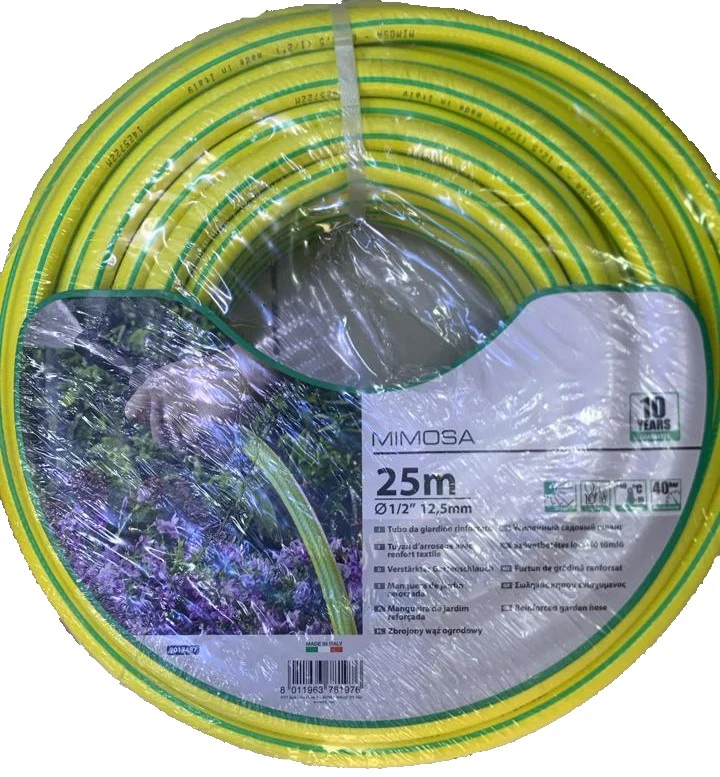
The Premium Quality Garden Hose Pipe listing offers 1/2 inch (12.5 mm) and 3/4 inch (19 mm) options, with 25 m and 50 m lengths. The listing describes textile mesh reinforcement and a UV, kink and weather resistant design, and gives a temperature range of minus 40 to plus 60 C. Select the exact combination you need on the product page and confirm the included fittings before ordering.
Two points on that page need care. The description calls the hose a durable rubber material, while its short description names Mimosa, and our separate FITT Mimosa listing describes that hose as UV resistant PVC. So if the material matters to you, ask us to confirm which hose you will receive before you order. The page also mentions a 10 year durability warranty without saying who gives it or what it covers; ask for the warranty terms in writing rather than relying on that line. The FITT Mimosa hose and the Geepas 30 m auto rewind reel were both out of stock when we checked on 10 November 2026, so this is the one hose we can point you to today.
Do not treat kink resistant as permission to fold a hose sharply. Look for a hose you can coil comfortably, and check its stated operating conditions. Storage out of direct sun remains sensible even when a product is described as UV resistant.
Match the connections, not just the hose
- Tap adapter: match the tap’s thread size and thread type. A hose’s internal diameter is a different measurement from the tap thread.
- Hose end connector: choose one specified for your hose diameter. Some connectors accept more than one size; others do not.
- Nozzle or sprinkler: check its connection system and required operating conditions. A product called a standard fitting still needs checking for compatibility.
- Washers and seals: inspect them if water escapes at a joint. Switch off the tap and release pressure before disconnecting parts.
Photograph your tap and existing connectors, and note the hose size. Those details make it easier to identify a suitable adapter than describing every component as half inch.
Our connector pages state sizes differently, so read them closely. The Beorol GSBP12 quick connector is listed for 1/2 inch hose, the plain Beorol quick connector for 3/4 inch hose, and the Beorol GSP1234 repair connector for both 1/2 and 3/4 inch hose. On the tap side, the Beorol GASP34 is titled as a 1/2 and 3/4 inch tap adaptor and says it fits 3/4 inch hoses, while the GASP1 is a 3/4 and 1 inch tap adaptor and reducer. None of these pages names a thread standard, so take your photograph and the old adapter with you, or send them to us, before you buy.
A cut or split hose is usually a repair, not a replacement
If a car wheel or a spade cuts the hose, cut out the damaged section with a sharp knife so both ends are square, push each end fully into a repair connector of the same size, and tighten the collars by hand. Run the water and watch the joint for a minute. A 25 m hose with one repair in the middle is still a 25 m hose; it is a cheaper fix than a new hose and it takes five minutes.
Keep garden water out of your drinking water
Two safety points get little attention in hose buying guides. The first is backflow. LSU AgCenter explains that if the pressure in the supply drops suddenly, water can move backwards from the hose into the household system. It names washing cars, bathing pets and applying pesticides as the situations where that water may be contaminated, and notes that a hose lying in the sun heats up, which raises the pressure inside it.
The simple protection is a hose bibb vacuum breaker, a small device that screws onto the tap thread, lets water flow out normally and opens to the air if the pressure reverses. LSU advises mounting it at least 6 inches (about 15 cm) above the ground so it never sits in a puddle, and checking it now and then, because hard water can make it stick. We do not currently list one, so ask a plumbing supplier. Until you have one, never leave the hose end lying in a bucket of fertiliser, a pond, a paddling pool or a sprayer tank. Fill a sprayer with the nozzle held above the liquid, and see our garden sprayer guide for mixing and rinsing.
The second is drinking. A University of Utah Health physician advises against drinking from a garden hose, citing a study by the Ecology Center that found many garden hoses contain hazardous chemicals, including lead. Our hose page does not describe the hose as safe for drinking water, so treat it as a watering hose only: no drinks for children on a hot afternoon, and fill pet bowls from the kitchen tap.
Hot water in the hose: the UAE summer problem
From May to September a hose left on a sunny wall or across paving fills with water that can come out hot enough to hurt. Use the volumes worked out earlier: a 25 m, 1/2 inch hose holds about 3 litres; a 50 m, 3/4 inch hose about 14 litres. Before watering, point the nozzle at a path or into a bucket and let that volume run until the water feels cool on the back of your hand. At 15 litres per minute, 3 litres take about 12 seconds and 14 litres about a minute. Pour the bucket on the garden later once it has cooled.
Keep children and pets away from the first flush, and never spray a person with a hose that has been lying in the sun. The same heat is the main reason to store the hose in shade, which also slows sun damage to the outer layer.
Choose a nozzle for controlled watering
A trigger nozzle lets you stop the flow while moving between pots. A gentle shower is useful when a strong stream would displace compost. Aim at the soil around the plant rather than washing the leaves by default.
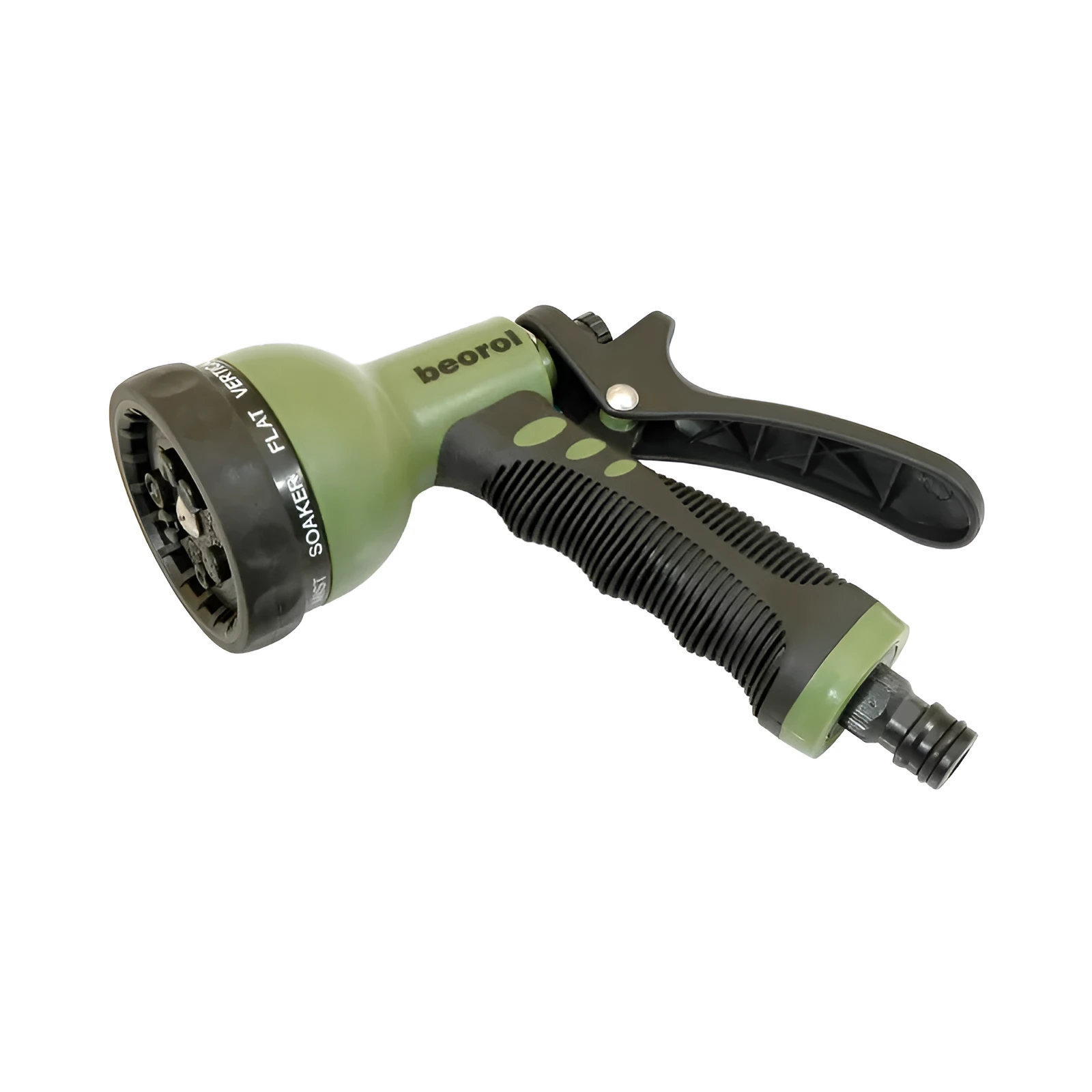
The Beorol GPP9 Water Spray Gun is listed with multiple spray patterns, a trigger and adjustable water control. Its page heading says 9 patterns, but the feature list names seven: jet, shower, flat, mist, soaker, cone and vertical. Plan on those seven. For plants, the shower and soaker settings are the useful ones; mist barely wets a pot and jet is for cleaning paving. Compare its connection with your hose end fitting. Use a gentle setting for watering; a powerful cleaning jet is not suitable for delicate seedlings.
The Beorol GPS6 nozzle set lists the same seven patterns with quick fit connectors and an ABS body, if you would rather have a set than a single gun. Whichever you choose, run the bucket test again with your watering pattern, because a shower setting usually delivers much less water than an open hose.
Water according to the plant, not a fixed hose routine
Early morning is a useful starting point for watering in UAE gardens. University of Arizona Extension’s Jeff Schalau suggests checking soil moisture before sunrise, when overnight movement of water in the soil has evened things out. Check moisture below the surface first, especially in pots: a dry looking top layer alone does not tell you how wet the root zone is. Containers, seedlings and established plants can need different watering frequencies.
The RHS container watering guide recommends checking moisture, applying water slowly to the compost and adjusting frequency to conditions. Avoid repeatedly flooding a pot that is already wet. Persistent pooling calls for a drainage check, not a longer watering session.
Use a gentle flow close to the soil so water has time to soak in. Reassess your routine as exposure, weather and plant growth change; a shaded balcony and an exposed villa bed should not automatically receive the same treatment.
How long to water a pot
Illinois Extension’s container advice is to water until water starts to drip from the drainage holes, which also flushes out salts left by fertiliser, and to water when the top inch (about 2.5 cm) of mix is dry. Penn State Extension adds that pots under about 25 cm across need water more often. Illinois also warns that a dried out soilless mix can shrink from the pot wall, so water runs straight down the gap.
The hose number helps here. At 8 litres per minute the nozzle delivers about 0.13 litres each second, so 2 litres takes 15 seconds and 5 litres about 38 seconds. At a full open 15 litres per minute, the same 2 litres arrive in 8 seconds, faster than most potting mix can absorb, and much of it runs off the top or down the side. That is the real case for a soft pattern on pots.
To set your own time, water one typical pot slowly, counting seconds, until it drips from the base. Note the count. Next time, give that pot about that many seconds and check the drainage holes. If the mix has shrunk from the wall, soak the pot in a bucket or sink so it takes water up through the drainage holes, as Illinois Extension suggests; lift it out once the mix feels evenly moist, then go back to the hose.
How long to water a 1 m2 bed
Iowa State’s figure for most garden areas is about an inch of water a week, which in metric is 25.4 litres on each square metre (1 mm of water over 1 m2 is 1 litre). That is a baseline from a cooler climate, so treat it as the starting point for October to March in the UAE and expect sandy beds in hot months to need more.
| Hose flow | Water for 1 m2 at 25.4 L | Minutes per week | Split into 2 waterings |
|---|---|---|---|
| 8 L per minute | 25.4 L | about 3 min 10 s | about 1 min 35 s each |
| 15 L per minute | 25.4 L | about 1 min 42 s | about 51 s each |
Then check the depth. University of Arizona Extension’s irrigation guidelines suggest wetting annuals and perennials to about 30 cm, shrubs to about 60 cm and trees to about 90 cm, and letting the top 2.5, 5 and 7.5 cm dry respectively before the next watering. A smooth steel rod pushed into the bed an hour after watering slides easily through wet soil and stops where it meets dry soil. If a vegetable bed is only wet to 10 cm, water longer at each session rather than more often. In sandy soil this check shows where your water goes, which is the same logic our hydrogel article uses before anyone buys a soil additive.
What a 100 m2 lawn asks of a hose
Lawns show why a hose alone rarely waters a whole garden. University of Arizona’s lawn guide AZ1817 (Umeda and Kopec, 2020) lists monthly water use for Bermuda lawns in Phoenix, a hot desert city, and recommends deep watering about every 3 days in early summer rather than several short runs a day. UAE weather is not the same as Phoenix weather, so use these figures as a reference and confirm with the probe.
| Month (Phoenix figure) | Water per month | Per day | Litres per 100 m2 | Hose time at 15 L per minute |
|---|---|---|---|---|
| January, 1.4 in | about 36 mm | about 1.2 mm | about 800 L a week | about 54 min a week |
| November, 2.1 in | about 53 mm | about 1.8 mm | about 1,240 L a week | about 83 min a week |
| July, 6.7 in | about 170 mm | about 5.5 mm | about 1,650 L every 3 days | about 110 min every 3 days |
Almost two hours of standing with a hose every third day in July is not a plan anyone keeps, and hand watering never spreads it evenly. For a lawn, use the hose to carry water to a sprinkler or an irrigation line, check how evenly it covers the lawn by setting out a few straight sided cans and comparing the depth in each after a run, and let a timer do the repeating. Our UAE lawn guide covers lawn watering, feeding and mowing in more detail, and our drip irrigation guide covers beds and rows.
When a tap timer helps
The Orbit Buddy Single Port Digital Tap Timer is listed as battery operated, with an LCD display, a dial for start time, duration and frequency, a manual watering mode and a rain delay function. It can make an established routine easier to repeat, but a timer alone does not establish how much water your plants need.
Set it from your own numbers. If the bucket test gave 15 litres per minute at the end of the hose and a sprinkler zone needs 1,650 litres every 3 days in July, the starting duration is 110 minutes every third day. If you water a 6 m2 vegetable bed through the hose and the target is 25.4 litres per square metre a week in winter, that is 152 litres a week, or about 10 minutes a week at 15 litres per minute, which you might split into two 5 minute runs. Then probe and adjust. The page gives no pressure, thread or battery details, so check the box and the instructions before fitting it to your tap.
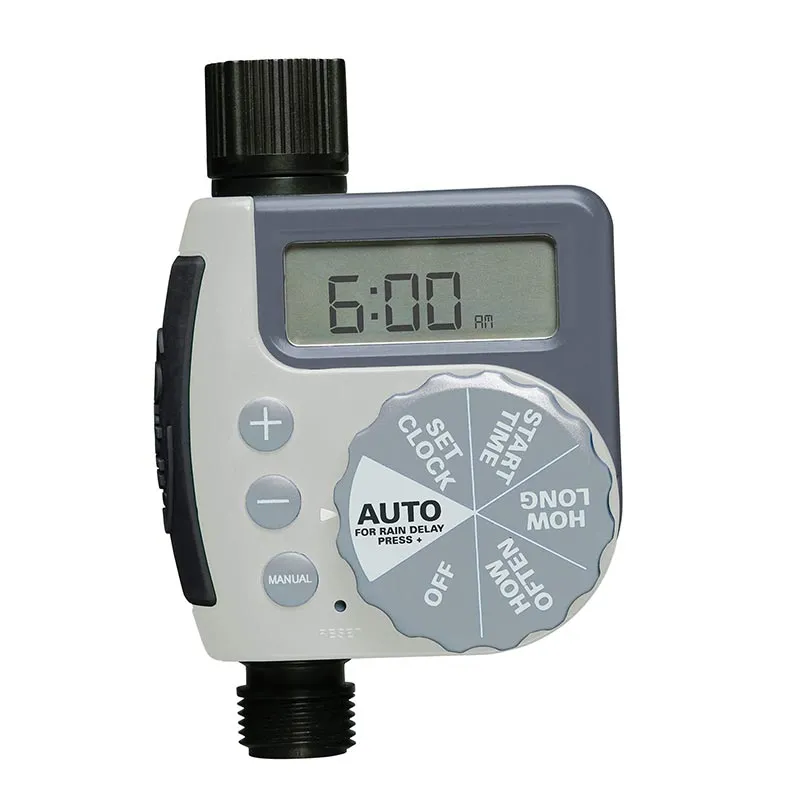
Before leaving a system unattended, follow its installation instructions, check connection and pressure requirements, inspect for leaks and watch a full cycle. Confirm that every intended plant receives water. Recheck the schedule and batteries regularly. For a drip system, follow that system’s requirements for filtration, pressure regulation and backflow protection. The Orbit page’s maintenance notes mention cleaning the inlet filter, which is the first thing to check if flow drops.
After watering: a simple care routine
- For a manual hose setup, turn off the tap and release residual pressure through the nozzle before storage.
- Check for leaks, damaged connectors and sharp kinks.
- Coil in broad, relaxed loops without pulling on fittings.
- Store in a shaded place, away from vehicle traffic and sharp edges.
For permanently connected timers or irrigation systems, follow the manufacturer’s instructions instead of applying a manual hose storage routine. Keep other equipment organised with our garden hand tools guide.
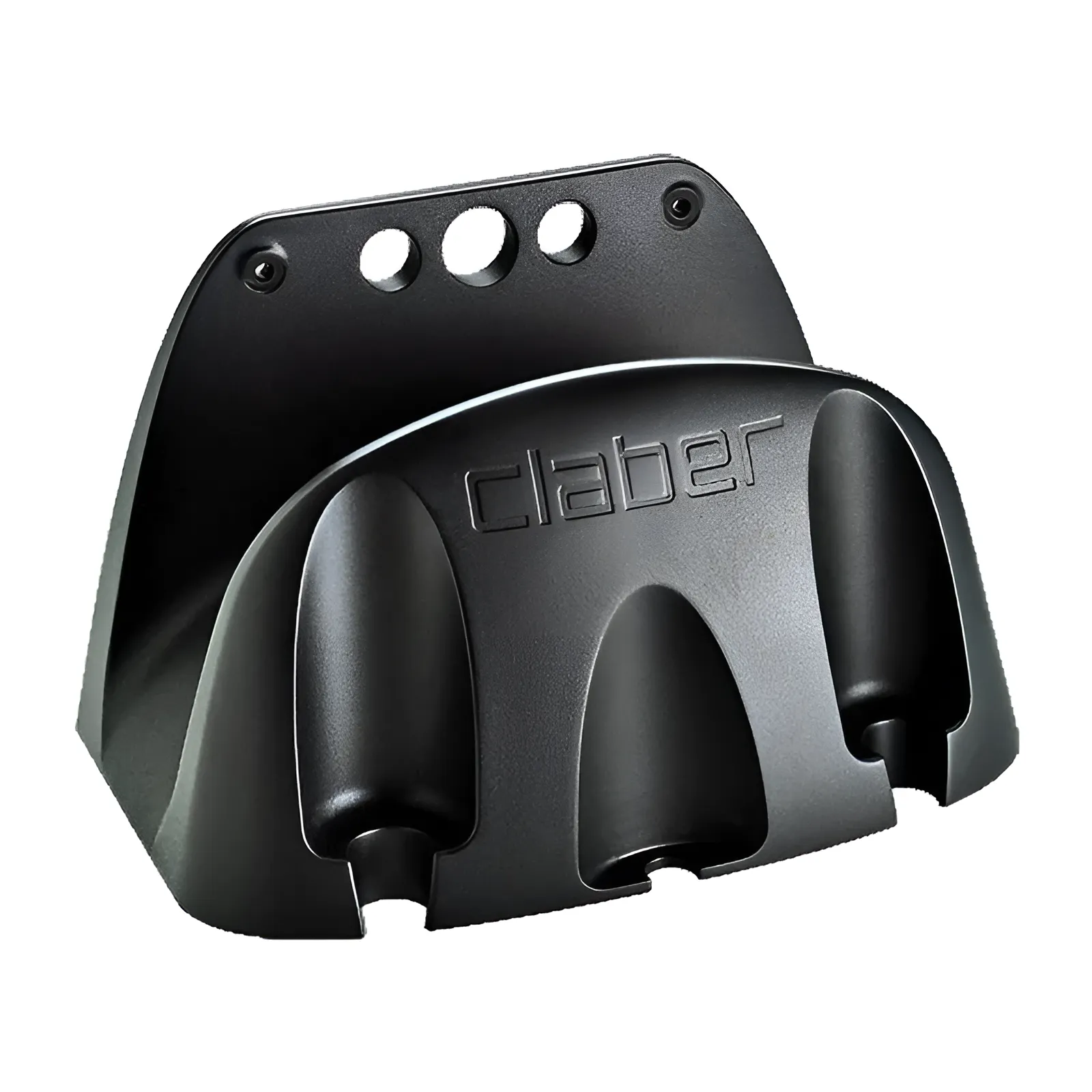
A wall holder keeps the coil off hot paving, out of the path of car wheels and away from the strimmer. Fix it on a north or east facing wall or under a canopy so the hose sits in shade for most of the afternoon, and at a height where the coil does not rest in water.
Compare the watering kit we checked
This is not a pesticide topic, so there are no rates or harvest intervals here. Instead, the table shows what each product page states and what it leaves out, as checked on 10 November 2026.
| Product | What it is | Size or fit on the page | Material on the page | Page does not say | Who it suits |
|---|---|---|---|---|---|
| Premium Quality Hose Pipe (30526) | Reinforced garden hose | 1/2 inch (12.5 mm) or 3/4 inch (19 mm); 25 m or 50 m | Rubber with textile mesh, though the short description names Mimosa (PVC on our Mimosa page) | Pressure rating, number of layers, drinking water suitability, who gives the 10 year warranty | Pots and courtyards (1/2 inch), long runs and sprinklers (3/4 inch) |
| Beorol GPP9 spray gun (29693) | Trigger nozzle | Standard hose fitting; 7 patterns listed under a 9 pattern heading | ABS nozzle, brass internal valve, rubber grip | Connection size, flow, pressure | Hand watering pots and beds |
| Beorol GPS6 nozzle set (29678) | Nozzle set | Quick fit; 7 patterns | ABS, rubber grip | Hose or connector size | An alternative to the GPP9 |
| Orbit Buddy single port timer (49642) | Battery tap timer | One outlet; start time, duration, frequency, rain delay | Not stated | Thread size, pressure range, battery type, schedule ranges | Repeating a tested routine on one tap |
| Claber wall holder (29719) | Wall mounted hose holder | Various hose sizes, no figure | UV resistant plastic | How many metres it holds | Keeping a coil in shade and off the ground |
| Beorol GSP1234 repair connector (29682) | Hose mender | 1/2 and 3/4 inch hose | ABS | Pressure rating | Fixing a cut hose |
| Beorol GASP34 tap adapter (29686) | Tap adapter | Titled 1/2 and 3/4 inch tap; fits 3/4 inch hose | Plastic with rubber gasket | Thread standard | Connecting a 3/4 inch hose to a tap |
| GASP1 tap adaptor (29674) | Tap adapter and reducer | 3/4 and 1 inch | Plastic | Hose size and thread standard | Larger outdoor taps |
The Beorol GSBP12 (1/2 inch) and plain Beorol (3/4 inch) quick connectors are also in stock. We did not box them because the right connector depends entirely on the hose and nozzle you already have.
UAE hose calendar: October to April and the summer
| Period | Villa garden | Balcony | Farm or plot |
|---|---|---|---|
| October to November | Planting season starts. Re-run the bucket test, replace worn washers, set timers to the lower autumn need and probe beds weekly | Hand water new pots slowly until they drain; check daily for the first two weeks | Lay out hoses and drip lines for the season; repair cuts before planting |
| December to February | Lowest water need. For trees and shrubs, Arizona advises the same amount per watering but less often in winter, so lengthen the gap, not the run | Many pots can go longer between waterings; finger test before each one | Use rain delay after rain; check that hose ends are not left in tanks |
| March to April | Need rises fast. Increase frequency step by step and probe after each change | Small pots may move back to daily checks | Check connectors and nozzles before the heat; look for leaks at every joint |
| May to September | Water before sunrise; run hot water out of the hose first; store the hose in shade; sprinkler and drip run on timers | Water at the same time each day, as Penn State advises for containers; keep the hose off the hot floor | Hand watering cannot keep up with rows; rely on drip and use the hose for filling and spot watering |
Weather changes within a season too, so keep using the finger and probe checks rather than trusting a fixed timer from one month to the next. If shade is part of your summer plan, our green shade net guide explains how much to use.
Common mistakes and what to do instead
- Buying the longest hose available. It weighs more, holds more hot water and costs flow. Measure the route with string and buy the shortest length that reaches.
- Watering pots on full jet. At 15 litres per minute water arrives faster than mix can absorb, washes out compost and runs off. Use shower or soaker and count seconds.
- Judging by the surface. A dry top can hide a wet root zone, and a wet top can hide dry soil below. Use a finger in pots and a steel rod in beds.
- Short daily sprinkles on beds. They wet the top few centimetres and leave roots below dry. Water longer and less often, then probe to the target depth.
- Leaving the hose on the sunny side of the house. The water inside can come out hot, and sun ages the hose. Store it in shade and run off the first flush.
- Mixing up hose size and tap thread. A 3/4 inch hose does not mean a 3/4 inch tap. Photograph the tap and match the adapter to its thread.
- Leaving the hose end in a tank or bucket. It is a backflow route into your house supply. Keep the end above the liquid and fit a vacuum breaker.
- Setting a timer from a guess. Timers repeat mistakes faithfully. Set duration from the bucket test and the area, then check with the probe after the first cycles.
Troubleshooting: when the hose is not doing its job
| Problem | Likely cause | What to do |
|---|---|---|
| Weak flow at the nozzle | Kink, closed valve, blocked nozzle, restrictive connector, long narrow hose | Bucket test at the tap and at the hose end. If the tap itself is weak, the hose is not the problem |
| Water sprays from the tap joint | Wrong adapter thread, missing or worn washer | Turn off, release pressure, check the washer, compare the adapter with a photo of the tap |
| Leak in the middle of the hose | Cut or split | Cut out the damage and fit a repair connector of the same size |
| Hose kinks every time it is pulled | Coiled tightly or stored in heat | Lay it straight in the shade for an hour, then coil in broad loops |
| Timer runs but no water arrives | Batteries, blocked inlet filter, tap left closed | Replace batteries, clean the inlet filter as the page advises, open the tap fully |
| Pots still dry after watering | Shrunken mix, water running down the gap | Soak the pot in a bucket, then water slowly on a soft pattern |
| Bed wet on top, dry at 20 cm | Too short a run | Water longer, less often; probe again |
Call a plumber if the tap itself leaks behind the wall, if flow at the tap is weak with nothing attached, or if you want a fixed backflow preventer or a new outdoor tap fitted. Those are supply problems a new hose will not solve. For a large garden where hand watering takes more than half an hour a day, talk to a landscape irrigation contractor about sprinkler zones or drip lines.
Safety checklist
- Do not drink from a garden hose, and do not let children do so.
- Run off the water standing in a sun warmed hose before it touches plants, pets or people.
- Keep the hose end out of buckets, tanks, ponds and sprayer tanks; fit a hose bibb vacuum breaker about 15 cm above the ground.
- If you rinse a pesticide sprayer, wear the gloves and eye protection the pesticide label names, and dispose of the rinse water as the label directs, never into a drain.
- Turn off the tap and release pressure before disconnecting anything.
- Coil the hose after use so nobody trips over it, and keep it off driveways.
- Store the timer and spare batteries out of reach of small children.
Frequently asked questions
Will a 3/4 inch hose fix low water pressure?
It may reduce flow losses along a restrictive hose run. It cannot increase the source pressure. Check leaks, kinks, filters and the equipment’s requirements before replacing the hose, and do the bucket test at the tap first.
Should I buy 25 m or 50 m?
Measure the usable route first. Buy enough reach with comfortable slack; choose the longer option when you need it, rather than simply because it is available. A full 50 m, 3/4 inch hose holds about 14 litres of water, which you will feel when you drag it.
Can I leave a hose in the UAE sun?
Check its manufacturer guidance. The GreenAsh hose listing recommends shaded storage. UV resistance does not mean unlimited life in direct sun, and the water inside a sunny hose can come out hot.
Does every garden need a timer?
No. Hand watering may be simpler for a few pots. A timer becomes useful when a suitable irrigation layout and watering routine are already established and you can inspect them regularly.
How many litres per minute does a garden hose give?
It depends on your supply, the hose and the nozzle, so measure it: fill a 10 litre bucket and divide 600 by the seconds it took. 40 seconds means 15 litres per minute.
How long should I water a pot with a hose?
Until water drips from the drainage holes. On a soft 8 litres per minute pattern that is about 15 seconds for each 2 litres the pot takes. Count it once for a typical pot and reuse the number.
Can I water a lawn by hand with a hose?
Only a very small one. On the Phoenix figures, a 100 m2 Bermuda lawn needs about 1,650 litres every 3 days in July, close to two hours at 15 litres per minute. Use a sprinkler and timer.
Is it safe to drink water from the hose?
No. University of Utah Health advises against it, and our hose page does not describe the hose as safe for drinking water.
Before you order
Have your route length, hose diameter, tap thread details and intended nozzle or sprinkler ready. Compare the linked hose and accessories, and ask GreenAsh to confirm any unclear fitting, the hose material or included component before purchasing. Then, on the first watering day, fill a bucket, time it and write the number on the tap.