
Blog
Rooting Hormone in the UAE: How to Grow Plants from Cuttings

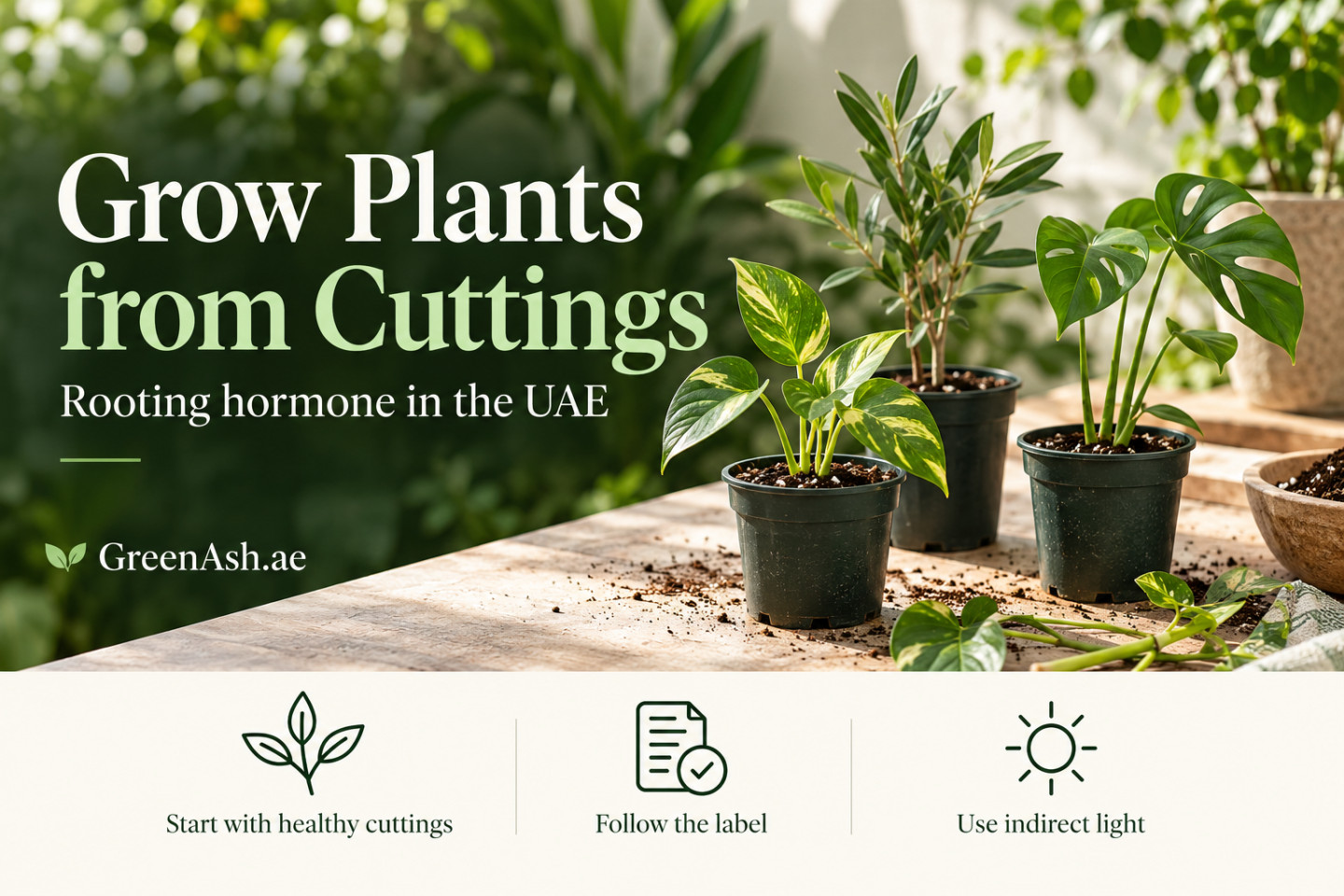
Rooting hormone can help some plant cuttings form roots, but it is only one part of successful propagation. A healthy cutting, a clean growing medium and a suitable environment matter just as much. For UAE gardeners, protecting an unrooted cutting from hot sun and drying air deserves attention before buying any powder.
The short answer: easy plants such as coleus, pothos and mint root without hormone. A 0.1% IBA powder suits soft, green cuttings, while university guides give woody cuttings such as bougainvillea stronger concentrations. In the UAE, October to March is the window, because a cutting in a pot needs a warm, never hot, root zone. By the end of this article you will know which cuttings to take this season, what strength of hormone each needs, how to mix a rooting medium, and how to keep a cutting alive through its first weeks.
Do you actually need rooting hormone?
Many easy-to-root houseplants can grow roots without it. Coleus is a useful beginner example: Missouri Extension advises hormone for all cuttings except easy rooters such as coleus, which it calls the easiest of all. For harder-to-root plants, an appropriate hormone may improve rooting, but success still varies with the species and the type and condition of the cutting. Illinois Extension explains that rooting hormones increase the rooting percentage of many plants and tend to shorten the time to root, while many houseplants root so easily on their own that hormone is not important.
Identify your plant before choosing a propagation method. A leafy stem cutting is not the right method for every plant, and succulents or cacti may require a drying period and different moisture management. Do not apply the enclosed, humid setup below indiscriminately to them. Purdue’s guide, for example, roots a jade leaf without any plastic bag, and the University of Florida (UF/IFAS ENH1228) lets a frangipani cutting dry for 3 to 5 days before planting and gives no hormone at all.
Quick decision table
| Your cutting | Hormone? | Strength university guides give | What it is NOT |
|---|---|---|---|
| Soft, green tip of coleus, basil, mint, pothos, philodendron | Optional | 0.1% IBA if used (Purdue, Montana State) | Not a reason to skip clean mix and shade; these fail from rot and drying, not lack of hormone |
| Softwood shoot of rosemary, lavender, salvia; soft tips of hibiscus and lantana | Helpful | 0.1% IBA (Purdue: 1,000 ppm for softwood); Montana State gives 0.1 to 0.3% | Not a flowering shoot; remove flowers and buds first |
| Semi-hardwood of bougainvillea, firm evergreen shrubs | Yes | 0.3% or 0.8% (Purdue); 3,000 to 6,000 ppm for bougainvillea (UF/IFAS ENH 874) | Not a job for a 0.1% powder alone if you need a high success rate |
| Leafless hardwood of fig or grape in winter | Helpful | 0.3% or 0.8% (Purdue); Montana State uses 0.1 to 0.3% | Not a cutting that needs a plastic tent; dormant wood does not need one |
| Frangipani (plumeria), jade, cactus | Not needed | None (UF/IFAS ENH1228 for plumeria) | Not a humid tent cutting; these rot in wet, enclosed conditions |
How rooting hormone works, and why strength depends on the cutting
Roots on a cutting come from cells near the cut base, usually at or just above a node, which is the point where a leaf joins the stem. The signal that tells those cells to become roots is auxin, a hormone the plant makes in its shoot tips and young leaves and sends down the stem. The Purdue Extension guide New Plants from Cuttings (HO-37) explains that rooting hormone products are synthetic forms of auxin, and that the two most used are IBA (indole-3-butyric acid) and NAA (naphthaleneacetic acid).
A soft green tip is young, actively growing tissue and roots readily, so it only needs a small boost. Woody stems are older and tougher, and university guides give them a stronger dose. Purdue sets out concentrations by cutting type: 1,000 ppm (0.1%) is used most often for herbaceous and softwood cuttings, while 3,000 ppm (0.3%) and 8,000 ppm (0.8%) are used for semi-hardwood and hardwood cuttings. A liquid product can be used at a low or high concentration for softwood or hardwood respectively. Montana State University Extension’s Cloning at Home (Winter 2026) gives a narrower home garden figure of 0.1 to 0.3% IBA for herbaceous, softwood and dormant hardwood cuttings.
More is not better. Penn State Extension warns that only a little hormone is needed and that excessive amounts will slow root development. The University of Florida’s bougainvillea guidelines add that thicker cuttings with more auxin may root better, but very high auxin can stunt branching. The right strength for the cutting type beats a heavy coat of a strong product.
Hormone does not supply food or water. A cutting has no roots, so it survives on the sugars stored in its stem and leaves and on whatever water it can pull through the cut end. Every leaf keeps making sugar but also loses water. This is why the instructions below keep some leaves, remove the rest, and raise the humidity: the balance between leaf area and water loss decides whether a cutting lives long enough to root.
Rooting hormone versus root booster fertilizer
| Product type | What to check | How to decide |
|---|---|---|
| Rooting hormone | Named active ingredient, formulation and permitted cutting treatment | Consider it for propagation where the plant and product directions fit. |
| Fertilizer marketed for roots | Nutrient analysis and feeding directions | Assess the plant’s nutrition needs; it is not interchangeable with a hormone dip. |
Words such as “root booster” alone do not identify the product. Read the ingredient panel and intended application. Our NPK guide explains fertilizer numbers. Do not replace a rooting treatment with concentrated fertilizer or assume a newly rooted plant automatically needs a high-phosphorus feed.
The science backs this up. Washington State University’s extension horticulturist Linda Chalker-Scott explains in The Myth of Phosphate Fertilizer that phosphorus only restores growth where the soil is short of it, and that extra phosphate can compete with iron and manganese uptake and harm the beneficial fungi on roots. NC State Extension asks for a rooting medium that is low in fertility. So a high phosphorus feed in the rooting pot does nothing that the hormone does, and can add salts to a cutting that has no roots to deal with them.
A rooting powder to compare at GreenAsh
GreenAsh lists Garden Safe TakeRoot Rooting Hormone. The product page lists 0.1% indole-3-butyric acid (IBA) and a 2 oz (56.6 g) pack. Its treatment is for cuttings; it is not a general watering additive.
At 0.1%, TakeRoot matches the 1,000 ppm strength Purdue lists for herbaceous and softwood cuttings. That makes it a good fit for basil, mint, coleus, hibiscus tips, lantana, rosemary and houseplant cuttings. It is weaker than the 3,000 to 6,000 ppm UF/IFAS gives for bougainvillea and the 0.3% or 0.8% Purdue lists for semi-hardwood and hardwood cuttings, so expect a lower and slower strike on woody cuttings and take extra cuttings to allow for losses.
Check the actual pack’s directions and permitted uses before purchase and application. The product page gives no registration number, and this article makes no local registration claim and does not extend its directions to unlisted uses.

Which plants root easily in the UAE cool season
The plants below are listed in university propagation guides as rooting from stem cuttings, and all of them are grown in UAE gardens and homes. The timing column is our advice for UAE conditions, based on the root zone temperatures those guides give.
| Plant | Cutting type | Source and what it says | Best UAE timing |
|---|---|---|---|
| Coleus | Herbaceous tip | Missouri: easiest of all, even in water; Nebraska: very easy | October to March, indoors or in bright shade |
| Basil, mint, scented geranium, citronella | Herbaceous tip | Montana State: herbaceous cuttings, roots typically in 2 to 4 weeks | October to February |
| Pothos, philodendron, monstera | Herbaceous tip with a node | Montana State lists all three; Missouri lists pothos and philodendron and says spring and early summer give quickest rooting for pothos and philodendron | Any month indoors, fastest from February to April |
| Geranium (pelargonium) | Herbaceous tip | Nebraska: very easy; Missouri lists it | October to February |
| Hibiscus, lantana | Soft tip (Missouri lists both under herbaceous cuttings) | Missouri lists both; hibiscus in bright light | October to November, or February to March |
| Rosemary, lavender, salvia, roses | Softwood | Montana State: softwood, roots in 6 to 8 weeks | November to February, from fresh growth after pruning |
| Bougainvillea | Semi-hardwood, 5 to 9 nodes | UF/IFAS ENH 874: IBA 3,000 to 6,000 ppm, 6 to 12 weeks | October to November, while nights stay above 13 C |
| Fig, grape | Dormant hardwood | NC State lists both as hardwood cuttings; Arizona Extension suggests starting with figs or grapes | December to February, once leaves have dropped |
| Frangipani (plumeria) | Mature grey wood, 30 to 38 cm | UF/IFAS ENH1228: dry 3 to 5 days, no hormone, no water for 5 to 6 weeks | March to April, as warmth returns |
A few plants deserve a note. Croton and dracaena are slow rooters according to Missouri, so give them the whole cool season. Bougainvillea is not an easy plant from cuttings at home, even though it grows so freely here. The UF/IFAS guide uses misting, bottom heat and a strong hormone and still allows 6 to 12 weeks. For more on growing it once you have a plant, see our bougainvillea guide.
One legal point from Montana State: patented or protected varieties, often new cultivars and hybrids, may not be propagated. If a plant came with a breeder’s label, check it first.
Prepare your propagation space first
Set out clean cutting tools, a clean pot with drainage, a plant label and fresh propagation medium before removing a stem. Penn State Extension recommends a light, moist medium that is free of pathogens, and says compost and garden soil are poor choices because they can carry pathogens and weed seeds.
Choose bright, indirect light. In a UAE home, check what happens at the actual location later in the day: a bright morning position may receive direct afternoon sun. Keep the tray away from a strong air-conditioning draft. These are practical adaptations of propagation guidance, not a fixed UAE growing calendar.
Mix a rooting medium
University guides agree on the recipe in principle: low in nutrients, open enough for air, moist but never waterlogged. Purdue writes that a rooting mix that is continuously waterlogged is devoid of air and cuttings will rot rather than form roots; it suggests 50% vermiculite and 50% perlite, or any well drained soilless potting mix with extra perlite. NC State gives 1 part peat to 1 part perlite by volume, or coarse sand, and warns that vermiculite alone compacts and holds too much water.
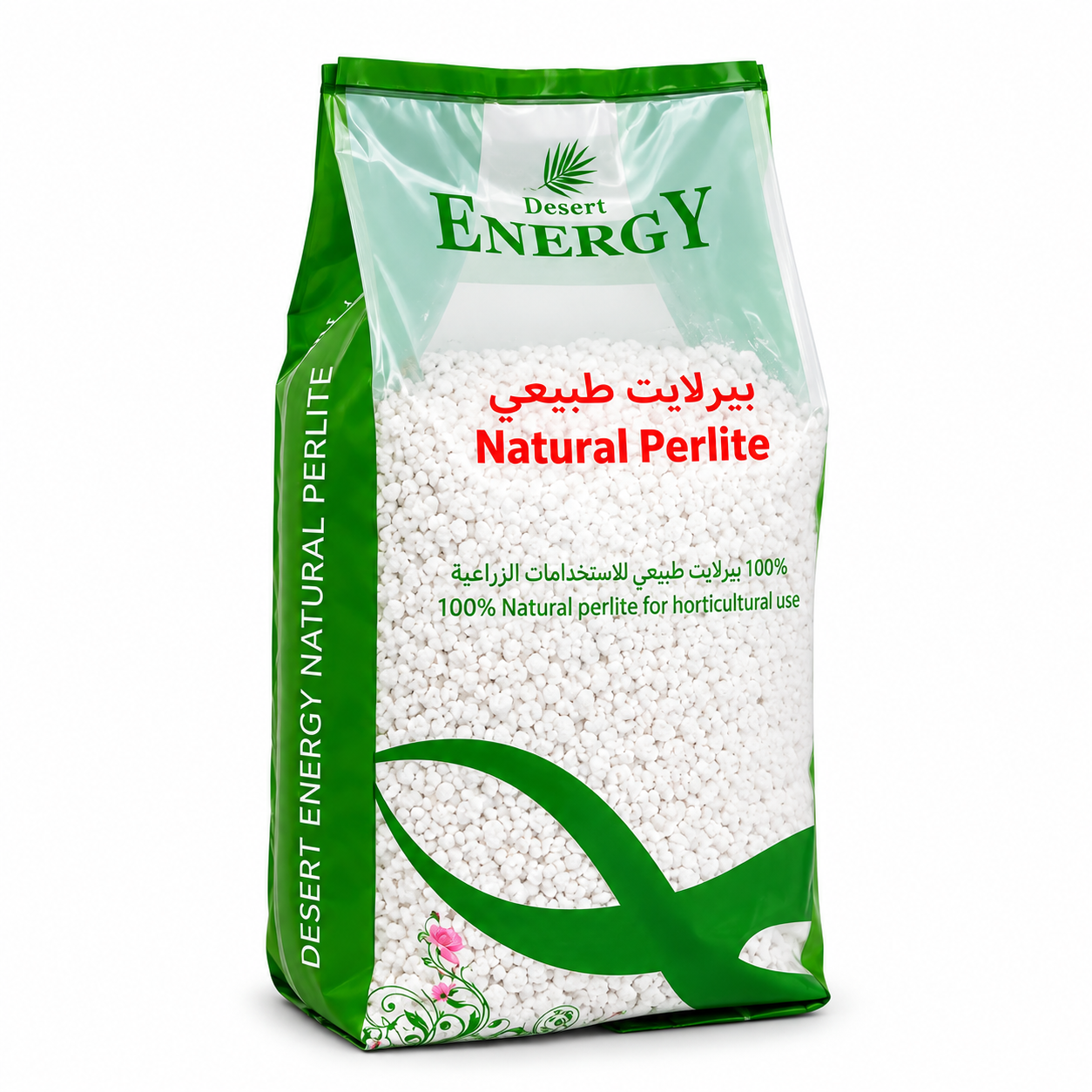
The Desert Energy perlite page gives a 1:1 mix with peat moss or coco peat for seed germination and 1 part perlite to 2 parts potting soil or compost for potting mixes. Worked out:
- One 1 L rooting pot: 0.5 L perlite and 0.5 L peat or coco peat (a 1:1 mix). A 10 L bag of perlite makes 20 L of this mix, enough for about twenty 1 L pots.
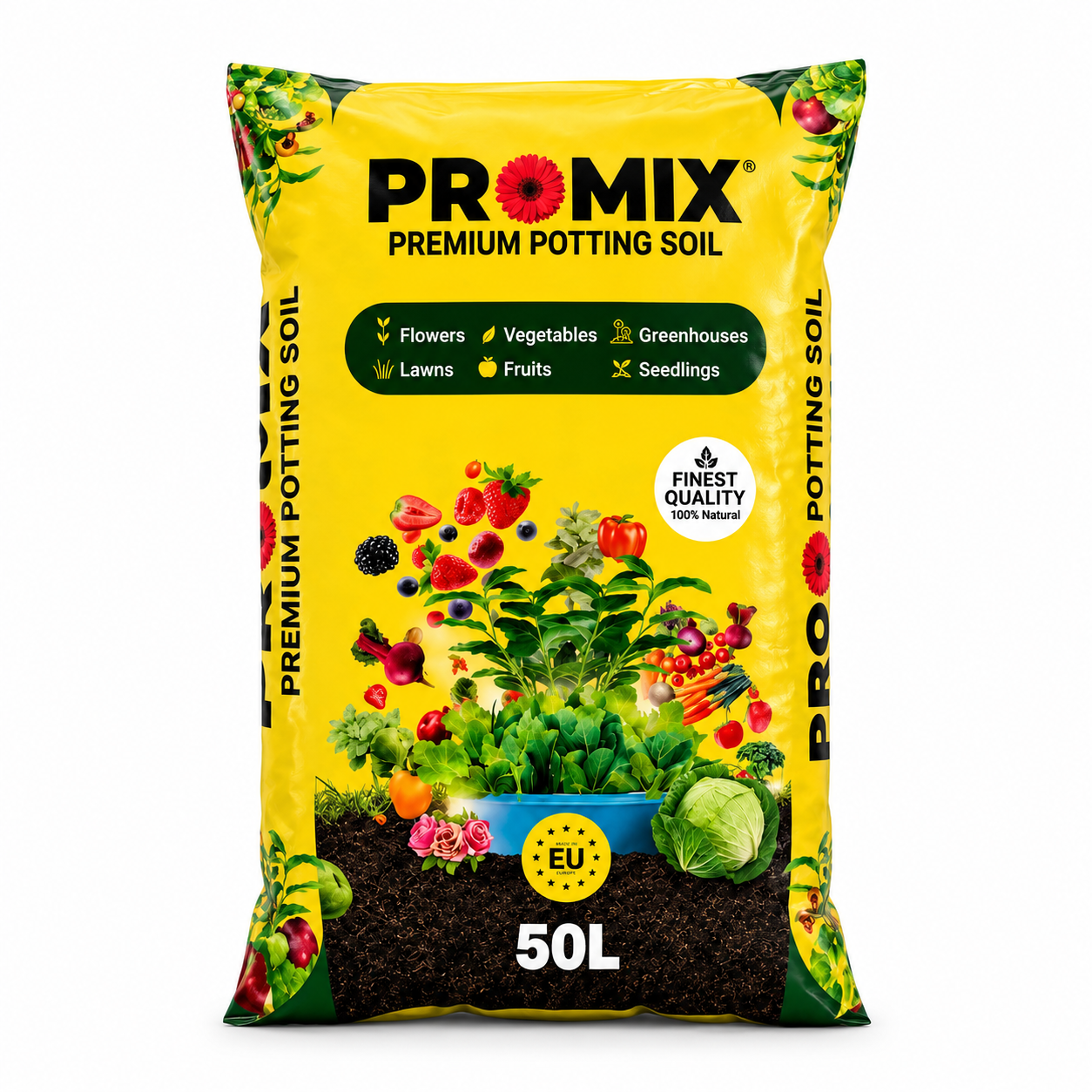
- Potting on rooted cuttings: 1 part perlite to 2 parts potting soil, from the perlite page. One 10 L bag with 20 L of potting mix gives 30 L. A 50 L bag of PROMIX needs 25 L of perlite at this ratio, which is two and a half 10 L bags.
- A 1 m2 propagation bed, 20 cm deep: that is 200 L of soil. The perlite page gives 10 to 20% for garden beds, so 20 to 40 L, or 2 to 4 bags of 10 L.
- 100 m2 of beds: 20,000 L of soil at 20 cm depth needs 2,000 to 4,000 L of perlite, which is 200 to 400 bags. At that scale, root cuttings in pots or a small nursery bed and plant them out later, as NC State advises, rather than amending the whole garden.
If you use garden sand, NC State and Missouri both say coarse sand works, and Missouri suggests heating moistened sand at 150 to 200 F (about 65 to 93 C) for 20 to 30 minutes to sanitise it. New peat, perlite and vermiculite need no sterilising, according to Missouri.
How to root a leafy stem cutting
- Select suitable growth. Choose a healthy shoot without visible pests or disease. Prefer non-flowering material; Montana State notes that flowering and fruiting divert energy away from roots. NC State recommends collecting cuttings in the early morning, when the plant is fully hydrated, and preparing them promptly. In the UAE, take them before about 9 am, when leaves are still firm.
- Use a clean, sharp blade. NC State says to disinfect tools with rubbing alcohol or 1 part household bleach to 9 parts water. A bypass pruner or a sharp knife makes a clean cut without crushing the stem.
- Prepare the stem. For many leafy houseplants, make a short cutting with several nodes, trim below a leaf joint and remove leaves that would sit beneath the medium. Keep some upper leaves. University guides give 5 to 15 cm for most soft cuttings: Purdue says 2 to 6 inches with at least three sets of leaves, Missouri and NC State say 4 to 6 inches, and Montana State says 3 to 5 nodes. Remove one half to two thirds of the leaves (Purdue), and on large leaves such as hibiscus, cut the remaining leaves in half (NC State). Length and cutting type should follow guidance for the identified plant rather than one universal measurement.
- Use a separate portion of hormone. Place only a small amount in a separate container; do not return leftovers to the original pack. Iowa State Extension’s hormone handling guidance explains that dipping into the main pack can spread disease. Purdue and NC State say the same.
- Follow the exact product directions. The TakeRoot product page calls for moistening the cut end, dipping it in the powder, then planting the cutting in a pot or soil mix with good contact. Tap off the excess, as NC State advises for powders. Do not pile powder around the stem or improvise a stronger treatment.
- Insert without scraping off the coating. Make a planting hole first with a pencil, insert the base and gently settle the medium. NC State inserts one third to one half of the cutting’s length; Montana State buries at least one node, preferably two. Keep leaves above the surface and space cuttings so foliage is not crowded. Label the plant and date.
- Maintain moisture and humidity appropriately. For leafy cuttings that benefit from enclosure, support a clear cover above the leaves. Check daily, ventilate and keep the medium moist without leaving the pot standing in water. Never put a covered pot in direct sun. Nebraska Extension uses condensation on the bag as the sign the mix is moist enough, and removes the bag for several hours if droplets form.
For tool selection and maintenance, see our garden hand-tool guide.

Woody and special cuttings
- Bougainvillea: UF/IFAS uses semi-hardwood cuttings with 5 to 9 nodes, strips leaves from the buried part, and never lets the cuttings wilt. At home, a clear cover and a warm spot out of sun stand in for the nursery mist system.
- Fig and grape: Purdue takes deciduous hardwood cuttings in winter from last season’s growth, with 2 buds above the mix line and about 5 cm of base in the mix. Montana State uses 15 to 25 cm lengths and says dormant cuttings need no humidity cover. Keep the buds pointing up, as Montana State reminds readers to plant cuttings the same way up as they grew.
- Frangipani: UF/IFAS takes 30 to 38 cm of firm grey wood with the tip, removes some or all leaves, dries the cut end for 3 to 5 days, sets it about 7.5 cm deep in well drained potting soil, and does not water for 5 to 6 weeks.
Can you root in water instead?
Montana State roots herbaceous cuttings in room temperature tap water with at least one node under water, changes the water weekly, adds no fertilizer, and moves the cutting into moist mix once roots reach 2.5 to 5 cm. Illinois Extension is less keen and notes that water roots are often weak. Our advice: water rooting is fine for pothos, coleus and mint on a windowsill, but use a mix for anything woody, and pot water-rooted cuttings early rather than letting the roots grow long.
UAE conditions: choose the setup, not just the month
Outdoor success depends on the plant’s growth stage and the conditions around the cutting. A shaded villa courtyard, an exposed balcony and a bright indoor room are different environments. Do not transfer a British spring calendar directly to every UAE plant.
The temperature target is the reason the cool season works here. Purdue keeps cuttings between 65 and 75 F (18 to 24 C) and warns against excessive heat, while Penn State and Illinois give a rooting media temperature of 75 to 80 F (24 to 27 C). For UF/IFAS, bougainvillea cuttings switch from softwood to hardwood when nights fall below 55 F (13 C). A small pot sitting in summer shade in the UAE runs far hotter than any of these figures, so outdoor cuttings are a cool season job.
If you cannot keep cuttings out of scorching light and drying wind, postpone the attempt or use a suitable indoor position. A plastic cover conserves humidity but can also trap heat. Missouri Extension specifically warns against putting plastic-covered cuttings in direct sunlight, because the heat will burn the foliage.
Season by season
| Months | What to root | Setup |
|---|---|---|
| October to November | Bougainvillea, hibiscus, lantana, coleus, basil, mint, geranium | Outdoors in bright shade from late October; indoors in early October if days are still hot |
| December to February | Fig and grape hardwood once leaves drop; rosemary, lavender, salvia and roses from pruning; herbs | Outdoors in bright shade or on a covered balcony; bring trays in on windy days |
| March to April | Frangipani; pothos and philodendron; last softwood cuttings | Move trays into morning sun only; pot on everything rooted before May |
| May to September | Houseplants only (pothos, philodendron, monstera) | Indoors in bright indirect light, away from the AC outlet; outdoor cuttings are not worth the losses |
Villa, balcony and farm
- Villa garden: use a north facing wall or the shade under a tree. A shade net over a simple frame creates a nursery corner; our shade net guide covers how much shade suits young plants.
- Balcony: wind dries cuttings faster than heat. Keep trays low, behind the balcony wall, and use clear covers. On a high, windy floor, an indoor windowsill may root better.
- Farm or large garden: root in pots or a small bed under shade near a water point, not in the field. NC State advises growing rooted cuttings on in containers or a nursery bed before final planting.
- Indoors with air conditioning: AC air is dry. A clear cover over the pot is more useful indoors than outdoors in winter, as long as the cover never touches the leaves.
Check progress without disturbing roots every day
Rooting time varies widely. Purdue suggests checking herbaceous and softwood cuttings after 2 to 3 weeks; Montana State expects herbaceous roots in 2 to 4 weeks and softwood in 6 to 8 weeks; Nebraska pots geranium and coleus cuttings after about 3 to 4 weeks; Purdue gives deciduous hardwood 2 to 4 months; and UF/IFAS gives bougainvillea 6 to 12 weeks. New leaves alone are not a reliable reason to move a cutting immediately. Check root development gently and occasionally. A gentle tug that meets resistance is a sign, but look at the drainage holes first, as roots often show there.
Once roots have developed sufficiently for the species, move the cutting to an appropriate potting mix and gradually reduce its dependence on the humid enclosure. Missouri moves cuttings once roots are at least 2.5 cm long, and Nebraska at 1.2 to 2.5 cm.
A sudden move from a protected tray to an exposed balcony adds avoidable stress. Increase exposure gradually and watch for wilting. Montana State hardens off over 7 to 10 days by lowering humidity and increasing light step by step; Nebraska allows 10 days to 2 weeks. Remove dead or diseased cuttings as soon as you see them, so rot does not spread through the tray.
First feed after potting on
Rooted cuttings in fresh potting mix need little or no feed for the first few weeks. When they are growing, a dilute liquid feed is enough; our liquid fertilizer guide covers how to mix one. The Nitro Phos 60 page, for example, gives 30 to 50 ml per 10 L of water every 10 to 15 days during active growth. That works out to 3 to 5 ml in a 1 L watering can, 15 to 25 ml in 5 L, and 48 to 80 ml in a 16 L sprayer tank. Start at the low end for young plants. Do not use any feed in the rooting medium itself.
Products compared
| Product | Active or analysis | Pack | Use | Rate on page | Harvest interval on page | Who it suits |
|---|---|---|---|---|---|---|
| Garden Safe TakeRoot (29099) | IBA 0.1% | 2 oz (56.6 g) | Dip for cuttings | No dose; moisten, dip, plant | None given | Herbaceous and softwood cuttings; weaker than guides give for woody cuttings |
| Desert Energy Natural Perlite (47027) | 100% expanded perlite, pH 6.5 to 7.5 | 10 L | Rooting and potting mixes | 1:1 with peat or coco for seeds; 1:2 with potting soil; 10 to 20% in beds | Not applicable | Anyone mixing a rooting medium |
| Fiskars P90 Bypass Pruner (29754) | Hardened steel bypass blades | One pruner | Taking cuttings | 26 mm cutting capacity | Not applicable | Woody cuttings of bougainvillea, fig, hibiscus |
| PROMIX Premium Potting Soil (60985) | Page gives no composition or analysis | 50 L | Potting on rooted cuttings | None; back label takes precedence | Not applicable | Potting on, mixed with perlite |
| Nitro Phos 60 (48026) | Page says NPK 2-2-2; table lists N and P only | 1 L | Liquid feed | 30 to 50 ml per 10 L, every 10 to 15 days | None given | A dilute feed after potting on; not a rooting hormone |
| Dragon Rooty 4-44-14 + 2% MgO (64115) | N 4%, P2O5 44%, K2O 14%, MgO 2% | 1 kg | Fertigation only | 4 to 6 kg per feddan (about 95 to 143 g per 100 m2); no per litre rate | None given | Farm fertigation systems; not a rooting hormone and not for cuttings |
Dragon Rooty and Nitro Phos 60 are in the table, not boxed, because neither contains a rooting hormone. Dragon Rooty’s page gives only a fertigation rate per feddan, which works out to roughly 1 to 1.4 g per m2 with no water volume or frequency, so it does not translate into a dose for a pot. Given the WSU evidence on phosphate, we would not add a high phosphorus feed to cuttings at all.
Common mistakes
- Dipping straight into the pack. It spreads disease into the whole supply (Iowa State). Pour a little into a dish and throw away what is left.
- Thick coats of powder. Penn State says excess hormone slows rooting. Tap off the excess so only a thin film remains.
- Taking flowering shoots. A shoot in flower is putting its energy into the flower. Remove flowers and buds, as the TakeRoot page and NC State both say, or choose a non-flowering shoot.
- Leaving all the leaves on. A cutting with no roots cannot replace water fast enough. Remove one half to two thirds of the leaves and halve large ones.
- Using garden soil or compost. These hold pathogens and drain poorly in a small pot. Use a peat or coco and perlite mix; see our damping off article for how soil fungi collapse young stems.
- Covered pots in sun. The cover becomes an oven. Bright shade only.
- Feeding the rooting pot. A cutting has no roots to take up nutrients, and fertilizer salts add stress. Feed only after potting on.
- Starting woody cuttings in May. By the time they root, the summer heat arrives. Woody cuttings are an October to February job here.
Common problems to investigate
- Wilting: check exposure, airflow, humidity and whether the medium has dried before adding more hormone.
- A soft or blackened base: remove failing material and review cleanliness, drainage and moisture. Appearance alone does not identify a specific disease or justify a fungicide.
- No roots yet: confirm the species, cutting type and growing conditions. Repeatedly lifting the cutting or reapplying powder is not a substitute for that check.
- Leaves yellow and drop but the stem stays green: the cutting may still root on stored reserves. Leave it until the stem softens or turns brown.
- Mould on the surface or leaves: too much humidity and too little air. Open the cover for a few hours a day, remove fallen leaves, and water less.
- Only callus, no roots, on a woody cutting: common with bougainvillea and hardwood at a low hormone strength. Give it more time, and next time take more cuttings or use a product with a strength closer to what the university guides give.
When to stop: if every cutting in a batch rots, empty the tray, discard the medium, wash the pot and start again with fresh mix and new cuttings. For a valuable or old plant, such as a family frangipani or a mature fig, ask a nursery or a professional propagator to take cuttings or try air layering rather than cutting away large pieces yourself.
Handling and storage
Read your supplied pack in full. The TakeRoot product page carries no safety, storage or disposal text, so the pack label is your guide. For background, the US Environmental Protection Agency’s IBA fact sheet (R.E.D. Facts, 1992) says IBA products in eye irritation Toxicity Category II must be labelled as causing substantial but temporary eye injury, and the labels it describes ask for goggles, a face shield or safety glasses and washing thoroughly after handling. If powder gets in an eye, the EPA fact sheet gives holding the eye open and rinsing gently with water for 15 minutes. EPA expects low toxicity to birds and aquatic species, and the fact sheet does not address bees.
- Protective equipment: safety glasses and disposable gloves while dipping. Work outdoors or near an open window and do not breathe the dust. The perlite page also advises a mask if perlite is dusty, and washing hands after handling.
- Children and pets: dip cuttings where children and pets cannot reach the dish, and wash the dish afterwards.
- Edible plants: the TakeRoot page lists vegetables among suitable cuttings and gives no harvest interval. The hormone goes on the base of a cutting weeks before any harvest, but follow any harvest limit on your pack.
- Bees and fish: the dip is applied indoors to a cut stem, so there is no spray drift. Do not rinse dishes or leftover powder into ponds or fountains.
- Storage: keep the original container closed, cool, dry and inaccessible to children, away from food, feed and water. Summer heat in a car or store room is a reason to keep it indoors.
- Disposal: wipe used powder from the dish with a paper towel and put it in household waste. Follow any disposal text on the pack.
Frequently asked questions
Can I root cuttings in water?
Some houseplants can root in water. Choose a method suited to the species, and expect adjustment when moving water-grown roots into potting mix. Montana State changes the water weekly and pots up at 2.5 to 5 cm of root. Do not add a powder product to the jar unless its own directions explicitly permit that use.
Will extra rooting hormone work faster?
No. Use the specified treatment and remove excess powder. Penn State notes that excessive hormone can slow root development.
What strength of rooting hormone do I need?
Purdue Extension gives 0.1% (1,000 ppm) for herbaceous and softwood cuttings and 0.3% or 0.8% (3,000 or 8,000 ppm) for semi-hardwood and hardwood cuttings. UF/IFAS uses 3,000 to 6,000 ppm for bougainvillea. A 0.1% powder such as TakeRoot fits soft cuttings best.
Can rooting powder rescue a rotting cutting?
It is not a substitute for a healthy starting stem and suitable conditions. Start again with healthy material and address the cause of failure.
Which month is best in the UAE?
There is no single answer for every species and growing space. Match the plant’s suitable growth stage with conditions you can manage, rather than relying on a date alone. As a guide, October to March suits most outdoor cuttings, with hardwood fig and grape cuttings from December to February and frangipani in March and April.
How long do cuttings take to root?
From university guides: 2 to 4 weeks for herbaceous cuttings (Montana State; Purdue says to check after 2 to 3 weeks), 6 to 8 weeks for softwood (Montana State), 6 to 12 weeks for bougainvillea (UF/IFAS) and 2 to 4 months for deciduous hardwood (Purdue).
Can I use honey or cinnamon instead?
None of the university guides we used for this article recommends them. If you try them, compare them with plain cuttings in the same tray, and use a tested IBA product for woody plants that are hard to root.
Is root booster fertilizer the same as rooting hormone?
No. A fertilizer supplies nutrients; a rooting hormone supplies auxin. A high phosphorus feed does not trigger roots on a cutting, and NC State asks for a low fertility rooting medium.
Before you buy
Identify the plant, confirm that cuttings are an appropriate method, and prepare a suitable rooting space. Then compare the linked TakeRoot product and its pack directions, a bag of perlite for the mix, and a clean pruner for the cut. If you need help choosing, share the plant name and a clear photo with GreenAsh rather than buying a product solely because its name mentions roots.
