
Blog
Termite Control in UAE: Anti Termite Treatment, House Termites & the Best Products

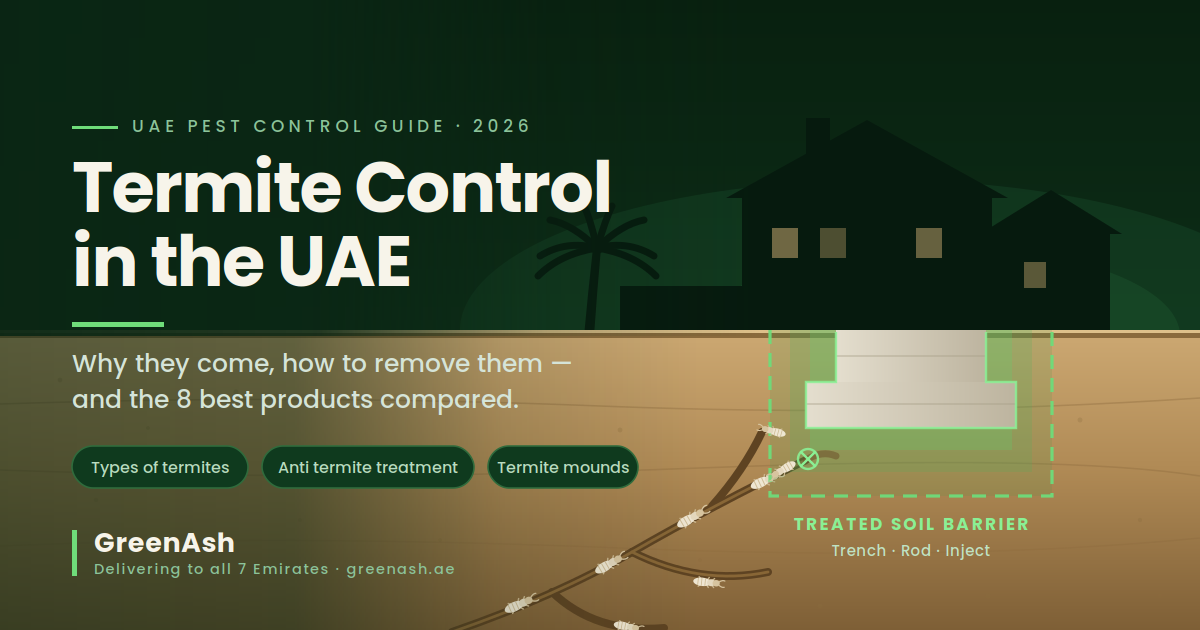
Termite Control in UAE: Anti Termite Treatment, House Termites & the Best Products in 2026
Last updated: August 2026 · Written by the GreenAsh technical team, Dubai · Serving Dubai, Abu Dhabi, Sharjah, Ajman, Ras Al Khaimah, Fujairah, Umm Al Quwain & Al Ain
Quick answer
Termites in the UAE are controlled by treating the soil, not just the insects you can see. The two chemical families that work are pyrethroids (cypermethrin, alpha-cypermethrin, lambda-cyhalothrin) which create a fast-acting repellent barrier, and neonicotinoids (imidacloprid) which are non-repellent, so worker termites carry the dose back and collapse the whole colony. A complete anti termite treatment means: identify the species → trench and rod the soil around the foundation → drill and inject infested walls and voids → treat exposed timber → remove the moisture source that attracted them.
- Best all-round for homes: Triple Power Insecticide 1L — AED 200
- Best for colony elimination: MIDASH Imidacloprid 21.4% — AED 220
- Best value professional barrier: Demon Max (Syngenta) 500 ml — AED 175
What this guide covers
- What termites actually are
- Types of termites in the UAE
- Termite mounds in the desert
- Why termites come to your house
- Signs of house termites
- Termite risk by emirate
- How to remove termites, step by step
- Dilution & dosage table
- Product comparison table
- 8 termite products reviewed
- How to choose the right one
- Preventing re-infestation
- Safety & UAE regulations
- Frequently asked questions
What are termites, and why are they such a problem in the UAE?
Termites are social insects of the order Blattodea, infraorder Isoptera — despite the local nickname “white ants” (النمل الأبيض), they are far more closely related to cockroaches than to ants. They live in colonies of anywhere from a few thousand to several million individuals, split into castes: workers that forage and feed the colony, soldiers that defend it, and reproductives (the king, queen and winged alates that swarm to start new colonies).
What makes them destructive is their diet. Termites digest cellulose using symbiotic protozoa and bacteria in their gut. Cellulose is the main structural component of timber, plywood, MDF, cardboard, paper, wallpaper backing, cotton fabric, and the paper facing on gypsum board — in other words, most of the non-concrete content of a modern UAE villa or apartment fit-out.
The UAE is close to an ideal termite environment. Year-round soil temperatures rarely drop below the point where colonies go dormant, so termite activity here is continuous rather than seasonal. Sandy, well-drained soils let subterranean species tunnel quickly and over long distances. And the single limiting factor in a desert — moisture — is supplied in abundance by irrigated landscaping, drip lines, air-conditioning condensate, swimming-pool backwash, and leaking service pipes. Add imported timber, palm-tree debris and organic mulch, and a villa in Al Barsha or Khalifa City effectively becomes an oasis for a colony that would otherwise struggle to survive.
The economic damage is not trivial. Termites do not trigger fire alarms or leave obvious water stains; they hollow structural timber and door frames from the inside out, leaving a paper-thin veneer of paint. Most UAE homeowners only discover an infestation when a skirting board crumbles under a vacuum cleaner or a door frame gives way — by which point the colony has usually been feeding for one to three years.
Types of termites found in the UAE
Correctly identifying the type of termite is the single most important step, because it dictates the treatment. Treating a drywood infestation with a soil barrier will fail completely, and vice versa. These are the groups that matter in the Emirates.
1. Subterranean termites (the main structural threat)
Genera commonly recorded in the Arabian Peninsula include Heterotermes, Microcerotermes, Amitermes and, in imported/landscaped settings, Coptotermes. These nest in the soil and travel to their food through tunnels. Because their bodies dehydrate rapidly in dry air, they build the tell-tale mud tubes — pencil-width tunnels of soil and saliva running up foundations, boundary walls, garage columns and inside wall cavities.
Treatment: a continuous chemical soil barrier plus colony-level control. This is what imidacloprid termiticides and cypermethrin soil treatments are designed for.
2. Drywood termites
Cryptotermes species are the classic drywood termites in the region, and they arrive a completely different way: not from the soil, but inside furniture, pallets, crates, antique wood or imported joinery. They live entirely within the timber they eat and need no soil contact and no external moisture. The giveaway is frass — tiny, gritty, six-sided faecal pellets that look like coarse coffee grounds or sand, piling up beneath a small “kick-out” hole.
Treatment: direct injection into galleries, surface treatment of exposed timber, or fumigation for heavy infestation. A soil barrier does nothing for drywood termites.
3. Dampwood termites
Uncommon in the UAE and almost always secondary to a plumbing or waterproofing failure. They need consistently wet, decaying wood. If you have dampwood termites, you have a leak, and fixing the leak is 80% of the fix.
4. Desert / sand termites
Psammotermes — the sand termite — is well adapted to arid Gulf conditions and is frequently found attacking irrigated landscaping, date palms, fence posts, timber pergolas, garden decking and buried cables. They are a common cause of dying young palms and shrubs in newly landscaped villa gardens across Dubai and Abu Dhabi.
| Type | Where it nests | Key evidence | Typical UAE location | Correct treatment |
|---|---|---|---|---|
| Subterranean | In the soil, up to 50–100 m from the food source | Mud tubes on walls and foundations; hollow-sounding timber | Villa foundations, ground-floor skirting, boundary walls, garden walls | Soil barrier (trench & rod) + non-repellent colony control |
| Drywood | Inside the timber itself | Frass pellets like coffee grounds; small round kick-out holes | Imported furniture, doors, wardrobes, wooden panelling, apartments at any floor | Drill-and-inject galleries + timber surface treatment |
| Dampwood | Wet, decaying wood | Damp, spongy timber; often with fungal staining | Under-sink cabinetry, bathroom joinery, roof leaks, planter boxes | Repair the leak first, then treat the timber |
| Desert / sand | Deep sandy soil, follows irrigation | Sand tubes on trunks and posts; dying plants; hollow palm bases | Villa gardens, date palms, decking, pergolas, farms | Soil drench around root zone + trunk/post barrier |
Termite mounds: do they exist in the UAE, and do they matter?
The towering, cathedral-style termite mounds people picture from documentaries are built by African and Australian mound-building genera such as Macrotermes. You will not see two-metre mounds in the UAE. What you do see here are much smaller structures:
- Low earthen mounds and crusts — irregular soil domes 5–40 cm high, sometimes appearing in undeveloped plots, farmland in Al Dhaid and Al Ain, and desert margins after rain.
- Carton nests — dark, sponge-like nests built inside wall cavities, service ducts, false ceilings and under floor screed, made of chewed wood and faeces. These are the “hidden mounds” that matter most in buildings.
- Mud tubes and sheeting — the flat, plastered-looking mud sheets across a wall or beam are effectively an extension of the nest, built to keep humidity in and predators out.
Why do termites come to your house? The 9 real causes in the UAE
Termites are not attracted to dirt or poor housekeeping. They are attracted to a specific combination of moisture + cellulose + soil contact + concealment. Here is what actually invites them into an Emirati home:
1. Over-irrigated landscaping against the building
Drip lines, sprinkler overspray and daily lawn watering keep the soil against the foundation permanently damp. This is by far the most common trigger in villa communities such as Arabian Ranches, Mirdif, Al Warqa, Jumeirah, Khalifa City and Al Zahia. Termites follow the water.
2. Air-conditioning condensate discharge
A split unit produces litres of water a day. When the drain line discharges onto soil beside the wall instead of into a drain, it creates a permanently moist column of earth that termites will colonise year-round.
3. Wood-to-soil contact
Timber pergolas, gazebos, decking joists, fence posts, garden furniture legs and landscape sleepers set directly into the ground give termites a bridge from soil into the structure — bypassing any barrier that exists at the foundation.
4. Organic mulch and compost beds
Bark chips, wood mulch and thick compost layers piled against a wall are both a food source and a humidity trap. Keep any mulch layer thin and pull it back at least 30 cm from the building line.
5. Imported furniture and timber
Drywood termites routinely arrive inside shipped wardrobes, antique pieces, wooden crates and pallets. This is why apartments on the 20th floor of a tower in Business Bay can get termites despite having no soil contact at all.
6. Date palms and dead plant material
Old palm stumps, buried root balls, dead trunks and construction timber left buried in the backfill are effectively a starter colony that came with the plot. This is extremely common in newly handed-over villas.
7. Plumbing and waterproofing leaks
A slow leak under a kitchen sink or a failed bathroom membrane wets the screed and adjacent timber joinery. Termites find it before you do.
8. Cracks and expansion joints in the slab
Subterranean termites need a gap of less than 2 mm to travel through. Slab cracks, service penetrations for pipes and cables, and untreated expansion joints are their standard entry routes.
9. No pre-construction treatment, or an expired one
Many buildings receive a pre-construction soil treatment before the slab is poured. That chemical barrier degrades over time. If your property is more than five to eight years old and has never had a top-up, assume the barrier is no longer continuous.
Signs of house termites (what to check this weekend)
- Mud tubes — pencil-thick earth tunnels on foundations, boundary walls, garage columns, inside store rooms and behind wardrobes.
- Hollow-sounding timber — tap along skirting boards, door frames and window reveals with a screwdriver handle. Termite-damaged wood sounds papery and may give way.
- Blistered or rippled paint that looks like water damage but has no plumbing behind it.
- Frass pellets — small gritty piles of ridged, six-sided pellets under furniture or window sills. That is drywood termites.
- Discarded wings on window sills, near lights, or in the pool skimmer after a swarm — usually after rain or a humidity spike.
- Tight-fitting doors and windows that suddenly stick, caused by the frame swelling from termite moisture and mud.
- Sagging or spongy laminate flooring and gaps opening at skirting joints.
- Dying garden plants or palms with sand tubes on the lower trunk — a sand-termite signature.
Termite risk across the UAE, emirate by emirate
| Emirate / area | Dominant risk | What drives it | Recommended approach |
|---|---|---|---|
| Dubai (Mirdif, Al Warqa, Arabian Ranches, Jumeirah, Al Barsha, Nad Al Sheba, Dubai Hills) | Subterranean + drywood | Dense villa landscaping, mature irrigated gardens, high volume of imported furniture | Full perimeter soil barrier + indoor crack & crevice treatment |
| Abu Dhabi (Khalifa City, Mohammed Bin Zayed City, Al Shamkha, Al Reef, Mussafah) | Subterranean + sand termites | Large villa plots, extensive turf irrigation, sandy backfill | Trench & rod barrier, plus treatment of palms and garden structures |
| Al Ain | Sand termites + subterranean | Date palm farms, agricultural land, oasis irrigation | Soil drench around root zones; treat all buried timber |
| Sharjah (Muweilah, Al Zahia, Al Nahda, Al Dhaid) | Subterranean | Older villa stock, farmland margins, ageing plumbing | Barrier treatment plus leak repair |
| Ajman & Umm Al Quwain | Subterranean + dampwood | Coastal humidity, older low-rise construction | Barrier + moisture control and ventilation |
| Ras Al Khaimah | Subterranean + drywood | Mountain wadi runoff, agricultural areas, timber-framed leisure structures | Barrier + timber treatment of pergolas and decking |
| Fujairah & East Coast | Dampwood + subterranean | Highest natural humidity and rainfall in the country | Aggressive moisture management + residual treatment |
GreenAsh ships termite control products to all seven emirates. Browse the full insecticides range or the wider pest control category for baits, repellents and application equipment.
How to remove termites: complete anti termite treatment, step by step
Step 1 — Inspect and map the infestation
Before mixing anything, walk the entire property with a torch and a screwdriver. Mark every mud tube, every hollow-sounding section of timber, every frass pile. Check the garden perimeter, garage, store room, under stairs, behind wardrobes, inside kitchen plinths and around every service penetration. You are trying to answer one question: is the termite coming from the soil, or is it living inside the wood?
Step 2 — Choose your chemistry
There are two strategies and they solve different problems:
- Repellent barrier (pyrethroids): cypermethrin, alpha-cypermethrin and lambda-cyhalothrin kill fast on contact and create a treated zone termites will not cross. Excellent for perimeter protection, fast knockdown and immediate results. They do not eliminate the parent colony.
- Non-repellent transfer (imidacloprid): termites cannot detect it, so they walk through the treated soil, pick up a sub-lethal dose and pass it to nestmates through grooming and trophallaxis. Slower — typically 2 to 8 weeks — but it collapses the colony.
For a serious, established infestation, professionals use both: imidacloprid for the soil and colony, a pyrethroid for immediate knockdown indoors and around the structure. That combination is why the products below are grouped the way they are.
Step 3 — Treat the soil: trenching and rodding
- Dig a trench roughly 15–20 cm wide and 25–30 cm deep directly against the external foundation wall, all the way around the building.
- Apply the diluted termiticide into the trench at approximately 4–5 litres of finished solution per linear metre, adjusting for soil porosity — sandy UAE soil drinks more than compacted fill.
- Where the trench meets paving, driveways or tiled terraces, drill 10–12 mm holes at 30 cm intervals through the hard surface and rod the solution down to the soil beneath.
- Backfill the trench with the excavated soil in layers, wetting each layer with more solution so the entire soil column is treated, not just the base.
- Seal all drill holes with cement mortar or colour-matched grout when finished.
Step 4 — Treat inside walls and voids
Drill 10 mm holes at 30 cm centres along the base of affected internal walls, roughly 10 cm above floor level, angled downward into the wall base. Inject solution under low pressure until it stops accepting fluid. Follow the mud tubes: where they run into a wall, the nest is usually on the other side. Treat cracks, expansion joints, service penetrations, under skirtings and behind loose tiles.
Step 5 — Treat the timber directly
For drywood termites, inject diluted product straight into the kick-out holes and galleries, then surface-spray all exposed unfinished timber — the backs of wardrobes, the undersides of shelves, roof battens, door frame reveals. Sealed and varnished surfaces absorb almost nothing, so treatment is only effective on raw wood or through drilled access.
Step 6 — Treat the garden and outbuildings
Soil-drench the root zones of affected palms and trees, treat the base of every timber post and pergola leg, and spray the boundary wall base. Sand termites will re-enter from the garden if you only treat the house.
Step 7 — Fix the moisture, then verify
Redirect AC condensate to a drain. Move drip emitters away from the wall. Repair leaks. Pull mulch back from the building. Then re-inspect at 2 weeks, 6 weeks and 3 months. Fresh mud tubes after week six mean the barrier has a gap — find it and re-treat that section.
Termite dilution & dosage quick reference
These are the manufacturer label rates for the products stocked at GreenAsh. Always confirm against the label on the bottle you receive, as rates are revised periodically and vary with pest pressure.
| Product | Active ingredient | Termite dilution rate | Best applied by |
|---|---|---|---|
| Triple Power 1L | Cypermethrin 8.4% + Tetramethrin 3% + PBO 6.3% | 10–20 ml per 1 L water (outdoor / crawling insects) | Compression sprayer, perimeter & crack treatment |
| Cymperator 25 EC | Cypermethrin 26% | Drywood: 50 ml / 10 L · Subterranean: 100 ml / 10 L | Sprayer, wood injection, ULV / thermal fogger |
| Demon Max 500 ml | Cypermethrin 25.3% | General 5–10 ml / L · Heavy termite 20–25 ml / L | Compression or power sprayer, soil & foundations |
| Cypermax 250 EC | Cypermethrin 25% | 1.5–3 ml per 1 L water (10–20 m² coverage per litre) | Sprayer, surface & crack-and-crevice |
| STUN 18.3 SC | Imidacloprid 18.3% w/v | Per label — professional soil-barrier rates | Trenching, rodding, sub-slab injection |
| MIDASH 21.4% | Imidacloprid 21.4% | Commonly 2.5–5 ml per 1 L water | Trenching, rodding, injection |
| Alpha-Cypermethrin 10% EC | Alpha-cypermethrin 10% | 10–15 ml per 1 L water | Residual spray, fogging, ULV |
| Sharda Lambda-Cyhalothrin 10% CS | Lambda-cyhalothrin 10% | 2–3 ml per 1 L water | Surface, spot and crack-and-crevice treatment |
You will need a decent sprayer. For indoor and spot work a 2 L handheld pressure sprayer is enough; for full perimeter trenching use a 12–22 L knapsack sprayer.
Termite control product comparison — GreenAsh UAE
| Product | Active ingredient | Type | Size | Mode of action | Best for | Price (AED) | Our rating |
|---|---|---|---|---|---|---|---|
| Triple Power ★ Top pick |
Cypermethrin 8.4% + Tetramethrin 3% + PBO 6.3% | EC | 1 L | Contact + residual, synergised knockdown | Whole-home treatment where termites appear alongside ants, roaches and other pests | 200 |
9.6 / 10 |
| Cymperator 25 EC | Cypermethrin 26% | EC | 1 L | Contact + residual | Pest control operators — labelled rates for both drywood and subterranean termites | 220 |
9.4 / 10 |
| Demon Max | Cypermethrin 25.3% | EC | 500 ml | Contact + stomach poison | Pre- and post-construction soil barriers on a budget | 175 |
9.3 / 10 |
| Cypermax 250 EC | Cypermethrin 25% + geraniol | EC | 1 L | Contact + ingestion | Large-area coverage at very low dilution rates | 220 |
9.1 / 10 |
| STUN 18.3 SC | Imidacloprid 18.3% w/v | SC | Concentrate | Systemic, non-repellent, colony transfer | Certified applicators eliminating an established colony | 195 | 9.5 / 10 |
| MIDASH 21.4% | Imidacloprid 21.4% | Liquid concentrate | 1 L | Systemic, non-repellent | Long-term soil barriers in hot sandy UAE soil | 220 | 9.5 / 10 |
| Alpha-Cypermethrin 10% EC | Alpha-cypermethrin 10% | EC | 1 L | Contact + residual | Budget broad-spectrum vector control with termites on label | 140 |
8.9 / 10 |
| Sharda Lambda-Cyhalothrin 10% CS | Lambda-cyhalothrin 10% | CS (micro-encapsulated) | 500 ml | Contact, slow-release residual | The longest indoor residual life; crack-and-crevice work | 140 | 9.2 / 10 |
Prices correct at the time of writing (August 2026). Check the product page for current pricing and stock.
The 8 best termite control products in the UAE — full reviews
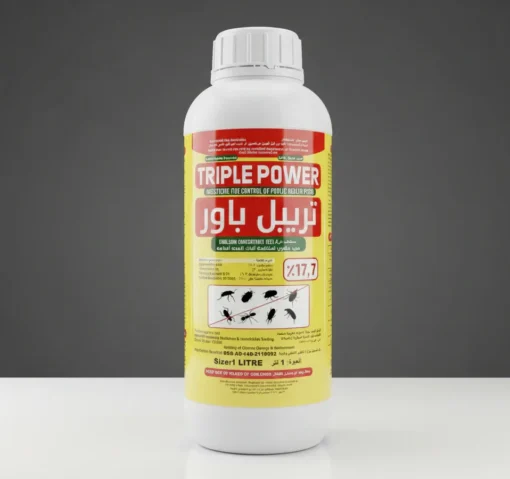
1. Triple Power Insecticide 1L — Public Health Protection
AED 200.00 AED 250.00
Active: Cypermethrin 8.4% + Tetramethrin 3% + Piperonyl Butoxide 6.3% (17.7% total) · Formulation: Emulsion Concentrate · Size: 1 L
Triple Power is our top recommendation for UAE homeowners and facility teams, and the reason is the formulation rather than the price. Most termite sprays give you one pyrethroid and nothing else. Triple Power gives you three components that each do a different job: cypermethrin provides the long residual kill that keeps working on the treated surface for weeks; tetramethrin is a fast-acting knockdown pyrethroid that drops insects on contact within seconds; and piperonyl butoxide (PBO) is a synergist that blocks the enzymes insects use to detoxify pyrethroids, which meaningfully raises efficacy against populations that have developed resistance to single-active products.
That last point matters more in the UAE than people realise. Cypermethrin has been the default active ingredient in Gulf pest control for decades, and resistance in urban cockroach and termite populations is a genuine and documented problem regionally. A PBO-synergised blend is how you get performance out of chemistry that is starting to lose its edge.
In practice, this is the product to reach for when your termite problem is not purely a soil-barrier job — when you also have ants trailing across the kitchen, cockroaches in the drainage, silverfish in the store room and wasps under the eaves. One bottle covers all of it. The label rate is 8–10 ml per litre for indoor crawling and flying insects and 10–20 ml per litre outdoors, which is generous dilution: a single litre makes 50 to 125 litres of finished spray. For a typical four-bedroom villa perimeter plus indoor crack-and-crevice work, one bottle is enough.
It is also low-odour and breaks down relatively quickly after application, which is why it is widely used in restaurants, hotels and commercial kitchens across Dubai where you cannot leave a strong chemical smell behind. Application is straightforward with any standard compression sprayer — no specialist equipment required.
What we like
- Three-way synergised formula outperforms single-active cypermethrin products
- PBO helps overcome pyrethroid resistance
- Very economical — 1 L makes up to 125 L of spray
- Low odour, suitable for kitchens and occupied buildings
- Genuinely broad spectrum: termites, ants, roaches, spiders, scorpions, ticks, flies, mosquitoes
Worth knowing
- Repellent chemistry — creates a barrier but will not collapse a large established colony on its own
- Public health use only; not for agricultural or plant application
- For deep soil barriers, pair it with an imidacloprid product
Verdict: the most versatile bottle on this list and the one we would put in most UAE homes. If you buy only one product, buy this. For an active structural infestation, buy this and MIDASH.

2. Cymperator 25 EC — Cypermethrin 26% EC
AED 220.00 AED 250.00
Active: Cypermethrin 26% · Formulation: Emulsifiable Concentrate · Group: 3A Pyrethroid · Size: 1 L
Cymperator is the most versatile professional product in the range, and its standout feature is that the label gives you separate, explicit rates for drywood and subterranean termites — 50 ml per 10 L for drywood work and 100 ml per 10 L for subterranean treatment. Very few products sold in the UAE are that specific, and it removes the guesswork that causes most DIY termite treatments to fail.
At 26% cypermethrin it is one of the most concentrated pyrethroids available here. It can be diluted in either water or mineral oil, which is what makes it unusually flexible: with water it is a surface and soil spray; with mineral oil it becomes a thermal fogging and ULV product for large-area work at 15–18 micron droplet size. That means a single 1 L bottle covers termite injection into infested timber, residual wall spraying for cockroaches, perimeter treatment, and outdoor mosquito fogging.
For termite work specifically, the drywood protocol is direct injection into the wood or application onto exposed timber surfaces, while the subterranean protocol is the higher-strength soil application. Both are documented on the label. For contractors running a mixed public-health portfolio across multiple sites, this is the efficient single-SKU choice.
What we like
- Separate labelled rates for drywood vs subterranean termites
- Highest cypermethrin concentration in this comparison
- Water or mineral oil dilution — sprayer, ULV and thermal fogger compatible
- Excellent value per litre of finished solution
Worth knowing
- Really designed for professional operators with proper equipment
- Repellent — best paired with a non-repellent for colony elimination
- Fogging applications need mineral oil and a fogger, adding cost
Verdict: the best choice if you run a pest control business in the UAE or manage multiple properties. Homeowners will find Triple Power easier to work with.
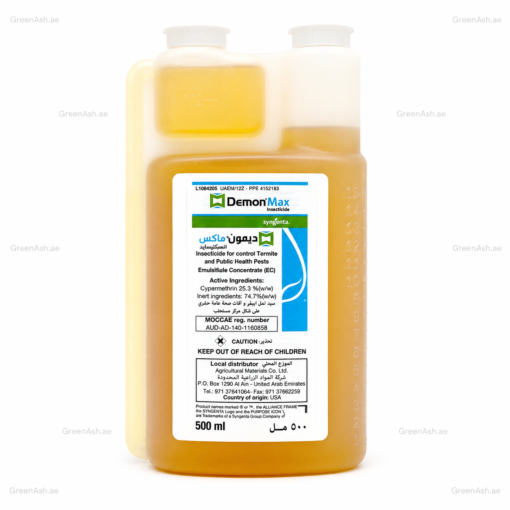
3. Demon Max Insecticide (Cypermethrin 25.3%) — 500 ml
AED 175.00 AED 199.00
Active: Cypermethrin 25.3% w/w · Formulation: EC · Brand: Syngenta · Origin: USA · Size: 500 ml
Demon Max has been a fixture in termite work for years and remains one of the most recognised names in the category. It is a Syngenta product made in the USA, and what you are paying for is consistency: the emulsification is clean, it stays in suspension in the tank, and it bonds well to porous surfaces like concrete, block and screed, which is exactly where a termite barrier needs to hold.
The label is explicit about termite use, including pre-construction soil treatment — applying to the soil beneath foundations and around the building perimeter before flooring and walls go up. If you are building a villa in the UAE, this is the single highest-value termite intervention you will ever make, and it costs a fraction of remedial treatment later. For existing structures, the heavy-infestation rate of 20–25 ml per litre is the strongest cypermethrin dose on this list.
The 500 ml pack is the reason it scores so well on value. At 5–10 ml per litre for general work, that bottle makes 50–100 litres of solution — enough for a full villa perimeter — for AED 175. For homeowners who want a proven brand without buying a full litre, it is the sensible entry point.
One practical note: it adheres and persists well, which is a strength outdoors and something to be deliberate about indoors. Keep it to skirtings, wall bases, cracks and voids rather than broadcast-spraying living areas. It is also toxic to fish and bees, so keep it away from ponds, water features and flowering plants that bees are working.
What we like
- Syngenta quality control and a genuinely proven track record
- Explicit pre-construction termite protocol on label
- Strong 20–25 ml/L option for heavy infestations
- Excellent surface adhesion on concrete and masonry
- Best cost-per-treatment in this comparison
Worth knowing
- 500 ml only — heavy users will get through it quickly
- Toxic to fish and bees; avoid ponds and flowering plants
- Repellent chemistry, so colony elimination needs a partner product
Verdict: the best price-to-performance ratio here, and the one to specify for pre-construction soil treatment on a new build.
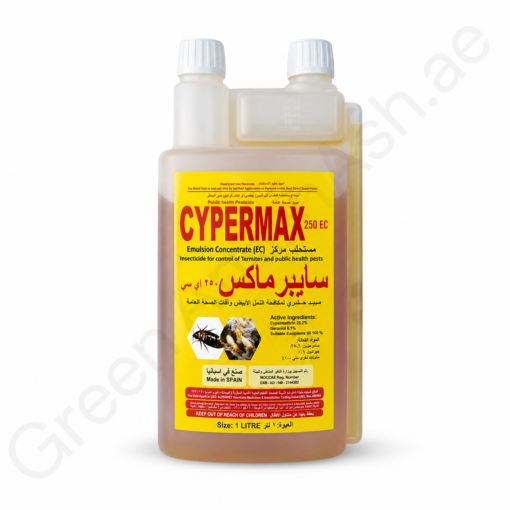
4. Cypermax 250 EC Insecticide 1L — Cypermethrin 25%
AED 220.00 AED 260.00
Active: Cypermethrin 25% + trace geraniol · Formulation: EC · Origin: Spain · Size: 1 L
Cypermax is the coverage champion. Its label rate is only 1.5–3 ml per litre of water — dramatically lower than the 5–25 ml/L of the other cypermethrin products here — with a stated coverage of 10–20 m² per litre of finished solution. Run the arithmetic and a single 1 L bottle produces somewhere between 330 and 660 litres of spray, enough to treat several thousand square metres. For large villas, compounds, warehouses, labour accommodation or facilities management contracts, no other product on this list comes close on cost per square metre.
The formulation is Spanish and includes a trace of geraniol, a plant-derived terpene alcohol that contributes to the product’s insect-active profile and softens the solvent smell typical of EC concentrates. It works through both contact and ingestion, and the target list is unusually broad for a termiticide: termites, cockroaches, ants, mosquitoes, flies, bed bugs, wasps, beetles, silverfish and centipedes.
The trade-off is precision. At 1.5–3 ml per litre you need to measure carefully — a syringe or graduated measure, not a bottle cap. Over-dosing wastes product and increases residue; under-dosing gives you a barrier termites walk straight through. Get the measurement right and it is superb; guess at it and results become inconsistent.
What we like
- Extraordinary coverage — up to 660 L of finished spray per bottle
- Lowest cost per treated square metre in this comparison
- Very wide target pest list including bed bugs and silverfish
- Milder odour than most EC concentrates
Worth knowing
- Low dose rates demand accurate measuring equipment
- Repellent chemistry — barrier, not colony elimination
- Overkill for a single small apartment
Verdict: the right choice for large properties and commercial contracts. If you are treating more than 500 m², this is the most economical bottle you can buy.
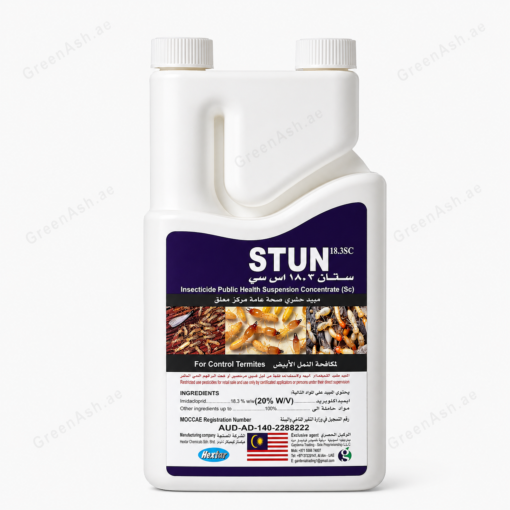
5. STUN 18.3 SC — Imidacloprid Suspension Concentrate
AED 195.00
Active: Imidacloprid 18.3% w/v (20% w/w) · Formulation: Suspension Concentrate · Use: Certified applicators
STUN is a fundamentally different tool from everything above it, and understanding why is the key to solving a serious termite problem. Every pyrethroid on this list is repellent — termites detect the treated zone and avoid it. That is excellent for keeping them out, but it also means the colony survives, relocates, and probes for a gap in your barrier. Any gap and they are back inside.
Imidacloprid is non-repellent. Termites cannot detect it, so they tunnel straight through treated soil, pick up a sub-lethal dose, and carry it back into the nest on their bodies. Because termites constantly groom each other and share food mouth-to-mouth (trophallaxis), that dose spreads through the colony — including to the reproductives and the queen, who never leave the nest and can never be reached by a contact spray. The result is gradual colony collapse rather than local avoidance.
The SC (suspension concentrate) format matters in UAE conditions. Micro-fine active particles are held in stable suspension, which means better distribution through sandy soil and a long, stable residual life in the ground — where a solvent-based EC would be more prone to breaking down or binding unevenly. STUN forms a continuous treated zone for pre-construction soil treatment, post-construction remedial barriers, wood protection and perimeter work.
The important caveat: STUN is a restricted-use product intended for certified applicators. Its rates depend on soil type, structure and infestation severity, and getting a soil barrier wrong is worse than not treating at all — a partial barrier just teaches the colony where the gap is. If you are a licensed operator, this is a first-rate tool. If you are a homeowner, use it through a professional or choose MIDASH below.
What we like
- Non-repellent transfer effect kills the colony, including the queen
- SC formulation gives outstanding soil stability and residual life
- Purpose-built as a termiticide, not a repurposed general insecticide
- Works for both pre- and post-construction barriers
Worth knowing
- Restricted use — intended for certified applicators
- Slow by design; expect 2–8 weeks to full colony collapse
- No fast knockdown, so it is not a “spray what you see” product
- Requires proper trenching and rodding equipment
Verdict: the most technically capable termiticide here. If you have a genuine structural infestation and access to a licensed applicator, this is what should go in the soil.
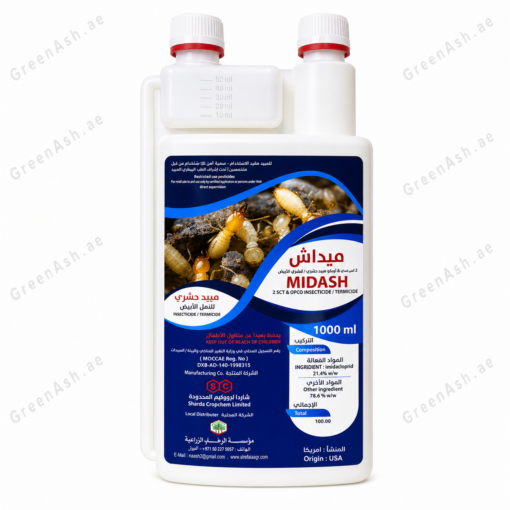
6. MIDASH Imidacloprid 21.4% — 1000 ml (Made in USA)
AED 220.00
Active: Imidacloprid 21.4% w/w · Formulation: Liquid concentrate · Origin: USA · Size: 1 L
MIDASH delivers the same non-repellent, colony-transfer chemistry as STUN, at a higher concentration (21.4% versus 18.3%), in a full-litre pack, with dilution rates that are practical for competent non-specialists — commonly 2.5–5 ml per litre of water. For most UAE homeowners dealing with a confirmed subterranean or sand-termite problem, this is the imidacloprid product to buy.
It is also the product on this list most explicitly formulated for local conditions. UAE soil is a difficult medium for a termiticide: highly porous, low in organic matter, and hot enough at depth to accelerate breakdown of less stable actives. MIDASH is described as penetrating deeply into sandy soil to form a continuous barrier and holding its residual under that heat load. In practical terms, that translates into a barrier that stays intact through a Dubai summer rather than one that thins out by September.
The application methods are the classic three: trenching (dig a channel against the foundation and flood it), rodding (drill through paving and inject to the soil beneath) and injection (into wall voids and infested timber). Used properly around a full villa perimeter, one litre goes a long way — at 5 ml/L it produces 200 litres of finished solution, roughly 40–50 linear metres of trench at standard rates.
It works for both prevention and active infestation. Before construction, apply to the soil beneath the slab and around the footprint. After construction, trench and rod the perimeter and inject affected walls. This is also the product we recommend for treating date palms and garden structures where sand termites are the culprit.
What we like
- Highest imidacloprid concentration on this list at 21.4%
- Non-repellent colony elimination in a homeowner-usable format
- Specifically suited to hot, sandy UAE soils
- Full 1 L pack; 2.5–5 ml/L makes 200–400 L of solution
- Made in the USA with consistent quality control
Worth knowing
- No visible fast knockdown — patience required
- Trenching and rodding is genuine physical work
- Barrier must be continuous; a gap undermines the whole treatment
- Toxic to bees; avoid flowering plants and treat at low bee activity
Verdict: the best termite-specific product a UAE homeowner can buy and apply themselves. Pair it with Triple Power for immediate knockdown and you have a complete two-part treatment.
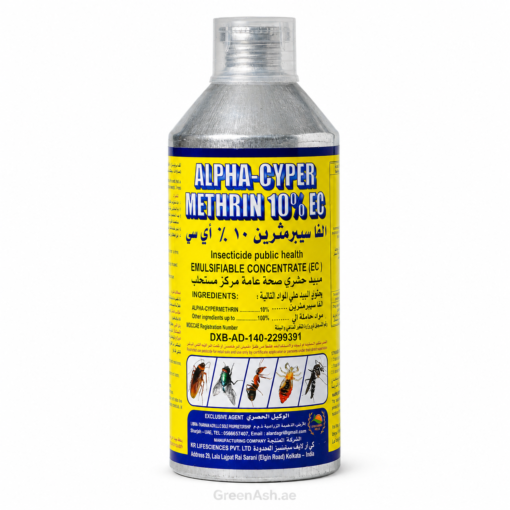
7. Alpha-Cypermethrin 10% EC — 1 Litre
AED 140.00 AED 170.00
Active: Alpha-cypermethrin 10% · Formulation: EC · MOCCAE Reg: DXB-AD-140-2299391 · Size: 1 L
Alpha-cypermethrin is not simply “weaker cypermethrin”. It is the purified, more insecticidally active isomer pair of cypermethrin, which means a 10% alpha-cypermethrin formulation delivers efficacy comparable to a considerably higher-percentage standard cypermethrin product. It works by modifying the gating kinetics of sodium channels in insect nerve membranes, producing hyperexcitation, paralysis and death — and it retains good activity against strains that have developed resistance to older actives.
Its primary role is vector control: mosquitoes (Aedes, Anopheles, Culex), flies and cockroaches in public health programmes run by municipalities and licensed operators. Termites appear on the target list alongside bedbugs and ants, so it will do useful work on a termite perimeter — but it is a broad-spectrum public health product first and a termiticide second.
At AED 140 for a full litre with a rate of 10–15 ml per litre, it is the most affordable entry point on this list, and it is UAE-registered under MOCCAE with the registration number printed on the label — worth noting if you are a facility manager who needs documented, compliant product for an audit trail. It handles residual spraying, thermal fogging and ULV, and the child-safe cap is a sensible touch on a 1 L bottle.
Where it falls short of the leaders is depth of termite performance. It has no non-repellent transfer effect, no synergist, and no soil-barrier protocol on the label. Treat it as a good general public health insecticide with termites on the list, not as a dedicated termiticide.
What we like
- Lowest price per litre on this list
- MOCCAE registered with a documented UAE registration number
- Alpha isomer gives strong efficacy at low concentration
- Spray, fogging and ULV compatible
- Effective against resistant vector strains
Worth knowing
- Vector control product first; termite performance is secondary
- No soil-barrier protocol on the label
- Label advises use by certified applicators
Verdict: excellent value for general public health work across a mixed pest load. For termites specifically, spend the extra on Triple Power or MIDASH.
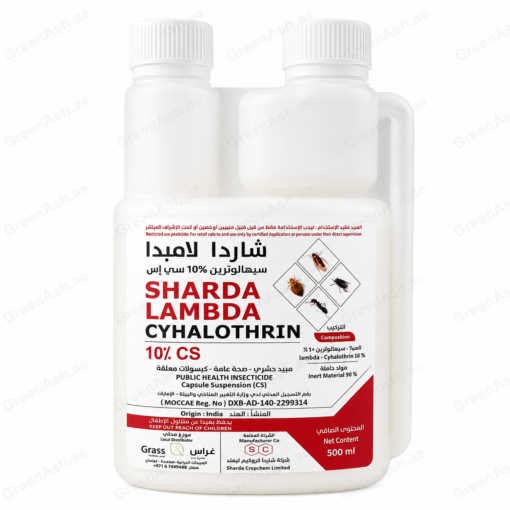
8. Sharda Lambda-Cyhalothrin 10% CS — 500 ml
AED 140.00
Active: Lambda-cyhalothrin 10% · Formulation: Capsule Suspension (micro-encapsulated) · MOCCAE Reg: DXB-AD-140-2299314 · Size: 500 ml
The CS formulation is what makes this product interesting. In a capsule suspension, the active ingredient is sealed inside microscopic polymer capsules. When you spray, those capsules deposit on the surface and release lambda-cyhalothrin gradually over weeks — you get immediate knockdown from the fraction released on contact, plus a slow, metered release that keeps the treated surface lethal for far longer than a conventional EC.
There are three practical consequences. First, residual life is much longer, so re-treatment intervals stretch out. Second, the capsules resist absorption into porous materials — on unpainted plaster, block or concrete an EC soaks in and disappears within days, while capsules sit on the surface where termites and cockroaches actually walk. Third, the encapsulation reduces odour and skin-contact exposure to the free active, which is why CS products are preferred for occupied indoor spaces.
The target list is one of the widest here — ants, bed bugs, cockroaches, flies, carpet beetles, mosquitoes, weevils, stored product beetles, silverfish, red flour beetles, wasps, spiders, ticks and termites. The dilution is 2–3 ml per litre, so 500 ml makes 165–250 litres of finished solution, which is very economical for a half-litre pack.
For termite work, its strength is indoor crack-and-crevice and spot treatment rather than soil barriers. Use it along skirtings, in wall voids, behind wardrobes, in service ducts, around door frames and at every point where mud tubes enter a room. That long residual is exactly what you want in places you cannot easily re-treat. Sharda Cropchem is a well-established manufacturer and the product carries a MOCCAE registration number.
What we like
- Micro-encapsulation gives the longest residual life in this comparison
- Resists absorption into porous masonry — stays where it lands
- Lower odour and reduced handling exposure
- Very wide labelled target list including termites and bed bugs
- Economical: 500 ml makes up to 250 L of spray
Worth knowing
- Not designed as a soil-barrier termiticide
- Repellent chemistry — no colony transfer effect
- May leave a faint visible deposit on dark surfaces
- Agitate well; capsules settle in the tank
Verdict: the best indoor residual product here. Use it as the interior half of a treatment where MIDASH or STUN handles the soil.
How to choose the right termite product for your situation
| Your situation | Buy this | Why |
|---|---|---|
| Villa with termites plus general pests, want one bottle | Triple Power 1L | Synergised three-way formula, low odour, covers everything |
| Confirmed subterranean colony, want it eliminated | MIDASH 21.4% + Triple Power | Non-repellent soil barrier for the colony, pyrethroid for knockdown |
| Building a new villa (pre-construction) | Demon Max or STUN 18.3 SC | Both carry pre-construction soil treatment protocols |
| Drywood termites in furniture or doors | Cymperator 25 EC | Specific labelled drywood rate for injection into timber |
| Apartment, indoor treatment only | Sharda Lambda-Cyhalothrin 10% CS | Longest residual, low odour, ideal for crack and crevice |
| Large compound, warehouse or FM contract | Cypermax 250 EC | Up to 660 L of spray per bottle — lowest cost per m² |
| Tight budget, mixed pest problem | Alpha-Cypermethrin 10% EC | Cheapest full litre, MOCCAE registered, broad spectrum |
| Licensed pest control operator | STUN 18.3 SC + Cymperator | Professional soil termiticide plus versatile fogging pyrethroid |
The rule of thumb
If you can see termites and want them dead today, use a pyrethroid. If you want them gone next month and staying gone, use imidacloprid. A serious infestation needs both — and that combination, applied to a properly trenched perimeter, is what separates a treatment that holds for years from one that fails by the next summer.
Preventing termites from coming back
- Move water away from the building. Re-route AC condensate to a drain. Shift drip emitters at least 45 cm from the wall. Fix leaking taps, pipes and irrigation valves the week you notice them.
- Break every wood-to-soil contact. Set posts, pergola legs and decking joists on concrete footings or metal shoes, never straight into the ground.
- Keep a clear inspection strip. Leave 30–45 cm of bare, visible ground against the foundation. No mulch, no soil banked up the wall, no stacked pots. You cannot find mud tubes you cannot see.
- Store timber off the ground. Firewood, offcuts, spare skirting and cardboard boxes belong on racks, not on a garage floor.
- Inspect imported furniture. Check the unfinished undersides and backs of anything wooden that arrives from overseas before it enters the house.
- Remove buried timber and old palm stumps from the garden — including construction debris left in the backfill.
- Seal cracks and penetrations in the slab, around pipes and at expansion joints with a suitable sealant.
- Re-treat the perimeter every 3–5 years, or sooner in heavily irrigated gardens. Chemical barriers degrade; they are not permanent.
- Book an annual inspection. Twenty minutes with a torch every year is far cheaper than replacing a door frame.
Safety, PPE and UAE regulations
Every product in this guide is a registered pesticide and must be handled accordingly.
Personal protection
- Nitrile gloves, long sleeves and long trousers, closed shoes, safety goggles and a respirator or dust mask when mixing and spraying.
- Mix outdoors or in a well-ventilated area. Never eat, drink or smoke during application.
- Keep people and pets out of treated areas until surfaces are fully dry — allow at least 30 minutes to a few hours depending on the product and ventilation.
- Wash hands, forearms and face thoroughly after handling, and launder work clothing separately.
Environmental precautions
- Pyrethroids are highly toxic to fish and aquatic life. Keep them out of ponds, water features, pool areas and storm drains.
- Both pyrethroids and imidacloprid are toxic to bees. Do not spray flowering plants, and treat early morning or late evening when foraging is lowest.
- Never apply directly to food, food-contact surfaces, animal feed or drinking water sources.
- Dispose of empty containers per local municipality guidance. Do not reuse pesticide containers for anything.
Regulatory context in the UAE
Pesticides sold in the UAE are registered with the Ministry of Climate Change and Environment (MOCCAE), and several products in this guide carry their registration number on the label — for example DXB-AD-140-2299391 for Alpha-Cypermethrin 10% EC and DXB-AD-140-2299314 for Sharda Lambda-Cyhalothrin 10% CS. Commercial pest control operations additionally require municipality licensing in each emirate (Dubai Municipality, Abu Dhabi Agriculture and Food Safety Authority, Sharjah Municipality and so on). Some products, including STUN 18.3 SC, are designated for certified applicators only. If you are treating a property you do not own, or operating commercially, confirm your licensing obligations before you spray.
Frequently asked questions about termite control in the UAE
How much does anti termite treatment cost in the UAE?
Professional treatment for a typical villa generally runs from around AED 800 to AED 3,000+ depending on plot size, construction type and infestation severity, with warranties usually offered for one to five years. Treating it yourself with products from this guide typically costs AED 200–450 in chemical for a standard villa, plus a sprayer — the trade-off is your labour and the risk of leaving a gap in the barrier.
How long does termite treatment take to work?
Pyrethroid products such as Triple Power, Demon Max and Cypermax kill on contact within minutes and establish a residual barrier immediately. Non-repellent imidacloprid products such as MIDASH and STUN work through colony transfer and typically take two to eight weeks to collapse a colony. Seeing live termites in week one after an imidacloprid treatment is normal and expected.
Can I treat termites myself, or do I need a professional?
Perimeter barriers, garden and outbuilding treatment, drywood injection in furniture and indoor crack-and-crevice work are all realistically DIY tasks with the right product and a decent sprayer. Call a licensed professional if termites have reached structural beams or roof timbers, if there is a carton nest inside a wall cavity, if the property is commercial or multi-tenant, or if you need pre-construction soil treatment for a new build.
What is the difference between repellent and non-repellent termiticides?
Repellent products (all the pyrethroids — cypermethrin, alpha-cypermethrin, lambda-cyhalothrin) are detected and avoided by termites, creating a barrier they will not cross. Non-repellent products (imidacloprid) are undetectable, so termites walk through, pick up a dose and transfer it to nestmates, killing the colony including the queen. Repellents protect; non-repellents eliminate.
Do termites live in apartments, or only in villas?
Both. Subterranean termites reach ground and lower floors from the soil, but drywood termites arrive inside imported furniture, wooden crates and joinery and can infest an apartment on any floor of any tower. If you find gritty pellets that look like coarse coffee grounds under a wardrobe, that is drywood termite frass — and a soil barrier is irrelevant to it.
Are there termite mounds in the UAE?
Not the large cathedral mounds seen in Africa and Australia. In the UAE you find low earthen mounds and soil crusts in undeveloped land and farmland, and — far more importantly — hidden carton nests built inside wall cavities, service ducts and under floor screed. Those hidden nests are the real target of any serious treatment.
Which insecticide is strongest against termites?
For raw contact strength, Cymperator 25 EC at 26% cypermethrin is the most concentrated pyrethroid in this guide. For actually eliminating a colony, MIDASH at 21.4% imidacloprid is the most effective, because it kills the nest rather than just the termites that touch treated surfaces. “Strongest” depends on whether you need knockdown or elimination.
Is termite treatment safe around children and pets?
Yes, when applied according to the label. Keep children and pets out of treated areas until surfaces are completely dry, ventilate indoor spaces after application, avoid spraying toys, bedding and food-contact surfaces, and store all concentrate locked away and out of reach. Once dry, treated surfaces present a much lower exposure risk than wet spray.
How often should I re-treat for termites?
Chemical soil barriers degrade over time, faster in hot, well-irrigated sandy soil. Plan a perimeter re-treatment every three to five years, and inspect annually. Indoor residual treatments using a CS product such as Sharda Lambda-Cyhalothrin last considerably longer than standard EC sprays, but should still be refreshed as part of the annual check.
Does GreenAsh deliver termite products across all emirates?
Yes. GreenAsh is based in Dubai and delivers to Dubai, Abu Dhabi, Sharjah, Ajman, Ras Al Khaimah, Fujairah, Umm Al Quwain and Al Ain. You can browse the full insecticide range, the pest control category, or contact the team for advice on sizing a treatment for your property.
Related guides & products
- Pest Control — the full GreenAsh range for homes and commercial sites
- Insecticides — every registered insecticide we stock
- Public health insecticides — professional-grade formulations
- Organic insecticides — neem-based and low-toxicity alternatives
- Repellents — lizard, snake and scorpion deterrents
- Advion Cockroach Gel Bait — for the roach problem you will probably find during the termite inspection
- Hymenopthor Granular Ant Bait — for real ants, once you have ruled out termites
- Knapsack sprayers — the right equipment for perimeter trenching
- Shop all products · GreenAsh blog
Disclaimer: this guide is provided for general information. Always read and follow the product label before use. Application rates, permitted uses and re-entry intervals vary by product and may be updated by the manufacturer or by UAE regulators. Where a product is designated for certified applicators, it must be applied by a licensed professional.