
Blog
Potash Fertilizer for UAE Gardens: When to Buy It and Which Type to Choose

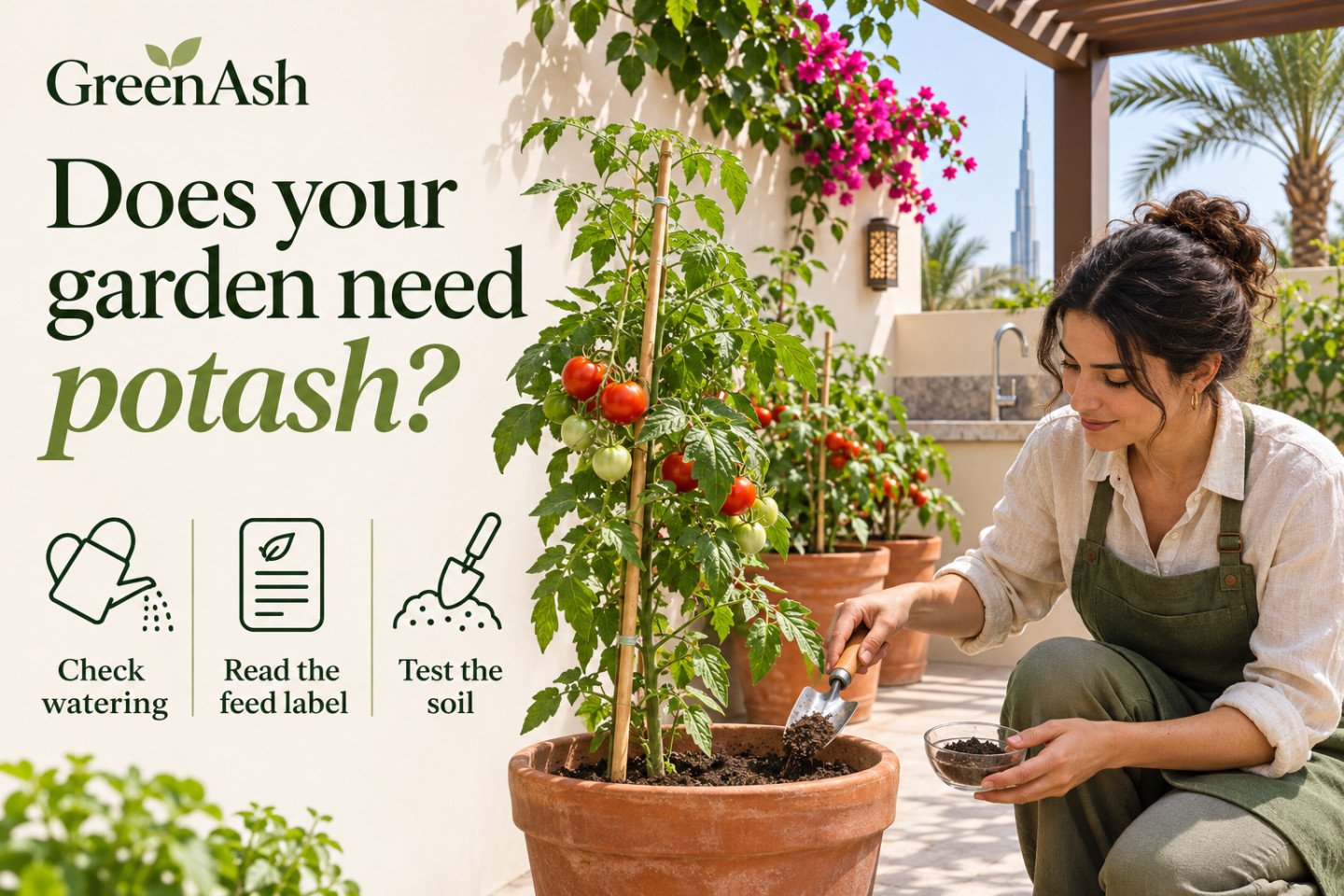
If a tomato plant on a UAE balcony develops crisp brown leaf edges as the first fruits form, should you buy potash? Start with the feed you already use. Its third NPK number tells you if you are already supplying potassium. Then check how evenly water reaches the roots. A plant beside a blocked dripper can look stressed even when the whole bed has received enough fertilizer.
The short answer: buy a straight potash fertilizer only when the oldest leaves show scorched, yellowing margins on several plants, your watering is even, and your current feed is low in potassium or a soil test says so. For most UAE beds that means sulphate of potash rather than muriate of potash, because it adds less salt. For pots and balconies, a soluble feed with a high third number is usually simpler than a straight potash. By the end of this article you will be able to tell a potassium problem from its look-alikes, pick the right type, and work out grams for a pot, a 1 m2 bed and a 100 m2 garden from the rates on the product pages.
When is extra potassium worth buying?
Plants use potassium to regulate water movement and support growth. A shortage can show up first along the edges of older leaves. That pattern is a clue to investigate. Heat exposure, uneven irrigation and salts around the roots can also cause leaf scorch. A photograph alone cannot tell you how much potassium to apply.
- Map the damage. Compare the oldest leaves with the newest, then look at neighbouring plants of the same variety. If only the pot closest to a sun-heated wall is affected, check its exposure and root-zone moisture before changing the feed for every pot.
- Check delivery. Run the irrigation and compare what comes out of each emitter. Check below the surface where the roots are growing. For a practical measuring method, see our drip irrigation guide.
- Read your current feed. Record the grade, how much you actually applied and the area or number of pots treated. Include soluble feeds as well as granules. Our guide to NPK numbers explains the label.
- Confirm the need. For recurring problems in a vegetable bed, ask a soil laboratory for sampling directions and a potassium recommendation for your crop. Tell the lab if the plants grow in a container mix. If salt accumulation is a concern, ask about testing the growing medium and irrigation water as well.
A quick diagnosis table
Potassium is one of the nutrients a plant can move out of old leaves to feed new growth. The UConn Home and Garden Education Center lists it with nitrogen, phosphorus, magnesium, chlorine and molybdenum as a mobile nutrient, so its symptoms appear on the older, lower leaves first while the new leaves can stay green. That single fact rules out several common problems before you spend anything.
| What you see | Likely cause | What to do |
|---|---|---|
| Oldest leaves yellow then brown along the margins and tips, edges may curl; new leaves green; several plants of the same crop affected | Potassium shortage is a real candidate | Check your feed’s third number and how much you applied; test soil or ask a lab; then use a potassium source at the label rate |
| Oldest leaves yellow evenly from the tip down the middle, whole plant pale, slow growth | More likely nitrogen. UConn notes nitrogen yellowing runs from the tip along the leaf ribs, potassium along the edge | Do not buy potash first. Review the nitrogen in your feed |
| Older leaves yellow between the veins while the veins stay green; on date palms, bright yellow frond tips with green bases | Magnesium, which UC IPM describes as common in date palms | See our Epsom salt and magnesium guide. Extra potash can make this worse |
| Newest leaves yellow with green veins | Not potassium. New growth points to an immobile nutrient such as iron | Check soil pH and iron before feeding potassium |
| Brown scorch on one plant or one side of the bed only; soil dry at root depth | Water delivery or heat, not a nutrient | Fix the emitter or shade; watch the next new leaves |
| Brown leaf tips and margins on many plants, white crust on the soil or pot rim, salty well or tanker water | Salt injury, which UConn lists as a mimic of deficiency | Leach the pot or bed with good water; adding potash adds more salt |
| Dark sunken patch at the base of tomato or pepper fruit | Blossom-end rot, linked to calcium and uneven watering, not potassium | Even out watering first |
Two conditions together make potassium the likely answer: the damage starts on the oldest leaves and moves up, and it appears on several plants of the same crop that share the same water. If only one of the two is true, keep looking.
What potassium does, and why sandy UAE soil runs short
The University of Minnesota Extension describes potassium as the nutrient that moves water, sugars and other nutrients through the plant, switches on enzymes involved in making protein and starch, and opens and closes the stomata, the leaf pores that let water vapour out and carbon dioxide in. A plant short of potassium loses some control over its own water. That is why the first symptom looks like drought scorch on the oldest leaves: the plant is pulling what potassium it has into new growth and letting the old leaves go.
Crops need more potassium than any other nutrient except nitrogen, according to the University of Wisconsin Nutrient and Pest Management programme. Their 2024 potassium cycle sheet also explains why a sandy garden can run short even though the ground is full of potassium. Between 90 and 98 percent of soil potassium is locked inside minerals and released far too slowly to feed a crop. Plants live on the small share dissolved in soil water or held loosely on clay and organic matter. Sand has very little clay to hold that loose share, so leaching is a particular concern in sandy soils, and coarse irrigated soils may need potassium every year.
A 2024 University of Georgia trial on peppers shows how fast this happens under irrigation. Coolong and McAvoy measured soil potassium falling from roughly 650 to about 200 pounds per acre between planting and fruit set, and put the loss down to leaching from routine irrigation. That was on Georgia soil with more clay than a typical UAE villa bed. Daily drip on sand, plus the extra water many gardeners use to flush salts, moves potassium down past the roots even faster.
UC IPM sees the same pattern in landscapes. Their nutrient deficiency page says potassium shortage is rare in California gardens except in container plants, fruit and nut trees in sandy soils, and palms, and that palms develop it readily in rapidly drained sandy soils with frequent irrigation or in container media. Those three cases describe a large share of UAE gardens.
The flip side matters just as much. The University of Wisconsin’s Bruce Spangenberg warns gardeners against potassium surpluses, because a high level of one nutrient changes how available the others are to the plant. Magnesium is the one we watch: like potassium it is taken up as a positively charged ion, and a large excess of potassium can hold it back. A date palm or citrus tree that already shows magnesium yellowing can get worse after heavy potash. Feed potassium to fix a real shortage, not as a flowering tonic every fortnight.
Which potash fertilizer fits the recommendation?
The third number on the bag expresses potassium as a potash equivalent (K2O). Two products can both supply potassium while adding quite different amounts of other nutrients. Compare the entire grade with the laboratory recommendation before choosing a bag.
| Fertilizer | What to check before buying |
|---|---|
| Sulphate of potash (potassium sulphate) | Supplies potassium and sulphur. Consider this source when the bed needs potassium and already has enough phosphorus. GreenAsh lists Vitax Sulphate of Potash in a 1.25 kg pack. |
| Monopotassium phosphate (MKP) | Supplies phosphorus along with potassium. The middle number in YAMFERT MKP 0-52-34 matters as much as the last one. If the test calls for potassium alone, this product would add phosphorus the recommendation did not call for. |
| Muriate of potash (potassium chloride) | Supplies potassium along with chloride. If your water or soil test flags salinity or chloride, have the results interpreted for your crop before selecting a source. |
How the common sources compare
The University of Minnesota Extension gives the usual strengths of the main potassium fertilizers. These are typical grades for the pure materials, not the analysis of any one product, so always read the bag.
| Source | Typical K2O (UMN) | What else it adds | Salt index (UGA) | Best fit in a UAE garden |
|---|---|---|---|---|
| Potassium chloride (muriate of potash) | 60 to 62% | Chloride | 116 | Rarely the best choice where water is already salty |
| Potassium sulphate (sulphate of potash) | 50% | Sulphur | 46 | Straight potassium for beds, fruit trees and shrubs |
| Potassium nitrate | 44% | Nitrogen | Not given | Fertigation where nitrogen is also wanted |
| Potassium magnesium sulphate | 20% | Magnesium and sulphur | Not given | Beds short of both potassium and magnesium |
| Monopotassium phosphate (MKP) | 34% (0-52-34) | A lot of phosphorus | Not given | Short foliar or fertigation use when phosphorus is also needed |
The salt index figures come from the UGA pepper trial, which compared sulphate of potash (46) with muriate of potash (116). In that trial, on Georgia soil, neither yield nor soil salinity differed between the two sources; salinity rose with the rate applied instead. Our reading for UAE gardens is cautious: where the irrigation water already carries salts, the source with less than half the salt index and no chloride is the safer default, and keeping the rate down matters more than the brand.
The University of Minnesota soil testing page points the same way for gardens. When a soil test shows phosphorus is already high, it suggests potassium sulphate or langbeinite (potassium magnesium sulphate), because they add little or no phosphorus. Many UAE beds that have had years of compound feeds and manure fall into that group.

Where MKP fits, and where it does not
MKP is a clean, fully soluble crystal, and the YAMFERT page aims it at flowering and fruit development by foliar spray, fertigation, drip and hydroponics. The catch is its analysis. Every 100 g carries 52 g of phosphate equivalent and 34 g of potash equivalent, so it is a phosphorus fertilizer first. Use it when a crop needs both, for example a short boost on fruiting tomatoes or peppers in a container mix that has been fed nitrogen-heavy feed. Do not use it to correct a potassium shortage in a bed that already tests high in phosphorus.

Liquid potassium products: what their pages tell you
The store also lists several liquids that sell on potassium. Amifol K states 33 percent soluble K2O with 5 percent free amino acids, but its page only says to dilute the 1 L bottle with water, with no water volume, so we cannot give you a dose from it. Potasol K describes itself as a high potassium bio-organic fertilizer but its page gives no analysis, no rate and no registration, so there is no way to compare it. Alga-Phite gives 21 percent P2O5 and 16 percent K2O with seaweed extract but no dilution rate. Until those pages carry label rates, we cannot recommend them for a measured potassium programme.
Products compared
All products below were in stock when we checked the store on 10 November 2026. Fertilizers do not carry a pesticide style harvest interval, and none of these pages states one.
| Product | Analysis on page | Pack | Use | Rate on page | Harvest interval on page | Who it suits |
|---|---|---|---|---|---|---|
| Vitax Sulphate of Potash | Not stated (sulphate of potash; UMN gives 50% K2O as typical) | 1.25 kg granules | Soil, or dissolved as a liquid feed | 70 g/m2 before planting, 35 g/m2 top dressing; fruit trees 140 g/m2; 30 g in 9 L | None stated | Beds, shrubs and fruit trees needing straight potassium |
| YAMFERT MKP 0-52-34 | 0-52-34 | 1 kg crystals | Foliar, fertigation, drip | Foliar 2 to 5 g/L; fertigation “according to crop and soil” | None stated | Fruiting crops needing phosphorus and potassium together |
| Phostrogen All Purpose | 14-10-27 + 2% MgO + trace elements | 400 g or 800 g powder | Watering can, foliar | 5 g per 4.5 L, every 7 to 14 days; half strength for young plants | None stated | Pots and balconies |
| Schultz Tomato and Vegetable 17-18-28 | 17-18-28 + micronutrients | 680 g powder | Soluble feed | No numeric rate on page | None stated | Only once you can read the rate on the pack |
| Amifol K | 33% K2O, 5% amino acids | 1 L | Soil or foliar | No water volume on page | None stated | Not recommended until a usable rate is published |
| Potasol K | Not stated | Not stated | Not stated | No rate on page | None stated | Cannot be compared; no analysis |
| Alga-Phite | 21% P2O5, 16% K2O, 10% seaweed (w/v) | 1 L | Foliar, fertigation | No dilution rate on page | None stated | Not a straight potassium source |
Work out what the bag and the bed each require
On a standard 0-52-34 analysis, 100 g of product contains 34 g of K2O equivalent and 52 g of phosphate (P2O5) equivalent. This illustrates the composition of the powder. The amount you can apply to a bed or dissolve in water is a separate question.
For a rectangular bed, multiply planted length by width to get square metres. If the product directions give grams of product per square metre for your crop, multiply that rate by the planted area. A laboratory recommendation expressed in grams of K2O per square metre uses different units. Ask the lab or grower adviser to convert it for the exact grade if you are unsure.
For a balcony pot, look for directions that explicitly cover containers and your application method. A bed rate cannot tell you how concentrated a watering-can solution should be. Keep a dated note of the amount applied so a second person watering the garden can see when the plants were last fed.
From K2O to actual potassium
Penn State Extension gives the conversion: multiply percent K2O by 0.83 to get percent elemental potassium. A bag at 50 percent K2O is about 41.5 percent potassium. You rarely need this, because recommendations are normally written in K2O too, but it explains why two labels that look different can describe the same material. The UGA trial makes the same point in reverse: its 400 pounds of potassium per acre equalled about 667 pounds of muriate of potash or 800 pounds of sulphate of potash, because the two products carry different strengths.
Worked doses: Vitax Sulphate of Potash in beds
The Vitax page gives 70 g/m2 before planting and 35 g/m2 during growth for vegetables and tomatoes, the same for flowers and shrubs, and 140 g/m2 in early spring for fruit trees. It tells you to apply evenly, rake it into the topsoil and water thoroughly.
| Area | Before planting (70 g/m2) | Top dressing (35 g/m2) | Fruit trees (140 g/m2) |
|---|---|---|---|
| Raised bed 1.2 m x 0.6 m (0.72 m2) | 50 g | 25 g | Not applicable |
| 1 m2 bed | 70 g | 35 g | 140 g |
| Area under a lemon tree canopy 2 m x 2 m (4 m2) | Not applicable | Not applicable | 560 g |
| 100 m2 vegetable plot | 7 kg (5.6 packs of 1.25 kg) | 3.5 kg (2.8 packs) | Not applicable |
The page does not state the K2O content. If the bag matches the typical 50 percent for sulphate of potash that UMN gives, one 35 g top dressing on 1 m2 supplies about 17.5 g of K2O, or about 14.5 g of potassium. Check the analysis printed on the pack before you rely on that figure.
Worked doses: Vitax as a liquid feed
The page says to dissolve 30 g in 9 L of water, which is about 3.3 g per litre. Use it as a soil drench from a watering can; the same page says to avoid contact with leaves and stems.
- 1 L jug for a single pot: 3.3 g
- 5 L watering can: 16.7 g (round to 17 g)
- 9 L watering can: 30 g, as on the page
- 16 L container for a row of pots: 53 g
Worked doses: MKP as a foliar spray
The YAMFERT page gives 2 to 5 g per litre for foliar use. Start at the low end on soft growth and in warm weather, and dissolve it fully before it goes into the sprayer.
| Sprayer | At 2 g/L | At 5 g/L | K2O and P2O5 at 2 g/L |
|---|---|---|---|
| 1 L hand sprayer | 2 g | 5 g | 0.68 g K2O, 1.04 g P2O5 |
| 5 L pressure sprayer | 10 g | 25 g | 3.4 g K2O, 5.2 g P2O5 |
| 16 L knapsack | 32 g | 80 g | 10.9 g K2O, 16.6 g P2O5 |
Notice the last column: at every strength the spray carries more phosphorus than potassium. A full 16 L knapsack at the low rate still delivers less K2O than one 35 g Vitax top dressing on a single square metre, if that bag is near the typical 50 percent. Foliar feeding is a top-up, not a way to rebuild a bed that is short of potassium.
Potassium for pots and balconies
A pot is a closed system. Whatever potassium the mix started with can be used up or washed out of the drainage holes over a season, and UC IPM names container plants as one of the main places potassium shortage turns up. Granular sulphate of potash is hard to dose in a 20 cm pot, because the Vitax area rates assume open ground. A soluble feed with a high third number is easier to measure and spreads evenly through the root ball.
Phostrogen’s 14-10-27 analysis puts nearly twice as much K2O as nitrogen into every can, and it includes 2 percent magnesium oxide, so it does not feed potassium alone. The page gives one level spoon (5 g) per 4.5 L of water, every 7 to 14 days in the growing season, and half strength for young plants.
- 1 L: 1.1 g (half strength 0.55 g)
- 4.5 L: 5 g, the page rate
- 5 L: 5.6 g
- 9 L: 10 g
- 16 L: 17.8 g
Each 5 g measure carries about 1.35 g of K2O, 0.7 g of nitrogen and 0.5 g of P2O5. That is a gentle, steady supply, which suits pots far better than one large dose. Water the pot with plain water first if the mix is bone dry, then apply the feed, and let some run out of the drainage holes every few waterings so salts do not build up. Our liquid fertilizer guide covers mixing and frequency in more detail.

A UAE timeline for potassium
| When | Villa beds and fruit trees | Balcony pots | Farms and large plots |
|---|---|---|---|
| October | Soil test if the bed had problems last season. Rake in sulphate of potash at the preplant rate only where the test or a clear history calls for it | Repot or refresh mix; start feeding at half strength once new roots grow | Soil and water samples before planting; plan potassium in the fertigation programme |
| November to January | Vegetables establish; top dress only if older leaves show margin scorch on several plants | Feed every 7 to 14 days with a soluble high potassium feed as fruiting crops start to flower | Apply potassium closer to need, in split doses through the drip; UMN advises applying closer to planting on sandy low CEC soils |
| February to March | Fruit trees: the Vitax page gives 140 g/m2 in early spring; tomatoes and peppers carry their heaviest fruit load | Peak feeding for tomatoes, chillies and flowering plants | Peak demand during fruit fill; check leaf margins on the oldest leaves weekly |
| April | Last top dressing for crops that will be cleared by May | Taper feeding as heat builds | Finish potassium before the last harvests |
| May to September | Little or no potash. Heat stress and salts often cause leaf scorch now, so fix water and shade first | Water more, feed less; flush pots with clean water to clear salts | Leach salts where water quality allows; feed perennials only on test results |
Salty water changes the picture year round. Every potassium fertilizer is a salt, and UGA found soil salinity rose with the amount applied. If your irrigation is from a well or tanker with a noticeable salt taste or the soil grows a white crust, keep to the lower end of the rates, prefer sulphate over chloride, and get the water tested before a large planting. For more on tomato feeding through the season, see our tomato growing guide.
Common mistakes
- Adding potash to every flowering plant by habit. Flowering is a stage, not a symptom. If your feed already has a high third number, a straight potash adds salt and can push magnesium down. Check the grade you already use first.
- Treating new leaf yellowing with potash. Potassium is mobile, so a true shortage shows on old leaves first. Yellow new growth points to iron or another immobile nutrient instead.
- Using MKP to fix a potassium shortage. It carries more phosphorus than potassium. In a high phosphorus bed it adds the nutrient you have too much of.
- Applying the bed rate to a pot. A 70 g/m2 rate cannot be shrunk to a pot by guesswork. Use a soluble feed with its own container dilution.
- Scattering granules on dry sand and walking away. The Vitax page says to rake it in and water thoroughly. Granules sitting against stems or wet leaves can scorch them.
- Choosing muriate of potash where the water is already salty. At 116 against 46 on the UGA salt index, it adds more than twice the salt effect of sulphate of potash, plus chloride.
- Feeding in July. Plants that are shutting down in heat use little, and the extra salt sits around the roots. Fix water and shade instead.
If it did not work
New leaves are the test. Damaged leaf margins will not turn green again, so judge the result on the leaves that open over the next three to four weeks. If they stay clean, the problem has stopped.
- Scorch keeps spreading to new leaves. Stop feeding. Leach the pot or bed with clean water and check salinity. UConn lists salt injury, drought and excess water as common mimics of nutrient shortage.
- Older leaves now yellow between the veins. You may have pushed magnesium down. Stop potash and read our magnesium guide before adding anything else.
- One plant is worse than the rest. Check its emitter flow and the root ball for rot or pests before adding more fertilizer.
- Fruit still small or poorly coloured. Check plant spacing, light and water. UGA found total pepper yield did not change with potassium rate or source, and at the Athens site the jumbo fruit grade fell above 300 pounds per acre of potassium. More is not always better.
Call in help when the same bed fails two seasons running, when a palm or citrus tree is declining, or when you farm more than a few hundred square metres. The UConn guide says the best way to confirm a shortage is to test both soil and plant tissue, and the Wisconsin sheet recommends testing irrigated sandy soils under high value vegetables every year. A soil and water testing laboratory or a qualified agronomist can turn those results into a rate for your crop. For sampling, the University of Minnesota suggests taking soil from several spots, mixing them in a bucket and sending 1 to 2 cups, and sampling raised beds rather than the paths between them.
Safety, storage and disposal
- Protective equipment. The Vitax and Phostrogen pages both say to wear gloves when handling, and Phostrogen adds to avoid contact with eyes and mouth. The MKP page gives no protective advice, so treat it the same way: chemical resistant gloves, and safety glasses when you weigh or pour fine powder or crystals.
- Harvest interval. None of these pages states a harvest interval, as they are fertilizers, not pesticides. Wash vegetables after a foliar spray and before eating, and do not spray leafy salads close to picking.
- Re-entry. No re-entry period is given. Keep children and pets out of the bed until granules are raked in and watered.
- Children and pets. The Vitax, MKP and Phostrogen pages all say to keep the product away from children and pets. Store it high, in the original bag, never in a food or drink container.
- Bees and fish. Spray foliar feeds early or late in the day when bees are fewer, and never let fertilizer water run into a fish pond or water feature, where extra nutrients feed algae.
- Storage. Keep bags sealed in a cool, dry place out of direct sun. The MKP page says to protect it from moisture, and a sealed bag also stops powders caking in humid coastal air.
- Disposal. Use leftover solution on another bed at the same rate. Do not pour it into a drain or onto paving. Put empty, rinsed bags in household waste.
Frequently asked questions
Should I add potash when my tomatoes start flowering?
Check the existing programme first. Flowering is a good time to review what the crop receives. It does not establish a shortage. If the soil test indicates adequate potassium and your feed already supplies it, an additional bag may bring little benefit.
Does sandy soil always need extra potassium?
Coarse soil can retain less potassium than soil with more clay, but texture alone cannot give you an application rate. A raised bed filled with imported soil and a patio pot filled with commercial mix can need different feeding plans even in the same villa garden.
Can I use the same product on leaves and through a dripper?
Check the current pack for the crop, application method and rate. A foliar direction applies to leaves. It does not establish a suitable concentration for roots or confirm compatibility with your irrigation equipment.
What is the difference between potash and potassium?
Potassium is the nutrient. Potash is the trade name for potassium fertilizers, and labels express their strength as K2O. Multiply percent K2O by 0.83 to get percent potassium, as Penn State explains.
Is sulphate of potash better than muriate of potash for UAE gardens?
For most home gardens, yes. Sulphate of potash has a salt index of 46 against 116 for muriate in the UGA trial, adds sulphur instead of chloride, and suits gardens where irrigation water is already salty. The UGA trial found no yield difference on Georgia soil, so on a large farm with low salinity water the cheaper source may be fine on an agronomist’s advice.
How much sulphate of potash should I give a lemon tree?
The Vitax page gives 140 g/m2 in early spring for fruit trees. Measure the area under the canopy: a tree with a 2 m by 2 m canopy covers 4 m2, which comes to 560 g. Spread it under the canopy rather than against the trunk, rake it in and water well. Our citrus fertilizer guide covers the rest of the feeding programme.
Can too much potash harm plants?
Yes. All potassium fertilizers are salts, so heavy rates raise root zone salinity, and UGA measured salinity rising with the amount applied. Excess potassium can also limit magnesium uptake, which shows as yellowing between the veins of older leaves.
Do date palms need potash?
Palms are one of the plants UC IPM names as prone to potassium shortage, especially in fast draining sandy soil with frequent irrigation. On palms it shows as yellow, orange or brown flecks and spots on the oldest fronds. The same page says magnesium shortage is common in date palms, so use a palm feed that supplies both rather than straight potash alone, and get a leaf or soil test before heavy feeding.
For more detail on potassium sources and interpreting a test, see the University of Minnesota Extension guides to potassium in crop production and garden soil testing, the UGA trial on potassium sources for peppers, Penn State’s note on how much potassium is really in your fertilizer, and the UConn guide to nutrient deficiency symptoms.
Ready to feed? Check your current feed’s third number, look at the oldest leaves, then choose sulphate of potash for beds or a high potassium soluble feed for pots, such as Vitax Sulphate of Potash or Phostrogen. If you are unsure which fits, message us with a photo of the oldest and newest leaves and the label of the feed you use now.
